Can OBD2 Diagnose an EGR Valve Problem?
Quick Answer
Yes, an OBD2 scanner can help diagnose an EGR valve problem by reading trouble codes such as P0400, P0401, P0402, and P0403. Advanced scanners may also display EGR-related live data or perform active tests. However, an EGR code does not automatically mean the valve is defective. Carbon-blocked passages, vacuum leaks, faulty sensors, and electrical problems can produce similar codes. Additional testing is often necessary to confirm the cause.
If your check engine light is on and your scanner displays an EGR-related code, you already have a useful starting point. The challenge is determining whether the exhaust gas recirculation valve itself is failing or another component is preventing the system from operating correctly.
Understanding what an OBD2 scanner can measure, what its codes actually indicate, and which checks to perform next can help you avoid unnecessary parts replacement.
How Does OBD2 Detect an EGR System Problem?
OBD2 detects EGR system problems by monitoring electrical signals and operating conditions that indicate whether exhaust gas recirculation is functioning as expected.
The EGR valve allows a controlled amount of exhaust gas to return to the engine’s intake system under appropriate operating conditions. This helps reduce combustion temperatures and nitrogen oxide (NOx) emissions.
Depending on the vehicle, the engine control module (ECM) may evaluate EGR operation using:
- EGR valve position: A position sensor may report whether the valve follows the commanded opening.
- Manifold pressure: The manifold absolute pressure (MAP) sensor may detect pressure changes associated with EGR flow.
- Mass airflow: Changes in mass airflow (MAF) readings can help the computer evaluate recirculated exhaust flow.
- Temperature or pressure sensors: Some systems use dedicated feedback sensors to monitor EGR operation.
- Electrical circuit monitoring: The computer may detect an open circuit, short circuit, or implausible control signal.
If monitored results fall outside the expected range under the correct testing conditions, the ECM can store a diagnostic trouble code (DTC).
As explained by Motorservice’s EGR diagnostic reference, similar EGR fault codes can originate from valves, sensors, wiring, or restricted airflow paths.
Which OBD2 Codes Indicate an EGR Problem?
The most relevant generic EGR-related codes are in the P0400–P0409 range. Each identifies a different type of system fault.
| Code | Meaning | What to Investigate |
|---|---|---|
| P0400 | EGR Flow Malfunction | Valve operation, passages, control system |
| P0401 | Insufficient EGR Flow | Carbon restrictions, valve opening, flow sensors |
| P0402 | Excessive EGR Flow | Valve closing, control faults, sensor feedback |
| P0403 | EGR Control Circuit Malfunction | Wiring, connectors, solenoids, actuators |
| P0404 | EGR Circuit Range/Performance | Position feedback and valve response |
| P0405–P0408 | EGR Sensor Circuit Low/High | Sensor signals, wiring, power, ground |
| P0409 | EGR Sensor A Circuit Malfunction | Sensor and circuit integrity |
Important distinction: P0401 describes insufficient detected EGR flow, not necessarily a broken EGR valve. A blocked passage may produce the same result even if the valve moves normally.
The code descriptions are consistent with the Bosch OBD diagnostic code reference. Vehicle-specific definitions and troubleshooting procedures should still be checked.
How to Check an EGR Problem With an OBD2 Scanner
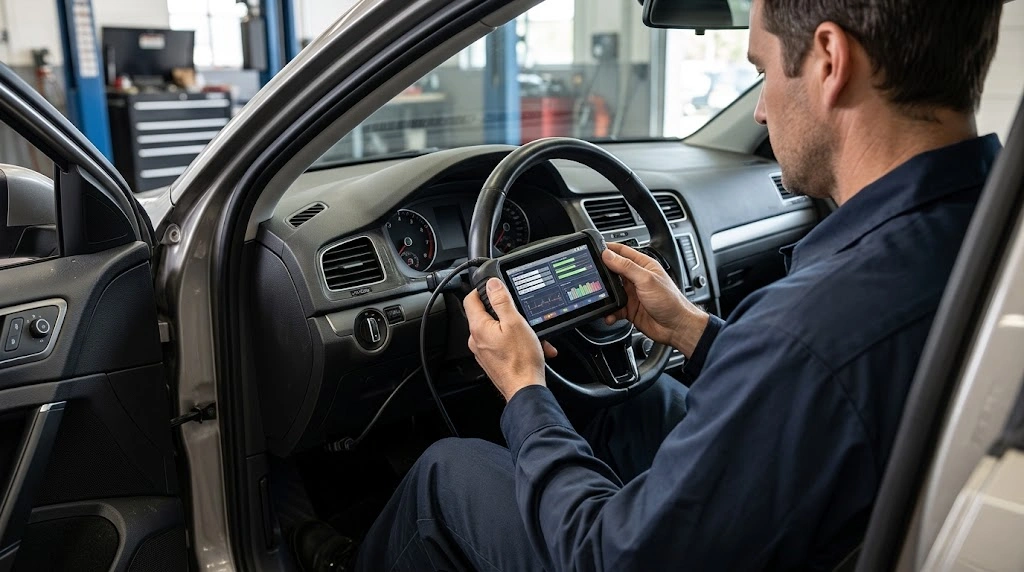
Start with the stored diagnostic evidence, then use the scanner’s available features to narrow the problem. Do not erase codes before recording them.
- Connect the scanner. Park safely, switch the ignition off, and connect the tool to the vehicle’s OBD2 diagnostic port. Follow the scanner’s instructions for switching on the ignition and establishing communication.
- Read all relevant codes. Check confirmed, pending, and permanent codes where supported. Record EGR-related codes and any other engine-management faults.
- Save freeze-frame data. Record available engine speed, temperature, load, and vehicle speed information associated with the detected fault.
- Inspect EGR-related live data. If supported, look for commanded EGR position, actual EGR position, MAP, MAF, or other relevant feedback parameters.
- Compare expected and actual operation. Use vehicle-specific service information to understand how EGR should behave under the observed conditions.
- Perform further checks. Inspect accessible connectors and vacuum hoses. If the evidence suggests a mechanical or circuit problem, follow the manufacturer’s diagnostic procedure.
- Verify the repair. After correcting the cause, clear codes only when appropriate and complete the required driving or diagnostic checks to determine whether the fault returns.
For a detailed explanation of scanner operation, see our guide on how to use an OBD2 scanner and read diagnostic codes.
What should you look for in live data?
On vehicles that report both commanded and measured EGR position, compare the two readings during permitted operating conditions. A persistent mismatch may suggest sticking, actuator failure, position-sensor problems, or wiring faults.
However, commanded and actual positions agreeing does not prove that exhaust gas is flowing correctly. A restriction downstream of a moving valve may still cause insufficient EGR flow.
Some vehicles estimate EGR flow indirectly rather than providing a dedicated flow reading. The exact parameters available depend on the vehicle and scanner.
Can an Advanced OBD2 Scanner Test the EGR Valve Directly?
Yes, some advanced scanners can perform EGR active tests, but this capability depends on the vehicle and diagnostic software.
A compatible bidirectional scanner may command an electronically controlled EGR valve to open or close and monitor the resulting position or engine response.
This helps distinguish a valve that fails to respond to commands from a system that responds electronically but still has an airflow problem.
Not every vehicle exposes the same test, and commanding valve movement does not automatically confirm the complete EGR system is healthy.
Our explanation of active testing and bidirectional vehicle diagnostics describes how these advanced functions differ from ordinary code reading.
Diagnostic Tip
Before attempting an active test, check the vehicle manufacturer’s prerequisites. Some tests require a specific engine temperature, ignition state, or operating condition. Never activate components without understanding the prescribed procedure.
What Else Can Cause an EGR Trouble Code?
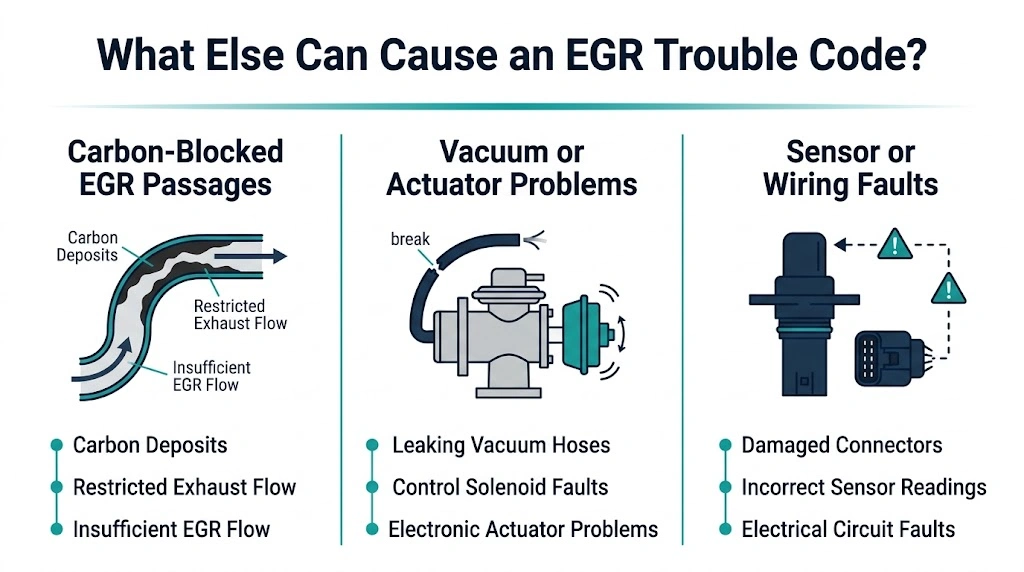
An EGR code may identify a problem affecting exhaust gas recirculation without identifying the defective component.
Carbon-blocked EGR passages
Carbon deposits can restrict exhaust gas movement through the valve, cooler, or connecting passages. The computer may detect insufficient flow even when the valve opens correctly.
Vacuum or actuator problems
Older vacuum-operated systems may fail because of leaking hoses, defective control solenoids, or insufficient vacuum. Electronically actuated systems have different electrical and mechanical failure possibilities.
Sensor or wiring faults
A damaged connector, incorrect sensor reading, or circuit fault can make normal EGR operation appear abnormal to the ECM.
A manufacturer diagnostic procedure for Mitsubishi P0401 insufficient EGR flow illustrates why checking sensor behavior and EGR passages matters before concluding that the valve must be replaced.
What Are the Signs of a Possible EGR Valve Problem?
Common symptoms can include rough idling, hesitation, reduced engine performance, stalling, or a check engine light.
The symptoms vary according to engine design and whether the EGR system allows too much or too little recirculated exhaust gas.
- Rough idle or stalling: Excessive EGR flow at idle can interfere with stable combustion.
- Hesitation: Incorrect recirculation may affect engine response during certain operating conditions.
- Reduced performance: Some vehicles limit power after identifying an emissions-control fault.
- Check engine light: The ECM may illuminate the warning after detecting a qualifying malfunction.
These symptoms are not unique to EGR problems. Ignition faults, intake leaks, fuel-delivery issues, and other engine problems may cause similar behavior.
What Are the Limitations of OBD2 EGR Diagnosis?
A scanner provides the information detected and shared by the vehicle’s electronic control system. It cannot physically inspect every valve passage or guarantee that a mechanical component is functioning correctly.
Important limitations include incomplete live-data support, unavailable manufacturer-specific tests, intermittent faults, and problems that have not met the conditions required to store a code.
A basic code reader may identify P0401 but cannot determine whether the underlying restriction is inside the valve, the connecting pipe, or another part of the EGR circuit.
Our guide to what OBD2 scanners cannot detect explains why electronically monitored data cannot replace physical inspection.
Warning
Do not remove or disconnect EGR components while the engine or exhaust system is hot. Avoid operating the engine in an enclosed garage, and never bypass an emissions-control system as a substitute for diagnosis or repair.
When Should You Seek Professional EGR Diagnosis?
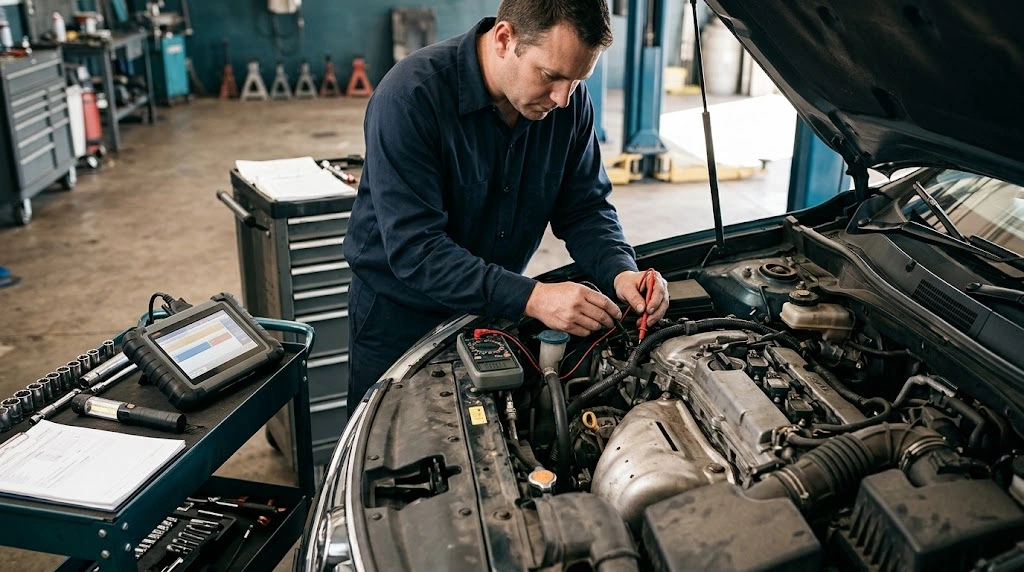
Professional testing is appropriate when an EGR code keeps returning, the engine stalls repeatedly, vehicle performance deteriorates, or the available scanner cannot identify the underlying cause.
A technician may need manufacturer-specific scan functions, circuit measurements, vacuum testing, or physical inspection of EGR passages.
For example, if the scanner confirms that the valve follows its commanded position but P0401 continues returning, investigating exhaust-flow restrictions may be more productive than immediately replacing the valve.
Likewise, a P0403 electrical fault generally calls for circuit diagnosis before mechanical cleaning.
Persistent poor drivability, severe power loss, or an overheating engine should be addressed promptly rather than treated as an ordinary emissions warning.
Frequently Asked Questions
Can OBD2 detect an EGR problem without a check engine light?
Yes. A scanner may retrieve a pending EGR-related code before the conditions for illuminating the check engine light are met. However, an undetected or unmonitored problem may produce no code at all.
Does P0401 mean I need a new EGR valve?
No. P0401 indicates insufficient detected EGR flow. Carbon-blocked passages, faulty control components, and incorrect sensor readings can also cause this code. Confirm the cause before replacing parts.
Can a cheap OBD2 scanner read EGR codes?
Yes. Many basic OBD2 scanners can read generic EGR powertrain codes such as P0401 and P0402. However, advanced live data and bidirectional EGR testing may require a more capable vehicle-compatible scanner.
Can an EGR valve be faulty without storing a trouble code?
Yes. A mechanical problem may exist before the ECM recognizes a monitored fault. The required diagnostic conditions may not have occurred, or the problem may be intermittent.
Will clearing an EGR code fix the problem?
No. Clearing a code removes stored diagnostic information but does not repair a sticking valve, restricted passage, damaged sensor, or wiring fault. The code may return when the monitor detects the problem again.
Can OBD2 confirm that an EGR repair worked?
OBD2 can help verify a repair by checking for returning codes, reviewing supported live data, and confirming completion of applicable diagnostic monitors. Some repairs also require manufacturer-specific tests to confirm proper operation.
Final Verdict
OBD2 is an effective starting point for diagnosing EGR system problems. It can identify relevant fault codes, provide useful operating data, and, with compatible advanced equipment, help test valve response.
However, an EGR fault code is evidence of a system problem, not proof that the valve requires replacement. The most reliable approach is to combine scan results with vehicle-specific diagnostic procedures and appropriate physical testing.
Identify the cause first, repair the actual fault, and use the scanner again to verify that the system operates correctly.

I’m Alex Rahman, a car enthusiast and automotive writer focused on practical solutions, car tools, and real-world driving advice. I share simple and honest content to help everyday drivers make better decisions.
