What Can OBD2 Not Detect? 12 Important Scanner Limitations
Quick Answer
What can OBD2 not detect? A basic OBD2 scanner cannot reliably identify mechanical wear, many brake and suspension problems, tire damage, fluid leaks, or faults in unsupported electronic modules. It mainly reads information that the vehicle’s computer monitors and makes available. Even advanced scanners cannot replace a physical inspection, as explained by the Environmental Protection Agency’s emissions diagnostics framework.
Common Problems an OBD2 Scanner May Miss
- Mechanical wear: Worn bearings, damaged suspension joints, and deteriorating brake pads may produce no diagnostic codes.
- Fluid leaks: Oil, coolant, and transmission fluid leaks may remain invisible until they affect monitored conditions.
- Brake and airbag faults: Basic scanners generally cannot access ABS or airbag modules.
- Early component failure: A weakening part may cause symptoms before the computer recognizes a fault.
- Battery condition: Voltage information cannot establish a battery’s complete state of health.
- Tire and steering damage: Physical tire defects, alignment problems, and steering wear require separate checks.
How to Confirm a Hidden Problem
- Check symptoms: Listen for unusual sounds and inspect for visible leaks or damage.
- Use appropriate tools: Combine scan results with mechanical tests and vehicle-specific diagnostics.
- Get professional help: Have safety-related faults inspected even when no codes appear.
An OBD2 scanner is one of the most useful tools I recommend keeping in a vehicle. But there’s a dangerous misunderstanding: a clean scan doesn’t necessarily mean your car is healthy.
Understanding what OBD2 cannot detect helps you avoid missed repairs and unnecessary parts replacement. I’ll explain the scanner’s blind spots, when advanced diagnostics help, and when you need a physical inspection.
What Does an OBD2 Scanner Actually Detect?
OBD2, or On-Board Diagnostics II, is a standardized vehicle diagnostic system that primarily monitors emissions-related performance. A scanner communicates with the vehicle’s electronic control modules to retrieve supported diagnostic information.
In the United States, OBD2 became standard for most 1996-and-newer light-duty vehicles. The system helps identify faults that affect emissions and certain powertrain operations.
What Information Can a Basic Scanner Read?

- Diagnostic trouble codes: Stored and pending fault codes from supported systems.
- Check engine light status: Whether the computer has commanded the malfunction indicator light on.
- Live sensor data: Supported information such as engine speed, coolant temperature, and fuel trims.
- Freeze-frame data: Recorded operating conditions associated with certain faults.
- Readiness monitors: Whether applicable emissions self-tests have completed.
- Permanent codes: Certain emissions-related faults that remain stored until specified clearing conditions occur.
These functions make OBD2 useful for investigating engine performance and emissions issues. However, access varies with the vehicle, scanner, and supported communication protocol.
The important distinction is simple: an OBD2 scanner reads available diagnostic information; it does not directly examine every vehicle component.
What Can OBD2 Not Detect? 12 Common Problems
OBD2 limitations fall into two categories: problems the vehicle doesn’t electronically monitor and information a basic scanner cannot access.
Here are twelve important examples.
1. Worn Brake Pads and Rotors
A standard OBD2 scanner cannot measure brake pad thickness or inspect rotor condition. Many vehicles have no electronic sensor that reports gradual brake wear.
Some vehicles include electronic brake wear sensors, but a basic code reader may not access their warnings.
- Grinding or squealing during braking
- Brake pedal pulsation
- Visible rotor scoring
- Reduced braking performance
Best diagnostic method: Inspect pad thickness, rotor surfaces, calipers, and related hardware.
2. Suspension and Steering Component Wear
Worn ball joints, control arm bushings, tie rods, and shock absorbers often develop problems without storing codes.
Electronic suspension systems may detect certain faults. However, those systems cannot reliably identify every mechanical defect.
- Clunking over bumps
- Uneven tire wear
- Excessive body movement
- Loose or wandering steering
Best diagnostic method: Inspect suspension joints, check for excessive play, and evaluate alignment.
3. Engine Oil Leaks
A scanner cannot directly see oil escaping through a damaged gasket or seal. A small leak may exist for months without triggering a diagnostic code.
Some vehicles monitor oil pressure or level electronically, but this doesn’t guarantee that every leak will be detected.
Best diagnostic method: Inspect the engine, check oil levels, and trace leaks with suitable inspection methods.
4. Coolant Leaks and Cooling System Damage
OBD2 may show abnormal coolant temperature, but it cannot reliably identify the location of a coolant leak.
A cracked radiator, leaking hose, or failing water pump seal can lose coolant before the engine computer recognizes a problem.
- Falling coolant level
- Sweet-smelling coolant odor
- Visible coolant residue
- Unexplained overheating
Best diagnostic method: Perform a cooling-system pressure test and visual inspection when appropriate.
Never remove a pressurized cooling-system cap while the engine is hot.
5. Transmission Mechanical Wear
Some transmission faults generate OBD2 codes, especially when electronically monitored operation falls outside expected limits.
However, worn clutch material, certain internal bearing problems, and early mechanical deterioration may not set a code.
- Delayed gear engagement
- Unusual transmission noises
- Shuddering during acceleration
- Fluid contamination
Best diagnostic method: Combine transmission-specific scanning with fluid inspection, road testing, and mechanical diagnosis.
6. Weak Battery Capacity
A scanner may display battery or charging-system voltage when the vehicle supports that data. Voltage alone cannot establish battery capacity or cold-cranking performance.
A battery can show acceptable voltage while struggling to supply sufficient current during engine starting.
Best diagnostic method: Use an appropriate battery tester and evaluate charging-system performance.
7. Tire Damage and Incorrect Alignment
Standard OBD2 cannot detect sidewall cuts, tread separation, tire aging, or incorrect wheel alignment.
Vehicles equipped with tire pressure monitoring systems may warn about inflation problems. That warning does not replace a complete tire inspection.
- Bulges or cracks in the tire
- Uneven tread wear
- Pulling to one side
- Steering-wheel vibration
Best diagnostic method: Inspect the tires, measure pressure and tread depth, and check alignment when indicated.
8. Exhaust Leaks Without Relevant Sensor Changes
OBD2 may detect oxygen sensor, catalyst, or fuel mixture abnormalities. Yet an exhaust leak can exist without crossing the system’s fault threshold.
This matters because exhaust leaks can create dangerous conditions even when the check engine light remains off.
Best diagnostic method: Inspect the exhaust system and investigate unusual exhaust noise or odors.
If exhaust fumes enter the cabin, stop using the vehicle until the cause is addressed.
9. Airbag and ABS Faults With Basic Scanners
Basic generic OBD2 code readers usually focus on emissions-related powertrain diagnostics. They generally cannot read the separate airbag or anti-lock braking system modules.
That doesn’t mean every scanner has this limitation. Enhanced scan tools can access additional modules on supported vehicles.
- ABS: Wheel-speed sensor and brake control faults
- SRS: Airbag and restraint-system faults
- TPMS: Supported tire pressure system faults
- Body modules: Selected electrical and comfort-system faults
Always check exact vehicle compatibility before assuming these functions are supported.
10. Wheel Bearing Damage
A noisy or worn wheel bearing may never generate an OBD2 trouble code. The problem is often mechanical rather than an electronically monitored failure.
Some bearing assemblies include wheel-speed sensors, but a working sensor doesn’t prove the bearing is healthy.
Best diagnostic method: Inspect for noise, roughness, and excessive bearing play using vehicle-specific procedures.
11. Intermittent Faults That Haven’t Met Detection Conditions
Some faults appear only during particular temperatures, speeds, or loads. The computer may not store a code until the required detection conditions occur.
A pending code can sometimes provide an earlier clue. However, the absence of a pending code still doesn’t rule out a developing problem.
Best diagnostic method: Record symptoms and operating conditions, then review live data and relevant system information.
12. Physical Damage and Structural Problems
OBD2 cannot inspect rust, accident damage, cracked brackets, damaged welds, or deteriorated structural components.
These defects require visual and sometimes specialized physical examination, regardless of how advanced the scanner is.
Best diagnostic method: Arrange a vehicle inspection, especially before buying a used car or after a collision.
OBD2 Detection Limits: Comparison Table
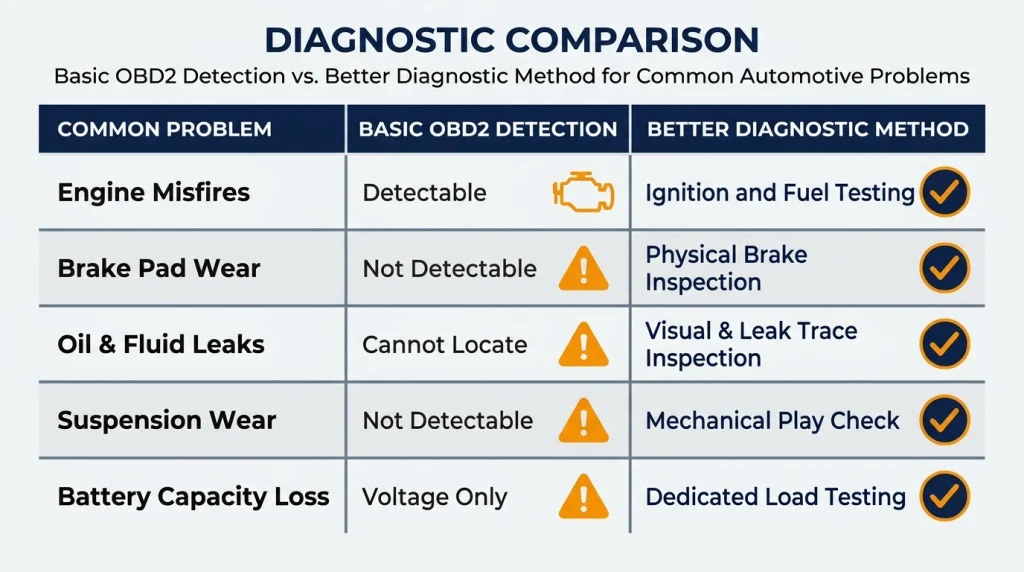
The table below compares common vehicle problems with what a basic generic OBD2 scanner can reasonably reveal.
| Vehicle Problem | Basic OBD2 Detection | Better Diagnostic Method |
|---|---|---|
| Engine misfire | Often detectable when monitoring criteria are met | Code analysis and ignition/fuel testing |
| Oxygen sensor fault | Often detectable | Live data and circuit testing |
| Brake pad wear | Generally not detectable | Physical brake inspection |
| ABS electronic fault | Generally unavailable | Compatible ABS-capable scanner |
| Oil leak | Cannot directly locate | Visual and leak inspection |
| Battery capacity loss | Cannot establish capacity | Dedicated battery testing |
| Suspension wear | Generally not detectable | Mechanical inspection |
| Emissions readiness | Supported | OBD2 readiness monitor check |
These differences explain why choosing a scanner with more functions doesn’t eliminate the need for regular vehicle inspections.
Can an OBD2 Scanner Detect Problems Without a Check Engine Light?
Yes. Some scanners can retrieve pending, stored, or permanent trouble codes even when the check engine light is off.
However, finding a code depends on the vehicle having detected and recorded the relevant fault.
Why Might There Be No Check Engine Light?
- Fault threshold: The monitored problem hasn’t met the conditions required to trigger a warning.
- Incomplete testing: Certain diagnostic monitors haven’t completed their checks.
- Unmonitored component: The problem affects something outside the relevant diagnostic system.
- Intermittent behavior: A fault may appear only under specific operating conditions.
- Different warning system: A separate module may control the relevant dashboard warning.
A particularly useful clue is the readiness monitor status. The Ohio Environmental Protection Agency’s OBD guidance explains how readiness checks can remain incomplete after codes are erased or battery power is disconnected.
That’s why I wouldn’t treat a blank code screen as a complete health report. I would also check readiness status and compare scan results with the driver’s symptoms.
Can OBD2 Detect Every Engine Problem?
No. OBD2 can identify many electronically monitored engine faults, but it cannot reliably identify every internal mechanical problem.
For example, codes may provide clues about poor combustion. They cannot independently confirm whether the root cause is a damaged valve, compression loss, or another mechanical condition.
Mechanical Engine Problems That Need Additional Testing
- Low compression: Requires compression testing or other appropriate mechanical diagnosis.
- Worn piston rings: May require compression and leak-down testing.
- Valve damage: May require mechanical examination and cylinder testing.
- Timing-chain wear: May need mechanical checks and comparison of camshaft/crankshaft data.
- Internal bearing wear: Requires investigation of noises, lubrication conditions, and mechanical damage.
Some of these problems can indirectly trigger codes. But a trouble code typically identifies a detected condition, not a guaranteed failed component.
Can an Advanced OBD2 Scanner Detect More Problems?
Yes. Advanced scanners may support manufacturer-specific diagnostics, additional control modules, active tests, and service functions.
These features go beyond the generic emissions-related information available to ordinary OBD2 code readers.
Basic Versus Advanced Diagnostic Tools
| Feature | Basic Reader | Advanced Scanner |
|---|---|---|
| Generic engine codes | Usually yes | Usually yes |
| Live powertrain data | Often basic | Often expanded |
| ABS and airbag codes | Generally no | Vehicle-dependent |
| Active component tests | Generally no | Some models |
| Service resets | Generally no | Vehicle-dependent |
| Mechanical inspection | No | No |
For example, BlueDriver’s enhanced diagnostic features include access to selected vehicle systems beyond basic powertrain codes.
Professional tools such as the Autel MaxiCOM series can provide even broader functions. Supported operations still depend on the vehicle’s make, model, year, and software coverage.
What Should You Do When OBD2 Shows No Codes?

If your vehicle has symptoms but the scanner reports no codes, investigate the symptoms rather than assuming nothing is wrong.
Here’s the diagnostic process I recommend.
- Record the symptoms. Note when the issue occurs, including engine temperature, speed, and driving conditions.
- Inspect the vehicle. Look for fluid leaks, damaged hoses, loose connections, and obvious mechanical defects.
- Check all available code types. Review stored, pending, and permanent codes where supported.
- Review readiness monitors. Check whether applicable emissions tests have completed.
- Examine live data. Compare relevant sensor information with expected operation using proper service information.
- Scan additional modules. Use a compatible enhanced tool if the symptoms involve ABS, airbag, transmission, or body systems.
- Perform physical testing. Use appropriate pressure, compression, battery, or electrical tests.
- Seek professional diagnosis. Escalate persistent symptoms or safety-related concerns to a qualified technician.
A scan is an excellent starting point. It should never become the only test used to make a repair decision.
Does Clearing OBD2 Codes Fix the Problem?
No. Clearing a trouble code removes diagnostic information, but it doesn’t repair the underlying fault.
The warning may return once the vehicle detects the problem again. Clearing codes can also reset emissions readiness monitors and erase useful diagnostic clues.
According to the Delaware Division of Motor Vehicles’ OBD inspection guidance, incomplete readiness monitors can affect emissions inspection results.
When Should You Avoid Clearing Codes?
- Before a mechanic has documented the stored diagnostic information
- When an intermittent problem is still being investigated
- Immediately before an emissions inspection
- When a serious engine or safety-related warning needs diagnosis
Some permanent codes cannot be removed through an ordinary erase command. Their removal depends on the vehicle completing the required conditions after repair.
Is an OBD2 Scanner Enough for a Used Car Inspection?
No. A used vehicle can have hidden mechanical, structural, or maintenance problems while showing no diagnostic codes.
A scan can reveal useful electronic information, but it cannot confirm accident history, structural integrity, or the condition of every mechanical component.
What Else Should You Check?
- Engine: Leaks, abnormal noises, fluid condition, and cooling-system performance.
- Transmission: Shift quality, fluid condition, and unusual noises.
- Brakes: Pad wear, rotor condition, brake lines, and braking performance.
- Suspension: Joint wear, damaged components, and unusual movement.
- Tires: Tread depth, age, visible damage, and uneven wear.
- Body: Corrosion, previous repairs, and possible structural damage.
- Electronics: Dashboard warning lights and available module diagnostics.
For a vehicle you’re considering purchasing, an independent pre-purchase inspection is worth arranging before making a final decision.
Which OBD2 Scanner Is Worth Buying?
The best scanner depends on what you’re trying to diagnose. A basic reader is useful for check engine light problems, while broader electronic diagnostics require additional functions.
These three models cover different needs, from simple code reading to expanded vehicle-system diagnostics.
💰 Best Budget Option
ANCEL AD310 OBD2 Scanner
★★★★☆ 4/5
A straightforward handheld reader for generic engine fault codes and common OBD2 functions. I recommend this type of tool for drivers who want basic diagnostics without relying on a smartphone. Don’t expect comprehensive ABS or airbag coverage.
🏆 Best for Everyday Diagnostics
BlueDriver Bluetooth Pro OBD2 Scanner
★★★★½ 4.5/5
This Bluetooth scanner pairs with a mobile app and offers enhanced diagnostics for supported vehicles. It’s my preferred style of tool for drivers who want more context than a basic handheld reader provides. Verify enhanced coverage for your exact vehicle.
🔧 Best for Advanced DIY Diagnostics
Autel MaxiCOM MK808S
★★★★½ 4.5/5
The MK808S offers multi-system diagnostics, live data, active tests, and supported service functions. I’d consider it for frequent vehicle maintenance or more involved troubleshooting. Check vehicle coverage, software requirements, and update costs before buying.
Product ratings above are editorial suitability assessments, not verified customer review averages. Product capabilities depend on the vehicle and software version.
Frequently Asked Questions
Can an OBD2 scanner detect a bad alternator?
An OBD2 scanner may reveal charging-related trouble codes or abnormal voltage readings when supported by the vehicle. However, it cannot fully test an alternator’s electrical output under every operating condition. A charging-system test with appropriate equipment is more reliable for confirming an alternator problem.
Can OBD2 detect a blown head gasket?
OBD2 may reveal symptoms associated with a head gasket problem, such as misfires or abnormal temperature readings. It cannot directly confirm gasket failure. A technician may need cooling-system pressure testing, combustion-gas testing, compression testing, or leak-down testing to investigate the suspected problem.
Can an OBD2 scanner detect transmission problems?
Yes, some transmission problems produce diagnostic codes that an OBD2 scanner can retrieve. However, generic readers may offer limited transmission information, and mechanical wear may not create codes. A compatible transmission-capable scanner and physical testing provide a more complete evaluation.
Can a car have serious problems without any OBD2 codes?
Yes. Brake wear, suspension damage, tire defects, fluid leaks, and certain internal mechanical problems can exist without diagnostic codes. Some faults also develop before the vehicle’s monitoring system recognizes them. Unusual sounds, warning lights, or changes in handling deserve attention regardless of scan results.
Does an expensive OBD2 scanner detect everything?
No. Advanced scanners can access more electronic modules and perform additional diagnostic functions, but they cannot inspect every physical component. Vehicle compatibility also limits available features. Even professional equipment must be combined with proper inspections, measurements, and mechanical testing.
Final Takeaway: Know What Your OBD2 Scanner Cannot See
OBD2 scanners are powerful diagnostic tools, but they have clear limits. They work best when a vehicle detects a monitored fault and makes the related information available.
They cannot reliably detect every mechanical defect, fluid leak, brake problem, tire issue, or early component failure. Even advanced tools need support from physical tests and proper diagnostic procedures.
My recommendation is simple: use OBD2 as your starting point, not your final verdict. Match the scanner’s findings with real symptoms before deciding that a vehicle is safe or a component needs replacement.
Ready to improve your diagnostic setup? Choose a scanner that supports your vehicle and the systems you need, then combine it with regular maintenance and professional inspections when necessary.

I’m Alex Rahman, a car enthusiast and automotive writer focused on practical solutions, car tools, and real-world driving advice. I share simple and honest content to help everyday drivers make better decisions.
