Can OBD2 Detect a Catalytic Converter Problem? Explained
Quick Answer
Yes, OBD2 can detect many catalytic converter problems, usually through the catalyst efficiency monitor and codes such as P0420 or P0430. It detects a loss of cleaning efficiency, not the converter itself directly, so a code points to the exhaust system and its sensors rather than proving the converter must be replaced.
A catalytic converter problem rarely announces itself clearly. The car may drive normally, the light may be the only symptom, and the code may sound like a verdict. OBD2 is useful here, but only if you understand what it is actually measuring. It does not look inside the converter. It compares what goes in with what comes out and judges whether the converter is still doing its job.
How OBD2 watches the catalytic converter
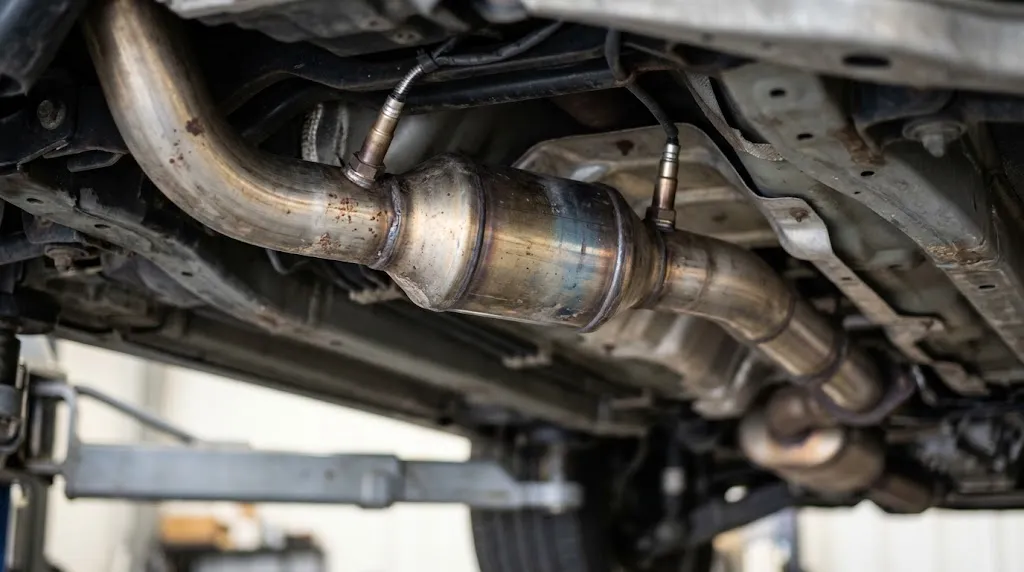
Most petrol vehicles have an oxygen sensor before the converter and another one after it. The upstream sensor switches rapidly as the engine control unit adjusts the air-fuel mixture. A healthy converter stores and releases oxygen while it converts pollutants, so the downstream sensor should look much steadier.
When the converter loses oxygen-storage capacity, that smoothing effect weakens. The downstream signal starts to swing more like the upstream signal. If the calculated efficiency falls below the manufacturer threshold during the catalyst monitor test, the system stores a fault code and turns on the check engine light.
The catalyst monitor is not continuous in the same way as misfire detection. It usually needs the engine to be warm, other monitors to have run, and suitable steady driving conditions. That is why a code can appear days after a problem begins, and why clearing codes can make the monitor show as not ready until the test runs again.
The U.S. Environmental Protection Agency lists catalyst efficiency among the emission-control functions OBD must monitor, alongside oxygen sensors, misfire, fuel delivery, and related systems. In other words, catalyst checking is a built-in part of OBD2, not an extra feature of an expensive scanner.
What the main catalyst codes mean
The code matters because it narrows the bank and the type of failure. Bank 1 is the side containing cylinder 1. On a four-cylinder engine there is normally only one bank, so P0420 is the usual code. On a V6 or V8, the same problem on the other bank gives P0430.
| Code | Meaning in plain terms |
|---|---|
| P0420 | Catalyst efficiency below threshold, Bank 1 |
| P0430 | Catalyst efficiency below threshold, Bank 2 |
| P0421 | Warm-up catalyst efficiency below threshold, Bank 1 |
| P0431 | Warm-up catalyst efficiency below threshold, Bank 2 |
Warm-up codes are a useful distinction. They point to the early part of the drive, when the converter is still reaching operating temperature, rather than to steady-state efficiency. That difference can change the diagnostic path, especially if the problem is worse on cold starts.
Other codes can appear alongside a catalyst code and change the story. Misfire, fuel-trim, oxygen-sensor, and exhaust-leak codes may be the cause rather than a coincidence. A converter can be damaged by the conditions that created those codes, so reading only P0420 and stopping there is a common shortcut to a wrong repair.
What OBD2 can detect, and what it cannot
OBD2 is strongest at detecting efficiency loss. It can flag a converter that no longer stores oxygen well enough, even when the car still feels normal to drive. It can also show related problems through companion codes, pending codes, freeze-frame data, and live sensor readings.
It is weaker at identifying the physical cause. A scanner cannot reliably tell you whether the catalyst material has aged, melted, broken apart, or been contaminated, or whether an exhaust leak is letting outside air into the system. It can point to the area and the pattern, but physical inspection and further tests are often needed to separate those causes.
OBD2 also cannot prove that a converter is healthy just because no code is present. An early-stage problem may not yet have failed the monitor test, the monitor may not have run, or a fault may be stored as pending rather than confirmed. A clean code list is reassuring, but it is not the same as a tailpipe emissions measurement.
Key Insight
P0420 and P0430 are efficiency verdicts, not part identifications. They say the monitored system failed its test. They do not say which component in that system failed.
How to check a suspected converter problem with a scanner
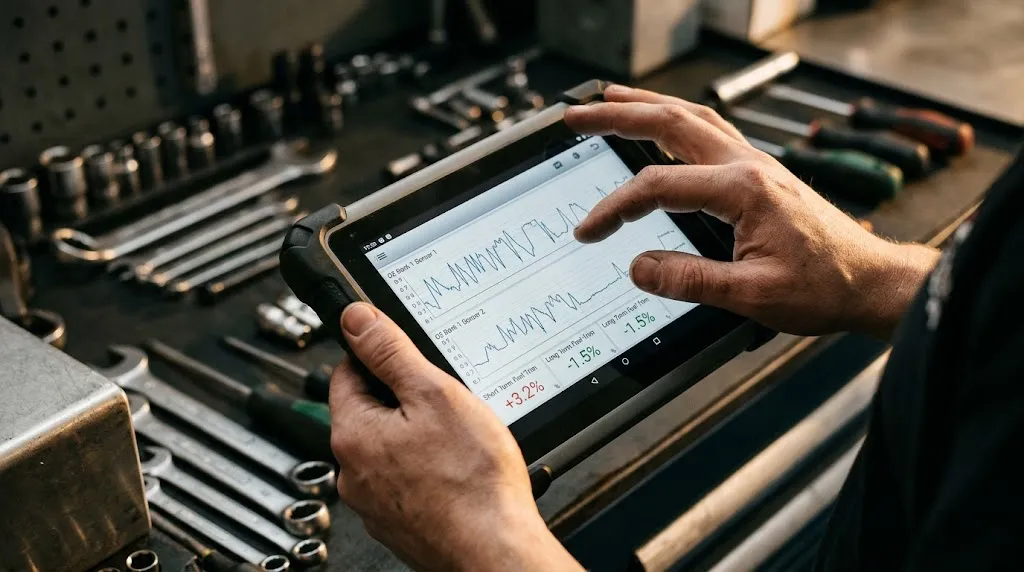
Start with the full picture, not just the catalyst code. A basic code reader can retrieve the code, but a scanner that graphs live oxygen-sensor data gives a much clearer test.
- Read all codes, including pending codes. Note any misfire, fuel-trim, or oxygen-sensor codes that appeared with the catalyst code.
- Check freeze-frame data. This snapshot shows engine speed, load, coolant temperature, and fuel trim when the fault was recorded, which helps separate a cold-start issue from a steady-driving issue.
- Check catalyst monitor readiness. If the monitor is not ready, the test has not completed since the last reset, so a missing code does not yet clear the converter.
- Graph upstream and downstream oxygen sensors at steady speed. A healthy downstream trace should be relatively flat compared with the rapidly switching upstream trace. If both traces look alike, efficiency is weak.
- Look at fuel trims. Large positive or negative long-term trims suggest the engine has been running rich or lean, which can overload or damage a converter over time.
If you need a refresher on sensor behaviour, our guide to how OBD2 diagnoses oxygen sensor faults explains the upstream and downstream roles in more detail. For the data itself, what OBD2 live data can show covers the readings that are most useful beyond a code list.
Temperature and back-pressure tests can add evidence for a clogged or melted converter, but they need care around hot exhaust parts and proper lifting equipment. They are not a reason to guess from a code alone, and they are not safe to improvise under a car supported only by a jack.
Why a catalyst code does not always mean a new converter
This is where many expensive mistakes happen. Several faults can make a healthy converter look inefficient to the monitor.
- A faulty downstream oxygen sensor. A slow, biased, or contaminated sensor can send a signal that mimics converter failure.
- An exhaust leak before the downstream sensor. Outside air entering the exhaust can distort the downstream reading.
- Long-term misfires or a rich mixture. Unburned fuel can overheat and damage the catalyst, but fixing only the converter leaves the cause in place.
- Oil or coolant reaching the exhaust. Contamination can coat the catalyst and reduce its effectiveness.
- Aging. A converter can simply lose efficiency after many years and miles, even without a single dramatic failure.
The practical rule is to work from the cheapest and most reversible explanations outward. Check for other codes first, inspect for obvious exhaust leaks, and confirm sensor behaviour in live data before treating the converter as the failed part. If the downstream sensor mirrors the upstream sensor after those checks, and no upstream cause explains it, converter failure becomes much more likely.
The same caution applies to clearing the code. Clearing P0420 also resets monitor readiness, so the catalyst monitor must run again before an emissions test can pass on OBD data. Our guide to checking emissions readiness with an OBD2 scanner explains that sequence, and stored versus pending trouble codes explains why a code can disappear temporarily without the fault being fixed.
Warning
Stop driving and get the car checked promptly if the check engine light flashes, power drops sharply, the converter glows, or you smell exhaust inside the cabin. Those signs suggest a more serious failure than a borderline efficiency code.
What to do next after a catalyst code
If the light is steady, the car drives normally, and there is no exhaust smell inside, the usual next step is diagnosis soon rather than panic. Note the exact code, save the freeze-frame data, and do not replace the converter on the first scan.
If there are companion codes, address those first in diagnostic order. A misfire or fuel-trim fault can both trigger an efficiency code and damage a new converter if left alone. If the car has lost power, rattles underneath, or smells strongly of sulfur, treat those as stronger evidence of physical converter damage and get a physical inspection.
For an emissions test, timing matters. A vehicle can fail because the light is on, because the code is stored, or because the catalyst monitor is not ready after clearing. That is why a repair should be followed by enough suitable driving for the monitor to complete, rather than by clearing the code just before the test.
Related Product
OBD2 scanner with live oxygen-sensor graphing
A scanner that graphs upstream and downstream sensors makes the catalyst check in this article practical, rather than guesswork from a code alone.
As an Amazon Associate, we earn from qualifying purchases.
Frequently Asked Questions
Can OBD2 detect a clogged catalytic converter?
It can suggest one, but not prove it alone. A clogged converter often causes power loss, especially under load, and may set efficiency or related codes. Back-pressure testing and physical inspection are usually needed to confirm a blockage.
Can a car pass an emissions test with a P0420 code?
Usually no, if the light is on or the code is stored. Even after clearing the code, the catalyst monitor must complete and pass, so clearing it just before a test does not solve the underlying failure.
Will P0420 go away on its own?
Sometimes, if the trigger was temporary and the monitor later passes consistently. If the converter itself has lost efficiency, the code normally returns after the monitor runs again. A temporary disappearance is not proof of a repair.
Can I drive with a catalyst efficiency code?
Short-term driving is often possible when the light is steady and performance is normal, but it should not be ignored. Emissions rise, an inspection can fail, and an upstream fault can damage the converter further. Stop promptly if the light flashes or power drops sharply.
Does OBD2 detect a stolen or missing catalytic converter?
It usually detects the resulting problem rather than the theft itself. A missing converter changes downstream sensor readings and exhaust behaviour, which can set catalyst and oxygen-sensor codes, but the scanner cannot tell you the converter was stolen rather than damaged.
Can a generic OBD2 scanner check catalyst efficiency?
Yes, for the core check. Any generic scanner should read P0420 or P0430 and monitor readiness. Graphing live oxygen-sensor data helps much more than a code-only reader when you need to separate a sensor fault from converter failure.
Conclusion
OBD2 can detect a catalytic converter problem, but its answer is narrower than the code suggests. It detects lost efficiency through oxygen-sensor behaviour and the catalyst monitor, not by inspecting the converter itself. That makes P0420 and P0430 a strong starting point, not a replacement order. Check companion codes, compare live sensor traces, and rule out sensor faults, exhaust leaks, and upstream engine problems first. When those checks still point to the converter, the diagnosis is much firmer, and any replacement is far less likely to be wasted.

I’m Alex Rahman, a car enthusiast and automotive writer focused on practical solutions, car tools, and real-world driving advice. I share simple and honest content to help everyday drivers make better decisions.
