Can OBD2 Calculate Volumetric Efficiency? Yes, With Limits
Quick Answer
Yes, OBD2 can calculate volumetric efficiency, but it does not report it directly. A scanner or app must estimate it from live data, usually mass airflow, engine speed, engine size, and intake air density. The result is a useful diagnostic estimate, not a factory measurement.
What Volumetric Efficiency Actually Measures
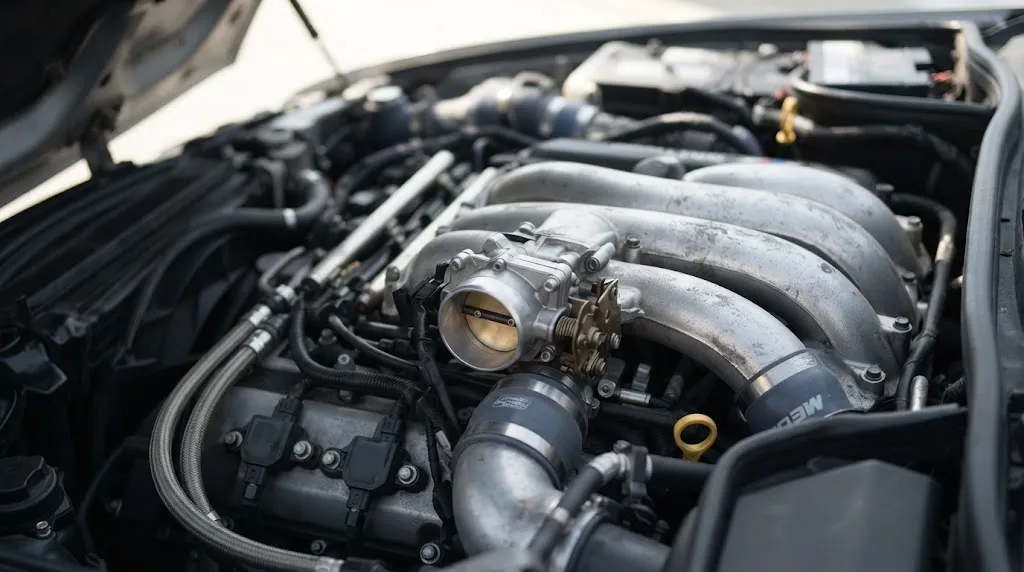
Volumetric efficiency, or VE, compares the air an engine actually takes in with the air it could theoretically take in. A four-stroke engine fills each cylinder once every two revolutions, so its theoretical airflow depends on displacement and speed.
If an engine filled every cylinder completely at atmospheric pressure, VE would be 100%. In practice, intake restriction, valve timing, exhaust backpressure, and air temperature all reduce filling. A healthy naturally aspirated engine often lands in the 75% to 90% range at wide-open throttle, while a turbocharged or supercharged engine can exceed 100% because boost forces extra air into the cylinders.
The key point is that VE is a ratio, not an airflow number by itself. Two engines can move the same grams per second yet have very different VE values if their displacements or speeds differ. That is why VE is more useful for judging breathing health than a single airflow reading.
Why OBD2 Does Not Report VE Directly
There is no standard Mode 01 PID labelled volumetric efficiency. Generic OBD2 gives the raw ingredients instead. The most useful ones are mass airflow (PID 0x10), engine speed (PID 0x0C), intake air temperature (PID 0x0F), and manifold absolute pressure (PID 0x0B).
That distinction matters. When an app shows VE, it is doing maths on those PIDs, plus an engine displacement value you or the app supplies. If any input is missing, wrong, or sampled at a different moment, the VE number moves with it. A guide to which OBD2 PIDs are most useful helps explain why not every car supports every PID in the same way.
Manufacturer-specific data can add detail, but the generic calculation stays the same in principle: compare measured airflow with the theoretical airflow for that engine at that speed and air density.
How the MAF Method Calculates VE
The cleanest OBD2 method uses a mass airflow sensor. First, work out theoretical volume flow. For a four-stroke engine, divide displacement by two revolutions per cycle, then multiply by RPM.
Theoretical volume flow = (engine displacement × RPM) ÷ 2. Convert that volume to mass by multiplying by intake air density. Air density itself comes from pressure and temperature: density rises with pressure and falls as air gets hotter, which is why a cold, high-pressure intake can hold more air mass in the same volume.
Then VE = (actual mass airflow ÷ theoretical mass airflow) × 100. The volumetric efficiency calculation guide from x-engineer uses the same density-based approach and shows how pressure, temperature, displacement, and speed fit together.
Here is a worked example, using rounded numbers. A 2.0-litre engine at 3,000 RPM has a theoretical volume flow of 3,000 litres per minute, or 0.05 cubic metres per second. At an air density of 1.2 kilograms per cubic metre, theoretical mass flow is 0.06 kilograms per second, or 60 grams per second. If the MAF sensor reports 51 grams per second at that moment, VE is 51 ÷ 60 × 100, or 85%.
Notice what the example assumes: steady speed, a stable throttle position, and a trustworthy MAF reading. A reading taken while RPM is still climbing will not match the theoretical value for a single RPM point.
What the Speed-Density Method Can and Cannot Do
Some engines have no MAF sensor and instead use manifold pressure, intake temperature, and RPM to estimate airflow. This is called speed-density. It can estimate air density well, but density alone does not reveal actual airflow.
The problem is circular. To turn manifold pressure and temperature into actual mass flow, the calculation still needs VE. If an app assumes a VE value, then uses it to report VE, the answer is not an independent measurement. It is mostly a reflection of the assumption.
Speed-density VE estimates become more meaningful when checked against another airflow signal, such as fuel flow combined with air-fuel ratio, or a known-good MAF reading from a similar operating point. On their own, treat them as a rough trend, not a precise diagnosis.
How to Run a Useful VE Check
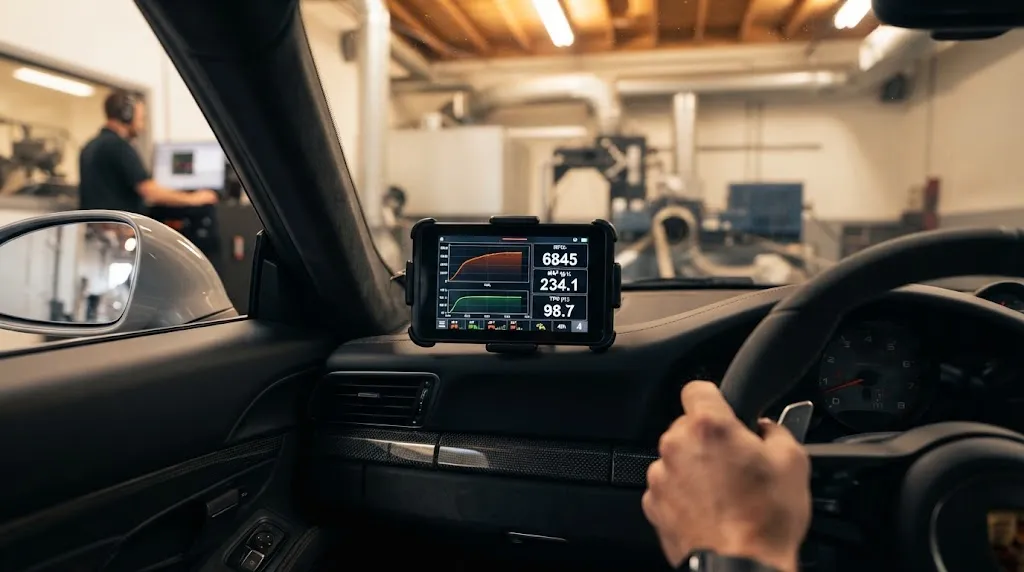
A single idle reading tells you little. VE is best judged at wide-open throttle, where the engine is asking for maximum airflow and intake restrictions show up most clearly. Use a safe road or dyno setting, and keep the test short and legal.
- Enter the correct engine displacement in the app. A 2.0-litre value on a 2.5-litre engine will distort every result.
- Warm the engine fully, then log MAF, RPM, throttle position, intake air temperature, and manifold pressure together.
- Make a smooth wide-open-throttle pull through the mid-range, then note MAF and RPM at the same instant near peak airflow.
- Repeat the pull and compare. A repeatable result matters more than one eye-catching number.
- Check the same operating point before and after a repair, rather than comparing idle VE with full-throttle VE.
Logging matters because OBD2 values update at different rates. A guide to what OBD2 live data can show is a useful reminder that a live screen is a sample, not a laboratory trace. The accuracy limits in how accurate OBD2 live data is also apply here: sensor error and update timing both feed straight into VE.
How to Read the Result
Do not judge VE by one universal pass mark. Engine design, boost, cam timing, and test conditions all shift the expected range. Use the table below as a starting point, then compare with the same engine at the same operating point.
| Result | What it often suggests |
|---|---|
| Near the expected range | Breathing is broadly normal at that operating point. |
| Clearly low at wide-open throttle | Possible restriction, boost loss, exhaust blockage, or a faulty airflow reading. |
| Above 100% on a boosted engine | Possible and normal when boost packs in more air than atmospheric filling alone. |
| Above 100% on a naturally aspirated engine | Suspect an input error, such as wrong displacement or a faulty MAF reading. |
| Wildly inconsistent | Suspect mismatched samples, changing throttle, or an unstable sensor signal. |
The most useful comparison is usually before and after a change: a new air filter, a boost-leak repair, or a cleaned sensor. If VE rises at the same RPM and throttle after the work, breathing probably improved. If it does not move, the restriction may be elsewhere.
Why VE Numbers Go Wrong
Most bad VE numbers come from bad inputs, not bad maths. A dirty or drifting MAF sensor is the classic case: if it under-reports airflow, calculated VE falls even when the engine is breathing normally. A guide to whether OBD2 can diagnose a mass airflow sensor explains why a plausible-looking MAF value still needs cross-checking.
Other common errors include using gross displacement for an engine with cylinder deactivation, entering litres as cubic inches, using manifold temperature instead of pre-throttle intake temperature, and comparing a MAF sample with an RPM sample taken a moment later. Altitude also matters: thinner air lowers mass flow, so a mountain result should not be judged against a sea-level expectation without a density correction.
Warning
Do not replace parts on a VE number alone. A low result points to a breathing or measurement problem, but it does not identify the part. Check fuel trims, boost pressure where fitted, intake leaks, exhaust restriction, and sensor plausibility before spending money.
VE Is Not the Same as Engine Load
Engine load and VE are related, but they answer different questions. Calculated load compares current airflow with a reference airflow value, while VE compares actual airflow with theoretical airflow for that displacement and speed. A high load reading does not automatically prove high VE, and a low VE reading does not automatically mean low load.
That distinction is worth keeping straight when comparing apps, because some displays use similar percentages for different calculations. The article on whether OBD2 can calculate engine load separates the scanner-reported load value from the airflow maths behind it.
Related Product
OBD2 Scanner With Live MAF and RPM Display
A scanner that logs MAF and RPM together makes a VE check far easier than reading two separate screens.
As an Amazon Associate, we earn from qualifying purchases.
Frequently Asked Questions
Can a basic OBD2 scanner show volumetric efficiency?
Usually not directly. Basic scanners tend to show MAF, RPM, and temperature, but leave the VE calculation to an app or to manual maths. If your tool has no VE field, log those PIDs and apply the formula above.
What PIDs do I need to calculate VE?
For the MAF method, you need mass airflow, engine speed, and intake air temperature, plus the engine displacement entered separately. Manifold pressure helps with density checks and speed-density estimates, but it does not replace a MAF reading for a direct calculation.
What is a good volumetric efficiency value?
There is no single good value for every engine. Many healthy naturally aspirated engines sit around 75% to 90% at wide-open throttle, while boosted engines can exceed 100%. Compare the result with the same engine, at the same RPM and throttle, rather than chasing a universal target.
Can VE diagnose a clogged air filter or exhaust?
It can point in that direction, but it cannot prove the cause. A restriction that limits airflow will usually lower VE at wide-open throttle. Still, a faulty sensor, boost leak, or valve problem can produce a similar pattern, so VE should trigger further checks rather than a final diagnosis.
Why does my VE change at idle?
Idle VE is normally low because the throttle is nearly closed and the engine is not trying to fill its cylinders fully. Idle VE is also sensitive to small airflow errors and accessory load. Wide-open-throttle readings are far more useful for judging breathing capacity.
Does OBD2 calculate VE for diesel engines?
The same airflow maths can apply, but diesel results need extra care. Many diesels run lean with excess air, use variable-geometry turbocharging, and may rely on different airflow strategies. Treat a diesel VE estimate as a trend indicator and cross-check it with boost, fueling, and exhaust data.
Conclusion
OBD2 can calculate volumetric efficiency, but only as an estimate built from live airflow, speed, displacement, and air density. The MAF method is the most direct route, while speed-density estimates need more caution because they can depend on the very value they claim to measure. Get the inputs right, test at wide-open throttle, repeat the check, and use VE as a clue for further diagnosis rather than a verdict on its own.

I’m Alex Rahman, a car enthusiast and automotive writer focused on practical solutions, car tools, and real-world driving advice. I share simple and honest content to help everyday drivers make better decisions.
