Can OBD2 Calculate Engine Load? PID 04 vs PID 43 Explained
Quick Answer
Yes, in practical terms: the engine control unit calculates engine load and makes it available through OBD2, so a scanner can display it. The scanner itself does not usually do the maths. It reads calculated load, PID 04, and, on many petrol cars, absolute load, PID 43. The result is a percentage, not a direct measurement of power or effort.
That distinction matters. “Engine load” is not one physical measurement; it is a comparison of current air, or on a diesel fuel flow, with a reference condition.
Does the scanner calculate load, or just report it?
The scanner normally reports it. The engine control unit already needs a load estimate to choose fuelling, ignition timing, and other control strategies, so it works that value out from its own sensor inputs. OBD2 then exposes the result as live data. A basic scanner or app requests PID 04, converts the returned byte into a percentage, and shows that number.
Some apps log load alongside RPM and throttle or graph it over time, but that is still presentation, not a new core calculation. The same boundary applies to other derived figures, as explained in whether OBD2 can calculate vehicle range.
Calculated load and absolute load are not the same number
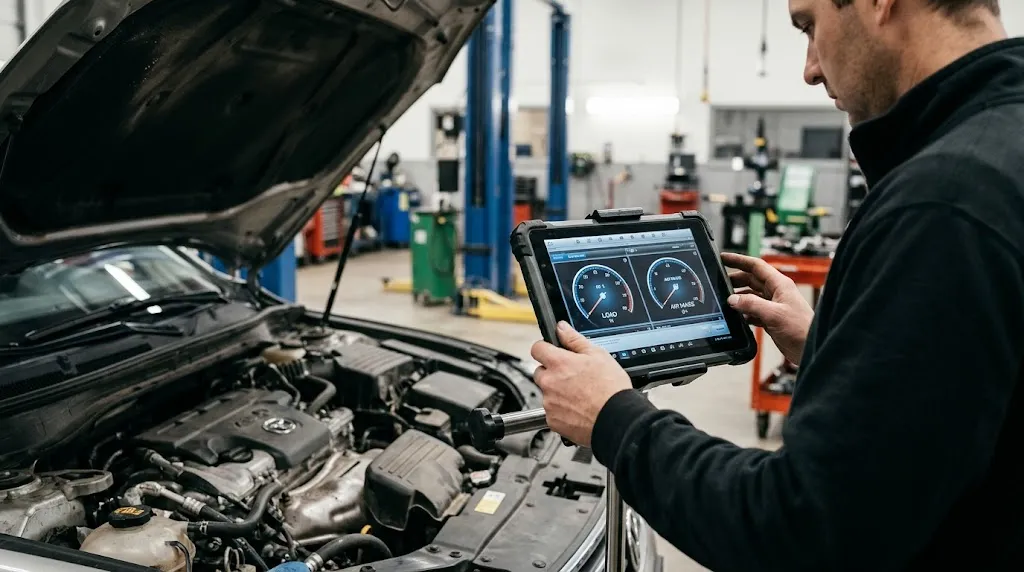
Confusing these two values is the most common source of puzzling readings. Calculated load, PID 04, is a share of the engine’s available capacity at that moment. Absolute load, PID 43, is air mass per intake stroke compared with a fixed volumetric reference. They can move together, but they answer different questions.
Calculated load is designed to reach about 100% at wide-open throttle, whatever the altitude, temperature, or RPM, for both naturally aspirated and boosted engines. Absolute load is tied to swept volume. A naturally aspirated engine normally peaks below about 100% on that scale, while a boosted engine can go well above 100% because forced induction pushes more air into each intake stroke than the engine would draw in on its own.
| Value | PID | What it compares | Useful reading |
|---|---|---|---|
| Calculated load | 04 | Current airflow with peak wide-open-throttle airflow now | Share of currently available capacity |
| Absolute load | 43 | Air mass per intake stroke with swept-volume air mass | Volumetric efficiency and pumping behaviour |
Check the label first: many tools shorten the names to “CALC LOAD,” “ENG LOAD,” or “ABS LOAD,” and some show only one. Vehicle Service Pros on calculated load versus absolute load uses the same framing: calculated load as a share of maximum breathing capability, and absolute load as a swept-volume comparison.
How the calculated load figure is worked out
For a petrol engine, the starting point is airflow. The control unit compares current airflow with the peak airflow the engine could achieve at wide-open throttle at that RPM, then corrects for barometric pressure and ambient air temperature. The SAE J1979 load definitions express this as current airflow divided by peak wide-open-throttle airflow at standard temperature and pressure for that RPM, with those pressure and temperature corrections.
Altitude shows why the correction matters. Thinner air at altitude means less air mass even at wide-open throttle, so without a correction the same throttle opening would look like a different load at sea level and on a mountain pass. With it, calculated load can still approach 100% in either place.
Diesels use the same PID, but with fuel flow in place of airflow — a reminder that “load” is a control calculation, not a universal sensor reading. PID 04 is a single byte, converted as byte value × 100 ÷ 255, giving 0% to 100%; 128 is about 50%, and 255 is 100%.
Key Insight
Calculated load reaching 100% does not mean maximum possible power in absolute terms. It means the engine is at its wide-open-throttle reference for the current RPM, altitude, and temperature. Absolute load is the figure that can reveal how much extra air a boosted engine is actually moving.
How to see engine load on an OBD2 scanner
Most tools put load under live data, not under fault codes. The menu name varies, but the sequence is usually consistent.
- Plug the adapter into the OBD2 port and connect it to the scanner or app.
- Turn the ignition on, and start the engine for a running-load reading.
- Open live data, data stream, or a custom gauge screen.
- Select “Calculated Load Value,” “Engine Load,” or “Absolute Load Value.”
- Watch the value at idle, then as you gently raise RPM and load.
Add RPM and throttle position to the same screen if you can. Load alone tells you demand changed; load with them tells you whether that change makes sense. If load does not appear, that does not automatically mean a fault: not every vehicle supports every PID. See which OBD2 PIDs are most useful before assuming the car is missing something important.
What a sensible load reading looks like
There is no single “good” load percentage for every car at idle, because engine size, idle speed, air conditioning, electrical load, and cold-start enrichment all change the baseline. The useful pattern is relative. At a warm idle with few accessories running, load should be modest. As you open the throttle and the engine does more work, load should rise. At wide-open throttle, calculated load should climb toward 100%.
A small engine working hard up a hill can legitimately show a higher load than a larger engine cruising lightly on the same road. Switching the air conditioning on, turning the steering at idle, or running a cold engine can also raise load without indicating a fault. Absolute load needs a different expectation: on a naturally aspirated engine it normally stays below about 100%, while on a turbocharged or supercharged engine it can rise well above 100% under boost. That is expected, not an error.
The best comparison is the same car under similar conditions. If idle load is much higher than usual, if load no longer rises smoothly with throttle, or if calculated load cannot approach its wide-open-throttle reference, that change is worth investigating.
When a load reading can mislead you
Load is only as good as the inputs behind it. A dirty or faulty mass airflow sensor, a vacuum leak, a restricted intake, or faulty boost control can distort the airflow picture and therefore the load calculation. In that case the scanner is not lying; it is faithfully displaying a calculation based on bad or incomplete input.
Manufacturer implementation is another limit. The SAE definitions standardise PID 04 and PID 43, but control strategies differ between makes, models, and engine types, so two cars can show different load behaviour in similar driving and still both be normal.
Support is a third limit. Spark-ignition engines are required to support absolute load, but diesels are not required to support PID 43, even though both support calculated load. A missing absolute load value on a diesel is therefore not, by itself, evidence of a fault.
Warning
Do not replace a sensor solely because load looks high or low. Load is a derived value, so a strange result points to a system to check — airflow, boost, vacuum, fuelling, or the sensor itself — not to a single part. Confirm with related live data and fault codes first.
What to check alongside engine load
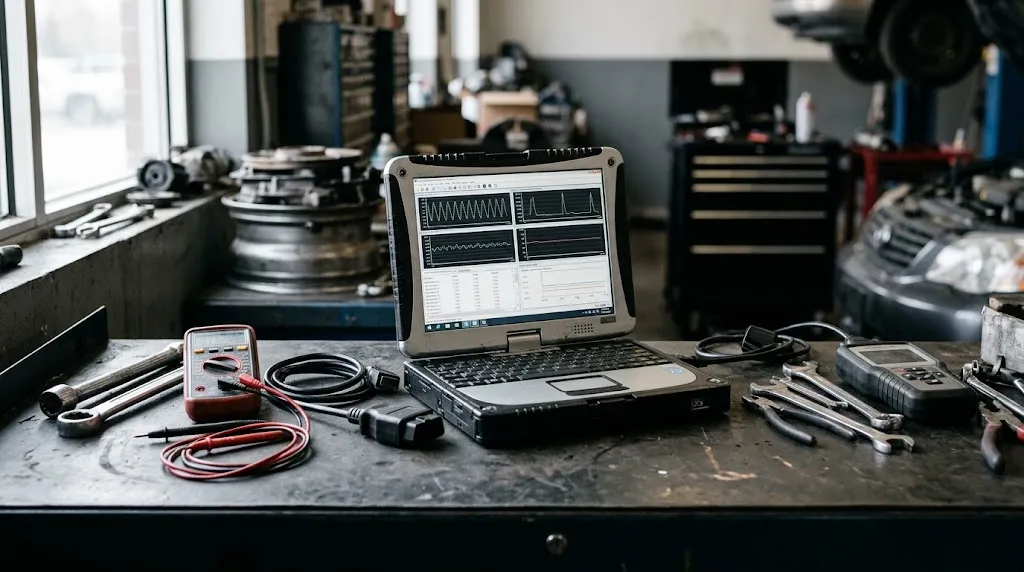
Load becomes diagnostic when cross-checked with RPM, throttle position, mass airflow, intake manifold pressure where available, coolant temperature, and short-term and long-term fuel trim. Together, they help separate a genuine breathing problem from a fuelling or sensor problem.
For example, high load with high airflow may point toward an air leak or added accessory load, while high load with low or inconsistent airflow makes the airflow measurement itself suspect. Strong fuel-trim correction at the same time adds weight to a fuelling or unmetered-air explanation.
That cross-checking approach is central to live-data diagnosis. What an OBD2 scanner can tell you maps the broader output types, so load is not treated as a standalone verdict. How accurate OBD2 live data is is worth reading before treating any single live value as proof. And whether OBD2 can diagnose a mass airflow sensor explains what generic data can and cannot prove about that sensor.
Can OBD2 calculate other kinds of “load”?
Readers sometimes use “load” loosely to mean towing load, payload, electrical load, or transmission load. OBD2 load does not measure those things directly. It describes engine breathing and, by extension, torque capacity in the SAE sense. It does not weigh a trailer, measure cargo, or report transmission torque, and it should not be converted into a towing rating or a horsepower figure.
Related Product
OBD2 scanner with live data
A scanner or adapter with a live-data screen is what you need to view calculated and absolute load alongside RPM and throttle position.
As an Amazon Associate, we earn from qualifying purchases.
Frequently Asked Questions
Is engine load the same as throttle position?
No. Throttle position describes how far the throttle is open, while load describes air or fuel flow relative to a reference. They often rise together, but load also depends on RPM, altitude, temperature, and boost.
Why does my calculated load never reach 100%?
It should approach 100% at wide-open throttle, but a short or partial-throttle test may not get there. If a full wide-open-throttle run still falls well short, check for restricted airflow or low boost, and compare load with RPM, throttle, and airflow.
Why is absolute load over 100% on my turbocharged car?
That is expected under boost. Absolute load compares air per intake stroke with the swept-volume reference at atmospheric pressure, so forced induction can push it above 100%, while calculated load is referenced to current wide-open-throttle capability.
Can OBD2 calculate engine load on a diesel?
Yes, for calculated load. Both petrol and diesel engines support PID 04, with diesels using fuel flow in place of airflow. Absolute load, PID 43, is required for petrol engines but not for diesels, so it may simply be unavailable on a diesel.
Does a high engine load reading mean my engine is damaged?
Not by itself. High load can be normal when climbing, towing, accelerating, or running accessories. It becomes a concern when it is unexpectedly high for the conditions, changes suddenly from the car’s usual behaviour, or appears with fault codes or poor running.
Can I use engine load to calculate horsepower?
Not accurately from load alone. Load is a percentage reference, not a power measurement, and converting it to horsepower would also need RPM, torque behaviour, and engine-specific data.
Conclusion
OBD2 can show engine load because the control unit calculates it and exposes it as live data, most directly as calculated load, PID 04, with absolute load, PID 43, on many petrol cars. The scanner usually reports that figure, not invents it. Read calculated load as a share of current wide-open-throttle capability, absolute load as a swept-volume comparison, and always check it alongside RPM, throttle, and airflow.

I’m Alex Rahman, a car enthusiast and automotive writer focused on practical solutions, car tools, and real-world driving advice. I share simple and honest content to help everyday drivers make better decisions.
