
Can a Dead Battery Cause an OBD2 Code? | Leadfoot
Quick Answer
Yes. A dead or weak battery can cause an OBD2 code, usually because low or unstable voltage makes sensors and control modules send signals outside their normal range. The most direct code is P0562, system voltage low. Fix the power supply first, then recheck the codes before replacing a sensor.
A check engine light after a dead battery feels backwards. The battery is not part of the exhaust system, yet the light is on and the scanner shows a code. In many cases the battery is the cause: a car needs steady voltage to read sensors, keep modules talking, and run readiness self-tests. When voltage falls, sags during cranking, or spikes during a jump start, the computer can record a fault even when the named part is still sound.
Why a Dead Battery Can Set a Code
An OBD2 system measures the electrical signal from a part and compares it with a range the manufacturer expects. If the signal is too high, too low, missing, or inconsistent, the system stores a diagnostic trouble code and, for many faults, turns on the check engine light.
Low voltage changes that signal before the part itself fails. Many sensors run on a stable 5-volt reference from the engine computer. When system voltage drops, that reference can wobble, sensor output can fall out of range, and communication between modules can drop out. Cranking is the hardest moment: a weak battery may still turn the engine over slowly, but voltage can dip sharply while the starter draws heavy current, and modules may reset or read a sensor at the exact moment power is lowest. A rough jump start can add the opposite problem, a brief overvoltage event from reversed cables, a poor clamp, or a sudden surge.
How Low Voltage Turns Into a Sensor or Communication Code
The battery and charging system power a network, not just the starter. The engine computer, transmission computer, ABS module, body module, and instrument cluster share the same supply and, in many cars, the same CAN bus network. A power problem in one place can therefore look like several unrelated faults.
Three patterns are common. First, a sensor code appears because the sensor signal falls outside its expected window. Oxygen, mass airflow, throttle position, camshaft, and crankshaft sensors all depend on stable power. Second, a misfire code appears because ignition or fuel delivery weakens. If voltage sags under load, combustion can become uneven, and the computer may store P0300 for a random misfire or a cylinder-specific code in the P0301 to P0312 range. The misfire was real in the sense that combustion was poor, but the root cause was power, not a bad coil. Third, a communication code appears because a module drops off the network. Codes starting with U, such as U0100 for lost communication with the engine computer, often point to a module that stopped replying after a reset or power loss.
This is also why an OBD2 scanner can point toward a bad battery without directly testing it. It sees the voltage-related codes, the live voltage reading, and the pattern of faults across systems. A dedicated battery test still gives a clearer answer, because a scanner reading alone cannot measure cranking amps or internal resistance.
Key Insight
A code names the symptom the computer detected, not always the part that caused it. Several unrelated codes together after a dead battery point to voltage, ground, or charging as the shared cause.
Codes Most Often Linked to a Dead or Weak Battery
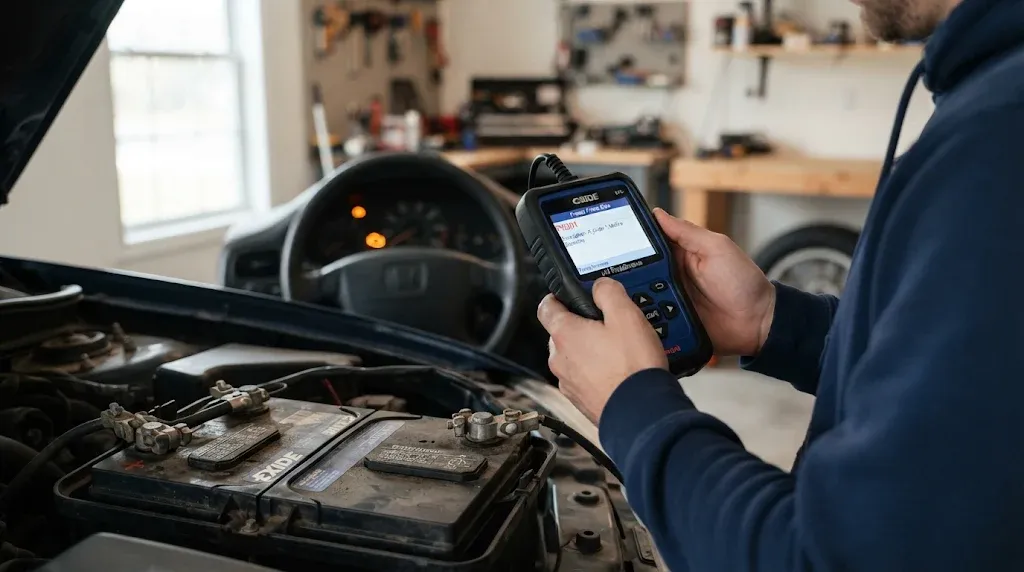
No single code proves a battery is dead. Confirm with a voltage reading and a battery test.
| Code | Meaning | What it usually suggests |
|---|---|---|
| P0562 | System voltage low | Battery, charging, wiring, or ground problem |
| P0563 | System voltage high | Overcharging, regulator fault, or jump-start surge |
| P0560 | System voltage malfunction | Voltage outside the expected range |
| P2503 | Charging system voltage low | Alternator or charging circuit not keeping up |
| P0300 | Random misfire | Weak spark or fuel delivery during a voltage dip |
| U0100 | Lost communication with ECM or PCM | Module reset, power loss, or network interruption |
| P1000 | Readiness not complete | Monitors reset after power loss; some Ford, Mazda, and Jaguar models |
P0562 is the clearest link. P0563 points more toward overcharging or a surge. P1000 means the readiness monitors have not finished their self-tests since power was lost; it does not by itself mean a part has failed.
A Dead Battery, a Weak Battery, and a Disconnect Are Not the Same Thing
A dead battery cannot hold a charge or deliver enough current to start the car. A weak battery can still start the car, especially in warm weather, but voltage falls under load. This is the situation most likely to create false sensor and misfire codes, because the car runs while the light comes on.
A disconnect is different. Removing the cables, or replacing the battery, cuts power to the computer and clears its volatile memory: stored codes, freeze-frame data, learned settings, and readiness monitor results are wiped. That can turn the light off temporarily, but it also resets the monitors to incomplete. A dead battery can cause a code, a disconnect can erase a code, and both can leave the car unable to pass an emissions test until the monitors run again.
What to Check Before Replacing a Sensor
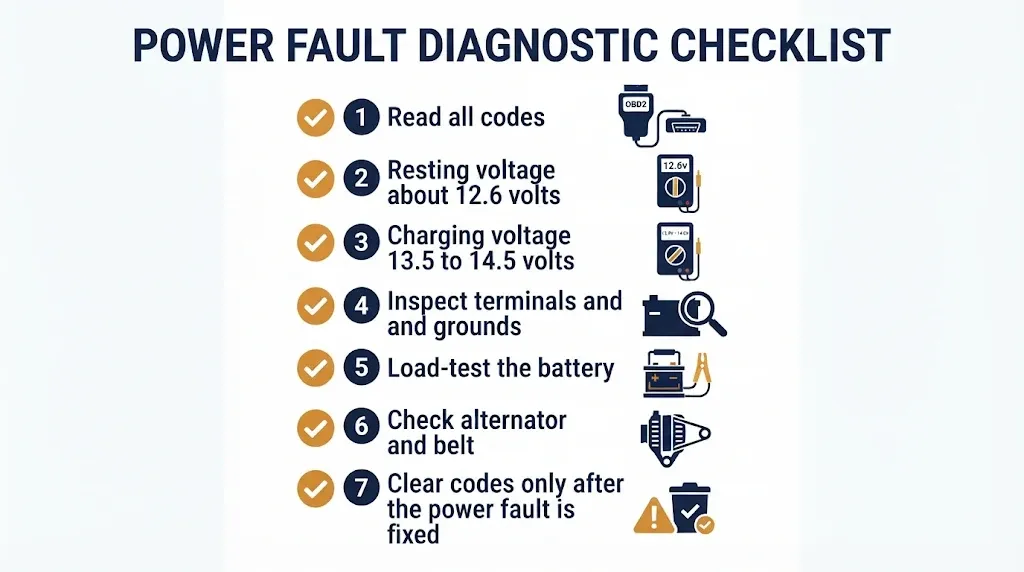
Work in order, from power outward. Replacing a sensor before checking voltage often leads to the same code returning on the new part.
- Read all the codes. Write down every stored, pending, and permanent code, plus freeze-frame data. Look for P0562, P0563, U-codes, and codes across unrelated systems.
- Check battery voltage at rest. With the engine off, a healthy 12-volt battery usually reads about 12.6 volts. Below 12.4 volts points to a discharged or weakening battery.
- Check voltage with the engine running. Charging voltage is typically 13.5 to 14.5 volts on many cars, though the exact range varies by model. Well below that range points to a charging problem; well above it points to overcharging.
- Inspect terminals, cables, and grounds. Corrosion, loose clamps, and a loose or rusted ground can cause the same voltage drop as a bad battery.
- Load-test the battery. A resting voltage reading cannot show whether a battery can deliver current under load.
- Check the alternator and belt. A slipping belt or an alternator that cannot hold voltage under load will drain a new battery and bring the codes back.
- Clear codes only after the power fault is fixed. Clearing an OBD2 code does not fix the underlying problem. If the same code returns after a repair and a few drive cycles, the part named in the code deserves a closer look.
After a Jump Start or a New Battery: What to Expect
A jump start can get the car moving, but it does not prove the battery is healthy. A battery that needed a jump once will often need one again, especially after sitting overnight or in cold weather. After a new battery is fitted, expect a short relearning period: idle may feel rough and shifts may feel different while the computer relearns its settings.
Readiness monitors need time too. OBD2 readiness monitors are self-tests for the oxygen sensors, catalytic converter, evaporative system, and other emissions parts. A battery disconnect resets them to incomplete. The EPA technical support document on OBD inspection programs notes that a disconnected battery is a common reason monitors are not ready at inspection. Drive normally for several days, often 50 to 100 miles of mixed driving, then check monitor status with a scanner before an emissions test. Some cars also need battery registration after a replacement, mainly cars with a battery management system. A scanner that fails after a battery change is often a sign of a blown fuse, a loose connection, or a power problem at the OBD2 port, rather than a dead scanner.
When the Code Probably Is Not the Battery
A battery explanation is less likely when voltage is normal and stable, only one system is affected, or the code returns after a new battery and a proper drive cycle. A single oxygen sensor code with no voltage or communication codes points to that sensor circuit. A vacuum leak, worn spark plug, or clogged injector can set the same codes, but the cause is mechanical. A flashing check engine light needs prompt attention, as it usually means an active misfire that can damage the catalytic converter.
Warning
Do not disconnect the battery to clear a code before an emissions test, and do not jump start a car with reversed cables. A disconnect resets readiness monitors and can cause a test failure, while reversed cables can damage modules, fuses, and the alternator.
Mistakes That Make a Battery Code Harder to Read

Clearing codes before writing them down loses the freeze-frame data and the pattern of codes. Replacing the part named in the code without checking power is another common error: a new sensor can still read low if system voltage is low, so the code returns and the new part is blamed. A jump start does not repair a bad cell or a failing alternator. Test voltage under load, not only at idle, and check the ground side too.
Related Product
Car Battery Tester
A battery tester helps you check voltage, cranking ability, and charging voltage before replacing a sensor named in a code.
As an Amazon Associate, we earn from qualifying purchases.
Frequently Asked Questions
Can a dead battery cause the check engine light to come on?
Yes. A dead or weak battery can cause low or unstable voltage, which can make sensors send out-of-range signals and modules lose communication. That can store a code and turn on the check engine light, even when the part named in the code is still sound.
Will the code go away after I replace the battery?
Sometimes, but not always. If the code was caused only by low voltage, it may clear after the repair and a few drive cycles, or it may need to be cleared with a scanner. If it returns under normal voltage, the fault is still present.
Can a dead battery cause a misfire code?
Yes. Low voltage can weaken spark and fuel delivery during cranking or under load, which can cause uneven combustion and a P0300 random misfire code or a cylinder-specific misfire code. Check battery and charging voltage before replacing coils, plugs, or injectors.
Does disconnecting the battery clear OBD2 codes?
Disconnecting the battery usually clears stored codes, freeze-frame data, and readiness monitor results, because that memory needs power to survive. It does not fix the fault, and permanent codes on newer cars can survive a disconnect. It also resets monitors to incomplete, which can cause an emissions test failure.
How long after a new battery will readiness monitors be ready?
It varies by car and driving pattern. Many cars need several days of normal mixed driving, often 50 to 100 miles of city and highway use, before all monitors complete. Check monitor status with a scanner before an emissions test rather than guessing from mileage alone.
Should I replace the battery or the sensor first?
Check power first when the car had a dead battery, slow cranking, or several unrelated codes. Test resting voltage, charging voltage, terminals, grounds, and battery load capacity. If power tests pass and the same code returns, diagnose the sensor or circuit named in the code.
Conclusion
A dead battery can cause an OBD2 code, and the most direct sign is P0562, system voltage low. Low voltage can also create sensor, misfire, and communication codes that point away from the real problem. Check resting and charging voltage, clean the terminals and grounds, and load-test the battery before replacing a sensor. After a new battery, allow time for the computer to relearn and for readiness monitors to complete. If a code returns under normal voltage, treat it as a separate fault and diagnose the part it names.

I’m Alex Rahman, a car enthusiast and automotive writer focused on practical solutions, car tools, and real-world driving advice. I share simple and honest content to help everyday drivers make better decisions.
