
Can OBD2 Detect Fuel System Problems? Yes, With Limits
Quick Answer
Yes, OBD2 can detect many fuel system problems, but it usually detects the effect, not the exact failed part. It watches fuel trim, fuel pressure, injector circuits and related sensors, then stores a code such as P0171, P0087 or P0201 when a reading moves outside its expected range. A code narrows the search to the fuel system; live data and a pressure check are still needed to confirm whether the pump, filter, regulator, injector or sensor is at fault.
A check engine light after hard starting, hesitation or poor fuel economy often raises the same question: will a scan tool tell you the fuel system is the problem? In many cases it will.
What OBD2 Actually Watches in the Fuel System
OBD2 does not watch fuel the way a gauge watches a tank. It watches the results of fuelling. The engine computer compares what it expected with what the sensors report, and it runs self-tests while you drive. When the gap stays too large for long enough, it stores a diagnostic trouble code and, in most cases, turns on the check engine light.
Three parts matter most: the fuel system monitor watches fuel trim, many vehicles monitor fuel rail pressure directly, and the computer checks injector circuits for electrical faults. The U.S. Environmental Protection Agency lists fuel trim lean and rich monitors among the OBD monitors for emission-related powertrain systems.
The Fuel Codes That Point to a Problem
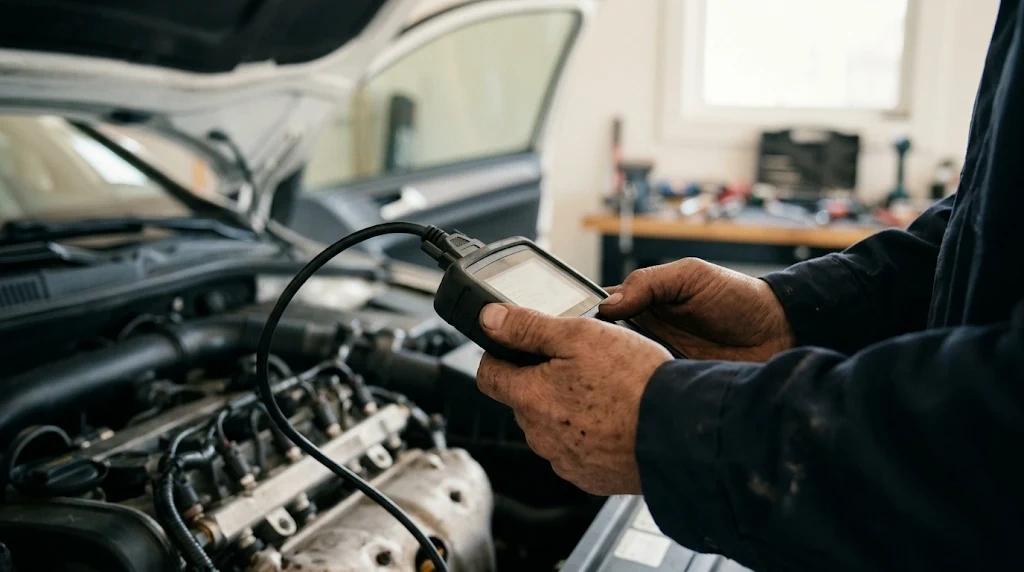
Fuel-related codes fall into a few clear groups. Lean and rich codes describe the mixture. Pressure codes describe rail pressure. Injector codes describe a circuit or a cylinder. None of them, on its own, proves a mechanical failure.
| Code group | What it means | Common fuel-related cause |
|---|---|---|
| P0171, P0174 | System too lean | Low pressure, clogged injector, restricted filter |
| P0172, P0175 | System too rich | Leaking injector, high pressure, faulty regulator |
| P0087, P0088 | Rail pressure too low or high | Weak pump, clogged filter, faulty sensor |
| P0190–P0194 | Pressure sensor circuit fault | Sensor, wiring or connector fault |
| P0201–P0208 | Injector circuit fault | Injector, wiring or connector fault |
Lean codes are the most common fuel clue, and also the most easily misread. P0171 means the computer had to add a large amount of fuel to keep the mixture correct, not that a specific fuel part has failed. A vacuum leak, a faulty mass airflow sensor and low fuel pressure can all produce the same code.
How Fuel Trim Gives Away a Fuel Problem
Fuel trim is the clearest window OBD2 gives into the fuel system. Short-term fuel trim shows the correction happening right now. Long-term fuel trim shows the learned correction over time. Together they show how hard the computer is working to hold the mixture steady.
When fuel delivery falls short, the mixture goes lean and the computer adds fuel, so short-term trim rises, and if the shortfall persists, long-term trim rises too. A steady positive trim, often above 10%, points to a lean condition. A steady negative trim points to a rich condition.
The pattern across driving conditions matters more than one reading. If trim is high at idle but normal at higher engine speed, a vacuum leak is more likely than a weak pump, because the leak matters most when airflow is low. If trim is high at idle and under load, low fuel pressure or a restricted filter becomes more plausible. If only one bank is lean on a V-engine, the cause is more likely on that bank, such as one clogged injector. Our guide to how OBD2 can diagnose fuel trim problems explains those patterns in more detail.
Key Insight
A fuel code names the system that failed its test. Fuel trim, fuel pressure and freeze-frame data name the conditions when it failed. The code alone rarely names the part.
What Live Data Can Show — and What It Cannot Prove
Live data turns a stored code into a moving picture. A scanner that streams data can show fuel rail pressure, short-term and long-term trim for each bank, oxygen sensor voltage, engine load and engine speed while the fault is happening. That context is often more useful than the code itself.
Fuel rail pressure is the most direct live reading when the vehicle supports it. Compare the reported pressure with the manufacturer specification for that engine speed and load. If reported pressure falls well below the requested pressure under acceleration, a weak pump, a clogged filter or a faulty regulator is a live possibility. If reported pressure looks normal while trim is high, the problem is more likely to be air, sensor or injector flow than pump pressure.
Not every vehicle reports fuel pressure through OBD2. Many port-injection vehicles have no fuel pressure sensor, so the scanner shows no pressure reading at all. That absence is not a fault. In those vehicles a mechanical fuel pressure gauge is still the conclusive pressure check. Our guide to how to read OBD2 live data covers how to choose the right readings.
What OBD2 Often Misses in the Fuel System
Some fuel faults develop slowly and stay inside the computer’s correction range for a long time. A pump that is getting weak may still deliver enough fuel at idle and light cruise, so no code appears until demand rises. A partially clogged filter may cause hesitation under load before trim crosses the threshold for a code. In those cases the driver feels the problem before OBD2 reports it.
Mechanical wear without a sensor is another blind spot. OBD2 has no sensor inside a fuel pump or filter to report wear or restriction. Intermittent faults are also easy to miss, and pending codes can help: they show a fault was seen once but has not yet repeated enough to become a confirmed code.
That is why a clean scan does not prove the fuel system is healthy. It proves no monitored test has failed yet. Our guide to what OBD2 cannot detect covers other blind spots in the same way.
A Practical Way to Check a Suspected Fuel Problem
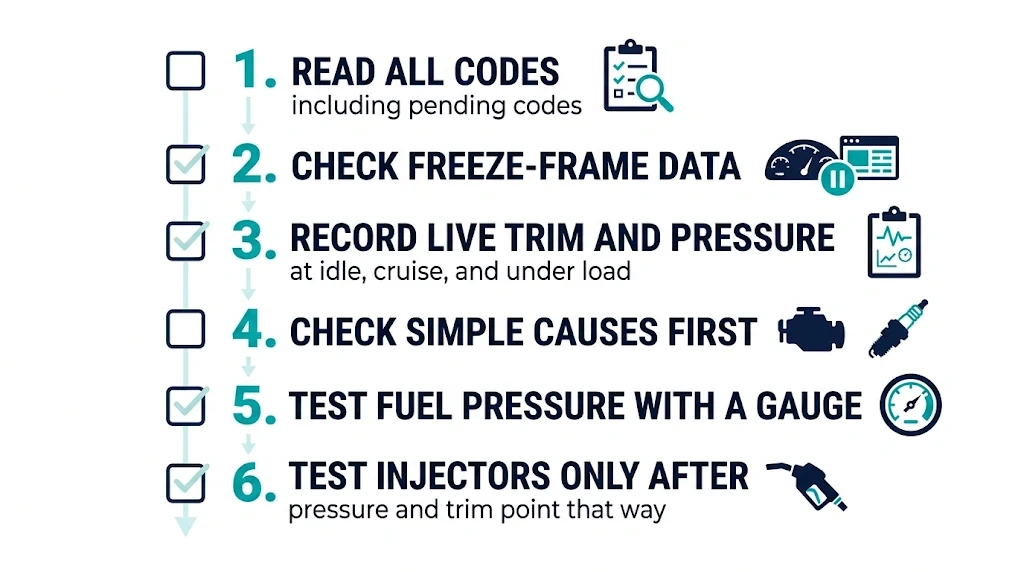
Use the scan as the first step, not the only step. The order below rules out the cheapest and most common causes first, and it avoids replacing parts on a code alone.
- Read all codes, including pending codes. Note the exact code, the bank, and any related codes for misfire, oxygen sensors or airflow.
- Check freeze-frame data. Note engine speed, load, coolant temperature and trim when the code was stored.
- Record live trim and pressure at idle, cruise and under load. A one-bank fault points to that bank; a two-bank fault points to a shared supply, air leak or sensor.
- Check the simple causes first. Look for a cracked vacuum hose, a dirty air filter and a faulty mass airflow reading.
- Test fuel pressure with a gauge where the vehicle allows it. Compare the gauge reading with the scanner reading and the manufacturer specification.
- Test injectors only after pressure and trim point that way. A balance, flow or leak-down test is more conclusive than a circuit code alone.
Do not clear codes and drive hoping the problem will declare itself more clearly. Clearing codes also clears freeze-frame data and resets readiness monitors, which removes the snapshot that showed when the fault happened.
Tip
Record trim and pressure before you replace anything, and record them again after the repair. If the numbers do not move back toward normal, the replaced part was probably not the cause.
Fuel, Air and Sensors: Why the Cause Is Often Shared
Fuel problems rarely exist in isolation because the mixture depends on fuel, air and sensor feedback together. A lean code can be caused by too little fuel, too much air, or a sensor that reports the wrong amount of either. Oxygen sensors are part of that loop: if a sensor is slow or biased, trim will move even when fuel delivery is correct. Our guide to whether OBD2 can detect an oxygen sensor problem explains how sensor codes differ from fuel codes.
Air-fuel ratio is the same idea expressed as a number. A scanner may calculate that ratio from sensor data, but the value is derived, not measured directly from fuel flow. Our guide to whether OBD2 can calculate air-fuel ratio explains what that calculation can and cannot tell you.
When a Fuel Problem Needs Urgent Attention

Most fuel codes allow a careful drive to a repairer, but some symptoms should not be ignored. A strong smell of fuel or visible fuel leaking is a fire risk: stop the engine, do not start it again to run a scan, and get help. Severe hesitation, stalling or a flashing check engine light also need prompt attention, because a flashing light usually means a misfire that can damage the catalytic converter.
Warning
Fuel is flammable and fuel systems stay pressurised after the engine is switched off. Do not open a fuel line or disconnect a pressurised fitting without relieving pressure safely and following the vehicle service procedure. If you are unsure, leave pressure testing to a qualified technician.
Related Product
OBD2 Scanner with Live Data
A scanner that streams fuel trim and fuel pressure helps you compare readings at idle and under load before deciding on a fuel repair.
As an Amazon Associate, we earn from qualifying purchases.
Frequently Asked Questions
Can OBD2 detect a bad fuel pump?
It can detect the effects of a bad pump, usually through lean codes such as P0171 or P0174, low fuel rail pressure codes such as P0087, or high fuel trim. It does not directly measure pump wear. A mechanical pressure test is the conclusive check.
Will a fuel problem always set a check engine light?
No. A fuel fault has to cross the monitor threshold before a code is stored and the light is turned on. A weak pump or partially clogged filter can cause hesitation while trim is still within the range the computer can correct.
What fuel pressure should OBD2 show?
There is no single correct pressure for all vehicles. Port-injection systems often run at much lower pressure than direct-injection systems, which can run above 200 bar. Compare the reported pressure with the manufacturer specification for your exact engine, speed and load.
Can OBD2 tell a clogged injector from a leaking injector?
Not on its own. A clogged injector tends to cause a lean condition, while a leaking injector tends to cause a rich condition, hard starting or fuel smell. Flow, balance and leak-down tests are needed to confirm the injector itself.
Does clearing a fuel code fix the fuel problem?
No. Clearing a code removes the stored fault and freeze-frame data, but it does not repair the pump, filter, injector or sensor. If the fault is still present, the code will usually return after the monitor runs again.
Can a vacuum leak look like a fuel system problem?
Yes. A vacuum leak adds extra air, so the mixture goes lean and the computer adds fuel. That can set the same P0171 or P0174 codes as low fuel pressure. Trim high at idle but normal under load points more toward a vacuum leak.
Conclusion
OBD2 can detect many fuel system problems, through fuel trim, pressure readings, injector circuit checks and the codes they produce. Its strength is in showing that the fuel system failed a test and under what conditions it failed. Its limit is that it rarely names the exact part. Read the code, check the freeze frame, compare trim and pressure at idle and under load, and confirm pressure with a gauge before replacing parts. That sequence turns a fuel code from a guess into a diagnosis you can trust.

I’m Alex Rahman, a car enthusiast and automotive writer focused on practical solutions, car tools, and real-world driving advice. I share simple and honest content to help everyday drivers make better decisions.
