Can OBD2 Calculate Air-Fuel Ratio? Lambda & PIDs
Quick Answer
Yes, OBD2 can help calculate or display an engine’s air-fuel ratio (AFR), but only when the vehicle provides suitable data. A scanner may show commanded lambda (the ECU’s target), sensor-based lambda from a wideband oxygen sensor, or an estimated AFR converted from those values. A basic code reader or a vehicle with only narrowband oxygen-sensor data may not provide an accurate live AFR number.
What Does OBD2 Actually Tell You About Air-Fuel Ratio?
OBD2 is a communication system, not a separate air-fuel measuring instrument. The scanner requests information from the engine control unit (ECU), then displays or converts whatever the ECU reports. The first question is therefore not simply whether a scanner has an AFR gauge, but what data that gauge uses.
Three readings often get called “air-fuel ratio,” even though they answer different questions:
| Displayed value | What it means | Main limitation |
|---|---|---|
| Commanded lambda / AFR | The mixture the ECU is requesting | A target is not proof of the mixture achieved |
| Measured or sensor lambda | The mixture inferred from wideband exhaust-oxygen feedback | Depends on sensor health and operating conditions |
| Calculated AFR | A number derived from lambda or independent air and fuel-flow data | Only as good as its inputs and fuel assumption |
That distinction matters most when diagnosing a lean or rich condition. The ECU may command a normal mixture while an air leak, fuel-delivery problem, sensor fault, or misfire changes the exhaust reading. For a general explanation of the data stream itself, see our guide to reading OBD2 live data.
How Do You Convert OBD2 Lambda Into AFR?
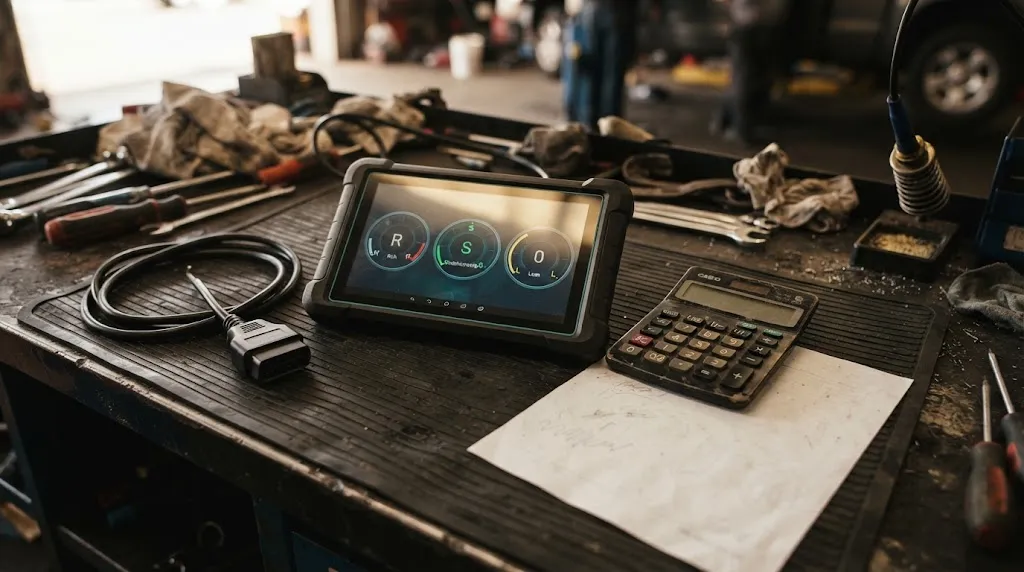
For a known fuel, the conversion is straightforward: AFR = lambda × the fuel’s stoichiometric AFR. Lambda is the actual or commanded air-fuel ratio divided by the stoichiometric ratio, depending on which signal you are viewing. Stoichiometric means the chemically balanced mixture for that fuel.
For conventional gasoline, 14.7 parts air to one part fuel by mass is a useful approximation. If your scanner reports lambda 0.90, the corresponding gasoline AFR is approximately 13.2:1 (0.90 × 14.7). If it reports 1.10, the result is approximately 16.2:1. These are arithmetic conversions, not independent measurements.
| Lambda | Approx. gasoline AFR | Meaning |
|---|---|---|
| 0.90 | 13.2:1 | Richer than stoichiometric |
| 1.00 | 14.7:1 | Stoichiometric |
| 1.10 | 16.2:1 | Leaner than stoichiometric |
Lambda below 1 is rich; lambda above 1 is lean. Do not confuse lambda with the reciprocal air-fuel equivalence ratio sometimes represented by the Greek letter phi, where the rich/lean direction is reversed. Scanner labels can be inconsistent, so check the parameter description rather than relying on “equivalence ratio” alone.
The 14.7 multiplier is not universal. Ethanol blends have different chemically balanced ratios, and the gasoline sold at a pump may already contain ethanol. The U.S. Department of Energy’s ethanol-blend guidance explains those fuel differences. A display that assumes pure gasoline can show a misleading numerical AFR for a high-ethanol blend even while its lambda reading remains useful.
Which OBD2 PIDs Can Provide AFR Information?
Look for these parameters in Service 01 (current powertrain data). The numbers are hexadecimal PID identifiers; some apps show friendly names instead. Support depends on the vehicle, ECU, scanner, and app.
| PID | Parameter | How to use it |
|---|---|---|
| 44 | Commanded fuel/air equivalence ratio (lambda) | Identify the ECU’s target, not measured AFR |
| 24–2B | Wide-range O2 sensor lambda and voltage | Read sensor-based lambda where supported |
| 34–3B | Wide-range O2 sensor lambda and current | Another wideband feedback format |
| 06–09 | Short- and long-term fuel trims, banks 1 and 2 | Check fuel corrections; not AFR itself |
| 10 / 5E | Mass air flow / engine fuel rate | Potential calculation inputs if both are valid |
The SAE J1979 parameter definitions distinguish commanded lambda from wide-range oxygen-sensor information. The publicly accessible OBD-II PID reference lists these separate identifiers. A vehicle may offer PID 44 without exposing an independent sensor reading through generic OBD2.
How to Check Air-Fuel Ratio With an OBD2 Scanner
- Confirm live-data capability. Use a scan tool or adapter app that can display engine PIDs. A fault-code-only reader is insufficient.
- Connect safely. Park outdoors or in a properly ventilated area, switch off the engine, connect the tool, and follow its connection instructions.
- Open live engine data. Look for “Commanded Equivalence Ratio,” “Lambda,” “A/F Sensor,” “Wideband O2,” or “Actual AFR.” Not every label appears on every vehicle.
- Check the source of each reading. Distinguish commanded lambda from upstream wideband sensor feedback. Select bank and sensor positions carefully; bank 1 sensor 1 commonly refers to an upstream sensor, but confirm your vehicle’s layout.
- Warm the engine and record the operating state. Note coolant temperature, fuel-system status, idle speed, and whether the ECU is in closed-loop control. Avoid interpreting cold-start values as a warmed-up baseline.
- Compare readings and save them. Observe commanded and sensor-based lambda together with short- and long-term fuel trims. Record screenshots or logs under stable conditions before drawing conclusions.
If you’re new to locating the port or navigating a scanner, our OBD2 scanner setup and use guide covers the basic connection process. Do not operate a scanner while driving; have a passenger monitor the display or review a safely recorded log afterward.
Why Some Scanners Cannot Show an Accurate Live AFR
Narrowband sensors do not measure a broad AFR range
A conventional switching oxygen sensor is good at indicating whether exhaust conditions are just rich or just lean of the stoichiometric point. It does not provide a precise continuous AFR across a wide range. By contrast, Bosch explains that wideband lambda sensors are designed to determine exhaust oxygen over a broader range for mixture control.
There is also a subtle PID 44 limitation: on systems using conventional oxygen sensors, the standardized commanded-lambda value can display 1.000 during closed-loop operation. That does not mean the exhaust mixture is fixed at exactly 14.7:1 every instant.
A sensor number can be misleading even when it is available
Wideband readings still depend on the exhaust reaching the sensor and the sensor reporting it accurately. An exhaust leak, misfire, sensor problem, or incorrect data interpretation can make a plausible number unreliable. During fuel cut on deceleration, startup enrichment, or certain operating modes, an apparently unusual lambda value may reflect deliberate engine control rather than a fault.
Some manufacturers provide richer A/F data through enhanced diagnostics than through generic OBD2. An app may calculate an AFR dial from commanded lambda, then label it simply “AFR.” If the tool does not reveal its source, treat that dial as an indication rather than a confirmed measurement.
Can You Calculate AFR From Airflow and Fuel Flow Instead?
Yes, in principle. AFR by mass = air mass flow ÷ fuel mass flow. If the ECU reports trustworthy air and fuel-flow quantities for the same moment, their ratio can estimate the mixture without converting lambda. For example, 14 grams of air per second divided by 1 gram of fuel per second equals 14:1.
Standard PID 10 supplies mass airflow on vehicles that support it. PID 5E can report engine fuel rate in volume per hour; using it for a mass ratio requires a suitable fuel-density conversion, and its availability and derivation vary. A guessed fuel flow computed using an assumed 14.7:1 AFR cannot then serve as independent proof that AFR equals 14.7:1: the reasoning would be circular.
This is different from calculating how much fuel an engine consumes. Our guide to fuel-flow calculations using OBD2 data explains that adjacent task. For checking rich or lean operation, reliable upstream wideband feedback is generally more direct than assembling a ratio from uncertain flow estimates.
How Should You Interpret AFR Alongside Fuel Trims?
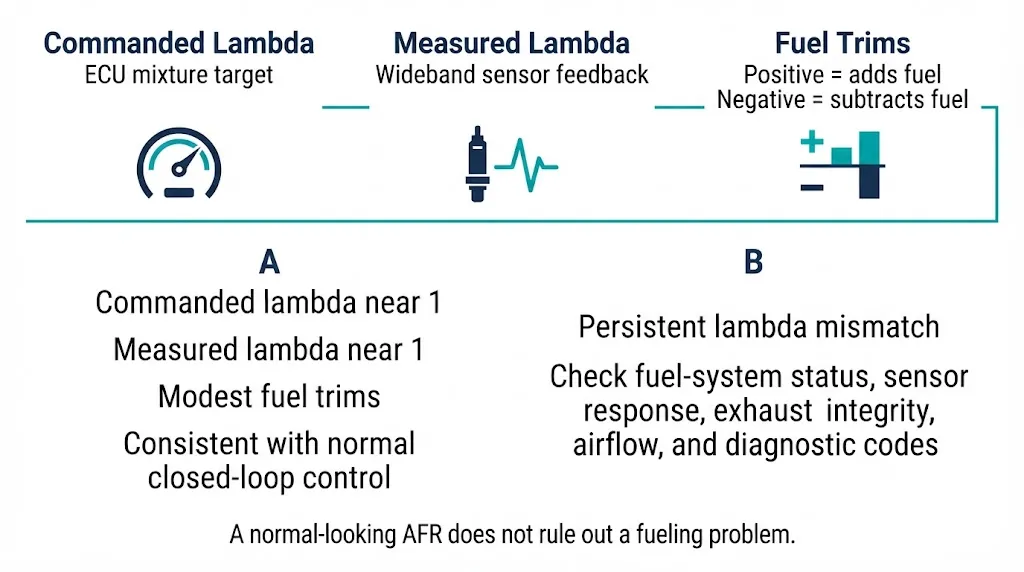
Fuel trims describe the ECU’s correction effort, not a direct AFR measurement. Positive trim generally means the ECU is adding fuel relative to its base calculation; negative trim means it is subtracting fuel. The engine can maintain lambda near 1 while applying a substantial correction, so a normal-looking AFR does not rule out a developing fueling issue.
If commanded lambda is near 1, measured lambda is also near 1, and trims are modest, that combination is consistent with normal closed-loop control under those conditions. If measured lambda differs persistently from commanded lambda, check fuel-system status, sensor response, exhaust integrity, airflow, and relevant diagnostic codes rather than immediately replacing an oxygen sensor.
For a deeper explanation of corrections, see how to diagnose fuel-trim problems with OBD2. One screenshot at idle is rarely enough to identify the failed component; comparing repeatable operating conditions is more useful.
Related Product
OBD2 Scanner With Live Lambda Data
A live-data-capable scanner can help you view supported lambda, wideband oxygen-sensor, and fuel-trim readings. Verify your vehicle’s PID coverage before choosing one.
As an Amazon Associate, we earn from qualifying purchases.
Frequently Asked Questions
Can a cheap Bluetooth OBD2 adapter show AFR?
Sometimes. The adapter only transports data; the vehicle must expose the relevant PID and the app must decode it correctly. Confirm support for commanded or sensor lambda before trusting an AFR gauge.
Does a 14.7:1 reading mean my engine is running perfectly?
No. It may be a commanded target or a gasoline-based conversion. Misfires, poor sensor response, and fuel corrections can exist alongside a display near 14.7:1.
Is lambda more useful than AFR for E85 or mixed fuels?
Often, yes. Lambda expresses mixture relative to that fuel’s stoichiometric point, whereas numerical AFR depends on the fuel blend. A fixed gasoline AFR multiplier is inappropriate for high-ethanol fuel.
Can OBD2 display AFR on a diesel engine?
Possibly, if the diesel ECU exposes appropriate air, fuel, or lambda data. Diesel engines frequently operate with excess air, so gasoline-style expectations around a constant 14.7:1 do not apply.
Does a downstream oxygen sensor show the engine’s actual AFR?
Not necessarily. A sensor after the catalytic converter reflects gases that have passed through the catalyst. For mixture-control diagnosis, identify the relevant upstream sensor and follow the vehicle’s service information.
Can I use fuel trims alone to calculate exact AFR?
No. Fuel-trim percentages tell you how much the ECU is correcting fuel delivery, not the actual air and fuel masses. They are valuable diagnostic clues but are not a substitute for appropriate lambda or flow measurements.
Conclusion
OBD2 can display or help calculate air-fuel ratio, but the meaning of the number depends on its source. Commanded lambda describes what the ECU wants; wideband sensor lambda provides exhaust-based feedback; and a calculated AFR inherits the assumptions of its inputs. Start by identifying the PID behind your scanner’s gauge. Then compare commanded and measured values, fuel trims, operating mode, and the fuel you’re using. If your vehicle does not expose an appropriate signal, a number labeled “AFR” is not automatically a reliable measurement. For diagnosis, context matters more than a single attractive reading.

I’m Alex Rahman, a car enthusiast and automotive writer focused on practical solutions, car tools, and real-world driving advice. I share simple and honest content to help everyday drivers make better decisions.
