What OBD2 Scanner Is Good for ABS? Top Options
Quick Answer
A good OBD2 scanner for ABS is one that can communicate with your vehicle’s anti-lock braking system, read and clear ABS trouble codes, and ideally display live wheel-speed sensor data. The Autel AutoLink AL619 is a practical option for basic ABS and airbag diagnostics, while the Innova 5610 offers broader system coverage and advanced functions. For ABS service procedures such as automated bleeding, consider a compatible advanced diagnostic tool. Always verify support for your exact vehicle before choosing a scanner.
An illuminated ABS warning light can leave you wondering whether you have a failed wheel-speed sensor, damaged wiring, or a more complicated brake-system problem. A suitable diagnostic scanner can help identify where to begin looking.
However, not every OBD2 scanner can read ABS fault codes. Many inexpensive code readers communicate primarily with the engine computer and cannot access the separate ABS control module.
The most useful scanner depends on what you need to accomplish: read a warning-light code, examine wheel-speed data, or perform advanced brake-system service functions.
What Makes an OBD2 Scanner Good for ABS?
A good ABS scanner needs more than ordinary engine-code reading capability. It must support enhanced diagnostics for the vehicle’s anti-lock braking system.
The most important features include:
- ABS code reading: Retrieves diagnostic trouble codes stored in the ABS control module.
- ABS code clearing: Erases eligible codes after the underlying problem has been diagnosed and repaired.
- Live wheel-speed data: Displays individual wheel-speed readings when supported, helping identify unusual sensor signals.
- Vehicle-specific coverage: Communicates with the correct ABS module for your vehicle’s year, make, model, and configuration.
- Diagnostic descriptions: Provides explanations that help identify the affected circuit or system.
- Service functions: Some advanced tools offer ABS bleeding, actuator tests, or steering-angle sensor calibration.
Not everyone needs every feature. For an occasional ABS warning light, reliable code reading may be enough to begin diagnosis. If you regularly repair braking systems, live data and specialized service functions become more valuable.
Which OBD2 Scanners Are Worth Considering for ABS?
Several scanners have manufacturer-documented ABS capabilities. The following options serve different diagnostic needs rather than representing a laboratory-tested ranking.
1. Autel AutoLink AL619 — For Basic ABS and Airbag Diagnostics
The Autel AutoLink AL619 is a dedicated handheld code reader designed for engine, ABS, and supplemental restraint system diagnostics on supported vehicles.
According to Autel’s official AL619 specifications, the scanner can retrieve ABS and airbag fault codes, clear supported fault information, and perform ordinary OBD2 diagnostic functions.
Useful capabilities:
- ABS and SRS fault-code diagnostics.
- Engine and emissions-related trouble-code reading.
- Supported warning-light clearing after repairs.
- Live powertrain data and graphing.
- A self-contained handheld interface.
Best suited for: Drivers who want a straightforward scanner for reading ABS fault codes without needing extensive workshop-level functions.
Important limitation: Do not assume the AL619 provides advanced ABS bleeding or every live ABS sensor parameter. Confirm the specific functions and vehicle coverage before purchasing.
2. Innova 5610 — For Broader Diagnostic Coverage
The Innova 5610 is a more advanced diagnostic scanner designed to access multiple vehicle systems, including ABS, SRS, engine, and transmission modules on supported vehicles.
Its documented features include system scanning, enhanced live data, selected bidirectional controls, and certain service procedures.
Useful capabilities:
- ABS fault-code reading and clearing.
- Enhanced live data from supported vehicle modules.
- Full-system diagnostic scanning.
- Selected active tests and service functions.
- ABS brake bleeding on compatible vehicles.
Best suited for: DIY enthusiasts and home mechanics who diagnose several vehicle systems and want more functionality than a basic code reader.
Important limitation: Advanced features vary by vehicle. Innova also documents regional restrictions, so buyers outside the United States and Canada should confirm support before considering this model.
3. Foxwell NT630 Plus — For ABS-Focused Service Work
The Foxwell NT630 Plus is an ABS- and airbag-oriented diagnostic tool with additional service capabilities.
Foxwell documents ABS code diagnostics, selected live data, actuator control, steering-angle sensor functions, and automated ABS bleeding procedures.
Useful capabilities:
- Read and clear supported ABS fault codes.
- View available ABS live data, including individual wheel speeds.
- Perform certain ABS component activation tests.
- Access supported automated ABS bleeding procedures.
- Perform selected steering-angle sensor calibrations.
Best suited for: Users who need to diagnose ABS faults and carry out supported brake-system service procedures.
Important limitation: A scanner’s advertised ABS bleeding feature does not guarantee it can perform that procedure on every vehicle.
4. Autel AutoLink AL629 — For Multi-System Code Reading
The Autel AutoLink AL629 adds engine and transmission diagnostics alongside ABS and SRS code-reading functions.
Autel documents its ability to read and erase diagnostic trouble codes from these four systems on supported vehicles.
Useful capabilities:
- ABS and SRS diagnostic trouble-code access.
- Engine and transmission code diagnostics.
- Supported code clearing.
- Powertrain live data and freeze-frame information.
- Handheld operation without a separate phone.
Best suited for: Car owners who want ABS diagnostics together with broader basic code-reading coverage.
Important limitation: The AL629 should not be assumed to provide all ABS actuator tests or automated bleeding procedures.
ABS Scanner Comparison: Which Type Fits Your Needs?
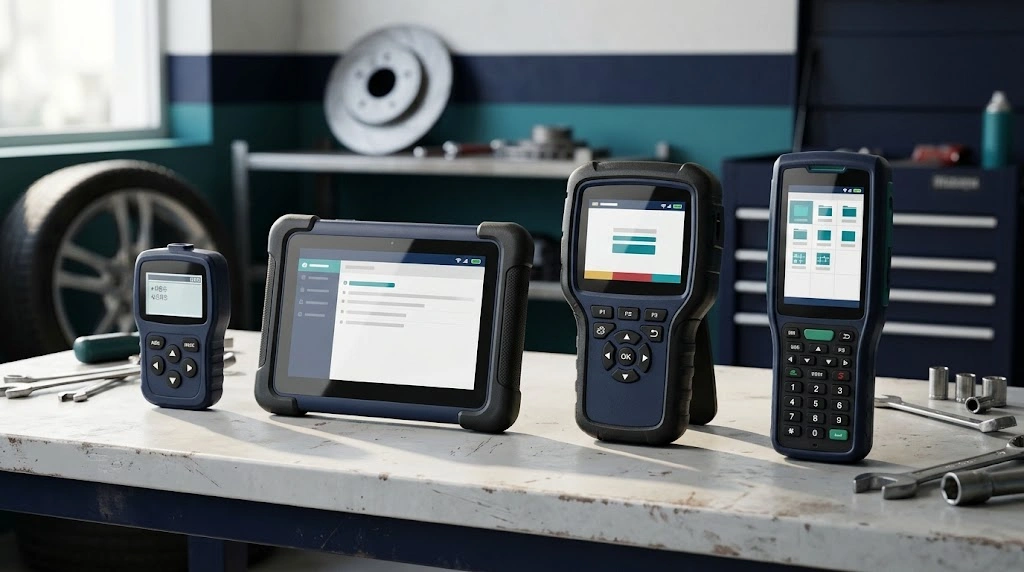
The most useful comparison is between the diagnostic tasks each scanner is designed to perform.
| Scanner | Documented ABS Capability | Additional Strength | Suitable User |
|---|---|---|---|
| Autel AL619 | ABS codes | SRS diagnostics | Occasional DIY diagnosis |
| Innova 5610 | ABS codes, live data, selected service functions | Broader system coverage and active tests | Advanced DIY work |
| Foxwell NT630 Plus | ABS codes, selected live data, bleeding and tests | ABS-focused service functions | Brake-system service |
| Autel AL629 | ABS codes | Engine, transmission and SRS diagnostics | Multi-system code reading |
How to interpret the comparison: These are manufacturer-documented capabilities, not guarantees for every vehicle. The exact diagnostic functions depend on software coverage and vehicle configuration.
Can a Regular OBD2 Scanner Read ABS Codes?
A regular engine-code reader usually cannot read ABS codes unless it specifically supports enhanced ABS diagnostics.
Standard OBD2 functions primarily address emissions-related powertrain diagnostics. ABS systems generally use a separate electronic control module that requires additional communication capabilities.
This distinction explains why a basic scanner may display “No Codes Found” even when the ABS warning light remains illuminated.
For a detailed explanation of this limitation, see our guide to whether OBD2 scanners can read ABS codes.
A scanner’s support for chassis-related trouble codes also does not automatically mean it can access every ABS module. The tool needs the correct vehicle-specific diagnostic software and communication functions.
How to Check ABS Scanner Compatibility Before Buying
Vehicle compatibility is the most important buying consideration. A scanner with excellent advertised features is of limited use if it cannot communicate with your car’s ABS computer.
Check compatibility in this order:
- Identify your exact vehicle: Record the model year, manufacturer, model, engine, and applicable trim or brake-system configuration.
- Open the manufacturer’s coverage checker: Look for your specific vehicle rather than relying on a broad claim such as “supports most cars.”
- Confirm ABS module access: Verify that the tool can read ABS trouble codes, not just engine codes.
- Check required functions separately: ABS live data, fault clearing, actuator tests, and brake bleeding may have different coverage.
- Check regional support: Verify that the scanner supports the market where the vehicle was originally sold.
- Review updates and costs: Determine whether software updates, subscriptions, or extra diagnostic packages are required.
Innova, for example, provides a vehicle compatibility checker on its official product page. Checkers like this are more useful than judging compatibility only by the connector shape.
Practical Tip
Before purchasing, ask the seller or manufacturer to confirm the exact ABS functions supported for your vehicle’s year, make, and model. A statement that a scanner supports “ABS” is not enough if you specifically need live wheel-speed data or automated bleeding.
How to Use an ABS-Capable OBD2 Scanner
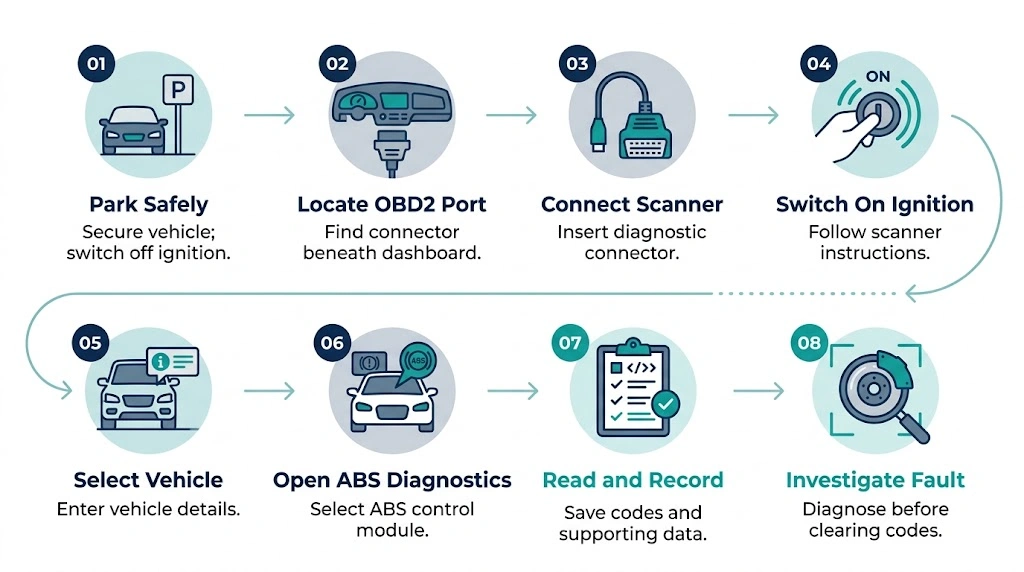
Once you have a compatible tool, reading ABS codes is generally straightforward.
- Park safely: Stop on level ground, secure the vehicle, and switch off the ignition before connecting the tool unless its instructions specify otherwise.
- Locate the diagnostic port: On many vehicles, the OBD2 connector is located beneath the dashboard near the driver’s seat.
- Connect the scanner: Insert the diagnostic connector securely without forcing it.
- Switch on the ignition: Follow the scanner’s instructions for ignition-on, engine-off operation or other required conditions.
- Select the vehicle: Enter the requested identification information or use automatic detection if available.
- Open ABS diagnostics: Choose the ABS, brake-system, or electronic brake control module from the scanner menu.
- Read and record codes: Save the full code numbers, descriptions, and available supporting data.
- Investigate the fault: Use the code information, service documentation, and appropriate inspections to determine the problem.
Do not immediately erase the codes. Stored information may help identify an intermittent problem that is difficult to reproduce.
For general scanner operation and code-reading fundamentals, see our step-by-step OBD2 scanner guide.
What ABS Problems Can a Scanner Help Diagnose?
An ABS-capable scanner can help narrow down several electrical and electronic braking-system faults.
Wheel-Speed Sensor Problems
Wheel-speed sensors provide rotation information used by the anti-lock braking system. Incorrect or missing signals can cause the ABS warning light to illuminate.
A scanner displaying individual wheel speeds may help identify a wheel reporting an unusual value compared with the others under suitable test conditions.
However, an unusual reading does not prove the sensor itself has failed. Wiring, connectors, sensor mounting, encoder rings, and related components may be involved.
ABS Pump and Control Circuit Faults
The ABS hydraulic control assembly may contain electrically controlled valves and a pump motor. Some advanced scanners can retrieve associated fault codes and perform selected component activation tests.
These tests can help technicians investigate electrical or control-related faults, but they must be carried out according to the vehicle manufacturer’s service procedure.
ABS Module Communication Problems
If the scanner cannot communicate with the ABS module, the cause may involve unsupported software, module power or ground problems, wiring faults, or network communication issues.
Before assuming that the ABS module needs replacement, verify scanner compatibility and inspect the relevant diagnostic connections.
Steering-Angle and Stability-Control Issues
Some vehicles integrate ABS with traction control and electronic stability control. A steering-angle sensor fault or calibration issue may affect these related systems.
A scanner supporting vehicle-specific steering-angle sensor diagnostics can be useful in these cases. Calibration should only be performed when appropriate for the repair and vehicle procedure.
Do You Need an ABS Scanner With Live Data?
Live ABS data is useful when trouble codes alone do not clearly identify the cause of a problem.
For example, a wheel-speed sensor-related fault may involve several possible causes. Viewing individual wheel-speed readings can provide additional evidence about which signal is abnormal.
However, live data has limitations. Different vehicles expose different parameters, some readings may be filtered, and a problem may occur only under specific driving conditions.
For occasional code retrieval, live ABS data is helpful but not always necessary. For repeated or intermittent ABS faults, it can be worth prioritizing.
Safety consideration: Do not attempt to operate a scanner while driving. Any road-test data collection should be conducted safely by a qualified person using an appropriate setup.
Does an ABS Scanner Need an Automated Brake Bleeding Function?
No. Automated ABS bleeding is not necessary simply to read diagnostic codes or investigate most ABS warning lights.
Automated bleeding is a separate service function used on certain vehicles and in specific repair situations. Depending on the brake system, the procedure may be required after hydraulic repairs or when air has entered portions of the ABS hydraulic assembly.
A scanner capable of reading ABS codes does not necessarily support automated bleeding.
If you intend to carry out brake hydraulic service, confirm both scanner compatibility and the exact manufacturer-prescribed procedure before starting.
Safety Warning
Brake bleeding and ABS actuator procedures can affect braking performance if performed incorrectly. Do not activate hydraulic components or perform brake-system service functions without the appropriate service instructions and equipment. If the brake pedal feels soft or braking performance changes, do not continue driving until the system has been properly inspected.
Why Might an ABS Scanner Show No Codes?
An ABS warning light with no readable codes does not necessarily mean that the ABS system is functioning normally.
Possible explanations include:
- The scanner searched the engine computer rather than the ABS module.
- The tool does not support the vehicle’s ABS controller.
- The scanner software is missing an applicable diagnostic function.
- The ABS module has a power, ground, or communication problem.
- The tool cannot display the relevant manufacturer-specific or historical fault information.
First, confirm that you selected the correct diagnostic system. Then verify vehicle coverage and scanner software.
If a correctly configured, compatible scanner cannot communicate with the ABS module, further electrical and network diagnosis may be required.
A communication failure should not automatically lead to replacing the control module.
Can You Clear an ABS Warning Light With a Scanner?
Yes, many ABS-capable scanners can clear supported ABS diagnostic trouble codes. However, clearing codes does not repair the underlying fault.
If the problem is still present, the warning light may return immediately or after the control module performs another system check.
The recommended approach is to record the codes, diagnose the cause, complete the necessary repairs, and then follow the vehicle’s procedure for clearing codes and verifying system operation.
Clearing diagnostic information prematurely can make an intermittent problem harder to investigate.
For related information about the consequences of erasing standard OBD2 diagnostic information, see our guide explaining how to read and clear OBD2 codes properly.
How Much ABS Scanner Capability Do You Actually Need?
The right tool depends on the level of diagnosis and repair you expect to perform.
| Your Situation | Prioritize These Features |
|---|---|
| ABS warning light appears occasionally | Compatible ABS code reading and clearing |
| Intermittent wheel-speed fault | ABS live data and vehicle-specific code information |
| Diagnosing multiple warning lights | Full-system scanning and broader module coverage |
| Performing brake hydraulic repairs | Supported ABS service bleeding and manufacturer procedures |
| Regular workshop diagnosis | Broad vehicle coverage, live data, actuator tests, and service functions |
If your only goal is to retrieve an ABS trouble code, paying for advanced functions you will never use may not provide much value.
On the other hand, if you regularly troubleshoot complex electronic systems, a basic ABS code reader may become restrictive.
Our broader guide to what to look for in an OBD2 scanner explains additional selection criteria such as software updates, connectivity, and diagnostic depth.
Common Mistakes When Choosing an ABS Scanner
Several misunderstandings can lead to buying a tool that cannot perform the required task.
- Assuming all OBD2 tools read ABS: Standard powertrain code reading and enhanced ABS diagnostics are different capabilities.
- Ignoring vehicle compatibility: A scanner may support one model year or brake controller but not another.
- Confusing ABS code reading with ABS bleeding: These are separate diagnostic and service functions.
- Assuming live data is included: Some ABS readers retrieve codes without displaying individual wheel-speed readings.
- Replacing parts based only on codes: Fault descriptions identify a diagnostic area, not necessarily the failed component.
- Overlooking regional restrictions: A scanner designed for one market may not support vehicles sold in another.
- Clearing codes before recording them: Erasing diagnostic information can remove valuable clues.
Checking the manufacturer’s coverage information before buying is usually more productive than choosing solely by feature count or marketing claims.
Is It Safe to Drive With the ABS Warning Light On?

An illuminated ABS warning light may indicate that anti-lock braking assistance is unavailable. On some vehicles, conventional braking may still function, but wheel lockup can be more likely during hard braking or on slippery surfaces.
The exact implications depend on the vehicle and the fault.
If the red brake warning light is also illuminated, the brake pedal feels abnormal, braking becomes less effective, or the vehicle pulls unexpectedly while braking, stop in a safe location and arrange professional inspection rather than continuing to drive.
An ABS scanner can provide diagnostic information, but it cannot establish that a vehicle is safe to drive solely because a code has been read or cleared.
Frequently Asked Questions
What is a good affordable OBD2 scanner for ABS?
The Autel AutoLink AL619 is one option worth evaluating for basic ABS and SRS code diagnostics. Its suitability depends on compatibility with your vehicle. An affordable scanner is only a good value if it supports the ABS functions you actually need.
Will a cheap OBD2 scanner read ABS codes?
Some inexpensive scanners support ABS diagnostics, but many entry-level readers only access standard engine and emissions-related trouble codes. Look for explicit ABS module support and verify vehicle coverage.
Can an OBD2 scanner diagnose a bad ABS sensor?
An ABS-capable scanner can retrieve relevant fault codes and, on supported vehicles, display wheel-speed sensor data. These findings can help identify a suspect circuit, but additional checks may be needed to distinguish a failed sensor from wiring or encoder-related problems.
What is the difference between an ABS reader and a full-system scanner?
A dedicated ABS reader focuses on retrieving supported ABS diagnostic information. A full-system scanner may communicate with many additional vehicle modules, including the transmission, airbag, body control, and climate-control systems. The actual coverage depends on the scanner and vehicle.
Can an ABS scanner reset the ABS light?
Many compatible scanners can erase ABS trouble codes after a repair. If the underlying problem remains, the warning light may return. Code clearing should not be treated as a repair.
Do I need a professional scanner for ABS bleeding?
You need a scan tool that supports the exact ABS bleeding procedure required by your vehicle. This may be an advanced consumer tool or a professional diagnostic system. Follow the vehicle manufacturer’s service instructions.
Will an ABS scanner work on every car?
No. ABS diagnostics are vehicle-specific, and support varies by model year, market, control module, and scanner software. Confirm compatibility before choosing a tool.
Final Verdict: What OBD2 Scanner Is Good for ABS?
A good OBD2 scanner for ABS is one that can reliably access your vehicle’s ABS control module and provide the diagnostic information needed for your intended work.
For basic ABS fault-code reading, the Autel AL619 is a reasonable model to investigate. For broader diagnostics and selected advanced functions, the Innova 5610 offers additional capabilities. For supported ABS service procedures, the Foxwell NT630 Plus is another option worth checking. The Autel AL629 is also useful to consider when multi-system code reading matters.
None of these options should be treated as universally compatible. Before deciding, verify the manufacturer’s coverage information for your exact vehicle and the particular ABS features you need.
The most important takeaway: Choose an ABS scanner by confirmed vehicle compatibility and diagnostic capability—not simply by its price, brand, or the number of advertised functions.

I’m Alex Rahman, a car enthusiast and automotive writer focused on practical solutions, car tools, and real-world driving advice. I share simple and honest content to help everyday drivers make better decisions.
