OBD2 Mode 07 Explained: Pending Codes & How to Read
Quick Answer
OBD2 Mode 07 (Service $07) lets a scan tool retrieve pending emissions-related diagnostic trouble codes detected during the current or last completed driving cycle. These codes identify faults the vehicle has detected but may not yet have confirmed. Mode 07 can reveal a problem before the check engine light comes on, but a pending code is a diagnostic clue, not proof that a particular part has failed.
What Does OBD2 Mode 07 Actually Read?
Mode 07 is one of the standardized diagnostic services used by OBD-II scanners. Its formal job is to request emissions-related trouble codes detected in the current or last completed driving cycle. The ETAS documentation of SAE J1979 diagnostic services identifies Service $07 as the request for pending diagnostic trouble codes (DTCs).
Unlike live sensor readings, a Mode 07 result is a stored code identifier such as P0301 or P0442, accompanied by a pending status in the scanner’s interface. The code tells you which monitored condition failed; it does not show a live measurement or automatically pinpoint the defective component.
Think of Mode 07 as the vehicle reporting an early diagnostic finding. It is particularly useful when a driver notices an intermittent symptom, when a check engine light has not yet appeared, or when a technician wants to see whether a repaired fault is detected again.
For a fuller explanation of what the pending status itself means, see the site’s guide to pending fault codes and how they change.
How Does a Fault Become a Mode 07 Code?
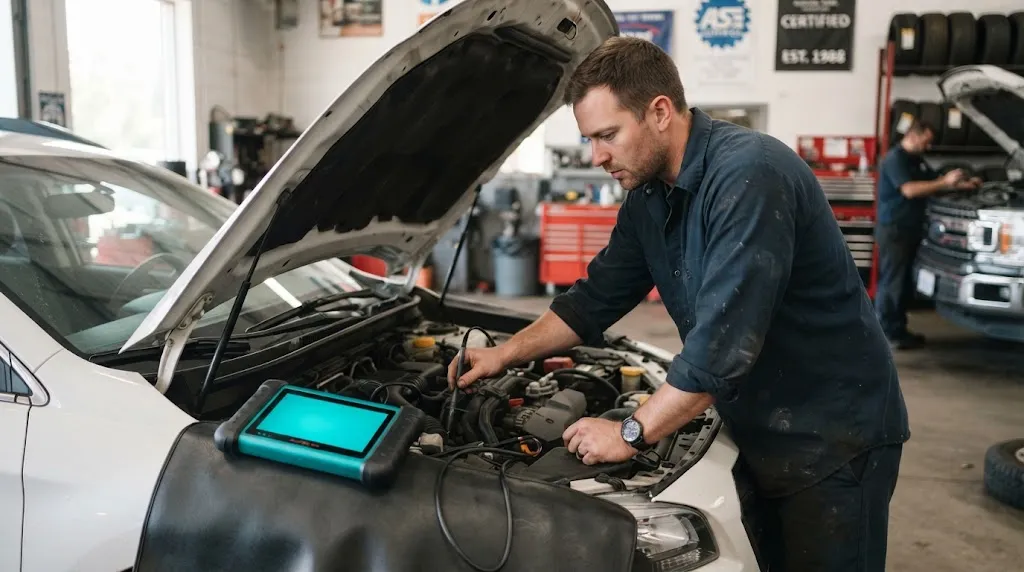
A vehicle’s engine computer runs diagnostic monitors for emissions-related functions, including misfire detection, fuel control, oxygen sensors, catalytic converter performance, and evaporative emissions. Each monitor has defined conditions under which its result counts.
For many faults, the sequence works like this:
- First failure: A monitor runs and detects a malfunction. The computer records a pending DTC, which a scanner can retrieve through Mode 07.
- Another qualifying test: The monitor runs again under the required conditions. If the malfunction recurs and meets the confirmation rule, a confirmed DTC may be recorded and the malfunction indicator lamp (MIL) may turn on.
- A passing result: If the monitor completes successfully without the fault recurring, the pending record may clear under the vehicle’s applicable rules.
That familiar two-trip sequence is not universal. Some serious malfunctions can command the warning light sooner, while other tests require additional cycles or particular engine conditions. California’s OBD malfunction and fault-code regulations describe different confirmation and erasure provisions for different monitored faults.
Most importantly, one more trip does not necessarily mean one more completed test. A catalyst or evaporative-system monitor may not run during a brief drive. Until its conditions are met, an unchanged pending code cannot by itself tell you whether the fault is still present.
Mode 07 vs. Mode 03 vs. Mode 0A
These services retrieve different categories of emissions-related fault records. Knowing which list you are viewing prevents a misleading “no codes found” result.
| OBD2 service | Record retrieved | Practical meaning |
|---|---|---|
| Mode 07 | Pending DTCs | A monitored fault was detected in the relevant cycle but may not yet be confirmed. |
| Mode 03 | Stored or confirmed DTCs | The fault met its confirmation criteria; it may or may not still be occurring. |
| Mode 0A | Permanent DTCs, where supported | A qualifying emissions-fault record remains until the vehicle satisfies its own clearing conditions. |
The same code number can appear under more than one status, so these lists are not mutually exclusive. Also, “stored” does not mean permanently stored in Mode 0A. For the confirmed-code side of the comparison, see what OBD2 Mode 03 retrieves.
How to Check Mode 07 With an OBD2 Scanner
Most consumer tools hide the technical name and label this function “Pending Codes,” “Pending DTCs,” or a similar menu item. Use the scanner’s instructions if its menu differs.
- Park safely. Apply the parking brake, switch the ignition off, and locate the vehicle’s diagnostic connector, usually under the dashboard.
- Connect the scanner. Plug a compatible OBD2 reader or adapter into the diagnostic port without forcing the connector.
- Switch the ignition on. Follow the tool’s prompts to establish communication. Reading stored diagnostic records typically does not require a running engine.
- Open the pending-code view. Choose OBDII/EOBD diagnostics, then Read Codes and Pending Codes. Some apps automatically retrieve Modes 03, 07, and 0A together.
- Save the results. Record each complete DTC, its status, the date, and any symptoms. Note whether the scanner is reading more than one emissions-related control module.
- Compare other information. Check confirmed codes, permanent codes, freeze-frame data if available, and I/M readiness before deciding what a result means.
If the tool cannot communicate, troubleshoot the connection before interpreting an empty code list. A communication error is not equivalent to a successful Mode 07 request returning zero pending codes. For the complete connection process, see how to use an OBD2 scanner properly.
What Should You Do When Mode 07 Shows a Code?
First, read the exact code and consider the symptoms. The status tells you how the computer currently classifies the finding; it does not tell you the repair or how urgently the vehicle needs attention.
Example: A Pending EVAP Leak Code
Suppose the scanner shows pending P0442, a code associated with a small evaporative-emissions leak. That does not automatically mean the purge valve or fuel cap is faulty. The system may have detected a leak condition, and the next useful checks include the cap seal, accessible hoses, and whether the EVAP monitor has run again.
Because EVAP tests depend on operating conditions, a short drive followed by another scan may not provide new evidence. A code that remains pending after that drive is not necessarily getting worse.
Example: A Pending Misfire Code
Now suppose the scanner reports pending P0301, indicating misfire detected on cylinder 1. Record it even if the light is off. If the engine runs smoothly, further inspection and appropriate testing can clarify whether the condition is intermittent.
If the engine is shaking, stalling, losing substantial power, or the check engine light flashes, treat the symptoms as urgent. A severe misfire can damage the catalytic converter; avoid continued driving and arrange diagnosis.
Key Insight
A pending code is neither a clean bill of health nor a diagnosis of a failed part. Interpret the code, monitor status, symptoms, and test conditions together.
Can Mode 07 Help Verify a Repair?
Yes. It is valuable for checking whether a monitored fault reappears after corrective work, sometimes before enough failures have occurred to create another confirmed code.
Before a repair, save the original codes and available diagnostic data. After the repair, follow the manufacturer’s verification procedure where available. If codes must be cleared, recognize that doing so may erase useful freeze-frame information and reset emissions readiness monitors.
Next, drive only under safe, legal conditions that allow the relevant monitor to run. Return to Mode 07 and check for the original pending code, while also checking Mode 03 and readiness status. If the monitor has completed its test and the code has not returned, that is stronger evidence than an empty pending list immediately after clearing memory.
For more context on the reset command, the site’s article on OBD2 Mode 04 and code clearing explains what gets reset. Mode 07 itself reads fault records; it does not clear them, run an actuator test, or perform a repair.
What If Mode 07 Shows No Pending Codes?
A successful scan with no pending results means the vehicle has no pending emissions DTCs to report through that service at that time. It does not prove every engine or emissions component is healthy.
The fault may be intermittent, the relevant monitor may not have run, the code may already have cleared, or the trouble may be outside generic emissions diagnostics. A scanner limited to generic OBD2 also may not retrieve diagnostic records from ABS, airbag, or body-control systems.
When symptoms remain, check confirmed codes, relevant live data, readiness status, and vehicle-specific diagnostic information rather than repeatedly clearing codes. If one scanner displays a pending code and another does not, verify that both tools actually requested Mode 07 and are connected to the relevant controller.
Does Mode 07 Tell You Whether the Car Is Ready for Inspection?

No. Pending codes and readiness are related but different information. Mode 07 reports faults detected through applicable diagnostics; I/M readiness shows whether required emissions monitors have finished their tests since the diagnostic information was last reset.
A vehicle might have no pending codes while several monitors remain “not ready.” It might also show a pending DTC even though other monitors have completed. The Oregon Department of Environmental Quality’s OBD guidance explains that an incomplete monitor means a relevant system test has not finished; it does not establish that the system passed or failed.
Inspection rules differ by location and vehicle. To prepare for a test, check the MIL, confirmed and permanent codes, and the required readiness monitors rather than assuming an empty Mode 07 list guarantees a pass.
Related Product
OBD2 Scanner With Pending-Code and Readiness Display
A compatible reader that separates pending, confirmed, and permanent codes and displays I/M readiness makes follow-up scans easier to interpret. Check vehicle and app compatibility before choosing one.
As an Amazon Associate, we earn from qualifying purchases.
Frequently Asked Questions
Can Mode 07 show a fault when the check engine light is off?
Yes. Pending emissions-related codes are often recorded before the fault meets the conditions for illuminating the malfunction indicator lamp. A dark dashboard does not rule out a Mode 07 result.
Can the same DTC appear in Mode 03 and Mode 07?
Yes. The same code identifier can appear under multiple statuses. Mode 03 identifies a confirmed code, while Mode 07 identifies a pending result under the applicable diagnostic rules.
Is a pending Mode 07 code always less serious than a stored code?
No. Pending describes confirmation status, not risk. An intermittent misfire may warrant prompt attention even without a confirmed code, especially if significant symptoms are present.
Why is Mode 07 empty even though the engine runs poorly?
The relevant self-test may not have completed, the problem may not meet its reporting threshold, or the fault may belong to a system outside generic emissions diagnostics. Investigate the symptom rather than treating the empty list as proof of normal operation.
Does the engine need to run to read Mode 07?
Usually not. Many scanners can retrieve stored pending-code information with the ignition on and engine off. Running the engine may be necessary for separate live-data checks or to satisfy a diagnostic monitor’s operating conditions.
Can a Bluetooth OBD2 adapter access Mode 07?
It can if the adapter, app, and vehicle support the service. Look for a Pending Codes menu; an app showing only stored codes may not have requested Mode 07.
Conclusion
OBD2 Mode 07 provides a useful early view of emissions-related faults: it reports pending codes from the current or last completed driving cycle, often before the dashboard warning light comes on. The useful next step is not to replace the component named in a code description. Save the code, consider symptoms, check other code statuses, and determine whether the relevant monitor has run again. After a repair, a completed, passing monitor and no returning code provide more confidence than clearing memory and immediately finding an empty list. Read Mode 07 alongside confirmed codes and readiness data for a more reliable picture.

I’m Alex Rahman, a car enthusiast and automotive writer focused on practical solutions, car tools, and real-world driving advice. I share simple and honest content to help everyday drivers make better decisions.
