Can OBD2 Diagnose a Diesel Engine? Capabilities & Limits
Quick Answer
Yes. OBD2 can diagnose many problems in a compatible diesel engine by reading fault codes, live sensor data, freeze-frame records, and emissions-monitor status. A basic scanner is useful for identifying the affected system, but injector tests, detailed DPF data, and certain repair functions often require diesel-capable, manufacturer-specific diagnostic equipment.
A diesel that hesitates, loses power, smokes excessively, or displays a warning light may have information stored in its engine computer. An OBD2 scanner can reveal part of that information without dismantling anything. The key question is which diesel systems it can access and what the readings prove.
What Can OBD2 Diagnose on a Diesel Engine?

On a compatible diesel vehicle, standard OBD2 primarily exposes engine-management and emissions-related faults. It reports conditions the vehicle’s electronic control unit (ECU) can detect; it does not inspect every mechanical component directly.
- Fuel delivery: Fuel-rail pressure faults, certain injection-control problems, and related sensor or electrical issues.
- Air intake and boost: Mass airflow, manifold pressure, turbocharger underboost, and some boost-control faults.
- Exhaust gas recirculation (EGR): Monitored flow or control faults that can contribute to reduced performance or emissions warnings.
- Diesel particulate filter (DPF): Supported efficiency, pressure-sensor, temperature-sensor, or regeneration-related fault codes.
- Exhaust aftertreatment: On equipped vehicles, certain nitrogen-oxide (NOx), selective catalytic reduction (SCR), or diesel exhaust fluid (DEF) system faults.
- Starting and running sensors: Monitored crankshaft, camshaft, coolant-temperature, or other electronic circuit faults where supported.
Not every diesel has these systems. Older engines may lack a DPF or SCR system, and available readings differ by make, model, engine, and software. For a broader explanation of standard diagnostic information, see what OBD2 data can tell you.
What Does a Basic OBD2 Scanner Actually Show?
The most useful output is often a diagnostic trouble code (DTC), such as P0087 for low fuel-rail pressure or P0401 for insufficient EGR flow. These examples identify a detected condition, not a guaranteed failed part. Low rail pressure could involve a restricted filter, supply issue, pressure regulation problem, or an inaccurate sensor.
Depending on vehicle and scanner support, you may also obtain live engine speed, coolant temperature, airflow, manifold pressure, vehicle speed, and other parameters. Freeze-frame information can show the operating conditions when a monitored fault was recorded. Readiness status indicates whether supported emissions self-tests have completed.
These capabilities are valuable because a trouble code alone rarely establishes a repair. For example, an underboost code combined with low measured manifold pressure under load suggests a real boost problem, but the next check still needs to distinguish a hose leak from an actuator, sensor, or turbocharger issue.
Key Insight
An OBD2 code identifies what the computer detected, not necessarily why it happened. Confirm the cause with related live data and appropriate mechanical or electrical checks before replacing parts.
Where Standard OBD2 Stops—and Enhanced Diesel Diagnostics Begin
Standard OBD2 is designed around shared emissions-diagnostic information. Vehicle-specific tools can access additional control modules, proprietary measurements, active tests, and service routines. That distinction matters most when diagnosing sophisticated diesel fuel and aftertreatment systems.
The following comparison describes typical capabilities, not a guarantee that every tool or vehicle supports each feature.
| Diagnostic task | Basic OBD2 reader | Enhanced diesel tool |
|---|---|---|
| Read generic engine fault codes | Usually yes | Yes, when compatible |
| View standard live data | Supported parameters | Standard and additional parameters |
| View DPF soot estimate or regeneration history | Often unavailable | Possible on supported models |
| Run injector tests or coding | Generally no | Possible with coverage |
| Request service regeneration | Generally no | Only on supported vehicles, with prerequisites |
A tool advertised as “all systems” is not automatically suitable for every diesel. Check the manufacturer’s vehicle-specific function list, especially if your goal involves DPF maintenance, injector coding, or a particular control module.
Will an OBD2 Scanner Work on Your Diesel Vehicle?
Compatibility depends on the vehicle’s intended sales market, model year, vehicle class, and diagnostic protocol—not merely whether it burns diesel. Many modern diesel passenger cars and pickups support standardized OBD2 or its regional equivalent, EOBD.
In the United States, standardized OBD2 was introduced for 1996-model-year passenger cars and light trucks, although diesel and heavier-vehicle rules vary by category and year. In Europe, diesel passenger-car requirements were introduced in stages beginning in the early 2000s, with broader compliance later. The OBDLink vehicle compatibility guidance explains why the original market and vehicle class matter.
A 16-pin port is a useful clue, but its presence alone does not prove that a generic scanner can access standardized diagnostic data. Before buying or connecting equipment, check the owner’s manual, emissions label, vehicle documentation, and the scanner’s compatibility list. Our guide to checking vehicle OBD2 compatibility walks through those checks.
What about heavy-duty diesel trucks?
Heavy-duty trucks may use SAE J1939 networks and diagnostic connectors that differ from the familiar passenger-car arrangement. Some equipment supports both standard OBD interfaces and commercial-vehicle protocols, but a typical inexpensive passenger-car reader may not communicate with the truck.
The U.S. EPA’s heavy-duty onboard diagnostics rule explains emissions monitoring for large highway engines. For commercial trucks, confirm engine, connector, protocol, and software coverage rather than choosing a scanner solely because its packaging says “diesel.”
How to Diagnose a Diesel Problem With OBD2
Use the scanner as the first stage of a diagnostic process, not as an automatic parts recommendation. This sequence preserves evidence and helps you decide whether the next step is a simple inspection or a specialist test.
- Confirm compatibility. Match your vehicle and diagnostic protocol to the scanner or app before starting.
- Park safely. Apply the parking brake and use a ventilated area. Begin with the engine off and follow the scanner’s connection instructions.
- Connect to the diagnostic port. On many light vehicles, the 16-pin connector is below the dashboard. Switch the ignition on as directed by the tool.
- Read all available codes. Record stored, pending, and permanent codes where supported, including their exact letters and numbers.
- Save freeze-frame and readiness information. These may show when a fault occurred and whether emission monitors completed their checks.
- Review relevant live data. If safe and necessary, run the engine while stationary to inspect available temperatures, pressure, speed, and airflow. Driving tests should be conducted safely without the driver operating the scanner.
- Investigate the likely causes. Compare the code and symptoms with service information. Check accessible hoses, connections, filters, or wiring only where the procedure is safe.
- Repair and verify. Address the actual fault, then rescan. Clear codes only when appropriate and confirm whether the fault returns.
For more detailed connection instructions, see how to use an OBD2 scanner correctly. Avoid deleting fault records before you save them; a repair technician may need that evidence to identify an intermittent diesel problem.
How to Interpret Common Diesel Symptoms
A scan becomes more useful when you combine the electronic evidence with what the vehicle is doing. The examples below illustrate diagnostic directions, not definitive diagnoses.
Loss of power or limp mode
Check for boost, fuel-pressure, airflow, and aftertreatment-related faults. Do not assume a faulty turbocharger or blocked DPF from the symptom alone; compare codes with pressure readings and service procedures.
Hard starting or rough idle
Fuel-rail pressure, engine-speed signals, temperature readings, or injection-control faults may offer clues. However, air in the fuel system, low compression, weak cranking, and other mechanical issues can exist without a helpful generic code. If the engine will not start, live-data availability also depends on what the ECU reports during cranking.
DPF or emissions warning
Read the stored faults before attempting any regeneration procedure. A pressure-sensor problem can resemble a filter restriction, while certain engine or aftertreatment faults can prevent regeneration. Enhanced scan data may help separate those possibilities, but the applicable service instructions determine what testing is safe.
Warning
Do not initiate forced DPF regeneration simply because a scanner offers the button. Regeneration creates very high exhaust temperatures and may be unsafe or prohibited when specific faults are present. Follow the vehicle manufacturer’s prerequisites or use a qualified workshop.
When OBD2 Cannot Give You the Full Answer
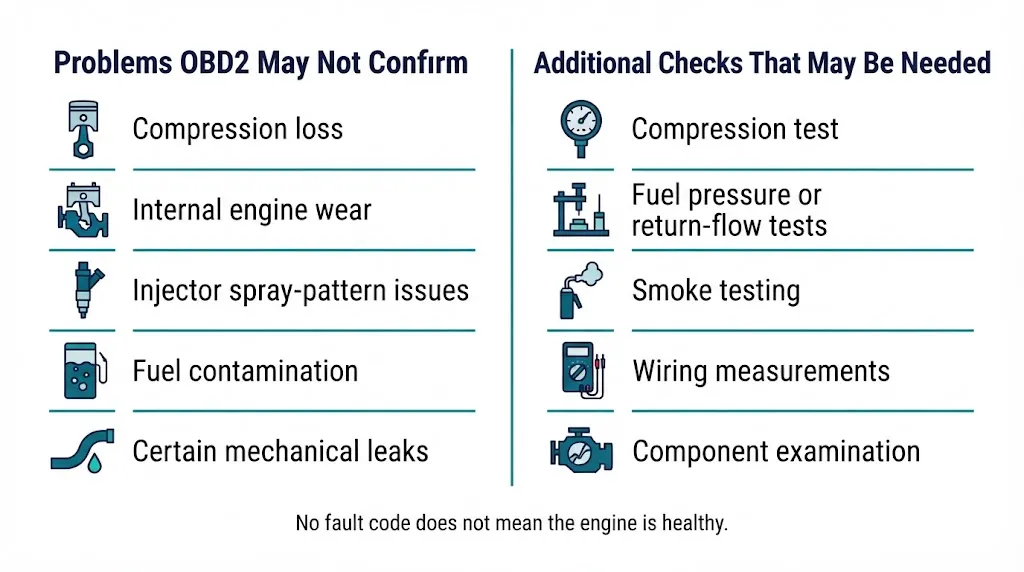
No fault code does not mean the engine is healthy. OBD2 monitors selected operating conditions, and a fault might not cross the threshold needed to set a code. Some problems occur intermittently, appear only under load, or involve mechanical parts that are not directly monitored.
Examples include compression loss, internal wear, injector spray-pattern issues, fuel contamination, and certain leaks. These can require a compression test, fuel-system pressure or return-flow tests, smoke testing, wiring measurements, or examination of removed components. On common-rail diesels, fuel pressure can be dangerously high; never loosen injection lines to “check pressure” while the system is operating.
If you have a persistent no-start, severe knocking, major fluid leak, overheating, or recurring power reduction, stop treating repeated code clearing as troubleshooting. Preserve the fault report and arrange a diagnosis with equipment appropriate for the engine.
Which Scanner Capabilities Matter Most?
For occasional check-engine investigations on a compatible diesel car, generic code reading plus freeze-frame and live data is a reasonable starting point. If you maintain a particular diesel model, prioritize documented coverage for that exact engine and the functions you need.
Look for the ability to display relevant manufacturer-specific diesel parameters, access the correct modules, and export diagnostic reports. Workshop-oriented functions such as injector coding, actuator testing, and DPF service procedures should be supported explicitly, not assumed from the phrase “OBD2 compatible.”
Distinguish scanner communication failure from a vehicle with no faults. A connection failure may involve incorrect protocol selection, an incompatible adapter, insufficient port power, wiring damage, or a control-module communication problem. Resolve that issue before interpreting an empty fault-code screen as a clean bill of health.
Related Product
Diesel-Compatible OBD2 Scanner With Live Data
A scanner with verified coverage for your diesel model can help you read faults and compare supported live measurements before deciding what to inspect next.
As an Amazon Associate, we earn from qualifying purchases.
Frequently Asked Questions
Will an OBD2 scanner sold for gasoline cars work on a diesel?
Often yes, if the diesel vehicle is standards-compliant and the scanner supports its protocol. Generic emissions functions are shared, but diesel-specific measurements and service routines may require enhanced software.
Can OBD2 diagnose a diesel engine that will not start?
It can reveal supported sensor, fuel-pressure, or electronic faults, and some live values during cranking. It cannot independently rule out low compression, fuel contamination, or every mechanical starting problem.
Can a basic OBD2 reader show how full the DPF is?
Usually not as a dependable soot-load value. Some vehicles expose relevant standard parameters, but detailed soot estimates, differential pressure, and regeneration history commonly require enhanced vehicle-specific access.
Why does my diesel show a warning light but no generic codes?
The warning may come from a module or manufacturer-specific system that a basic reader cannot access. Check scanner compatibility, pending faults, and enhanced diagnostics before assuming no problem exists.
Can I clear diesel fault codes after fixing the problem?
Often yes, following the appropriate service procedure. First save the records; clearing codes can erase useful data and reset readiness monitors, while supported permanent codes must clear through the vehicle’s own diagnostic process.
Does the diesel engine have to be running during an OBD2 scan?
Usually no for retrieving stored codes: ignition on with the engine off is commonly sufficient. The engine must run for live readings that depend on actual operation, such as idle speed or boost response.
Conclusion
OBD2 is a practical starting point for diagnosing a modern diesel engine. It can identify monitored fuel, air, boost, and emissions faults and show operating data that makes the next inspection more targeted. Its limits matter just as much: a fault code does not confirm a broken component, and a basic reader cannot perform every diesel-specific test.
First confirm vehicle compatibility, then record codes, freeze-frame information, and relevant live readings before clearing anything. If the evidence points toward injector testing, aftertreatment service, or a mechanical failure, use equipment and procedures designed for that engine rather than guessing from a generic code.

I’m Alex Rahman, a car enthusiast and automotive writer focused on practical solutions, car tools, and real-world driving advice. I share simple and honest content to help everyday drivers make better decisions.
