What Information Does OBD2 Provide? Codes, Live Data & Limits
Quick Answer
OBD2 provides five main categories of information: diagnostic trouble codes (DTCs) that identify which monitored system has a fault, live data (PIDs) showing real-time sensor and operating values, freeze-frame data recording conditions at the moment a fault set, readiness monitor status showing whether emissions self-tests have run, and Mode 06 on-board test results. It does not tell you which part has failed, and generic OBD2 coverage is limited primarily to emissions-related systems.
When a scan tool plugs into the OBD2 port, it is not reading a single “answer.” It is requesting data from a set of standardized diagnostic services, each designed to report a different layer of information. The value of what you see depends on understanding which layer you are looking at.
Diagnostic Trouble Codes: What the Code Tells You — and What It Does Not
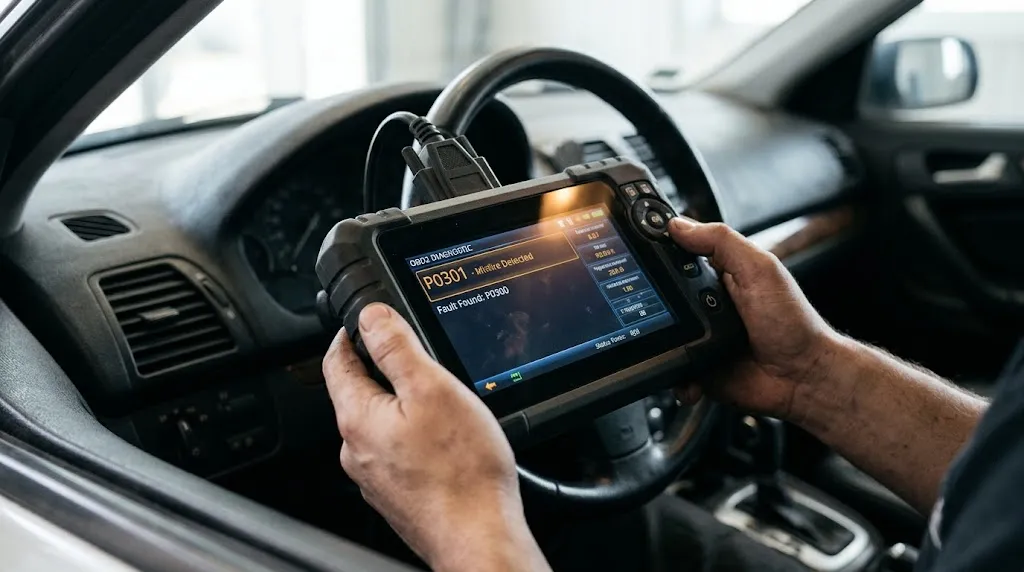
Diagnostic trouble codes are the most familiar OBD2 output, and also the most misunderstood. A code identifies the circuit, component, or system area where the engine control module detected a problem. It does not identify the failed part.[reference:0]
The five-character structure carries useful information before you look up the definition. The first letter indicates the system group:
- P — Powertrain: engine, transmission, and emissions controls
- B — Body: airbags, climate control, lighting
- C — Chassis: ABS, suspension, steering
- U — Network: communication between modules
A code like P0171 (System Too Lean) illustrates the limit precisely. The code tells you the engine is running with too much air or too little fuel. It does not tell you whether the cause is a vacuum leak, a dirty mass airflow sensor, low fuel pressure, or a failing injector. Replacing the first component mentioned in an online search is a common and expensive mistake; the code is a starting point for testing, not a parts order.[reference:1]
Key Insight
A trouble code names the symptom the computer detected, not the failed component. The diagnostic value comes from using live data and test results to narrow the cause — not from the code definition alone.
Live Data: Real-Time Sensor and Operating Parameters
Live data, requested through OBD2 service Mode 01, streams current values from the vehicle’s sensors and calculated parameters while the engine runs. These are called Parameter Identifiers, or PIDs. A scan tool may display dozens of them; the exact list varies by vehicle make, model, and tool coverage.[reference:2]
Common PIDs include engine RPM, vehicle speed, engine coolant temperature, calculated engine load, throttle position, intake air temperature, mass airflow rate, fuel trim values, oxygen sensor voltages, and control module voltage.[reference:3] Some PIDs are measured directly; others are calculated by the control module from other inputs. Calculated engine load, for example, is derived from airflow relative to the engine’s maximum capacity, not read from a dedicated load sensor.[reference:4]
The diagnostic value of live data is comparison. A coolant temperature reading that never reaches normal operating range suggests a thermostat issue. A fuel trim value that is heavily positive at idle but returns toward zero at higher RPM points toward a vacuum leak rather than a fuel delivery problem. The number alone means little; the number in context of what the engine is doing is what matters.
Freeze Frame: The Snapshot of the Moment the Fault Set
When an emissions-related fault is detected, the control module can store a set of operating conditions at the instant the fault occurred. This is freeze-frame data, retrieved through Mode 02. It is not a recording and it is not reconstructed later — it is a snapshot of selected PIDs at the moment the diagnostic strategy stored the fault.[reference:5]
Freeze frame answers a specific question: what was the engine doing when the problem was detected? Common stored fields include engine speed, coolant temperature, engine load, vehicle speed, and fuel system status. That context matters. A misfire recorded at idle, cold, may point in a different direction than a misfire recorded under heavy load at highway speed.[reference:6]
Not every code has a freeze frame. Pending and permanent codes may not carry a snapshot, and body or chassis module faults may require manufacturer-specific access rather than generic OBD2 Mode 02. If the scan tool shows no freeze-frame data, that is information too — it means the record is not available through that service, not that the conditions were normal.[reference:7]
Readiness Monitors: Whether the Self-Tests Have Run
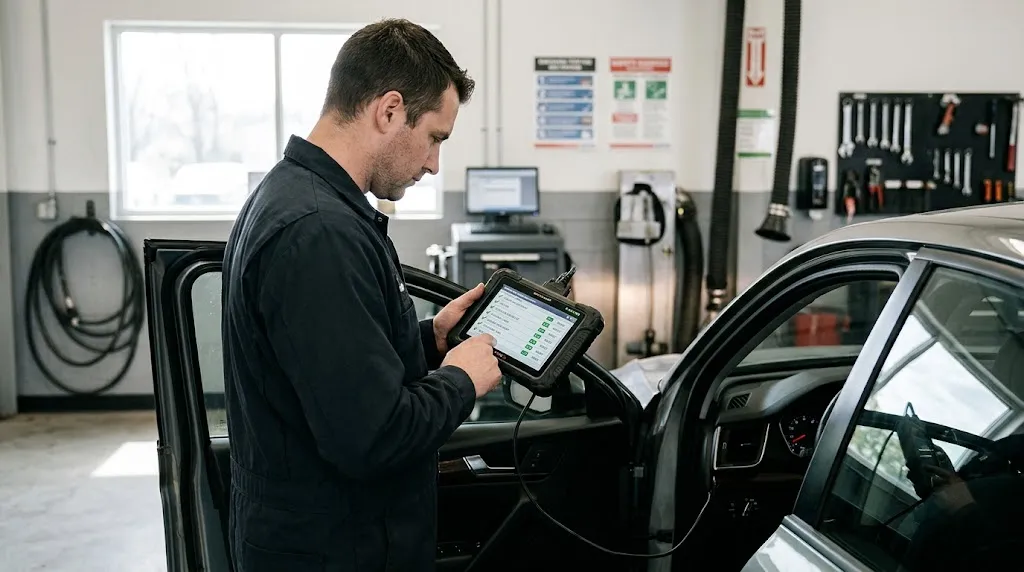
Readiness monitors are the part of OBD2 that receives the least attention from casual users and matters most for emissions testing. A readiness monitor indicates whether the vehicle’s computer has completed its self-test of a specific emissions control system. The monitor is either “ready” — the test has run — or “not ready” — the test has not yet completed.[reference:8]
Up to eleven monitored systems may be tracked, depending on the vehicle. Typical monitors include catalyst efficiency, oxygen sensor response, oxygen sensor heater, misfire detection, evaporative emissions, and heated catalyst. These self-tests run during normal driving, but some require specific conditions such as a cold start, a steady cruise, or a fuel-level window. A battery disconnect or a code clear resets readiness monitors to “not ready.”[reference:9]
This is why a vehicle can pass a tailpipe emissions test conceptually but fail an OBD2 inspection: the computer has not yet completed its own checks, so the state cannot confirm that the emissions systems are functioning. California’s Bureau of Automotive Repair has tightened readiness-monitor requirements for smog inspections, reflecting how central this status is to verifying emissions repair effectiveness.[reference:10]
Mode 06: On-Board Test Results Before the Light Comes On
Mode 06 retrieves the actual numerical results of the on-board monitoring tests — the same tests that determine whether a readiness monitor sets and whether a fault code eventually triggers. Instead of a pass/fail code, Mode 06 returns test identifiers, measured values, and sometimes minimum or maximum limits for monitored components and systems.[reference:11]
Mode 06 is useful in two situations. First, it can show a monitor that is running but approaching a limit before a code sets — a misfire counter climbing, or a catalyst efficiency test result trending toward the threshold. Second, it can help confirm whether a repair actually changed the monitored behavior, rather than simply clearing the code and waiting for the light to return. Mode 06 does not predict component failure, and the test definitions vary by manufacturer, so the same numeric value does not mean the same thing across different vehicles.[reference:12]
What OBD2 Cannot Tell You
OBD2 is a standardized emissions-driven diagnostic system. Its boundaries follow from that origin.
- It does not diagnose root causes. A code or a test result identifies a condition the computer detected; it does not isolate the failed component or the sequence of events that produced the condition.[reference:13]
- Generic OBD2 coverage is emissions-focused. A basic scan tool may not access ABS, airbag, body, or manufacturer-specific modules. Those systems may require enhanced or OEM-level equipment.[reference:14]
- It is not a continuous recording. Freeze frame captures selected values at one moment; it does not show a trend or a timeline. Live data shows what is happening now, not what happened earlier.[reference:15]
- Intermittent faults may not reproduce. A fault that set under a specific load, temperature, or vibration condition may not set again in the driveway. The stored record may be the only evidence available.
- Mechanical faults without electrical or emissions signatures may not set a code. A worn bearing, a clogged filter, or a sticking brake caliper does not necessarily trigger an OBD2 monitor.
Warning
Clearing codes before saving freeze-frame and Mode 06 data destroys the record of the conditions that set the fault. Save the full scan report before clearing anything.
How the Tool and the Vehicle Change What You See
The same OBD2 port can return very different amounts of information depending on the scan tool. A basic code reader may only request Mode 03 and display stored emissions codes. A mid-range tool adds live data, freeze frame, and readiness monitors. Advanced tools may access manufacturer-specific PIDs, bidirectional controls, and module-level data outside the generic OBD2 standard.[reference:16]
Vehicle support also matters. OBD2 is standardized for emissions-related diagnostics on 1996 and newer gasoline vehicles and 1998 and newer diesels in the United States, but the specific PIDs and monitors a given vehicle supports vary. A PID that is blank or unavailable on one vehicle may be fully supported on another.[reference:17] The practical rule is that the scan tool is a data request device; what it can show is constrained by both the tool’s capability and the vehicle’s implementation.
Related Product
OBD2 Scanner with Live Data and Freeze Frame
A scanner that displays live PIDs, freeze-frame records, and readiness monitor status gives you access to the OBD2 information discussed in this guide.
As an Amazon Associate, we earn from qualifying purchases.
Frequently Asked Questions
Does OBD2 tell you exactly which part to replace?
No. A diagnostic trouble code identifies the system or circuit where the control module detected a fault, not the failed component. The code narrows the diagnostic area; live data, freeze frame, and direct testing are needed to isolate the cause.
What is the difference between live data and freeze-frame data?
Live data shows current values while the vehicle is running. Freeze frame is a stored snapshot of selected values captured at the moment a fault was set. Live data answers “what is happening now”; freeze frame answers “what was happening then.”
Can a generic OBD2 scanner read ABS or airbag codes?
Many basic code readers cannot. Generic OBD2 coverage is primarily emissions-related powertrain data. ABS, airbag, body, and manufacturer-specific modules often require an enhanced or OEM-level scan tool with access to those systems.
Why are my readiness monitors “not ready” after a repair?
Clearing codes or disconnecting the battery resets readiness monitors to “not ready.” The vehicle must complete the applicable drive cycle — sometimes several — before each monitor runs and sets to “ready.” Some monitors require specific conditions such as a cold start or a steady cruise.
Does Mode 06 show a problem before the check engine light comes on?
It can show a monitor’s measured result approaching a limit before a code sets, but the interpretation depends on the manufacturer’s test definitions and limits. Mode 06 is a diagnostic aid, not a predictive failure warning.
What information does OBD2 provide that a visual inspection cannot?
OBD2 reports what the control module has measured, calculated, and stored: sensor values, calculated load, fuel trim, monitor test results, and the operating conditions at the moment a fault set. A visual inspection cannot show those stored numerical records or the internal self-test status.
Conclusion
OBD2 is most useful when you treat it as a layered reporting system rather than a single answer machine. Codes tell you where to look. Live data tells you what the engine is doing now. Freeze frame tells you what it was doing when the fault set. Readiness monitors tell you whether the self-tests have run, and Mode 06 gives you the numerical test results behind those pass/fail states.
The practical skill is knowing which layer answers the question in front of you — and recognizing that none of them replaces testing. Save the full report before clearing anything, and use the data to narrow the diagnosis rather than to skip it.

I’m Alex Rahman, a car enthusiast and automotive writer focused on practical solutions, car tools, and real-world driving advice. I share simple and honest content to help everyday drivers make better decisions.
