
How Long Do OBD2 Monitors Take to Become Ready? Explained
Quick Answer
Most OBD2 monitors become ready after a few days of mixed city and highway driving, often within 50 to 100 miles. A single well-matched drive cycle can set many monitors in 30 to 60 minutes, but EVAP and some other non-continuous monitors may need several cold starts and several days, especially if fuel level, temperature, or driving pattern does not meet the test conditions.
That range frustrates drivers because it is not a countdown timer. Readiness is measured in completed self-tests, and each test waits for its own conditions. This article focuses on timing, and links to the Leadfoot guides that cover reset procedure and allowed counts in detail.
What “Ready” Actually Means
A readiness monitor is a self-test run by the vehicle computer for one emissions-related system. “Ready” or “Complete” means the test has run and passed since the last reset. “Not Ready” or “Incomplete” does not mean the system failed. It means the test has not run yet.
The distinction matters for timing. Continuous monitors, such as misfire, fuel system, and comprehensive component monitoring, run often while the engine operates and normally return to ready quickly if no fault is present. Non-continuous monitors run only when specific enabling conditions are met. Catalyst, oxygen sensor, oxygen sensor heater, exhaust gas recirculation, secondary air, and EVAP monitors fall into this second group on many vehicles, although the exact set depends on the vehicle.
“Not supported” is a third status, not an unfinished test. A monitor your vehicle does not have cannot become ready.
How Long It Usually Takes: Three Timelines
There is no single manufacturer-independent time, but most cases fall into one of three patterns.
| Situation | Typical time to ready | What usually decides it |
|---|---|---|
| Dedicated drive cycle, conditions met | 30 to 60 minutes of driving | Cold start, steady cruise, and deceleration in one trip |
| Normal mixed driving | A few days, often 50 to 100 miles | Varied trips, including city and highway driving |
| EVAP or stubborn non-continuous monitor | Several days, sometimes longer | Cold soak, fuel level, temperature, and repeated cycles |
The first row is the fastest realistic case, not a promise. A manufacturer drive cycle creates the right conditions in sequence, so it can set several monitors in one trip, although a monitor may still need another cycle after a component replacement or a missed condition.
The second row is the most useful expectation for most drivers. Colorado’s emissions guidance states that, in most cases, a few days of normal city and highway driving will complete the drive cycle and set the required monitors to ready. That guidance comes from the Colorado Department of Public Health and Environment.
A reset starts this clock. Clearing codes or disconnecting the battery can return non-continuous monitors to Not Ready, even if the check engine light stays off. That is why clearing codes shortly before an inspection can backfire, as explained in the guide to whether a used car can pass an OBD2 scan after clearing codes.
Why the Same Car Can Take Hours One Time and Days the Next
Time alone does not run a monitor. Enabling conditions do, and if they are not met, extra miles may add almost nothing. The most common conditions are a cold start, a fully warmed engine, steady cruising, deceleration without heavy braking, and a suitable fuel level and ambient temperature.
A cold start is stricter than it sounds. For many EVAP tests, the engine should have sat for several hours, often overnight, so coolant and intake air temperatures are close to ambient temperature. A warm restart after a short stop may not count, even if the trip that follows is long.
Fuel level is another quiet gatekeeper. Many EVAP tests require roughly one-quarter to three-quarters of a tank. A nearly empty or completely full tank can prevent the test from starting, so keeping the tank mid-range during the readiness period avoids a wasted week. Very cold or very hot weather can delay the same test, and a five-minute trip may never reach the warm-up or steady-cruise phase a monitor needs.
Turning the ignition off mid-cycle, clearing a code again, or disconnecting the battery restarts the process for the affected monitors. Repeated checks that clear codes can therefore make readiness take longer, not shorter.
A Realistic General Drive-Cycle Outline
Manufacturer drive cycles differ, so use your owner’s manual or service information for the exact sequence. The general pattern below shows why a proper cycle takes longer than a single highway run.
- Start cold, after the vehicle has sat for several hours, and idle briefly while the engine warms.
- Drive at moderate city speeds with normal stops, so idle, acceleration, and light-load operation are covered.
- Cruise steadily at highway speed for several minutes, without constant speed changes.
- Slow down by easing off the accelerator, rather than braking hard, where it is safe to do so.
- Repeat the steady cruise and deceleration phases if the first cycle does not set every monitor.
Do not break speed limits or create a hazard to complete a cycle. A trip without a cold start, steady cruise, or proper deceleration may simply never trigger the test, even if it is long.
Why EVAP Is Usually Last
EVAP checks whether fuel vapour is contained, rather than checking a continuously operating sensor. That test is sensitive to fuel level, temperature, pressure, and how long the vehicle has sat, and it often runs after other conditions are satisfied, putting it at the end of the queue.
EVAP can therefore remain Not Ready after catalyst and oxygen sensor monitors have set. Short trips, a very full or very low tank, or a cold snap can add days to that wait. The delay alone is not proof of a leak, but if EVAP is the only monitor left after several cold starts, mixed driving, and a mid-range fuel level, check whether a fault is blocking the test rather than simply adding more miles.
Tip
Check readiness the day before an inspection, not on the way there. That leaves time for one more cold start and mixed drive.
How to Check Progress Without Resetting the Clock
Use a scanner’s Inspection and Maintenance readiness function, often labelled I/M Readiness, and record which monitors are Ready, Not Ready, and Not Supported. Check after a drive, not during it, and do not clear codes to “refresh” the reading. Clearing is itself a reset.
Note the date, driving type, fuel level, and whether the start was cold. That short log often reveals the pattern faster than mileage alone, such as three warm restarts with no highway cruise, or a full tank all week. If your scanner does not show readiness clearly, the guide to whether an OBD2 scanner can check emissions readiness explains what to look for.
When Time Alone Will Not Fix It
More driving helps only when the missing test is waiting for conditions. It does not help when the test is blocked by a fault, a sensor reading outside the expected range, or a repair that did not fix the underlying problem.
Watch for three signals: the check engine light returns, the same monitor stays Not Ready after several proper cycles, or other monitors set normally while one never moves. Any of those patterns points to diagnosis rather than another week of driving. The guide to why OBD2 monitors are not ready separates those causes more fully, and the guide to whether an OBD2 code will come back after clearing explains why a returning code is diagnostic information.
Warning
Do not clear codes again just before an inspection to turn the light off. The light may go out, but the monitors return to Not Ready, and the inspection system is designed to detect that reset.
When Should You Book the Inspection?
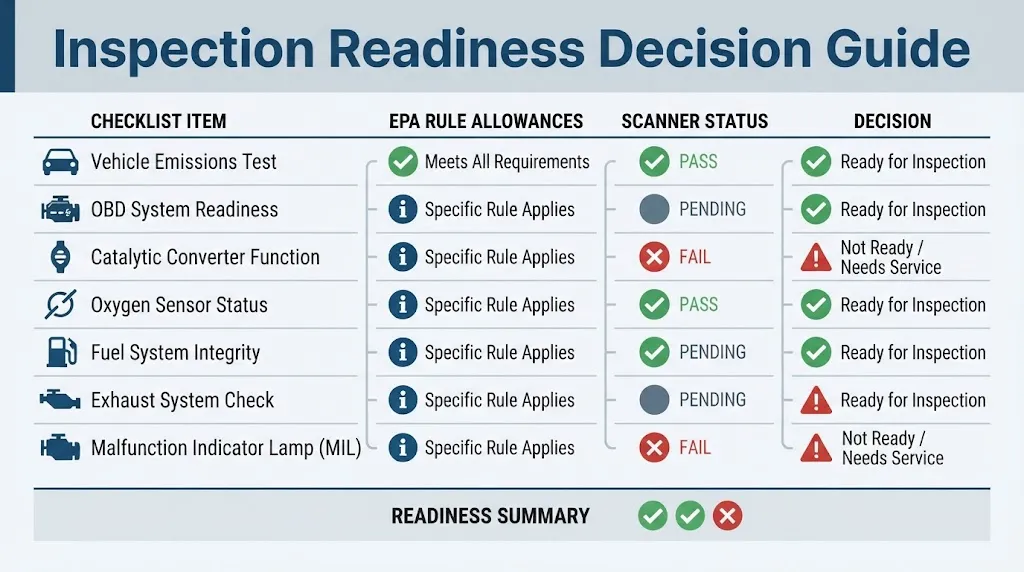
Book the inspection after a readiness check shows the required monitors ready, not after a set number of days. Days are a useful planning guide, but the scanner reading is the decision point.
The general EPA-based pattern allows up to two incomplete non-continuous monitors for 1996 to 2000 gasoline vehicles and typically one for 2001 and newer gasoline vehicles, with continuous monitors required ready. Some states are stricter, and diesel rules can differ, so treat that pattern as a starting point, not a guarantee. The U.S. EPA’s inspection and maintenance resources are the authoritative place to start when checking how state programs are structured.
For the exact count for your car, see the guide to how many OBD2 monitors can be incomplete. Allow a few days of mixed driving after a reset, check readiness, and only then book the test. If one monitor remains, give it one more cold start and mixed drive with a mid-range fuel level before deciding whether the delay is normal or needs diagnosis.
Related Product
OBD2 Scanner With Readiness Check
A scanner with an I/M readiness display lets you check which monitors are ready before you book an inspection, instead of guessing from days or miles driven.
As an Amazon Associate, we earn from qualifying purchases.
Frequently Asked Questions
Can OBD2 monitors become ready in a single drive?
Sometimes. A manufacturer drive cycle that starts cold and includes warm-up, steady cruise, and deceleration can set many monitors in one trip, often in 30 to 60 minutes. EVAP and other sensitive monitors may still need another cold start or another cycle.
Does highway mileage alone set all the monitors?
No. Highway cruising helps catalyst and oxygen sensor tests, but it does not replace a cold start, city driving, idle time, or deceleration. A mix of conditions matters more than total miles, which is why 100 highway miles can leave a monitor unfinished.
How long after a battery replacement should I wait?
Plan for a few days of mixed driving, often 50 to 100 miles, and then check readiness. A battery disconnect resets monitor memory in a similar way to clearing codes, so the same cold-start and mixed-driving conditions apply before an inspection.
Does idling in the driveway count toward readiness?
Only partly. Idling can help warm-up and some heater or idle-related checks, but it cannot replace steady cruising, deceleration, or a cold-start sequence. Extended idling alone is unlikely to set the non-continuous monitors.
Can I pass inspection with EVAP still not ready?
Possibly, depending on your vehicle year and your state’s rule. Many programs following the general EPA pattern allow one incomplete non-continuous monitor for 2001 and newer vehicles, and EVAP is often that monitor. Check your state’s current rule and your scanner reading before booking, because some programs are stricter.
What if monitors are still not ready after a week of normal driving?
Stop adding miles blindly and check the pattern. Confirm the fuel level was mid-range, that cold starts occurred, and that mixed city and highway driving was included. If those conditions were met and one monitor still has not moved, or a code has returned, the next step is diagnosis rather than another drive cycle.
Conclusion
For most cars, readiness takes a few days of mixed driving rather than a fixed number of miles. A well-matched drive cycle can shorten that to under an hour, while EVAP can stretch it across several cold starts. Check the scanner reading, keep fuel mid-range, include cold starts and steady cruising, and do not clear codes again before the test.

I’m Alex Rahman, a car enthusiast and automotive writer focused on practical solutions, car tools, and real-world driving advice. I share simple and honest content to help everyday drivers make better decisions.
