Can OBD2 Diagnose Emissions Problems? Explained
Quick Answer
Yes, an OBD2 scanner can diagnose many emissions-related problems. It reads trouble codes, checks emissions readiness monitors, and may display live engine data. This helps identify problems involving oxygen sensors, catalytic converters, EVAP systems, misfires, and fuel control. However, a scanner cannot always identify the exact failed part or measure actual tailpipe pollution. Some faults require additional testing.
A vehicle can have an emissions problem even when it seems to drive normally. A small fuel vapor leak, a slow oxygen sensor, or an inefficient catalytic converter may produce few noticeable symptoms.
OBD2 makes these problems easier to investigate. Instead of guessing which component has failed, you can examine the information collected by the vehicle’s onboard computer.
The important distinction is that OBD2 identifies detected faults and operating conditions, not necessarily the underlying mechanical cause. Knowing how to interpret that information can prevent unnecessary repairs.
What Emissions Problems Can an OBD2 Scanner Detect?
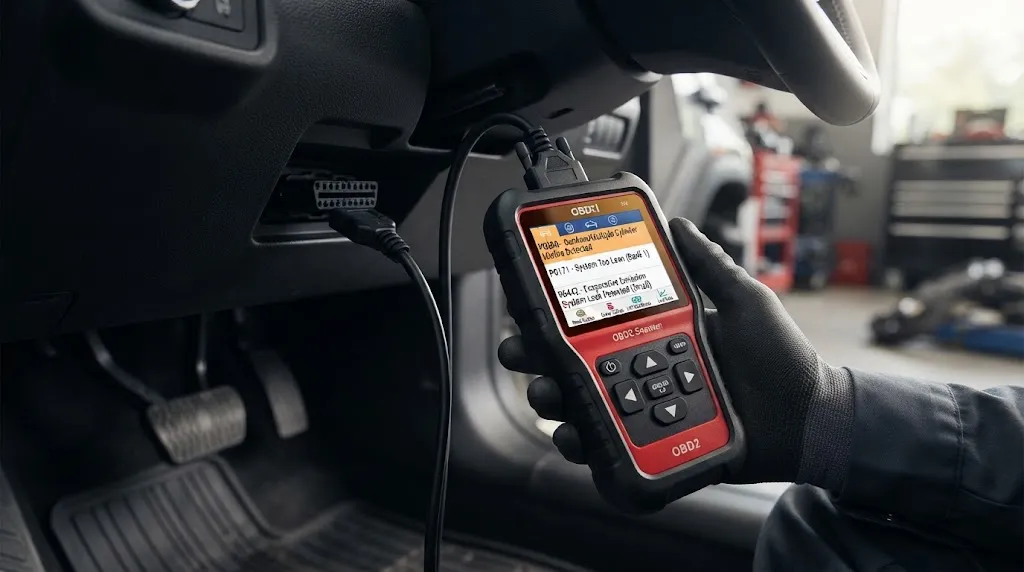
OBD2 monitors numerous engine and emissions-control systems. When the computer detects an issue that meets its diagnostic criteria, it can store a diagnostic trouble code (DTC).
The following are common examples of emissions-related systems and the faults an OBD2 scanner may reveal.
| System | Possible Problem | Example Code |
|---|---|---|
| Catalytic converter | Catalyst efficiency below threshold | P0420 |
| Oxygen sensor | Sensor circuit or response fault | P0130 |
| EVAP system | Small fuel vapor leak detected | P0442 |
| Fuel control | System too lean | P0171 |
| Engine combustion | Random or multiple-cylinder misfire | P0300 |
| EGR system | Insufficient exhaust gas recirculation flow | P0401 |
These codes identify the type of fault detected. They do not automatically prove that the component named in the code needs replacement.
Catalytic converter problems
The catalytic converter helps reduce harmful exhaust pollutants. OBD2 evaluates its performance using sensor information and diagnostic tests.
A code such as P0420 indicates that the monitored catalyst efficiency is below the required threshold. But the cause could involve exhaust leaks, fuel-control problems, sensor issues, or a deteriorated converter.
Replacing the converter without investigating these possibilities can lead to an expensive and unsuccessful repair.
Oxygen sensor and fuel-mixture problems
Oxygen and air-fuel ratio sensors help the engine computer manage combustion and evaluate exhaust conditions.
A scanner can retrieve sensor-related fault codes. Compatible tools may also display sensor measurements and fuel trims, which show how the computer adjusts fuel delivery.
A lean-condition code, for example, may indicate unmetered air, inadequate fuel delivery, or another issue. It does not automatically mean the oxygen sensor is defective.
EVAP leaks and fuel vapor problems
The evaporative emissions control system prevents gasoline vapors from escaping into the atmosphere.
OBD2 can identify certain EVAP leaks, purge-flow faults, and electrical problems. A loose or damaged fuel cap may contribute to some EVAP faults on vehicles using a conventional cap.
Small leaks can be difficult to locate. A professional smoke test or manufacturer-specific diagnostic procedure may be needed after the scanner identifies the affected system.
How to Check Emissions Problems With an OBD2 Scanner
The most useful approach is to gather diagnostic information before clearing anything. A basic scanner can handle the first checks on many compatible vehicles.
- Locate the OBD2 port. On many vehicles, it is beneath the dashboard near the driver’s seat. Consult the owner’s manual if it is difficult to find.
- Connect the scanner. With the vehicle safely parked, plug in the device and follow its instructions for switching on the ignition or starting the engine.
- Read stored and pending codes. Record the complete code numbers and descriptions. Check permanent codes too, if supported.
- Check readiness monitors. Look for catalyst, oxygen sensor, EVAP, and other applicable emissions monitors.
- Review freeze-frame data. If available, examine the conditions recorded when the relevant fault was detected.
- Inspect live data. On a compatible scanner, review useful measurements such as fuel trims, coolant temperature, and sensor readings.
- Investigate the likely cause. Use the code information and vehicle-specific service procedures to decide which physical or electrical checks are necessary.
For example, suppose a scanner displays P0442. That gives you a reason to investigate the EVAP system. It does not tell you exactly where the leak is located.
Checking the fuel cap, inspecting accessible hoses, and following the manufacturer’s leak-detection procedure are more useful than immediately replacing a valve.
Tip
Save trouble codes and freeze-frame data before performing repairs. Clearing codes too early may erase valuable clues and reset emissions readiness monitors.
Understanding Emissions Readiness Monitors
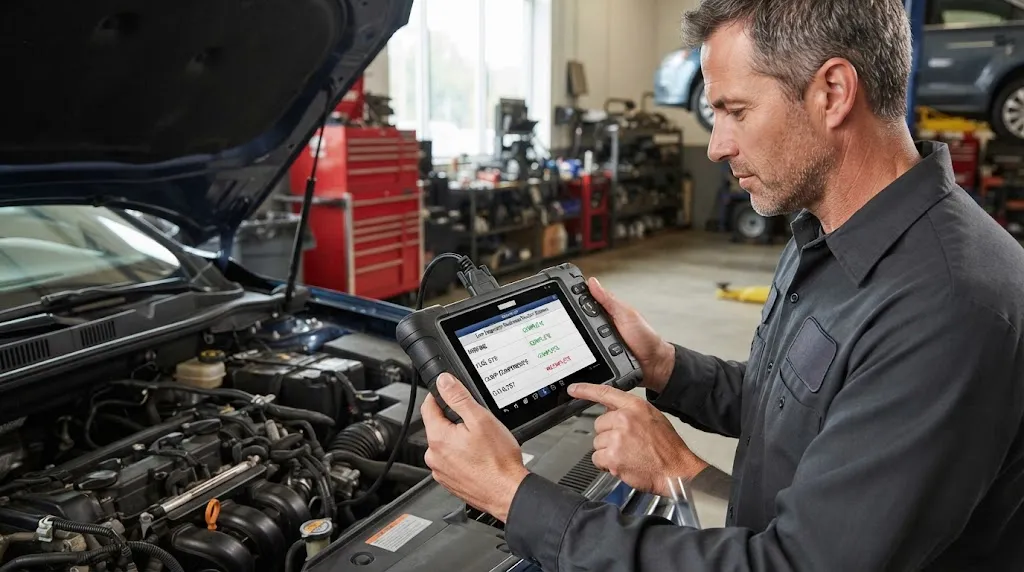
Readiness monitors are one of the most useful OBD2 features for anyone preparing for an emissions inspection.
These monitors indicate whether the vehicle has completed specific onboard diagnostic checks since the last relevant reset.
Common monitored systems include the catalytic converter, oxygen sensors, EVAP system, and EGR system where equipped.
A monitor generally reports one of these conditions:
- Ready or complete: The onboard diagnostic test has finished.
- Not ready or incomplete: The required test has not finished.
- Not supported: The vehicle does not support that particular monitor.
Here is the crucial detail: Ready does not mean the component is guaranteed to be healthy. It means the monitoring process has completed. Trouble-code and warning-light status must be considered separately.
Likewise, a monitor marked not ready does not prove something is broken. The vehicle may simply need to encounter the driving conditions required to complete the test.
An EPA evaluation of OBD evaporative emissions monitoring explains this distinction between completed monitoring and incomplete system evaluation.
Why readiness monitors may remain incomplete
A monitor may remain incomplete after diagnostic codes are cleared, the battery is disconnected, or the vehicle’s computer is reset.
Some tests need particular engine temperatures, driving speeds, fuel levels, or operating conditions. A short drive around the neighborhood may not complete every monitor.
Rather than relying on a universal driving distance, follow the vehicle manufacturer’s drive-cycle instructions when necessary.
Can OBD2 Tell Whether Your Car Will Pass an Emissions Test?
An OBD2 scanner can help assess inspection readiness, but it cannot guarantee a passing result.
Many emissions inspection programs evaluate the malfunction indicator light, diagnostic trouble codes, and readiness status. Requirements vary by state, vehicle model year, and inspection method.
Before an inspection, use the scanner to check:
- Whether the check engine light is commanded on.
- Whether emissions-related trouble codes are stored.
- Whether the required readiness monitors are complete.
- Whether the vehicle reports any other diagnostic status that may affect inspection.
Some programs allow a limited number of incomplete monitors. Others apply different rules or additional inspection requirements.
The Oregon Department of Environmental Quality’s OBD guidance explains how onboard diagnostics helps identify emissions-control problems during vehicle inspections.
Check your own jurisdiction’s requirements rather than assuming another state’s rules apply.
Can an OBD2 Scanner Find Emissions Problems Without a Check Engine Light?
Yes. A scanner may reveal pending codes, previously stored fault information, or incomplete emissions tests even when the dashboard warning light is off.
A pending code can appear when a monitored issue has been detected but has not yet met the criteria for a confirmed fault.
This can be useful when investigating an intermittent problem or checking a used vehicle.
However, some mechanical issues may not trigger an OBD2 code at all. The absence of a warning light or stored fault does not prove that every emissions component is working perfectly.
What an OBD2 Scanner Cannot Diagnose by Itself
OBD2 is an excellent starting point, but its diagnostic reach has limits.
It cannot directly measure all tailpipe pollutants. Standard scanners retrieve onboard diagnostic information rather than measuring actual exhaust concentrations with laboratory-style equipment.
It cannot always identify the exact failed component. Multiple faults can produce similar sensor readings or trouble codes.
It cannot physically locate every leak. A code may suggest an EVAP or exhaust problem, while finding its location requires an inspection or additional equipment.
It cannot detect every developing fault. Some conditions remain below diagnostic thresholds, occur intermittently, or have not been evaluated because a monitor is incomplete.
Not every scanner accesses the same data. Basic devices typically provide standardized emissions-related functions. Enhanced scanners may offer manufacturer-specific information, bidirectional controls, or additional tests.
Key Insight
A diagnostic code identifies what the computer detected, not necessarily why it happened. Accurate diagnosis comes from combining code information, operating data, and targeted tests.
What to Do After Finding an Emissions-Related Code
Start by separating the reported symptom from the suspected cause.
If multiple codes appear, look for relationships. A fuel-control problem or misfire may influence catalytic converter performance, for example.
Inspect simple, relevant possibilities first, provided the vehicle is safe to work on. Use vehicle-specific diagnostic instructions before testing components or electrical circuits.
After correcting a confirmed fault, verify the repair. This may involve checking live readings, repeating a diagnostic procedure, and driving under the conditions needed for the relevant monitor to complete.
Do not assume the repair succeeded merely because the check engine light is currently off.
Warning
A flashing check engine light can indicate a serious misfire capable of damaging the catalytic converter. Reduce load, stop safely, and arrange prompt diagnosis. Avoid continued driving when the engine is running severely rough.
Is a Basic OBD2 Scanner Enough for Emissions Diagnosis?
For initial diagnosis, a basic scanner is often sufficient. It can retrieve emissions-related codes and may report readiness status.
A scanner offering live data and freeze-frame information is more useful when investigating recurring faults or evaluating engine conditions.
Advanced functions become valuable when diagnosis requires system-specific tests. For example, certain bidirectional scanners can command supported EVAP components during a diagnostic procedure.
Check compatibility before relying on a particular feature. An advanced scanner does not guarantee that every test is supported on every vehicle.
For occasional checks, the sensible approach is to start with the available diagnostic information and use specialized equipment only when the fault requires it.
Related Product
OBD2 Scanner With Emissions Readiness Check
A compatible scanner with trouble-code reading, I/M readiness status, and live data can help you investigate emissions faults before arranging further testing.
As an Amazon Associate, we earn from qualifying purchases.
Frequently Asked Questions
Can OBD2 detect high vehicle emissions without storing a fault code?
A scanner may display operating data that suggests an engine-control problem, even without a stored code. However, it cannot reliably quantify all exhaust pollutants. Direct emissions measurement may be necessary.
Can a cheap OBD2 scanner check emissions readiness?
Many inexpensive OBD2 scanners support standardized I/M readiness information. Confirm that the specific scanner offers this function and supports your vehicle before relying on it.
Will clearing OBD2 codes fix an emissions problem?
No. Clearing codes removes diagnostic information but does not repair the underlying fault. It can also reset readiness monitors, leaving the vehicle unprepared for an inspection until required tests complete.
Can an OBD2 scanner test a diesel emissions system?
Yes, on compatible diesel vehicles. Available functions depend on the vehicle and scanner. Some advanced diesel emissions diagnostics require manufacturer-specific tools and procedures.
Does a P0420 code always mean the catalytic converter is bad?
No. P0420 indicates that the monitored catalyst efficiency is below threshold. Exhaust leaks, sensor problems, fuel-control faults, and converter deterioration are among the possible factors requiring investigation.
How soon after repairs can I check emissions readiness?
You can check immediately, but an incomplete monitor may need additional driving before its test finishes. The required conditions depend on the vehicle and monitor. Follow manufacturer guidance rather than assuming a fixed distance.
Final Thoughts
OBD2 can diagnose many emissions-related problems by identifying fault codes, reporting readiness status, and providing useful engine data. It is especially valuable for narrowing down the system that needs attention.
For reliable results, treat the scanner as the starting point rather than the final diagnosis. Record the findings, investigate possible causes, complete necessary repairs, and confirm that the relevant onboard tests have finished.

I’m Alex Rahman, a car enthusiast and automotive writer focused on practical solutions, car tools, and real-world driving advice. I share simple and honest content to help everyday drivers make better decisions.
