
Can You Charge a Car Battery With a Jump Starter?
Yes, a jump starter can add a little power to a weak car battery, but it usually won’t fully charge it. A jump pack helps start the engine. A real battery charger restores the battery safely and completely.
Your car won’t start, and you need an answer fast. You want to know if a jump starter can do more than one quick save.
I’m Alex Rahman, and I help drivers fix common car problems in plain English. I’ve dealt with dead batteries, jump packs, and bad winter starts, so let’s sort out what works.
Key Takeaways
- A jump starter can help start the car, but it rarely gives a full charge.
- A smart charger works better for weak, drained, or stored batteries.
- Don’t jump a frozen, cracked, or badly swollen battery.
- After a successful jump, test the battery if the car dies again.
What does a jump starter do to a car battery?
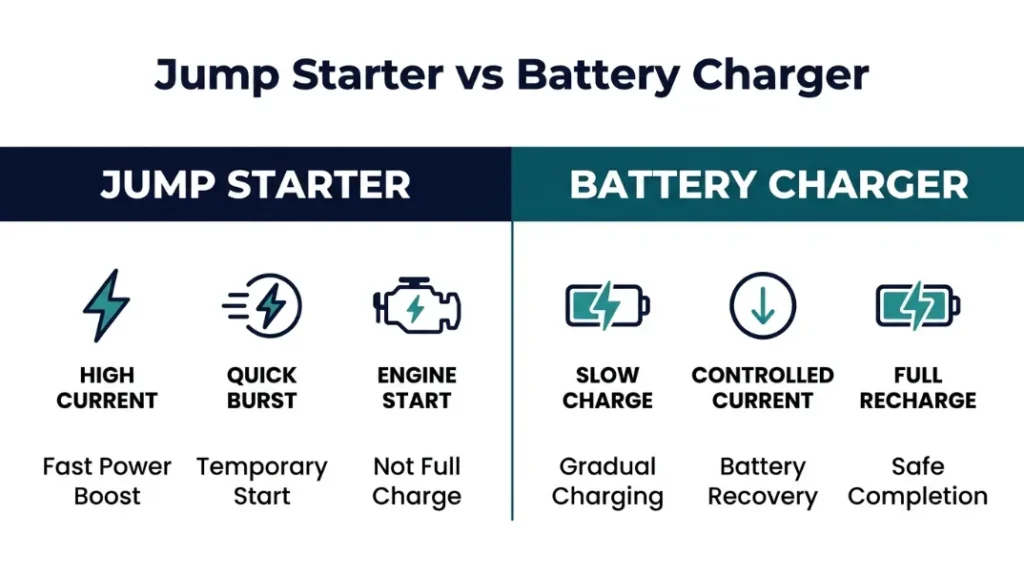
A jump starter gives the battery a short burst of power. That burst helps the starter motor crank the engine.
Here’s the key difference. A jump starter starts the car. A charger restores battery energy over time.
How is a jump starter different from a battery charger?
A portable jump starter stores energy inside its own battery. It releases high current fast, often in seconds.
A battery charger works slower and smarter. It feeds controlled current until the battery reaches a safer charge level.
Most gas cars in the USA use a 12-volt lead-acid battery. Industry charts used in 2024 still place 12.6 volts near full charge.
Many jump packs cannot raise a low battery from empty to full. They simply don’t have the right charging logic.
Brands like NOCO and Clore Automotive make strong jump packs. Brands like CTEK and Schumacher Electric focus more on proper battery charging.
Why can a weak battery still crank after a jump?
A weak battery may still accept a little surface charge. That short boost can give you one good start.
Surface charge does not mean the battery is healthy. It only means the voltage rose for a short time.
That’s why a car may start once, then fail again later. The battery never regained real reserve capacity.
If you want a deeper look, the Interstate Batteries charging guide explains charging basics well. Now let’s look at when a jump pack helps and when it does not.
Can you charge a car battery with a jump starter safely?
Yes, you can sometimes add enough power to start the engine safely. But that only works when the battery still has some life left.
The short answer is simple. A jump starter helps a weak battery more than a damaged battery.
When does a jump pack help enough to start the car?
A jump pack helps most when the battery got drained by lights, short trips, or cold weather. In those cases, the battery may still accept some current.
It also helps when the battery sits around 12.0 volts to 12.3 volts. That range often means the battery is low, not dead beyond recovery.
Most alternators charge between about 13.8 and 14.8 volts once the engine runs. So if the engine starts, the car can begin refilling the battery.
AAA sees many no-start calls from simple battery drain, not instant battery death. Their AAA jump-start advice covers the basic roadside steps.
When should you avoid using a jump starter?
Avoid using a jump starter on a frozen, cracked, or swollen battery. Avoid it if you smell sulfur or see leaking acid.
Don’t force a jump on a battery below about 10.5 volts without care. One bad cell may already exist inside the case.
Warning:
Do not jump a frozen battery. Ice can crack the case, and sparks can ignite gas around a damaged battery.
Some lithium jump starters use low-voltage lockout for safety. Manual override can bypass that lock, but it also raises risk.
Good question — when does that matter? It matters when the battery sits so low that the jump pack thinks no battery is connected.
How do you use a jump starter to add enough power?
You should use the jump starter exactly as the maker directs. Correct steps protect the battery, the jump pack, and you.
Here’s what that means in plain English. Clean contact and the right clamp order matter more than rushing.
Which safe steps work best on the roadside?
Step-by-Step
- Turn the car off and remove the key.
- Check the battery for cracks, leaks, or swelling.
- Connect the red clamp to the positive battery post.
- Connect the black clamp to the negative post or ground point.
- Power on the jump starter, then wait 30 to 60 seconds.
- Start the engine and disconnect the clamps in reverse order.
If the car does not start within a few tries, stop. Repeated cranking heats the starter and drains the jump pack fast.
Keep clamp teeth on clean metal. Rust, dirt, and loose contact steal current.
How long should you leave it connected?
Leave it connected only as long as the jump starter maker suggests. For many units, that means under one minute before cranking.
Some drivers leave the pack attached for a few minutes. That can add a little surface charge, but it still won’t replace a true charger.
Tip:
If the battery only needs a small boost, wait one minute before cranking. That short pause can improve your first start attempt.
If the engine starts, turn off big power drains. Shut off the rear defroster, heated seats, and strong audio loads first.
Now let’s look at the harder cases. Some batteries won’t recover no matter how long you wait.
What if the battery is too dead, old, or damaged?
If the battery is too far gone, a jump starter may do nothing useful. The pack may click, refuse output, or start the car once and never again.
Age matters here. Most car batteries last around three to five years under normal use.
Which signs show the battery will not recover?
Watch for slow cranking after a full jump attempt. Watch for dim lights, rapid clicking, or a case that bulges.
A resting voltage under 10.5 often points to a bad cell. A battery that drops again after one short drive also raises concern.
Sulfation also causes trouble. That means hard crystals formed on the lead plates during long discharge.
A smart charger may sometimes help mild sulfation. A jump starter usually cannot fix it.
If the car dies again the same day, test the battery and alternator. Consumer Reports also notes that repeated jump starts often point to a deeper problem, as their battery charger advice explains.
How does cold weather change the result?
Cold weather makes weak batteries act worse. At 32 degrees Fahrenheit, cranking power can drop by about 20 percent.
At 0 degrees Fahrenheit, the loss can reach about 50 percent. Oil also thickens, so the engine needs more power to turn.
That double hit explains many winter no-starts. The battery gives less, while the engine demands more.
Road salt and corrosion also hurt clamp contact. So clean terminals matter even more in winter.
Should you use a jump starter, battery charger, or maintainer?
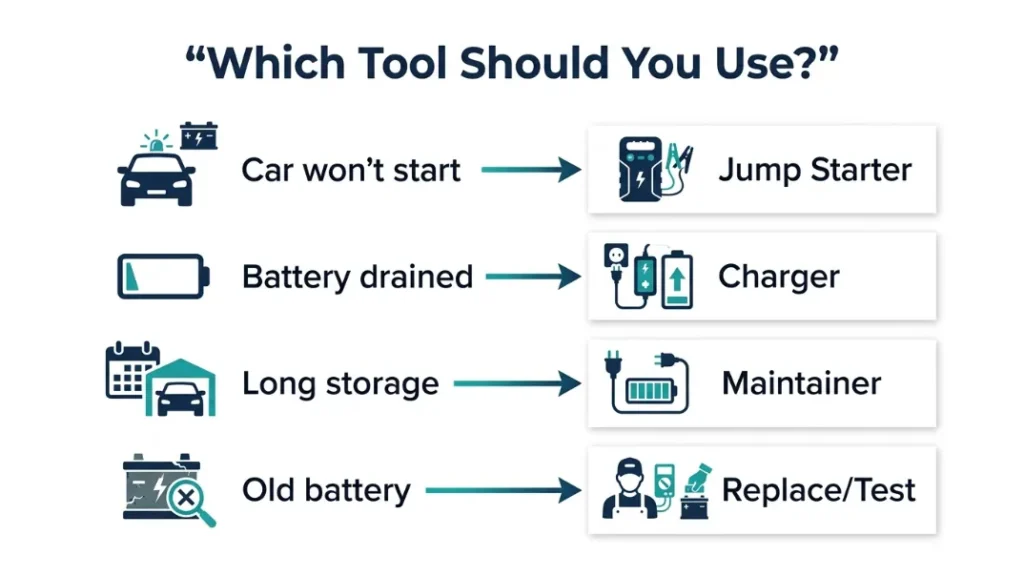
You should choose the tool based on the battery problem. Emergency starting, full charging, and long storage need different tools.
Here’s where it gets interesting. Many drivers buy one tool and expect it to do every job.
Which tool fits each battery problem?
| Situation | Best Tool | Why It Works |
|---|---|---|
| Car won’t start right now | Jump starter | It gives high current fast. |
| Battery drained after lights stayed on | Smart battery charger | It restores charge in a controlled way. |
| Stored car for weeks or months | Battery maintainer | It keeps the battery topped off safely. |
| Battery old, weak, or sulfated | Smart charger, then test or replace | A jump pack alone won’t solve the cause. |
A jump pack belongs in the trunk for emergencies. A charger belongs in the garage for recovery and care.
A maintainer works best for weekend cars, motorcycles, and stored vehicles. That’s why many owners end up needing two tools, not one.
What does the cost and convenience tradeoff look like?
A jump starter costs more up front than simple cables, but it works without another car. That matters on dark roads and empty parking lots.
A battery charger usually costs less than a good jump pack. It also does the job better when the battery needs real charging.
If you park outside, a compact jump pack gives peace of mind. If you store vehicles, a charger or maintainer gives better battery life.
Tip:
For battery health, short emergency jumps and long controlled charging should stay separate in your mind.
Which jump starter features matter if you want charging help?
If you want more than one rescue attempt, internal capacity matters a lot. Big amp claims alone do not tell the full story.
Many cheap packs advertise huge peak amps. Those numbers sound great, but reserve energy matters more for repeat starts.
Which specs matter more than flashy amp claims?
Look for watt-hours or usable capacity first. That number tells you how much stored energy the jump pack really holds.
Next, check reverse polarity protection and spark-proof clamps. Those safety features reduce roadside mistakes.
Also check low-voltage support. Some smart packs refuse output when the battery sits too low.
If you drive a larger engine, check gas and diesel size ratings. Cold weather also favors stronger packs.
NOCO makes compact lithium units for everyday drivers. Clore Automotive often suits shop use and larger vehicles.
Which product is the most useful for this job?
If you want a trusted emergency unit, this model stands out. It offers enough punch for most cars, plus strong safety features.
NOCO Boost Plus GB40 1000A UltraSafe Car Battery Jump Starter
It helps most drivers who want a compact, safe jump pack for dead-battery emergencies.
Just remember the limit. Even a good pack like this still does not replace a true smart charger.
What mistakes damage batteries and drain jump packs?
The biggest mistake is treating a jump starter like a charger. That choice wastes time and can hide a failing battery.
The second big mistake is repeating jump starts without testing the system. That turns one battery problem into two.
Which common errors should you avoid?
- Cranking too long: This overheats the starter and drains the pack.
- Ignoring bad terminals: Corrosion blocks current flow.
- Driving only five minutes after a jump: That rarely restores enough charge.
- Leaving lights and accessories on: They pull power right after the jump.
- Skipping battery age: An old battery may need replacement, not rescue.
Many drivers also forget to recharge the jump pack after use. Then the next emergency comes, and the pack sits half empty.
Which edge cases catch drivers off guard?
Parasitic drain often fools people. A glove box light, dash cam, or faulty module may drain the battery overnight.
AGM batteries also need the right charger mode for best results. A jump starter does not know battery chemistry the way a smart charger does.
Low-voltage lockout can also confuse drivers. The jump pack may seem broken when it is only blocking unsafe output.
So what does that mean for you? If the same battery fails twice, stop jumping and start testing.
What should you do after the engine starts?
After the engine starts, keep the car running and reduce heavy electrical loads. Then decide whether the battery needs charging, testing, or replacement.
This part matters as much as the jump itself. A poor follow-up often leads to the next no-start.
How long should you drive after a jump?
Drive at least 20 to 30 minutes if the battery only suffered a light drain. Highway speed often helps more than idling in place.
But don’t assume that drive fully charged the battery. Short trips, traffic, and cold weather can limit alternator recovery.
If the battery drained deeply, use a smart charger when you get home. That gives the battery a better chance to recover.
When should you test the battery or alternator?
Test the battery if the car starts slowly again within a day or two. Test it sooner if the battery is older than three years.
Test the alternator if the battery light stays on or the car dies while driving. A parts store, AAA, or local shop can usually check both.
As a simple rule, jump once, charge next, and test if it happens again. That rule saves time, money, and roadside stress.
Can you charge a car battery with a jump starter? Only a little, and only as a short-term fix. Use a jump pack to start the car. Use a smart charger to restore the battery the right way. If the problem keeps coming back, test the battery and charging system. I’m Alex Rahman, and that’s the path I’d take on my own car.
Frequently Asked Questions
Can a jump starter fully charge a car battery?
No, most jump starters do not fully charge a car battery. They give enough burst power to start the engine, not slow controlled charging.
How long should you leave a jump starter connected to a battery?
Usually only long enough for the maker’s jump procedure, often under one minute before cranking. A few extra minutes may add slight surface charge, but not a full recharge.
Will driving after a jump recharge the battery?
Yes, driving can recharge the battery some after a jump. It may not fully restore a deeply drained or old battery, especially on short trips.
Can you charge an AGM battery with a jump starter?
You can jump-start an AGM battery with a compatible jump pack. You should use a smart charger with AGM mode for proper charging afterward.
Why does my battery die again after a jump?
The battery may be old, sulfated, or damaged. A weak alternator or parasitic drain can also cause the battery to die again.
Can a totally dead battery damage a jump starter?
Yes, a badly failed battery can overwork a jump starter. That risk rises if you keep cranking or use manual override without care.

I’m Alex Rahman, a car enthusiast and automotive writer focused on practical solutions, car tools, and real-world driving advice. I share simple and honest content to help everyday drivers make better decisions.
