Can a Jump Starter Charge Phones? Yes — Here’s How
Yes, most modern jump starters can charge phones. They come with USB-A or USB-C ports that work just like a regular power bank. Simply plug in your phone cable, and the jump starter will deliver power to your device. The charging speed depends on the output wattage of the specific model you own.
I have been stuck on the side of a highway with a dead car battery and a nearly dead phone. Not a great combination. I grabbed my jump starter from the trunk, got the car running — and then realized I had no idea if I could plug my phone in to charge while I waited for the engine to warm up. I am Alex Rahman, and that roadside moment sent me deep into researching exactly how jump starters handle phone charging. What I found surprised me, and it will probably surprise you too.
Most people buy a jump starter for one reason: to restart a dead car battery. But today’s portable jump starters are much more than that. Brands like NOCO and GOOLOO have turned these compact devices into full-blown emergency power stations. The question is not just whether they can charge your phone — it is how well they do it, and whether you are using the right ports.
- Most lithium jump starters include USB-A and USB-C ports designed for charging phones and tablets.
- Charging speed depends on output wattage — look for Quick Charge 3.0 or USB-C PD for fast charging.
- Jump starters function as power banks when not connected to a car battery.
- Older lead-acid jump starters typically cannot safely charge phones via USB.
- A fully charged jump starter can often charge a smartphone 10 to 15 times before needing a recharge.
How Does a Jump Starter Work as a Phone Charger?
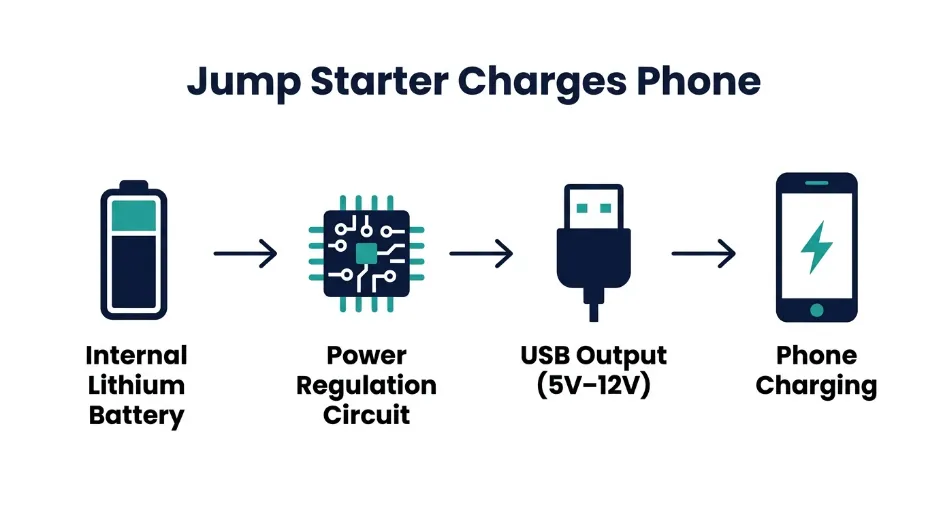
A modern lithium jump starter contains a high-capacity lithium-ion battery pack — the same core technology inside your smartphone. Because of this, manufacturers can route power from that internal battery through USB ports at safe, regulated voltages for small electronics.
The jump starter acts as a portable power bank when you are not using it on your car. You simply plug your charging cable into the USB port, connect it to your phone, and power flows from the jump starter’s battery to your device. It is the exact same process as using a portable charger you carry in your bag.
The key difference between a jump starter and a regular power bank is the peak amperage output. Jump starters can push hundreds or even thousands of amps through their clamps to a car battery. But the USB ports are regulated separately, delivering a safe 5V to 12V output that is appropriate for phones and tablets.
Always charge your jump starter to full capacity before storing it in your car. That way it is ready both as an emergency car starter and a phone charger whenever you need it.
Do All Jump Starters Have USB Ports for Charging?
No — not all jump starters can charge phones, and this is where buyers often get confused. Whether a jump starter includes phone charging capability depends almost entirely on its battery type.
| Jump Starter Type | Can Charge Phone? | Typical USB Ports |
|---|---|---|
| Lithium-Ion (modern) | Yes | USB-A, USB-C, Quick Charge |
| Sealed Lead-Acid (older) | Rarely / No | Sometimes a basic 5V USB port |
| Traditional Jumper Cables | No | None |
Lithium jump starters — the compact, pocket-sized units that have become popular since around 2015 — almost universally include at least one USB port. Older sealed lead-acid units, like the heavy black boxes you might find in a garage from the early 2000s, were designed only for jumping vehicles.
What USB Ports Will You Find on a Jump Starter?
Understanding the types of USB ports on your jump starter tells you exactly how fast it will charge your phone. Here is what each one means in plain English.
USB-A (Standard): The rectangular port you have been using for years. On a jump starter, this typically outputs 5V at 1A or 2.1A. That is standard charging speed — fine for overnight or slow top-ups, but not fast charging.
USB-A with Quick Charge (QC 3.0): Qualcomm’s Quick Charge technology (developed in San Diego, California) allows compatible Android phones to charge significantly faster — sometimes up to 4x faster than standard USB. A port labeled “QC 3.0” on your jump starter will fast-charge any QC-compatible device.
USB-C Power Delivery (PD): This is the gold standard for fast charging in 2024. USB-C PD can deliver anywhere from 18W to 100W or more, enabling fast charging for iPhones (iPhone 8 and later), modern Android phones, tablets, and even laptops. If your jump starter has a USB-C PD port, use it for your phone whenever possible.
A jump starter with a 20W or higher USB-C PD port can fast-charge a modern iPhone from 0% to 50% in under 30 minutes — the same speed as a dedicated wall charger.
How Many Times Can a Jump Starter Charge Your Phone?
This depends on two things: the jump starter’s battery capacity (measured in milliamp-hours, or mAh) and your phone’s battery size. Let me break this down with real numbers.
A typical smartphone has a battery between 3,000 mAh (smaller iPhones) and 5,000 mAh (most Android flagships). A mid-range lithium jump starter usually carries between 12,000 mAh and 20,000 mAh of usable capacity.
In real-world testing by TechGearLab (2025), the GOOLOO GP2000 — a 37Wh lithium jump starter — fully charged an iPhone up to 15 times from its USB-A port before needing a recharge itself. That is exceptional capacity for a device that also jump-starts a car.
Keep in mind that actual charge cycles depend on energy conversion efficiency (typically 80–90% for lithium-ion systems) and how much capacity the jump starter reserves for emergency starting.
A 15,000 mAh jump starter can typically charge an average smartphone 3 to 5 times fully. A 20,000 mAh unit can push that to 6 to 8 full charges. Higher-capacity models designed for trucks can charge a phone 10 to 15 times on a single charge.
Can You Charge Your Phone While Jump-Starting a Car at the Same Time?
Technically yes — but this is not always a good idea. Here is the situation: when your jump starter is actively sending high-amperage current through its clamps to a car battery, the internal battery management system is working hard. Running the USB ports simultaneously pulls additional load from the same battery.
Most quality lithium jump starters from brands like NOCO (a Cleveland, Ohio-based battery technology company founded in 1914) include smart circuitry that protects the device from overload. The USB ports will either continue operating normally or throttle output to protect the unit.
Never use a jump starter’s USB ports while the clamps are connected to a severely discharged or damaged car battery. Faulty batteries can cause voltage spikes that could affect connected electronics. Jump the car first, disconnect the clamps, then charge your phone.
Recommended Product: NOCO Boost Plus GB40
NOCO Boost Plus GB40 1000A UltraSafe Lithium Jump Starter – 12V Portable Jump Box, Power Bank & Jumper Cables
The GB40 is one of the most trusted lithium jump starters on the market, and its built-in USB power bank port makes it genuinely useful for phone charging during emergencies — not just a nice-to-have feature tacked on as an afterthought.
Does Charging Your Phone Drain the Jump Starter’s Emergency Power?
Yes, it does — and this is a real concern if you are relying on your jump starter to get your car running. Every mAh you use to charge your phone reduces the power available for a car jump start.
A typical car engine needs somewhere between 150 and 400 cold cranking amps (CCA) for a brief moment to start. Most lithium jump starters are designed to deliver this in short bursts without draining their entire battery. But if you have already used significant capacity charging your phone, you may not have enough reserve for a vehicle start.
The practical advice here is simple: use the phone charging feature freely when your car is running fine. Save the jump starting capacity for actual emergencies. If you are stranded with a dead battery, prioritize the jump start first.
Many modern jump starters display remaining battery percentage on an LED indicator or digital screen. Check this before using your jump starter as a power bank so you always know how much emergency reserve you have left.
How to Charge Your Phone with a Jump Starter: Step-by-Step
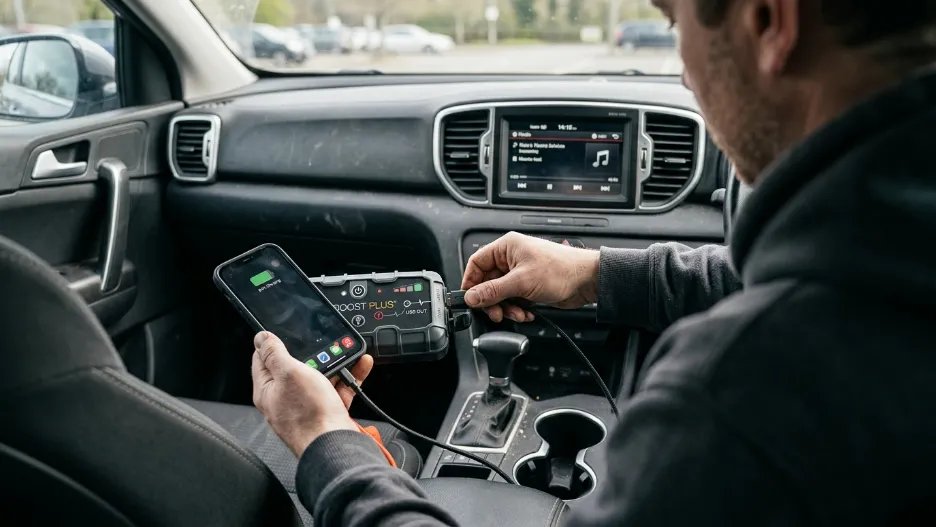
- Make sure your jump starter is charged to at least 50% capacity (check the indicator lights or display).
- Press the power button on the jump starter to activate it — most units require this step before USB ports become live.
- Identify the correct USB port: use USB-C PD for fast charging modern phones, or USB-A Quick Charge for compatible Android devices.
- Plug in your standard phone charging cable (Lightning, USB-C, or Micro-USB).
- Connect the other end to your phone. Charging will begin automatically.
- When your phone is charged, disconnect the cable and power off the jump starter to preserve its battery.
Are Jump Starters Safe to Use as Phone Chargers?
Yes — quality lithium jump starters are safe to use as phone chargers. The USB ports on reputable models include built-in protections: over-current protection, over-voltage protection, and short-circuit protection. These are the same safety standards required of stand-alone power banks.
The key word there is “reputable.” No-name cheap jump starters bought from unknown sellers may skip quality control on their USB regulation circuits. Stick with established brands. NOCO, GOOLOO, Hulkman, and Clore Automotive (a US-based manufacturer with decades in automotive electronics) all produce units with proper USB safety certifications.
Always look for jump starters that carry UL certification or CE marking if you are buying in Europe. These certifications confirm the device meets electrical safety standards for consumer electronics.
Avoid using cheap, uncertified jump starters to charge phones. Poor voltage regulation on budget units can deliver inconsistent power that shortens your phone’s battery lifespan or, in rare cases, causes overheating. The cost difference between a certified unit and a no-name one is not worth the risk.
Can a Jump Starter Charge a Laptop or Tablet Too?
Many modern jump starters can charge tablets and some can charge laptops — but this depends entirely on the USB-C Power Delivery wattage they support.
Tablets like the iPad Air or Samsung Galaxy Tab typically charge optimally at 20W to 30W via USB-C PD. Most mid-range jump starters with USB-C ports support this range without any issues. For a laptop like a MacBook Air, you need at least 30W to charge at a reasonable speed, and 60W or more for the MacBook Pro.
Jump starters with high-capacity batteries — in the 20,000 mAh to 26,800 mAh range — sometimes include 45W or even 65W USB-C PD ports specifically to handle laptops. The GOOLOO GP3000 and similar premium units fall into this category. If laptop charging matters to you, check the USB-C wattage specification before buying.
If you want one device to charge phones, tablets, and laptops while also jump-starting your car, look for a jump starter that explicitly lists USB-C PD at 45W or higher in its specifications. This single spec tells you it is genuinely capable of handling all your devices.
Jump Starter vs Power Bank: What Is the Actual Difference?
This is a question I get a lot. The honest answer is: not much, in terms of phone charging. Both use lithium-ion cells, both regulate USB output voltage, and both provide portable power. The difference comes down to peak power delivery.
A standard power bank — like those made by Anker or Belkin — delivers power at low, sustained rates appropriate only for small electronics. It cannot deliver the burst of high current needed to start a car engine.
A jump starter includes special circuitry and heavy-gauge cables that allow it to temporarily push hundreds of amps to a vehicle battery. That capability adds cost, weight, and size compared to a phone-only power bank. But for anyone who keeps one device in their car for emergencies, a jump starter that doubles as a power bank offers clear value over carrying two separate devices.
In practical terms, a lithium jump starter is a power bank with jump-starting superpowers. You get phone charging every day and car-starting capability when you actually need it. For anyone who drives, that dual function makes a jump starter a smarter carry than a standalone power bank.
How Long Does It Take to Recharge the Jump Starter Itself?
This varies by model. Older lithium jump starters charged via Micro-USB at slow 5V/2A rates, meaning a full recharge could take 8 to 12 hours. That is frustratingly slow for a device you might need in a hurry.
Modern units with USB-C input — especially those with Power Delivery input — can recharge their own battery in 2 to 4 hours from a fast wall charger. The NOCO Boost X GBX45 (an upgraded version of the GB40 line) advertises the ability to recharge in under 3 hours via its USB-C input.
Some premium models include a built-in AC charging port, letting you plug them directly into a wall outlet like a traditional lead-acid charger. The Hulkman Alpha85S takes this approach and can recharge fully in about 3 hours from AC power. Keep your jump starter on a regular charging schedule — top it off once a month whether you have used it or not.
Modern lithium jump starters can charge phones through USB-A and USB-C ports, acting as full power banks. They are safe for everyday phone charging, capable of charging tablets and some laptops, and can provide 3 to 15 full phone charges depending on their capacity. The only rule: do not drain the battery so much that you cannot jump-start your car when you actually need to.
Conclusion
The short answer has always been yes — your jump starter can charge your phone. But now you know exactly how, what to look for, and what to watch out for. Modern lithium jump starters are genuinely capable power banks that happen to also save you from a dead battery on a cold morning.
I am Alex Rahman, and my advice is this: if you drive a car, keep a quality lithium jump starter in your vehicle. It replaces your standalone power bank, your emergency flashlight, and your jumper cables all in one. Just remember to top it off monthly and check your charge indicator before leaning on it as a daily phone charger.
The NOCO GB40 linked above is the model I recommend most often to friends and family — it is proven, compact, and the USB output is reliable enough to charge a phone quickly in an emergency. Pick one up and put it in your trunk today.
Frequently Asked Questions
Can a jump starter charge a phone while the car is off?
Yes. A lithium jump starter works as a standalone power bank regardless of whether your car engine is running. Simply power on the unit and plug in your phone cable — no car connection is needed.
Does using the USB port drain the jump starter’s ability to start a car?
Yes, every charge you use reduces available capacity. Always check the battery indicator before relying on a jump starter for an emergency car start, especially if you have been using it for phone charging.
Can you damage your phone by charging it with a jump starter?
No, not with a quality jump starter from a reputable brand. The USB ports are regulated separately from the high-current jump-starting circuitry and include over-voltage and short-circuit protection. Stick with certified brands to be safe.
What is the best jump starter for charging phones fast?
Look for a model with USB-C Power Delivery at 20W or higher. The NOCO Boost X GBX45 and GOOLOO GP2000 are strong options that combine reliable jump-starting with fast USB-C phone charging.
How long will a jump starter hold its charge in storage?
Most lithium jump starters retain their charge for 6 to 12 months in storage under normal temperatures. However, monthly top-up charges are recommended to keep the lithium cells healthy and the unit ready for an emergency.
Can a jump starter charge an iPhone?
Yes. Any jump starter with a USB-A or USB-C port can charge an iPhone. For fast charging on iPhone 8 and later, use a jump starter with a USB-C Power Delivery port and a USB-C to Lightning or USB-C to USB-C cable.

I’m Alex Rahman, a car enthusiast and automotive writer focused on practical solutions, car tools, and real-world driving advice. I share simple and honest content to help everyday drivers make better decisions.
