How Many Times Can a Jump Starter Be Used? (The Full Answer)
Most jump starters deliver 20 to 30 jump starts on a single charge. Over their full lifespan, lithium models handle 500 to 1,000 charge cycles before losing significant capacity. That means thousands of potential starts before you ever need a replacement. How long yours lasts depends on battery type, engine size, temperature, and how well you maintain it.
You grab your jump starter on a cold morning. The car won’t start. You connect the clamps — and it fires right up. But now you’re wondering: how many times can I actually do this?
I’m Alex Rahman, and I’ve been testing and writing about automotive tools for years. This is one of the most common questions I hear, and the answer isn’t just “it depends.” There are real numbers, real limits, and real ways to get the most out of every charge cycle.
Let’s break it all down — from single-charge capacity to total lifespan.
- Most lithium jump starters deliver 10 to 30 jump starts per charge, depending on engine size and battery condition.
- Over its lifespan, a lithium unit handles 500 to 1,000+ full charge cycles before performance drops noticeably.
- Lead-acid jump starters max out at around 200 to 500 charge cycles total — far fewer than lithium.
- Cold weather, larger engines, and dead batteries all reduce how many jumps you get per charge.
- Recharge after every use and top off every 2 to 3 months to extend your unit’s life significantly.
How Many Times Can You Use a Jump Starter on One Charge?
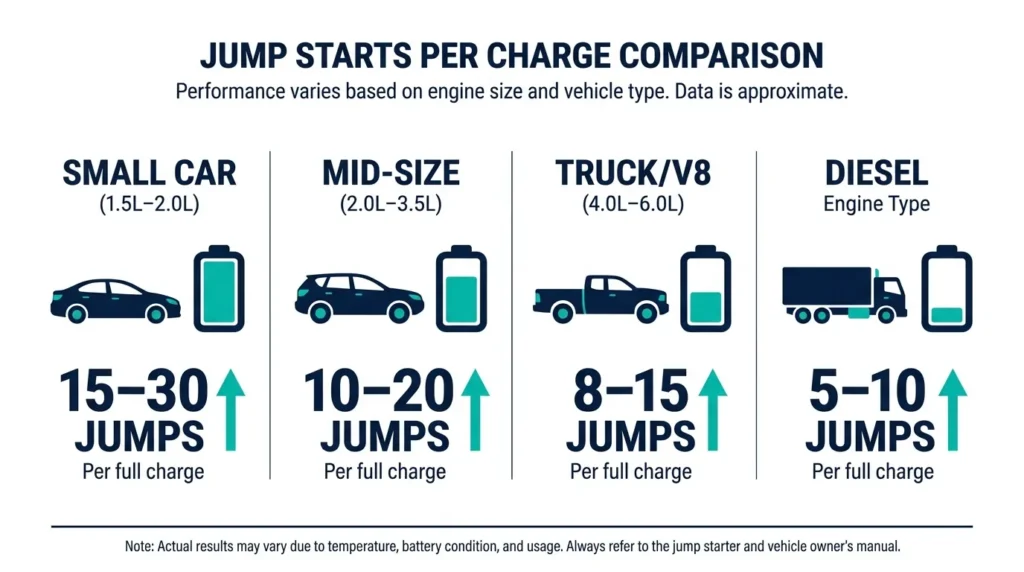
The short answer: most portable jump starters can jump-start a vehicle 10 to 30 times on a single charge. That range is wide because several factors push the number up or down.
A compact lithium jump starter with 12,000 mAh capacity might squeeze out 10 jumps on a small sedan. A high-capacity unit at 20,000 mAh on the same car could hit 20 to 30 starts. Engine size changes everything.
Here’s a real example. Weego — a well-known portable power brand — tested their jump starters in-house at maximum current draw and consistently got at least 4 jumps before needing a recharge. That was at extreme limits. Normal use gives you far more.
If you’re jump-starting a small 1.5L gas engine, expect toward the higher end of the range. A 6L truck or diesel will eat through your charge much faster.
What Factors Affect How Many Jumps You Get Per Charge?
Four things directly impact how many starts you’ll get before the battery runs low. Understanding them helps you plan better — especially before a road trip or winter season.
1. Battery Capacity (mAh Matters Most)
Capacity is measured in milliampere-hours (mAh). Think of it as a fuel tank. A 12,000 mAh unit is a small tank. A 20,000 mAh unit is bigger. More capacity equals more jumps per charge — simple as that.
Standard jump starters in the 6,000 to 12,000 mAh range offer roughly 10 to 15 jumps on a compact car. Larger units at 20,000 mAh or more can push 20 to 35 starts per charge on similar vehicles.
2. Engine Size and Type
Small gasoline engines (under 2.0L) need 300 to 500 amps to start. Large V8s or diesel engines can demand 700 to 1,000+ amps. The bigger the demand, the faster your jump starter drains.
A lithium jump starter rated for a 6L gas engine will drain noticeably faster starting that engine versus a 1.5L compact. Always match your jump starter’s rated engine size to your actual vehicle.
3. Battery Health in the Vehicle
A weak or partially dead car battery draws more power from your jump starter. The more dead the battery, the harder your unit has to work.
If you’re jump-starting a battery that’s only slightly low, you’ll use less power. If it’s completely dead — especially an old battery — expect to burn through more of your jump starter’s capacity in one shot.
4. Ambient Temperature
Cold weather is a double problem. It reduces your jump starter’s output efficiency and makes the car’s engine harder to start. In sub-freezing temperatures, you may need 20 to 50% more power to get the same engine running.
Lithium-ion batteries lose capacity below 32°F (0°C). Lead-acid batteries drop even harder in the cold. If you live somewhere with harsh winters, this directly affects how many starts you get per charge.
Small car (1.5L–2.0L gas): 15–30 jumps per charge | Mid-size sedan or SUV (2.0L–3.5L): 10–20 jumps | Full-size truck or V8 (4.0L–6.0L): 8–15 jumps | Diesel engine (any size): 5–10 jumps. These estimates assume a 12,000–16,000 mAh lithium jump starter at room temperature.
How Many Times Can a Jump Starter Be Used Over Its Full Lifespan?
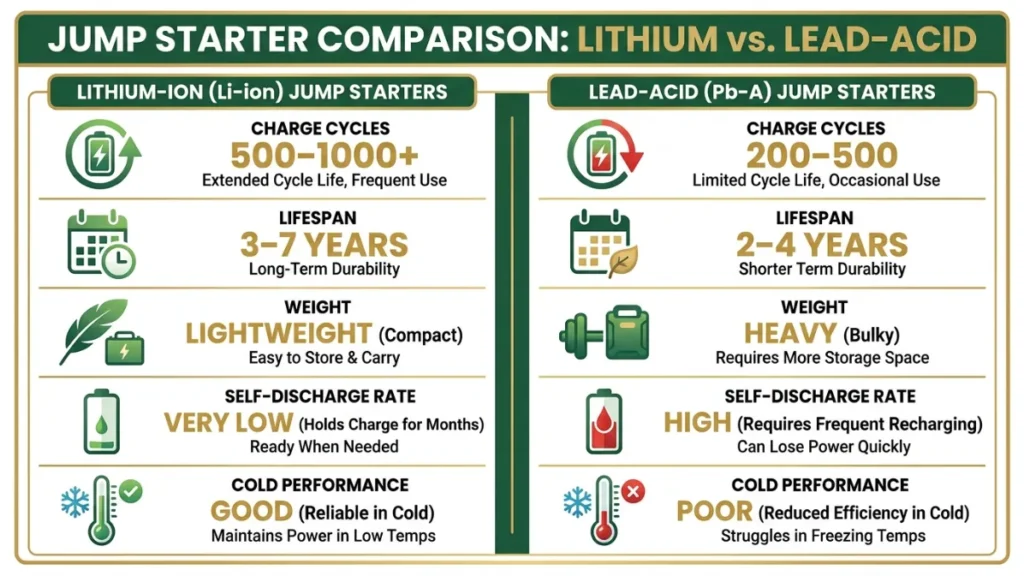
Now here’s the bigger question. Not just per charge — but total, over the life of the unit.
This depends almost entirely on battery type. There are two main types in portable jump starters: lithium-ion and lead-acid (AGM).
Lithium-Ion Jump Starters
A quality lithium-ion jump starter handles 500 to 1,000 full charge cycles before capacity drops meaningfully. Premium LiFePO4 (lithium iron phosphate) models can push 2,000 to 3,000 cycles under ideal conditions.
Let’s do the math. If you get 20 jumps per charge and the battery handles 500 cycles — that’s a theoretical maximum of 10,000 jump starts over the unit’s life. Real-world use is lower. But the point is: a good lithium jump starter is built to last for years of regular use.
HULKMAN, a well-regarded jump starter brand, states their modern lithium batteries last 300 to 500 full charge cycles before dropping to 80% capacity. After that point, performance decreases — but the unit doesn’t just stop working.
Lead-Acid (AGM) Jump Starters
Lead-acid units — including sealed AGM types — typically handle 200 to 500 charge cycles. That’s roughly half the lifespan of a comparable lithium model. They also self-discharge faster (about 5% per month) and are far more sensitive to being left in a partial charge state.
Clore Automotive, a professional jump starter manufacturer, notes that their professional-grade lead-acid units typically last 2 to 3 years in a shop environment with regular heavy use. Light home use could stretch that to 4 to 5 years.
| Feature | Lithium-Ion | Lead-Acid (AGM) |
|---|---|---|
| Charge Cycles | 500–1,000+ | 200–500 |
| Overall Lifespan | 3–7 years | 2–4 years |
| Cold Weather Performance | Good (drops 20–40% below freezing) | Poor (heavy drop below freezing) |
| Self-Discharge Rate | Very low (holds charge 6–12 months) | High (5% per month) |
| Recharge Frequency (storage) | Every 3–6 months | Every 1–2 months |
| Weight | Light (1–3 lbs) | Heavy (10–30 lbs) |
NOCO Boost Plus GB40 1000 Amp 12-Volt UltraSafe Lithium Jump Starter Box
The NOCO GB40 delivers 1,000 amps of starting power and up to 20 jump starts per charge — perfect for cars, trucks, and SUVs up to 6.0L gas or 3.0L diesel, with spark-proof clamps for safe use every time.
Does Using a Jump Starter Multiple Times in a Row Damage It?
Yes — if you do it wrong. Most jump starters have a built-in protection system. If the engine doesn’t start on the first try, the unit limits repeated attempts to prevent overheating.
The standard advice from manufacturers like Interstate Batteries is clear: if the car doesn’t start on the first attempt, disconnect the clamps and wait 30 seconds before trying again. This lets the internal cells cool down and recover voltage.
Never crank the engine for more than 3 to 5 seconds at a time. Sustained high-current draw overheats the internal cells fast. That shortens lifespan more than anything else.
Don’t attempt more than 3 consecutive jump starts without recharging. Multiple rapid attempts in a short window heat up the internal cells and can permanently reduce the battery’s capacity — or trigger the unit’s thermal shutdown.
How Long Can a Jump Starter Hold a Charge When Not in Use?
This is where lithium and lead-acid split dramatically.
A quality lithium jump starter holds its charge for 6 to 12 months in storage. Some premium units tested by Weego held a full charge for up to one year with no use.
Lead-acid units self-discharge at roughly 3 to 5% per week. Left in your trunk for two months, a lead-acid jump starter could be down 40% — or lower — before you even touch it.
The practical takeaway: if you have a lithium unit and check it every 3 months, you’re in good shape. With a lead-acid unit, you need to check and top it off every 4 to 6 weeks.
Set a phone reminder every 3 months to check your jump starter’s charge level. A 5-minute check twice a year can add years to your unit’s life — and guarantee it works when you actually need it.
How to Maximize How Many Times You Can Use Your Jump Starter

Good maintenance makes a real difference. Here’s what actually extends the life of your unit and keeps the per-charge count high.
- Recharge immediately after every use — even if the indicator shows power remaining.
- Top off every 2 to 3 months during storage — never let it sit at 0%.
- Store at room temperature — avoid glove boxes in summer (temps can hit 150°F+).
- Keep the clamps clean and dry — corrosion on connectors reduces power transfer.
- Never leave it plugged in permanently — constant trickle charging degrades lithium cells over time.
- Run a test jump once every 6 months to verify performance is still strong.
When Should You Replace a Jump Starter?
A jump starter won’t just stop working one day. It fades gradually. Here are the warning signs that it’s time to replace yours.
- It no longer holds a charge for more than a few days — a sign of severe cell degradation.
- It fails to start a vehicle it used to start easily — capacity has dropped significantly.
- The casing is swollen or warped — this is a safety issue and the unit should be retired immediately.
- The battery indicator shows full but performance is weak — the voltage sensor may have drifted, a known issue with aged lead-acid units.
- It’s been stored uncharged for 6+ months — the internal cells may be permanently damaged.
For most home users, a lithium jump starter lasts 3 to 5 years with normal care. A professional shop running daily use might replace one every 2 to 3 years.
Here’s the real number to keep in mind: after 300 to 500 full charge cycles, most lithium jump starters drop to about 80% of their original capacity. They still work — they just won’t deliver quite as many jumps per charge as they did when new. Plan for a replacement around the 4- to 5-year mark if you use it regularly.
Lithium vs. Lead-Acid: Which One Lasts More Uses?
Lithium wins — and it’s not close. Here’s the practical breakdown for everyday drivers.
Lead-acid jump starters cost less upfront. But they need more maintenance, lose charge faster in storage, and wear out sooner. They also weigh significantly more — most are 10 to 30 pounds versus 1 to 3 pounds for lithium.
Lithium costs more at purchase but delivers more jumps per charge, more cycles over its life, better cold-weather performance, and much lower maintenance requirements. For the average driver, the Schumacher Electric and NOCO Genius lines are strong examples of well-built lithium units that balance cost and performance.
If you use a jump starter once or twice a year as an emergency backup, go lithium. The low self-discharge rate alone means it’ll actually be charged when you need it.
Does Cold Weather Reduce How Many Times You Can Use a Jump Starter?
Yes — noticeably. Cold temperatures reduce both the jump starter’s output and the car battery’s ability to receive power efficiently.
Lithium-ion batteries lose roughly 20 to 40% of their effective capacity in sub-freezing temperatures. Lead-acid types fare even worse. This means your 20-jump unit in warm weather might only deliver 12 to 15 jumps in January.
The fix: store your jump starter inside the car or indoors, and let it warm up for a few minutes before use in extreme cold. Some lithium units have a built-in low-temperature protection that prevents operation below a safe threshold — always check the manual before winter.
According to HULKMAN’s support documentation, jump starts per charge are measured in lab conditions at standard temperatures. Real-world cold-weather results will always be lower.
Frequently Asked Questions
How many jump starts can a lithium jump starter do on one charge?
Most lithium jump starters deliver 10 to 30 jump starts per charge, depending on engine size and battery capacity. Smaller engines on higher-capacity units push toward the higher end of that range.
How many total uses does a jump starter have over its lifetime?
A quality lithium jump starter handles 500 to 1,000 full charge cycles before capacity drops significantly. With 15 to 20 jumps per cycle, that’s potentially thousands of total jump starts over the unit’s life.
How often should I recharge my jump starter if I’m not using it?
Recharge it every 2 to 3 months during storage. Letting a lithium unit sit at 0% for extended periods causes permanent cell damage that reduces both capacity and lifespan.
Can you use a jump starter multiple times in a row?
You can, but limit yourself to 3 attempts before pausing. Let the unit rest for at least 30 seconds between tries, and never crank the engine for more than 5 seconds at a time to prevent overheating the internal cells.
Does cold weather affect how many times a jump starter can be used?
Yes. Cold temperatures reduce lithium battery output by 20 to 40%, meaning you’ll get fewer jumps per charge in winter. Store your unit indoors and let it warm up before use in freezing conditions.
How long does a jump starter hold its charge in storage?
A lithium jump starter holds a charge for 6 to 12 months in proper storage. Lead-acid units lose about 5% per month and need to be topped off far more frequently to stay ready.
When should I replace my jump starter?
Replace it when it can no longer hold a charge, fails to start vehicles it previously handled easily, or if the casing shows swelling or damage. Most lithium units last 3 to 5 years with regular care.
The Bottom Line
A good lithium jump starter gives you 10 to 30 jumps per charge and handles hundreds of charge cycles over its lifespan. That’s years of reliable use — as long as you recharge it after every use and check it every 3 months in storage.
The biggest mistake people make is ignoring the unit until they need it — then finding a dead battery. A two-minute maintenance habit twice a year prevents that completely.
If you’re choosing a new unit, go lithium. The higher upfront cost pays for itself in longevity, performance, and peace of mind. I’m Alex Rahman — and the right jump starter, properly maintained, should never leave you stranded.

I’m Alex Rahman, a car enthusiast and automotive writer focused on practical solutions, car tools, and real-world driving advice. I share simple and honest content to help everyday drivers make better decisions.
