Can a Jump Starter Explode or Overheat? Safety Facts
Can a jump starter explode or overheat? Yes, but only under specific conditions. A jump starter can overheat if stored in a hot car or used on a frozen battery. Explosions are rare but possible if the internal battery fails due to moisture, overcharging, or physical damage. Using a quality jump starter correctly keeps the risk extremely low.
I remember the first time I watched someone connect jumper cables backward on a freezing January morning. There was a sharp pop, a little smoke, and a very embarrassed look on his face. Nothing exploded, thankfully. But it got me thinking — how real is the danger?
I’m Alex Rahman, and I’ve spent years researching automotive safety gear. When people ask me whether a portable jump starter can blow up or catch fire, the answer is more nuanced than a simple yes or no.
Let’s break it all down clearly so you know exactly what you’re dealing with.
- Jump starters can overheat when stored in hot vehicles or used incorrectly, but violent explosions are rare.
- Lithium-ion batteries inside jump starters are the most susceptible to heat-related failures like swelling or venting.
- Connecting clamps in reverse order or to a frozen battery dramatically increases the risk of sparks and battery rupture.
- A quality jump starter with BMS protection, reverse polarity detection, and UL 2743 certification is far safer than a cheap uncertified unit.
- Storing a jump starter in a cool, dry place and charging it every three months prevents most failures.
What Is Actually Inside a Portable Jump Starter?
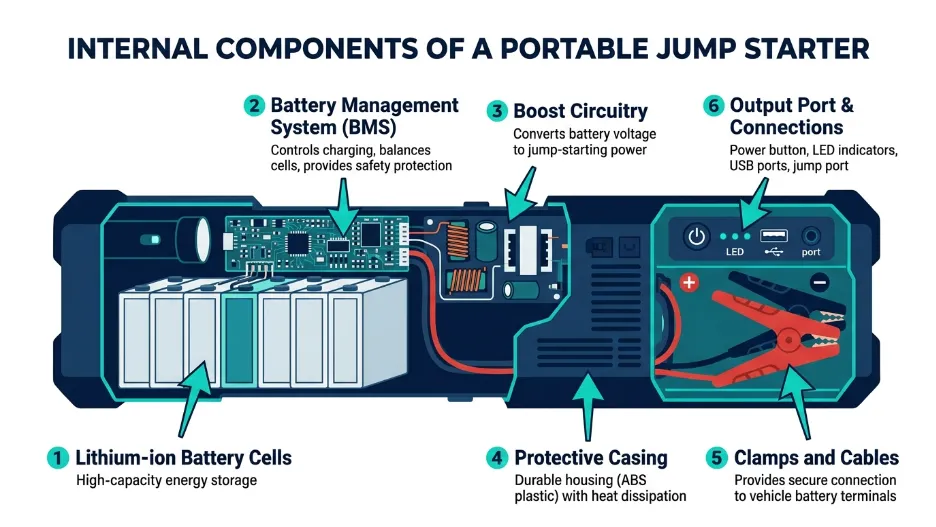
Before you can understand the risks, you need to know what you’re working with. A portable jump starter is essentially a compact battery pack with built-in boost circuitry and a set of heavy-duty clamps. The battery inside is almost always one of two types: lithium-ion (Li-ion) or lead-acid.
Lithium-ion models are the modern standard. They’re light, compact, and powerful — popular brands like NOCO, TOPDON, and GOOLOO all use lithium cells in their jump starters. Lead-acid models, like the Clore Automotive Jump-N-Carry series, are older, heavier, and typically used in professional shop environments.
Both battery types carry some level of risk under extreme conditions. But lithium-ion batteries are more sensitive to heat and overcharging. That sensitivity is the root of most real-world overheat and explosion concerns.
When buying a jump starter, look for the UL 2743 certification label. This is the safety standard for portable power packs, and it tells you the unit has been independently tested for electrical and thermal safety.
Can a Jump Starter Actually Explode?
The short answer is yes — it is technically possible, but it’s genuinely rare under normal conditions. Any device containing lithium-ion or lead-acid batteries has a small theoretical risk of explosion if the battery is compromised.
Here is how an explosion could happen. A lithium-ion cell can enter a state called thermal runaway — a chain reaction where heat causes chemical decomposition, which produces more heat and gas, which in turn raises pressure inside the cell. If the outer casing cannot contain that pressure, the cell ruptures. In the worst cases, this rupture ignites the electrolyte fluid, which is flammable.
The most common causes that push a jump starter toward this outcome are:
- Overcharging: When a lithium cell is charged beyond its voltage limit (typically above 4.5V), the electrolyte breaks down and produces combustible gas.
- Moisture exposure: Water reacts with the lithium electrolyte to form gas, increasing internal pressure over time.
- Internal short circuit: A manufacturing defect or physical damage can cause a large current discharge inside the cell, generating intense heat rapidly.
- Physical damage: Dropping, crushing, or puncturing the casing can damage the separator between positive and negative electrodes, triggering a short circuit.
Never use a jump starter on a frozen battery. Attempting to jump-start a battery in freezing temperatures can cause it to crack or explode due to the rapid temperature change and uncontrolled chemical reaction inside the frozen cells. This applies whether you are using a jump box or traditional jumper cables.
When Can a Jump Starter Overheat?
Overheating is far more common than explosion, and it’s the more realistic risk for most drivers. Lithium-ion batteries are particularly susceptible to high temperatures. Car interiors during summer months can easily reach 120°F (49°C) or higher — well above the safe operating range for most lithium cells.
Here are the main scenarios where a jump starter can overheat:
- Stored in a hot car: Leaving a lithium jump starter in your vehicle through summer heat can cause the battery to swell or vent internal gases, reducing capacity and eventually causing cell failure.
- Multiple rapid jump attempts: Attempting too many jumps back to back without letting the unit rest raises its internal temperature significantly.
- Using the wrong voltage: A 24V jump starter used on a 12V system forces excess current through the circuit, generating heat that can damage both the jump starter and the vehicle’s electrical system.
- Cheap units without thermal protection: Low-quality jump starters sold without a Battery Management System (BMS) have no circuit to detect or cut off power when temperature rises dangerously.
A jump starter overheats most often from being stored in a hot car or from overuse without rest intervals. Explosions are rare and typically result from internal cell defects, moisture damage, or severe misuse. Both risks are manageable with a certified unit and proper storage habits.
What Happens When You Connect the Clamps Backward?
Reverse polarity is one of the most common jump starter mistakes, and it carries real risk. Connecting the positive clamp to the negative terminal creates an immediate short circuit. The resulting surge of current can damage your vehicle’s ECU (Engine Control Unit), blow fuses, fry onboard electronics, and in some cases, cause the car battery to heat up rapidly and vent explosive hydrogen gas.
When a damaged or overcharged car battery is already leaking hydrogen gas, a spark from a wrong connection can ignite those vapors. This is not a jump starter exploding — it’s the car’s battery reacting. The distinction matters, but the danger is equally real.
Modern jump starters from reputable manufacturers address this with reverse polarity protection — a built-in circuit that detects an incorrect connection and refuses to pass current until the clamps are properly positioned. NOCO’s UltraSafe line, for example, includes spark-proof technology that prevents any current from flowing until a correct connection is confirmed.
Do not connect the negative clamp directly to the dead battery’s negative terminal if you can avoid it. Instead, connect it to an unpainted metal surface on the engine block. This reduces the chance of igniting any hydrogen gas that may have escaped from the battery.
Lithium-Ion vs. Lead-Acid Jump Starters: Which Is Safer?
| Feature | Lithium-Ion | Lead-Acid |
|---|---|---|
| Weight | Light and compact | Heavy |
| Heat sensitivity | High — prone to swelling above 49°C | Lower — more heat tolerant |
| Cold performance | May underperform below freezing | Works better in cold weather |
| Shelf life between charges | 5–10% self-discharge per month | Discharges faster |
| Explosion risk | Higher under thermal runaway | Lower explosive energy |
| Safety features available | BMS, reverse polarity, over-temp cutoff | Basic protection in most models |
Lead-acid jump starters like the Clore Automotive Jump-N-Carry JNC660 are workhorses in professional settings — they handle repeated heavy use and cold weather better. But lithium-ion models dominate the consumer market because of their size and convenience. For everyday drivers, a well-made lithium jump starter with proper safety features is the more practical choice.
Safety Features That Actually Prevent Overheating and Explosions
Not all jump starters are created equal. The difference between a safe unit and a risky one comes down to these core protection features:
- Battery Management System (BMS): The most critical safety feature. A BMS monitors cell voltage, current, and temperature in real time and shuts down the unit if any parameter goes out of range. Units without a BMS should be avoided entirely.
- Reverse polarity protection: Prevents current from flowing when clamps are connected incorrectly. NOCO and TOPDON include this as standard.
- Over-temperature cutoff: Automatically disconnects the battery if internal temperature exceeds a safe threshold.
- Over-current and over-voltage protection: Stops current flow if a fault causes an unsafe surge. This protects both the jump starter and your car’s electronics.
- Spark-proof clamps: Prevents dangerous sparks when you make the final connection — critical if the car battery has been venting hydrogen gas.
The UL 2743 certification from Underwriters Laboratories is the gold standard safety certification for portable power packs sold in North America. If a jump starter carries this mark, it has been independently tested to meet strict electrical and thermal safety requirements. Always check for it before buying.
Read Full Review : NOCO Boost Plus GB40 Review
NOCO Boost Plus GB40 1000A UltraSafe Car Battery Jump Starter Pack, 12V Lithium Jump Starter Battery Booster Pack, Portable Power Bank Charger & Jumper Cables For 6.0-Liter Gasoline And 3.0-Liter Diesel Engines
The NOCO GB40 is one of the most trusted jump starters available — it includes spark-proof technology, reverse polarity protection, and a compact build that fits under a car seat, making it a smart, genuinely safe choice for everyday drivers.
How to Use a Jump Starter Safely (Step-by-Step)
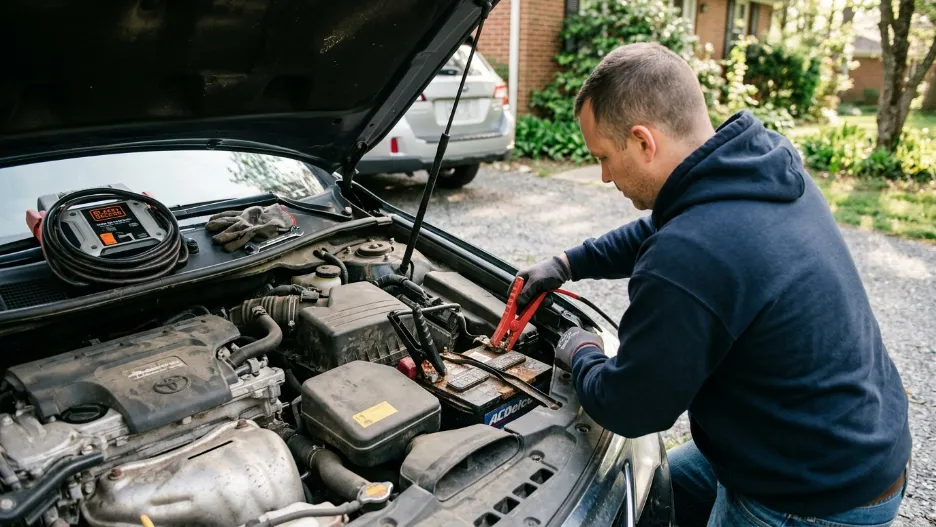
Even the best jump starter becomes dangerous in the wrong hands. Follow this exact procedure every time to eliminate virtually all risk.
- Turn off the vehicle and all accessories — radio, lights, climate control, everything.
- Inspect the dead battery. Look for cracks, bulging, leaking fluid, or visible damage. If damaged, do not jump-start — replace the battery instead.
- Check your jump starter’s charge level. Make sure it has enough power for at least one full jump attempt.
- Connect the red (positive) clamp to the positive (+) terminal of the dead battery.
- Connect the black (negative) clamp to an unpainted metal surface on the engine block — not to the negative battery terminal if possible.
- Turn on the jump starter and wait 60 seconds before attempting to start the car.
- Start the car. If it does not start after three attempts, stop and let the jump starter rest for a few minutes before trying again.
- Once the car starts, disconnect the black clamp first, then the red clamp. Keep clamps away from each other and from moving parts.
- Drive the car for at least 15 to 20 minutes to let the alternator recharge the battery.
Is It Safe to Store a Jump Starter in Your Car?
This question comes up constantly, and the honest answer is: it depends on your climate and how you store it. Keeping a jump starter in your car for quick access makes sense. But there are real risks to leaving a lithium-ion battery pack in a vehicle that regularly sees extreme temperatures.
During summer, car interiors can hit 120°F (49°C) or higher. That is above the safe threshold for most lithium-ion cells, which begin to degrade, swell, and potentially vent above around 140°F (60°C). Over repeated exposures, this significantly shortens the battery’s lifespan and increases failure risk.
In winter, the cold reduces the jump starter’s capacity, meaning it may not deliver enough cranking power when you need it most. The cells themselves are not damaged by cold, but performance drops substantially below freezing.
Store your jump starter in an insulated bag or hard case and keep it in the trunk rather than the back seat. This reduces temperature swings. In extreme heat, bring it inside the house between uses. Charge it every 90 days to prevent deep discharge, which can permanently reduce capacity.
Warning Signs That Your Jump Starter Is Unsafe to Use
Your jump starter will usually give you warning signs before it fails catastrophically. Do not ignore these red flags:
- Visible swelling or bulging: The casing should be flat. Any puffing means gas has built up inside the cells — stop using it immediately.
- Unusual heat during use or charging: Mild warmth is normal. Hot to the touch means something is wrong internally.
- Burning or chemical smell: This is a direct sign of electrolyte venting or internal combustion starting. Move away and let the unit sit in open air.
- No longer holding a charge: If the battery drains within days of a full charge, the cells have degraded significantly and the unit is no longer reliable or safe.
- Physical cracks or dents in the casing: Structural damage can expose the internal cells, increasing short circuit and fire risk.
If you notice any of these signs, stop using the jump starter. Do not throw it in regular trash — lithium batteries require proper recycling disposal to prevent fire in waste facilities. Many auto parts stores like AutoZone and O’Reilly accept used battery packs for recycling.
Can a Jump Starter Damage Your Car?
This is a separate concern from safety, but it’s worth addressing because it’s one of the most common fears people have. A quality jump starter, connected correctly, will not damage your car’s electronics. Modern jump starters deliver a controlled 12V output — exactly what your car expects during starting.
Damage happens in two scenarios. First, if you use a cheap, uncertified unit without voltage regulation, it can deliver inconsistent voltage that spikes and damages sensitive modules like the ECU, transmission control unit, or fuel injection system. Second, connecting clamps backward without reverse polarity protection creates a short circuit that can blow fuses, burn wiring, or fry the ECU directly.
Some vehicles — particularly newer hybrids and EVs — require special procedures or a dedicated jump point. Consult your owner’s manual before jump-starting any modern vehicle. Never attempt to jump the high-voltage traction battery in a hybrid or electric vehicle using a standard jump starter. You can only safely jump the 12V auxiliary battery.
A quality jump starter will not damage your car if used correctly. The risks come from reverse connections, wrong voltage units, or cheap uncertified products. Modern vehicles with sensitive electronics benefit most from a jump starter with built-in voltage control and spark-proof clamps rather than traditional jumper cables.
What Does “Thermal Runaway” Actually Mean?
You will hear this term often in lithium battery safety discussions, and it’s worth understanding plainly. Thermal runaway is a self-accelerating chain reaction inside a lithium-ion cell. Here is how it unfolds:
Heat — from overcharging, a short circuit, or external temperature — causes the electrolyte inside the cell to begin decomposing. That decomposition generates more heat and produces flammable gases. The gases raise internal pressure. If the pressure exceeds what the cell casing can contain, the cell vents — and if the vented gases ignite, you have a fire or explosion.
A well-designed Battery Management System (BMS) is the primary defense. It monitors cell temperature and cuts off charging or discharging the moment temperature begins to rise dangerously. Reputable manufacturers like NOCO, TOPDON, GOOLOO, and CARKU all build multi-layer BMS protection into their lithium jump starters. According to the National Fire Protection Association (NFPA), lithium battery fires are almost always traceable to a specific failure — not a design that is inherently prone to fire under normal use.
Thermal runaway in a portable jump starter is not random. It requires a triggering condition — physical damage, moisture, persistent overcharging, or extreme heat exposure. Eliminate those conditions and the risk is negligible in a quality unit.
Conclusion
Here is the bottom line. A portable jump starter can overheat or, in extreme cases, explode — but only when something has gone seriously wrong. That might be a damaged battery, a wrong connection, an uncertified cheaply-made unit, or prolonged exposure to dangerous temperatures.
The risk is not something to lose sleep over. Millions of drivers use jump starters safely every year. What separates safe use from dangerous use is simple: buy a certified unit with a proper BMS and safety features, connect the clamps correctly every single time, and store the device away from extreme heat.
I’m Alex Rahman, and the advice I always give is this — don’t cut corners on safety gear. A quality jump starter costs a little more, but it’s the device you will reach for when you’re stranded and stressed. That is not the moment you want to discover you bought the cheap version.
Frequently Asked Questions
Can a jump starter catch fire while stored in my car?
Yes, but only under extreme conditions. Lithium-ion jump starters can swell and vent flammable gases if left in a car interior that consistently reaches temperatures above 120°F (49°C). To prevent this, store your jump starter in an insulated case and bring it inside during prolonged heatwaves.
What happens if I connect a jump starter to a frozen battery?
Attempting to jump-start a frozen battery is dangerous and can cause it to crack or explode due to rapid gas expansion inside the frozen cells. Always let a frozen battery thaw completely in a warm environment before attempting to jump-start or charge it.
Is a lithium jump starter more dangerous than a lead-acid jump starter?
Lithium-ion jump starters carry a higher risk of thermal runaway under extreme conditions, while lead-acid models are more tolerant of heat. However, modern lithium jump starters with proper BMS protection are very safe in everyday use and offer significant advantages in size and performance.
Can connecting clamps backward cause an explosion?
A reverse polarity connection can cause a short circuit that generates heat, sparks, and potentially ignites hydrogen gas venting from a damaged battery. Quality jump starters with reverse polarity protection prevent current from flowing until the clamps are correctly connected.
How often should I charge my jump starter to keep it safe?
You should fully recharge your jump starter every 90 days, even if you have not used it. Lithium-ion batteries self-discharge at roughly 5 to 10 percent per month. Deep discharge below a critical threshold can cause permanent cell damage and increase the risk of failure during the next use.
Are cheap jump starters from unknown brands dangerous?
Uncertified jump starters without a Battery Management System, reverse polarity protection, or thermal cutoff are significantly more dangerous than certified models from reputable brands. They may also deliver inconsistent voltage that can damage vehicle electronics. Always look for UL 2743 certification or equivalent when purchasing.

I’m Alex Rahman, a car enthusiast and automotive writer focused on practical solutions, car tools, and real-world driving advice. I share simple and honest content to help everyday drivers make better decisions.
