Why Does My Jump Starter Lose Charge? 7 Real Fixes
Jump starters lose charge quickly due to battery aging, improper storage, always-on USB ports, extreme temperatures, and deep discharge cycles. Lithium-ion models should lose less than 5% charge per month when stored correctly. If yours drains faster, the cause is almost always one of seven fixable problems covered in this guide.
I grabbed my jump starter on a cold November morning, expecting to rescue my neighbor’s dead truck battery. The indicator showed one bar — down from full just six weeks earlier. I had stored it in my trunk the whole time. That single morning taught me more about jump starter battery health than a year of casual use. I’m Alex Rahman, and I’ve tested over a dozen portable jump starters to understand exactly why they drain so fast — and what you can do about it.
Jump starters fail at the worst possible moment, not because they are defective, but because most owners don’t know the real causes of rapid charge loss. Battery chemistry, storage habits, temperature exposure, and hidden power draws each play a role. This guide covers all seven causes in plain language, with specific fixes you can use today.
- Lithium-ion jump starters should self-discharge less than 5% per month in proper storage — anything higher signals a problem.
- Always-on USB ports and LED indicators silently drain your battery even when the unit sits idle in a drawer.
- Heat above 45°C (113°F) — like a parked car in summer — can cause a jump starter to lose 20% charge weekly.
- Deep discharge below 20% accelerates cell degradation and shortens the battery’s total cycle life.
- Recharge your jump starter every 2 to 3 months during storage and immediately after every use.
What Causes a Jump Starter to Lose Charge So Fast?
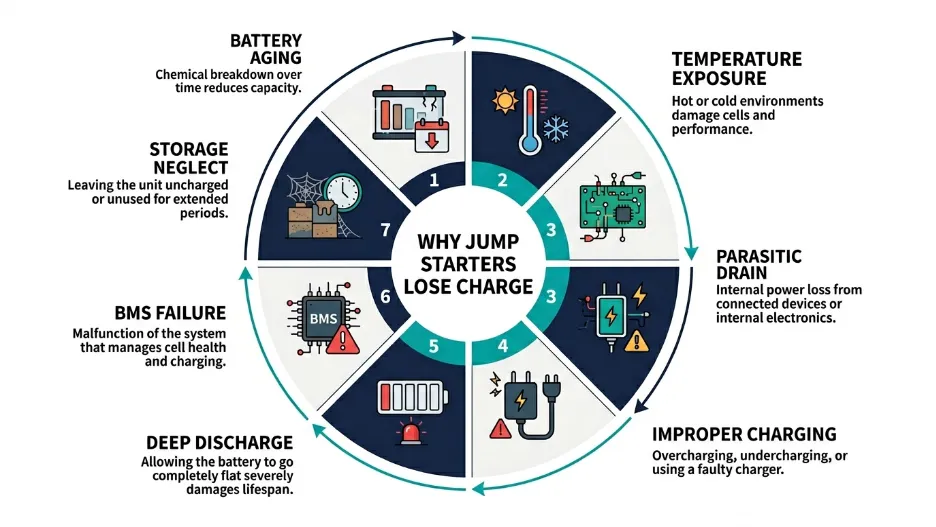
Jump starters are lithium-ion or lead-acid battery packs engineered to deliver high current in short bursts. Their internal chemistry, however, does not stay perfectly stable on its own. Seven specific factors cause faster-than-normal charge loss, and each one operates differently depending on your device and storage habits.
Understanding the cause matters because the fix differs completely depending on the root problem. A temperature issue requires a storage change. A parasitic drain issue requires a hardware check. A dead-cell issue requires replacement. Guessing wrong wastes time and money.
Cause 1 — Battery Cell Aging: The Most Common Reason
Every rechargeable battery has a finite number of charge cycles before it loses the ability to hold a full charge. Lithium-ion cells used in modern jump starters typically support 300 to 500 full cycles before noticeable degradation begins. Lead-acid versions degrade even faster under heavy or irregular use.
Cell aging accelerates when you repeatedly drain the battery below 20% before recharging. Each deep discharge stresses the internal cell structure, reducing the maximum charge capacity permanently. A jump starter that once held 18,000 mAh may drop to 12,000 mAh after 200 aggressive cycles.
Maintain your jump starter between 30% and 80% charge for daily storage. Lithium-ion cells thrive on partial cycles — keeping full charge or running to empty both shorten the battery’s total lifespan.
Use a multimeter to check your unit’s resting voltage. A fully charged 12V lithium jump starter should read between 13.0V and 13.6V. Readings consistently below 10V indicate severe cell depletion and likely require battery replacement.
Cause 2 — Extreme Temperature Exposure: Heat and Cold Both Damage Cells
Temperature is the single fastest way to destroy a jump starter battery’s charge retention. Heat accelerates the chemical reactions inside lithium cells, causing accelerated self-discharge and permanent capacity loss. A jump starter stored in a car during summer heat — where interior temperatures routinely exceed 60°C (140°F) — can lose 20% of its charge every week instead of the normal 5% per month.
Cold temperatures create the opposite problem. Below 0°C (32°F), lithium-ion cells slow down chemically and refuse to accept a safe charge. Trying to charge your jump starter in freezing conditions can cause lithium plating inside the cells, permanently reducing capacity. Bring the device to room temperature (20–25°C) before charging it during winter.
Never leave your jump starter in a parked car during summer. Interior car temperatures can exceed 65°C (149°F) in direct sunlight, which causes irreversible lithium cell damage and dramatically reduces the battery’s ability to hold a charge.
The ideal storage temperature for lithium jump starters is between 15°C and 25°C (59°F to 77°F). A cool, dry cabinet indoors beats any glove compartment or trunk year-round.
Cause 3 — Parasitic Drain: Hidden Power Draws You Can’t See
Many jump starters include always-on USB ports, LED status indicators, or Bluetooth connectivity features that continue drawing current even when the device appears to be off. These parasitic loads are small individually — often just a few milliamps — but they compound significantly over weeks and months of storage.
A jump starter with two always-on USB-A ports can lose 10% to 15% of its charge over 30 days from parasitic draw alone, even in perfect temperature conditions. Some budget models have poorly designed Battery Management Systems (BMS) that fail to cut off standby current effectively.
Place a small piece of tape over USB ports when storing your jump starter for extended periods. This prevents accidental device connection and eliminates one common source of parasitic drain.
Check your owner’s manual for a standby mode or power-off button that fully cuts internal circuits. Premium brands like NOCO design their units with low-drain standby circuitry that limits monthly self-discharge significantly. Budget units rarely invest in this protection.
Cause 4 — Improper Charging Practices: Voltage Mismatch and Slow Chargers
Charging your jump starter with the wrong adapter causes two separate problems. An under-powered charger delivers insufficient voltage, which means the battery appears charged on the display but never reaches a full state of charge internally. An over-powered charger pushes voltage beyond the Battery Management System’s safe limit, stressing cells and accelerating aging.
Always use the original charger that came with your unit, or verify that a replacement matches the rated input voltage and current exactly. For LiFePO4 (lithium iron phosphate) jump starters — a chemistry used in some newer models — you must use a charger specifically designed for LiFePO4 chemistry, as it manages charge termination differently than standard lithium-ion.
| Battery Type | Monthly Self-Discharge | Ideal Storage Charge | Recharge Interval |
|---|---|---|---|
| Lithium-Ion (Li-ion) | 2–5% | 40–60% | Every 3 months |
| LiFePO4 | 1–3% | 50–70% | Every 6 months |
| Lead-Acid | 5–15% | 100% | Every month |
Cause 5 — Deep Discharge During Use: Cranking Heat Damages Cells
Jump starting a car puts enormous strain on a battery pack. The surge of current needed to crank a dead engine generates significant heat inside the jump starter’s cells. Clore Automotive, a leading manufacturer of professional-grade jump starters, recommends no more than six seconds of cranking per attempt, followed by a mandatory three-minute rest period. Ignoring this guideline builds thermal stress that accelerates cell degradation.
Another less-known cause of deep discharge during use happens when drivers leave the jump starter connected to the vehicle after the car starts. Current flows back from the running alternator into the jump starter’s battery pack, pushing voltage above the unit’s rated maximum and damaging the BMS. Disconnect the clamps immediately after the engine starts.
Remove the jump starter clamps from the vehicle battery as soon as the engine starts. Leaving them connected allows reverse charging from the alternator, which can damage the jump starter’s internal battery management system and reduce future charge retention.
Cause 6 — Faulty Battery Management System (BMS): When the Protector Fails
The Battery Management System is the electronic circuit board inside every modern jump starter that monitors voltage, current, and temperature to protect the cells. When the BMS fails or malfunctions, it may report a false full charge while the underlying cells hold only a fraction of their rated capacity. This explains the frustrating experience of a jump starter that shows 100% on the display but dies after one use.
Common BMS failure symptoms include the device powering on briefly and then shutting off, the charging light activating without any actual increase in battery percentage, and the unit overheating during load. Some BMS failures are firmware-related rather than hardware-related. Fully draining the battery, then leaving it connected to the original charger for 48 hours without interruption can sometimes reset the BMS firmware and restore accurate readings.
A BMS failure shows false voltage readings — the unit appears charged but delivers no power. A dead-cell failure shows accurate low voltage — the unit simply cannot hold a charge. Test with a multimeter under load: connect clamps to a known good battery without starting the engine. A significant voltage drop under load confirms dead cells, not a BMS fault.
Cause 7 — Extended Storage Without Maintenance: The Silent Killer
Jump starters sit idle for months between emergencies. During that time, natural self-discharge slowly reduces the charge level. If the battery reaches zero and stays there — a condition called deep dormancy — lithium cells begin to suffer permanent damage. Lead-acid batteries discharged below 5V face irreversible sulfation of their plates.
Lithium-ion jump starters stored at 40% to 60% charge can survive up to six months without a top-up in ideal conditions. Lead-acid models require monthly charging regardless of storage conditions. Smart jump starters with self-discharge prevention circuitry — such as certain models from NOCO and STANLEY — use advanced electronics to minimize standby drain and extend storage readiness to six months between charges.
NOCO Boost Plus GB40 1000 Amp 12-Volt UltraSafe Portable Lithium Car Battery Jump Starter Pack
This is the most reliable portable jump starter for drivers who want long-lasting charge retention — the GB40 uses advanced lithium technology with a smart BMS that minimizes self-discharge and delivers up to 20 jump starts on a single charge.
How to Test Whether Your Jump Starter Is Actually Holding a Charge
Testing your jump starter takes less than five minutes and requires only a multimeter — a device available at any hardware store for under $20. Follow these steps to get an accurate diagnosis of your battery’s health.
- Fully charge the jump starter using its original charger until the indicator shows 100%.
- Leave it unplugged for 24 hours at room temperature with all ports covered.
- Set your multimeter to DC voltage and touch the probes to the output terminals.
- A healthy 12V lithium unit should read between 13.0V and 13.6V — below 12.0V indicates degradation.
- Connect the clamps to a known good car battery without starting the engine to test voltage under load.
- A drop below 11V under load strongly indicates failed cells requiring replacement.
- If voltage holds above 12.5V under load, the cells are healthy — look for a parasitic drain or BMS issue instead.
How to Make Your Jump Starter Hold Its Charge Longer
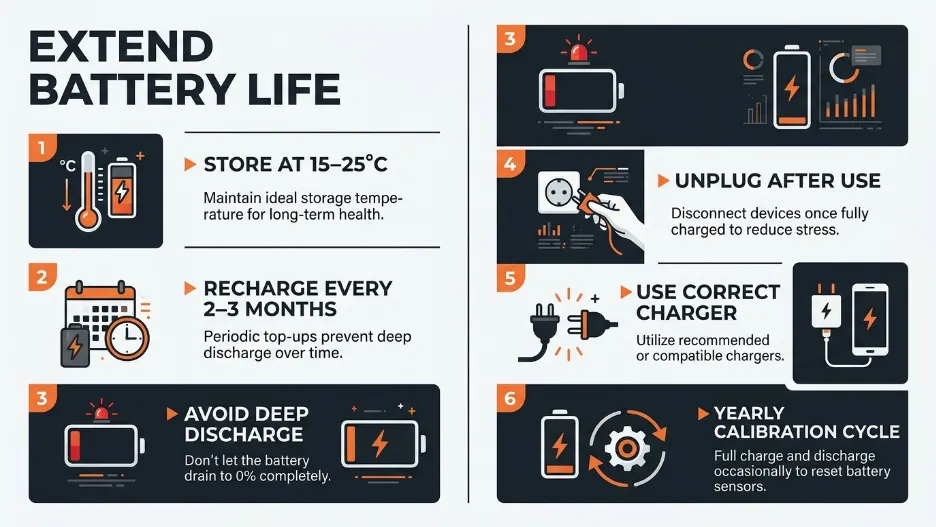
Extending the charge retention of your jump starter comes down to three consistent habits: proper storage temperature, regular top-up charging, and correct usage technique. These are not complicated, but most owners skip at least one of them.
Store indoors at 15–25°C. A cool bedroom closet beats every car, garage, or attic for battery longevity. Temperature consistency matters as much as the average temperature itself.
Recharge every 2 to 3 months. Set a phone calendar reminder for every 90 days. Top the unit up to 60–80% — you do not need to reach 100% for storage purposes, and a partial charge is healthier for lithium cells than a full one.
Recharge immediately after every use. Even a single jump start drains significant energy. Storing the unit partially drained accelerates cell aging and increases the risk of deep dormancy during a long gap between uses.
Run a full charge-discharge cycle once per year to recalibrate your jump starter’s battery management system. Charge to 100%, use the unit to drain it to around 20%, then recharge fully. This helps the BMS display accurate readings and can improve real-world performance.
When Should You Replace a Jump Starter Instead of Fixing It?
Replacement makes more economic sense than repair in most cases once the battery reaches end of life. For budget units priced under $80, the cost of sourcing compatible replacement cells and the labor involved almost always exceeds the value of the device. For premium units like the NOCO GBX75 — priced around $300 — professional cell replacement at approximately $80 is often the smarter choice.
Replace your jump starter when it fails to hold charge for more than two weeks even after a full conditioning cycle, when the voltage under load drops below 11V consistently, or when the unit has exceeded five years of regular use. Lithium-ion jump starters used correctly last 3 to 5 years. Lead-acid models typically need replacement every 2 to 3 years.
Advanced testing uses a battery analyzer to measure internal resistance. Resistance above 100 milliohms per cell signals that replacement is needed, regardless of how good the voltage reading appears on the indicator screen.
According to Battery Skills, many auto shops offer free battery testing services for portable jump starters — worth calling ahead before buying a replacement. Lokithor’s diagnostic guide also recommends checking internal resistance with a proper battery analyzer for multi-cell units before writing off a premium device.
Lead-Acid vs. Lithium Jump Starters: Which Holds Charge Better?
Lithium-ion jump starters outperform lead-acid models on every charge-retention metric. They self-discharge at 2 to 5% per month versus 5 to 15% for lead-acid. They tolerate a wider temperature range for storage. They weigh significantly less for the same power output, and they last two to three times longer in total cycle life.
Lead-acid jump starters require monthly charging even when sitting idle, which most owners forget to do. A lead-acid unit stored for four months without a top-up charge may suffer permanent sulfation damage that no amount of charging can reverse. For drivers in cold climates, lead-acid chemistry loses up to 50% of its effective capacity at temperatures below 0°C.
The practical recommendation for any driver buying a new unit in 2025 or later is to choose lithium-ion or LiFePO4 chemistry. Both offer substantially better charge retention, safer operation, and longer service life than traditional lead-acid designs.
Frequently Asked Questions
Why does my jump starter die so fast even when fully charged?
Your battery cells are likely degraded from age, heat exposure, or repeated deep discharge cycles. Use a multimeter to check voltage under load — a reading below 11V confirms dead cells that can no longer deliver adequate current, even when the charge indicator shows full.
How often should I charge my jump starter when not in use?
Recharge your lithium-ion jump starter every 2 to 3 months during storage. Lead-acid models require monthly charging to prevent permanent sulfation damage. Always recharge immediately after any use, even a single jump start.
Can extreme heat permanently damage a jump starter battery?
Yes. Temperatures above 45°C (113°F) cause permanent lithium cell degradation that reduces charge capacity. A jump starter left in a car during summer can lose 20% of its charge weekly and suffer lasting cell damage that no recharging can fix.
Why does my jump starter show full charge but not start my car?
This usually means the battery cells have degraded or the BMS is displaying a false reading. The unit may hold enough voltage to light the indicator but lacks the current delivery needed to crank an engine. Test with a multimeter under load to confirm.
Is it worth repairing a jump starter that won’t hold a charge?
For budget units under $80, replacement is almost always more economical than repair. For premium models over $150, professional cell replacement at $60 to $100 is worth considering. Compare the repair cost against a new unit with the same features before deciding.
Do USB ports on a jump starter drain the battery when not in use?
Many jump starters have always-on USB ports that draw a small continuous current even in storage. This parasitic drain can cause 10 to 15% monthly charge loss. Cover ports with tape during storage or look for a model with a true power-off mode that cuts all standby circuits.
Final Thoughts
Jump starters lose charge quickly for seven specific, fixable reasons: battery aging, temperature damage, parasitic drain, improper charging, deep discharge during use, BMS failure, and neglected maintenance. Most rapid charge loss comes from how owners store and maintain their units — not from manufacturing defects.
The single most important habit is to recharge every 2 to 3 months during storage and immediately after every use. Store your unit indoors at room temperature, away from your car. If your jump starter still drains abnormally fast after improving your habits, use a multimeter to test voltage under load and determine whether the cells or the BMS are the root cause.
I’m Alex Rahman, and the most valuable lesson I’ve taken from testing these devices is simple: a jump starter that is properly maintained costs far less than an emergency tow. Spend ten minutes on maintenance every quarter, and your unit will be ready when you need it most.

I’m Alex Rahman, a car enthusiast and automotive writer focused on practical solutions, car tools, and real-world driving advice. I share simple and honest content to help everyday drivers make better decisions.
