
What Car Problems Can an OBD2 Scanner Detect? Guide
Quick Answer
An OBD2 scanner can detect engine, fuel, emissions, transmission, sensor, and some brake and airbag faults by reading trouble codes and live data from your car computer. It points to the system or circuit at fault. It does not name the exact failed part, and it cannot see most mechanical wear.
- Engine faults include misfires, lean or rich fuel mix, and sensor faults.
- Emissions faults include catalyst, EVAP leak, and EGR faults.
- Transmission faults include shift, solenoid, and speed sensor faults.
- Basic readers often miss ABS, airbag, and maker specific faults.
Your check engine light gives no detail. It can mean a loose gas cap or a failing converter. This guide shows what an OBD2 scanner can detect, what it can only point toward, and what it cannot see. After reading, you can scan with more care and talk to a shop with clear facts.
In this article
- How Does an OBD2 Scanner Detect a Problem?
- What Engine Problems Can an OBD2 Scanner Detect?
- What Emissions Problems Can an OBD2 Scanner Detect?
- What Transmission Problems Can an OBD2 Scanner Detect?
- What Problems Can It Detect Beyond the Engine?
- How to Read a Code Without Replacing the Wrong Part
- What Problems Can an OBD2 Scanner Not Detect?
- What Should You Do After a Scan?
How Does an OBD2 Scanner Detect a Problem?
An OBD2 scanner detects a problem by reading data from your car computer. Sensors watch engine speed, air flow, fuel mix, coolant temperature, oxygen levels, and exhaust flow. When a reading falls outside the set range, the computer stores a diagnostic trouble code, known as a DTC.
The scanner reads that code through the OBD2 port under the dash. It can also show live data, such as RPM, coolant temperature, fuel trim, and oxygen sensor voltage. Live data helps you see how a system acts while the engine runs. Freeze frame data shows engine speed, load, and temperature at the moment a fault was stored.
Codes fall into groups by their first letter. P codes cover powertrain, B codes cover body systems, C codes cover chassis systems, and U codes cover network faults. A code such as P0301 points to a misfire in cylinder 1. A code such as P0420 points to low catalyst efficiency. To learn what a scanner does, start with code reading, live data, and freeze frame data.
Stored codes stay in memory after a fault. Pending codes show a fault that has happened once but has not yet met the test for a stored code. A pending code can point to an early fault. It can also clear on its own if the fault does not return. The OBD2 scanner guide notes that a code identifies a system, while the cause still needs checks.
What Engine Problems Can an OBD2 Scanner Detect?
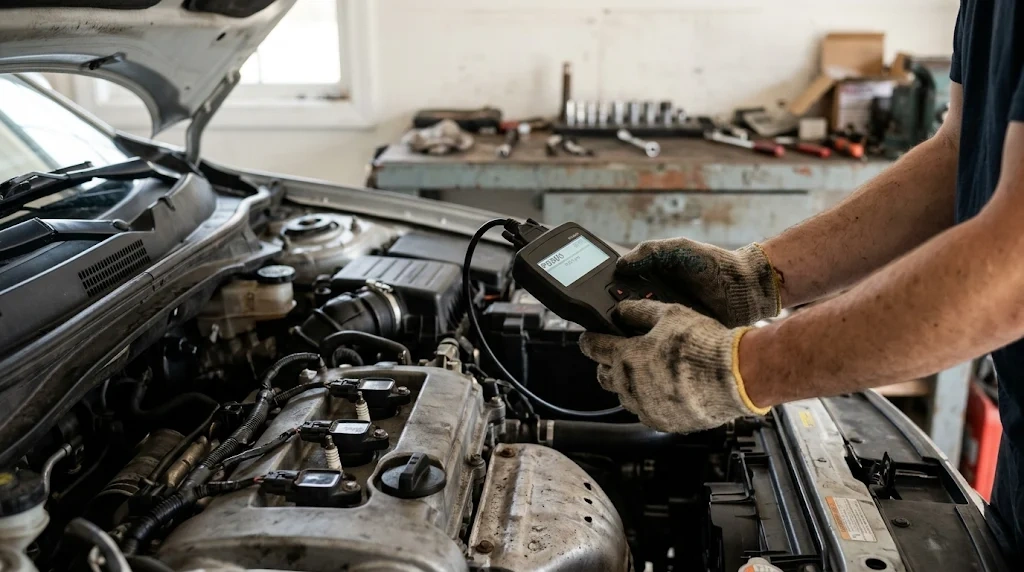
An OBD2 scanner can detect many engine problems that affect combustion, fuel delivery, air flow, and sensor signals. It reads misfire counts, fuel trim, sensor voltage, and engine load. Those readings help you narrow a rough idle, a loss of power, or poor fuel use to one system.
What misfire problems can a scanner find?
A scanner can find engine misfires and name the cylinder that misfired. A P0300 code means a random misfire across cylinders. A P0301 code means a misfire in cylinder 1. A P0302 code means a misfire in cylinder 2. The pattern helps you test spark plugs, ignition coils, fuel injectors, and wiring for that cylinder first.
A misfire code does not prove which part failed. A bad spark plug, a weak coil, a clogged injector, low compression, or a vacuum leak can cause the same code. Live misfire counts show if the fault happens at idle, under load, or only when the engine is cold. That detail helps you test the right part.
What fuel and air problems can a scanner find?
A scanner can find fuel and air problems through fuel trim and air flow readings. A P0171 code means the engine runs too lean on bank 1. A P0172 code means the engine runs too rich on bank 1. Lean means too much air or too little fuel. Rich means too much fuel or too little air.
Fuel trim shows how much the computer must adjust the fuel mix. High positive trim can point to a vacuum leak, a dirty mass air flow sensor, low fuel pressure, or an exhaust leak. High negative trim can point to a leaking injector, high fuel pressure, or a faulty sensor. Live data lets you watch trim change with engine speed and load.
What sensor problems can a scanner find?
A scanner can find sensor faults in the oxygen sensor, mass air flow sensor, throttle position sensor, coolant temperature sensor, and crankshaft position sensor. Each sensor sends a signal to the computer. When a signal drops out, reads out of range, or moves too slowly, the computer stores a code.
Oxygen sensor codes are common. A slow sensor can hurt fuel use and raise exhaust output. A faulty mass air flow sensor can cause stalling, hesitation, and poor fuel use. A coolant temperature sensor fault can cause hard starts and a rich fuel mix. For detail on one common case, see oxygen sensor faults.
The table below sums up the main systems a scanner can check, the fault it can point to, and a code example.
| System | Problem It Can Point To | Code Example |
|---|---|---|
| Engine | Misfire in one cylinder | P0301 |
| Fuel system | Lean or rich fuel mix | P0171 |
| Sensors | Oxygen sensor fault | P0130 |
| Emissions | Low catalyst efficiency | P0420 |
| Emissions | EVAP leak | P0455 |
| Transmission | Shift solenoid fault | P0750 |
The table shows a clear point. A scanner points to a system and a code, not to a single part. Each row still needs a test before you buy a part.
What Emissions Problems Can an OBD2 Scanner Detect?
An OBD2 scanner can detect emissions faults in the catalyst, EVAP system, EGR system, oxygen sensors, and secondary air system. The OBD2 system was built to watch emissions control parts. When one part fails or loses efficiency, the computer stores a code and may turn on the check engine light.
The EPA OBD II guidelines require makers to watch all emissions related systems. Those systems include the catalytic converter, the evaporative emissions control system, the EGR system, the fuel delivery system, the heated oxygen sensor, and the secondary air injection system. The system must also detect engine misfires, which can harm the catalytic converter.
What catalyst problems can a scanner find?
A scanner can find low catalyst efficiency through a P0420 code. The computer compares the oxygen sensor before the converter with the sensor after the converter. When both sensors read in a similar way, the converter may no longer clean the exhaust well. A weak oxygen sensor or an exhaust leak can cause the same code. A test of the sensors and exhaust can separate those causes.
What EVAP problems can a scanner find?
A scanner can find EVAP leaks through codes such as P0440, P0455, and P0456. The EVAP system traps fuel vapor and sends it to the engine to burn. A loose or missing gas cap is a common cause of a large leak code. A cracked hose, a faulty purge valve, or a faulty vent valve can also cause a leak code. Tighten the cap first, then scan again after a drive cycle if the code returns.
What EGR problems can a scanner find?
A scanner can find EGR faults through flow and position codes. The EGR system sends a small share of exhaust gas back into the engine to lower combustion temperature. A stuck valve, a blocked passage, or a faulty sensor can set a code. A code can also come from low flow or high flow. A check of the valve, passages, and sensor helps you find the cause.
Readiness monitors add one more emissions check. Each monitor runs a self test on one emissions system. A scanner can show if a monitor is ready or not ready. A not ready monitor can mean the code memory was cleared not long ago. It can also mean the car has not yet run the drive cycle that monitor needs.
What Transmission Problems Can an OBD2 Scanner Detect?
An OBD2 scanner can detect transmission faults when it can reach the transmission control module. It can read shift solenoid codes, speed sensor codes, pressure control codes, and fluid temperature faults. It can also show live data for gear, input speed, output speed, and fluid temperature.
Access depends on the scanner. A basic code reader often reads engine codes only. It may miss transmission codes even when the transmission has a fault. A scanner with transmission access can read maker specific codes and show more live data. For a closer look at tool access, see transmission diagnostics.
Common transmission faults include harsh shifts, delayed shifts, slipping gears, and a transmission stuck in one gear. A solenoid code can point to an electrical fault in the solenoid circuit. A speed sensor code can point to a faulty input or output sensor. A temperature fault can point to low fluid, a blocked cooler, or a faulty sensor. Fluid level and fluid state still need a physical check.
Tip
Write down each code, the freeze frame speed and temperature, and the symptom before you clear a code.
A transmission code can also come from low battery voltage or a faulty engine sensor. Check battery voltage and engine codes first. If the car slips, jerks hard, or will not shift, stop driving and seek a shop check. A scan cannot fix a mechanical fault inside the transmission.
What Problems Can It Detect Beyond the Engine?
An OBD2 scanner can detect some faults beyond the engine when it can reach other modules. Access depends on the scanner and the car. A basic reader reads generic engine and emissions codes. An advanced scanner can read ABS, airbag, body, and network codes on many cars.
ABS faults are a clear example. A scanner with ABS access can read wheel speed sensor faults, ABS module faults, and pump circuit faults. A wheel speed sensor fault can turn on the ABS light and affect traction control. Brake pad wear, rotor wear, and low brake fluid still need a visual check. To check tool access, see ABS code scanners.
Airbag faults are another example. A scanner with SRS access can read airbag module faults, seat belt pretensioner faults, and crash sensor faults. A loose connector under a seat can set an airbag code. Airbag work carries a safety risk, so do not probe airbag wiring without training and the right steps. A shop check is the safe path when the airbag light stays on.
Battery and charging faults can also show up in a scan. A scanner can show system voltage and some charging related codes. Low voltage can cause false codes in many systems. A weak battery can also cause hard starts and odd sensor readings. A scanner cannot test battery health on its own. A load test or a battery tester is still needed.
Body faults vary by car. Some scanners can read door, window, light, and climate faults. Others cannot reach those modules at all. Tire pressure faults may show up when the car has a tire pressure system that reports through the computer. A flat tire with no sensor fault will not show up as a code.
How to Read a Code Without Replacing the Wrong Part
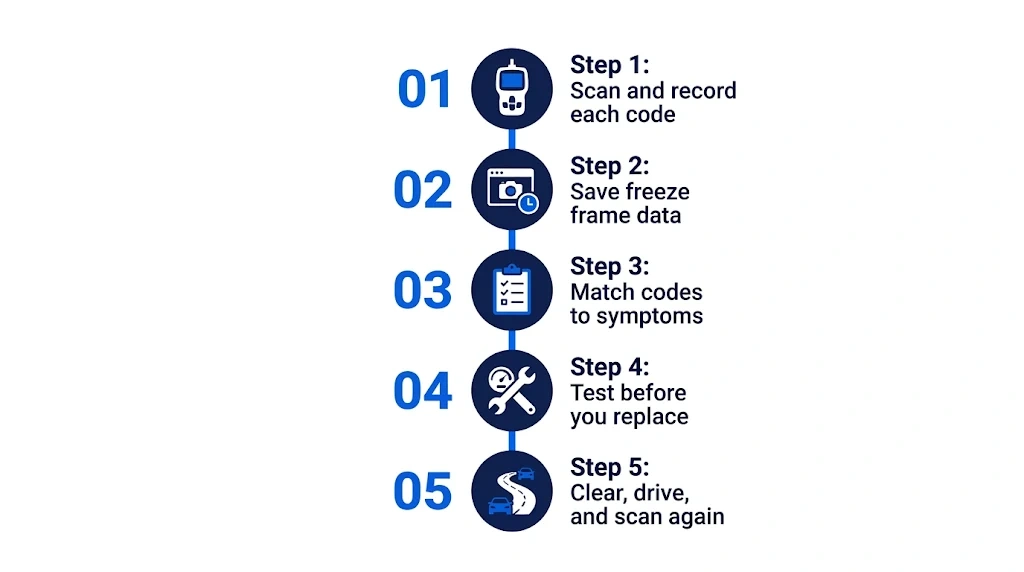
A code gives you a starting point, not a part order. A good scan follows a clear order. It keeps the code, the context, and the symptom together. That order helps you avoid a guess that costs money and leaves the fault in place.
Step 1
Scan and record each code
Plug in the scanner, read all codes, and write down each code number and description. Note stored codes and pending codes in separate lists.
Step 2
Save freeze frame data
Save engine speed, load, coolant temperature, and fuel trim from the freeze frame. Note if the light is steady or flashing.
Step 3
Match codes to symptoms
Match each code to the symptom, the fuel level, the battery state, and any work done just before the fault. Look for one cause that fits all the facts.
Step 4
Test before you replace
Check wiring, connectors, hoses, and fluid level first. Test the sensor or part named by the code when a test exists for it.
Step 5
Clear, drive, and scan again
Clear the code only after a test and a repair. Drive through normal use, then scan again to see if the code returns.
Do not clear a code before you record it. Clearing erases the freeze frame and resets readiness monitors. That loss can hide the fault and can cause an emissions test to fail. A code that returns after a repair points to a cause you have not yet found.
What Problems Can an OBD2 Scanner Not Detect?
An OBD2 scanner cannot detect most mechanical wear. It reads signals from sensors and modules. It cannot see a worn brake pad, a worn clutch, a worn suspension bushing, or a worn belt. It cannot hear a squeak, feel a vibration, or see a leak that has no sensor.
A scanner also cannot detect a fault that sets no code. A weak fuel pump, a failing timing belt, a worn engine part, or a slipping clutch may cause symptoms with no code. A fault that happens only under one set of conditions may also miss a scan. Live data can help, but only if you catch the fault while it happens.
Some electrical faults also sit outside the scan. A bad ground, a corroded connector, or a weak battery can cause false codes. Those faults can look like sensor faults. A visual check of wiring and battery voltage can save you from a wrong part swap. The standardized OBD II system helps one scanner work on many cars, but it does not give every scanner access to every module.
Warning
A flashing check engine light means a severe misfire that can harm the converter. Stop driving and seek help at once.
A clean scan does not prove a car is sound. A used car can have worn parts, poor repairs, or a cleared code history with no codes at all. A scan is one part of a check. A road test, a lift check, and service records still matter. A scanner cannot replace a hands on inspection.
What Should You Do After a Scan?
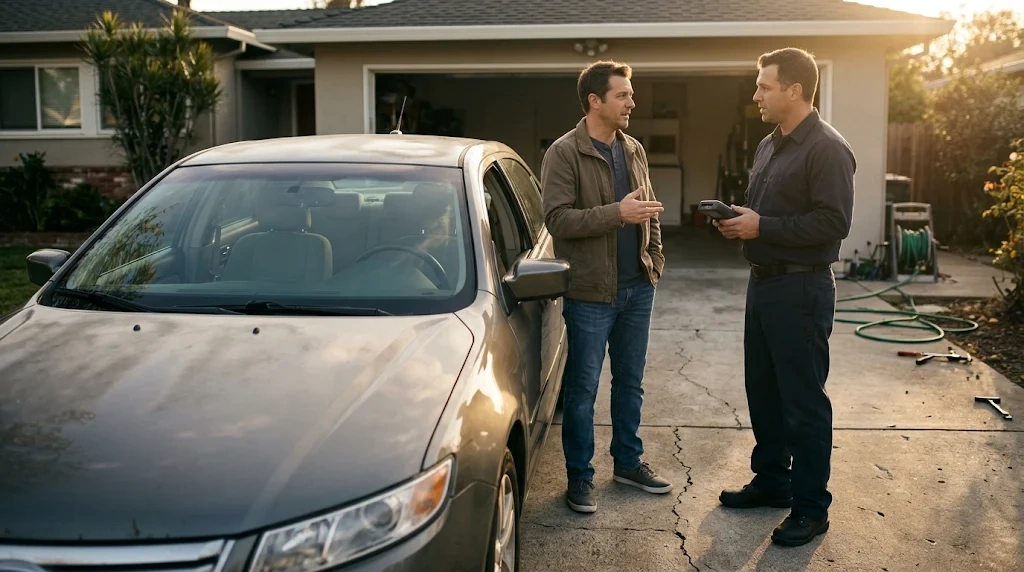
Your next step depends on the code, the symptom, and the light. A steady light with a simple EVAP code may need a cap check and a second scan. A flashing light, a severe misfire, overheating, or a fuel smell needs a stop and a shop check. A transmission slip or an airbag light also needs a shop check.
If you
Have a steady light and one simple code
Choose a cap, hose, and connector check, because a small fault often causes the code.
If you
Have a flashing light, slip, or airbag light
Choose a shop check, because the fault can cause damage or a safety risk.
If you
Are buying a used car
Choose a scan plus a road test and a lift check, because a clean scan cannot prove the car is sound.
Keep your scan notes for the shop. A code number, a freeze frame, and a clear symptom list help a technician test the right system first. That record also helps you check if a repair fixed the fault. Scan again after the repair and after normal driving to see if the code stays clear.
OBD2 Scanner
An OBD2 scanner lets you read the codes and live data covered in this guide.
Frequently Asked Questions
Can an OBD2 scanner detect a bad catalytic converter?
An OBD2 scanner can point to a weak catalytic converter, but it cannot prove the converter is the failed part. A P0420 code means converter efficiency reads low. That result can come from a worn converter, a weak oxygen sensor, or an exhaust leak. A shop test of the sensor and exhaust can separate those causes before you pay for a part.
Can an OBD2 scanner detect transmission problems?
An OBD2 scanner can read transmission codes on many cars, but access depends on the scanner and the car. It can point to shift faults, solenoid circuits, speed sensors, and fluid temperature faults. A basic reader may show engine codes only. A scanner with transmission access gives a fuller picture of shift problems.
Can an OBD2 scanner detect a bad oxygen sensor?
An OBD2 scanner can point to oxygen sensor faults through sensor circuit codes and slow response readings. A faulty sensor can cause poor fuel use, rough idle, and a check engine light. A code can also come from wiring, an exhaust leak, or a vacuum leak. Check the wiring and sensor signal before you replace the sensor.
Can an OBD2 scanner detect brake problems?
A basic OBD2 scanner often cannot read brake wear, but a scanner with ABS access can read wheel speed sensor and ABS module faults. Brake pad wear, rotor wear, and brake fluid level need a visual check. A wheel speed sensor fault can turn on the ABS light. A shop check is wise when the ABS light stays on.
Can an OBD2 scanner detect a bad battery?
An OBD2 scanner can show charging voltage and some battery related codes, but it cannot test battery health by itself. Low voltage can cause false codes in many systems. A weak battery can cause hard starts and odd sensor readings. A load test or a battery tester gives a clear check of battery health.
Can an OBD2 scanner find a problem with no warning light?
An OBD2 scanner can find stored and pending codes even when no warning light is on. A pending code shows a fault that has happened once but has not yet met the test for a stored code. Live data can also show a sensor reading that looks wrong. A scan before a road test can catch an early fault.
Will an OBD2 scanner tell me which part to replace?
An OBD2 scanner cannot name the exact part to replace. It names the system or circuit that reported a fault. A code can come from a part, wiring, a hose, low fluid, or low voltage. Test the part and its wiring first. Replace one part at a time, then scan again after a drive.
Conclusion
The answer to what car problems can an OBD2 scanner detect is clear: it finds faults in engine, fuel, emissions, transmission, and related electronic systems. It points to the system at fault, but it does not prove which part failed. If your light is flashing, stop driving and seek help at once.

I’m Alex Rahman, a car enthusiast and automotive writer focused on practical solutions, car tools, and real-world driving advice. I share simple and honest content to help everyday drivers make better decisions.
