
What Does a Car Battery Power? Starter, Lights, and More
Quick Answer
A car battery powers the starter motor, the ignition system, lights, and the electronics that run with the engine off. It stores chemical energy and turns it into electric current on demand. While you drive, the alternator makes most of the power and recharges the battery.
- Starts the engine by sending a strong burst of current to the starter motor.
- Powers lights, wipers, horn, locks, and the radio with the engine off.
- Keeps memory, alarms, and keyless entry alive while the car is parked.
- Steadies voltage and adds power when demand tops alternator output.
You turn the key and the engine wakes, yet the battery does far more than that one job. This guide lists each system the battery feeds, in plain order. After you read it, you will know what runs on battery power, what runs on the alternator, and what the battery cannot run alone.
What Does a Car Battery Power in Short?
A car battery powers starting, lighting, and ignition, plus the low-power electronics that stay on when the engine is off.
The name for this job is SLI, which stands for starting, lighting, and ignition. The SLI battery in most cars is a lead-acid unit that stores chemical energy and turns it into electric current. That current flows through wires, fuses, and switches to each part that needs it.
Wikipedia notes that six cells, each near 2.1 volts, join to give about 12.6 volts at full charge. Wikipedia also notes that a start uses less than 3 percent of battery capacity, so the battery is built for short bursts, not long supply. A start is short and sharp, so the battery is built to give a large burst for a few seconds and then recharge.
How Does the Battery Power the Starter and Ignition?
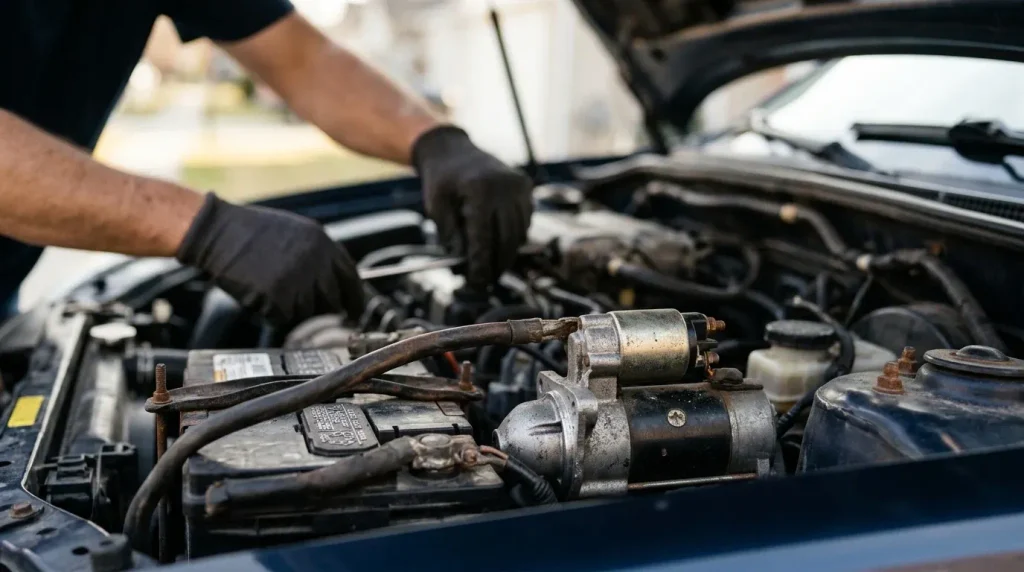
The battery powers the starter motor first, and the starter motor turns the engine until fuel and spark can take over.
When you turn the key or press the start button, a small signal closes a relay or solenoid. That switch then joins the battery to the starter through a thick cable. The starter spins the flywheel, and the engine begins to turn.
The battery also feeds the ignition system during the start. Spark plugs need a timed spark to light the fuel and air mix in each cylinder. The engine control unit also needs power at this point, so it can set fuel delivery and spark timing.
- Battery sends current to the starter solenoid.
- Solenoid joins the battery to the starter motor.
- Starter motor spins the flywheel and cranks the engine.
- Ignition sparks the fuel and air mix.
- Engine runs, and the starter drops out.
What Does the Battery Power When the Engine Is Off?
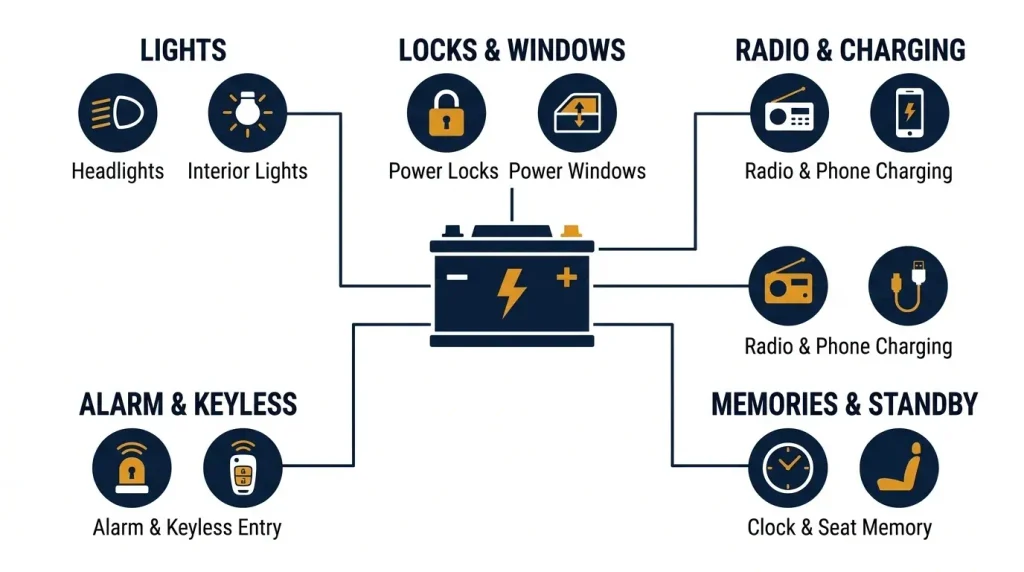
A car battery powers lights, locks, the radio, and the small systems that watch and remember while the car is parked.
Headlights, interior lights, and brake lights can run from the battery with the engine off. Wipers, the horn, power windows, and power locks also draw from it. The radio, phone charger, and USB ports use battery power too, though each one drains the charge.
- Alarm and keyless entry receiver
- Clock, radio presets, and seat memory
- Engine control unit in standby
- Dashcam in parking mode, if fitted
- Telematics and tracking module, if fitted
These draws are small, yet they add up over days. See what drains a car battery when the car sits with the engine off. A car left for weeks can lose enough charge to crank slowly or fail to start.
Tip
Switch off headlights and interior lights before you leave the car, so a short stop does not drain the battery.
What Does the Battery Power While the Engine Is Running?
While the engine is running, the alternator makes most of the power, and the battery acts as a reserve and a stabilizer.
AutoZone describes the car electrical system as a network that sends current to each part that needs it. The alternator is driven by a belt from the engine, and it sends power to lights, fans, pumps, and control units. It also sends power back to the battery, so the battery can start the car again.
The table below shows who does each job while the car runs.
| System | Battery | Alternator |
|---|---|---|
| Engine start | Sends a burst to the starter | Does not start the engine |
| Power, engine off | Powers lights and electronics alone | Makes no power |
| Power, engine on | Adds power at peak demand | Makes most of the power |
| Charge and voltage | Stores energy and steadies voltage | Recharges the battery |
Wikipedia notes that the regulator keeps alternator output between 13.5 and 14.5 volts. The battery fills the gap when lights, heater, and rear defroster run together at idle. It also soaks up spikes, so a surge does not reach a control unit.
Does the Battery Power an Electric Car in the Same Way?
An electric car does not use its 12-volt battery in the same way, because a large traction battery drives the wheels.
The traction battery is the high-voltage pack that moves the car. The 12-volt auxiliary battery still powers lights, locks, wipers, and the control units that run those parts. A DC-to-DC converter charges the 12-volt battery from the traction pack, so there is no alternator and no starter motor to feed.
A hybrid car sits between the two cases. Its traction battery helps move the car, while its 12-volt battery still runs lights and low-power electronics.
What Happens When the Battery Cannot Power the Car?

A weak battery first shows up as a slow crank, dim lights, or a click with no start.
Lights may fade when you try to start the car. The radio or clock may lose its settings after a failed start. A scan tool can help detect a bad battery before it leaves you with no start.
If power fails on the road, learn what happens when a car battery dies and how to respond. A jump start can help, yet a battery that will not hold a charge needs a test and a swap.
Warning
Jump-start a dead battery only with the steps in your manual, and keep metal tools clear of both terminals. A short can spark, melt wiring, and cause burns.
What Can a Car Battery Not Power?
A car battery cannot run a house, a large appliance, or a long camping load, because it is built for short bursts.
It is an SLI battery, not a deep-cycle battery. A full drain can cut its life, so long use with the engine off is a poor match for its design. Air conditioning also needs the engine, because the compressor runs from the engine, not from battery power alone.
A plugged-in scanner can add a small draw, so check the OBD drain on battery before you leave it plugged in for days. Phone charging and a short radio session are fine, yet hours of use with the engine off will drain the charge.
Car Battery
A car battery is the part that starts the engine and powers lights and electronics with the engine off.
Frequently Asked Questions
Can a car battery power the radio with the engine off?
A car battery can power the radio with the engine off, because the radio draws a small current from the battery. The charge will fall with use, so a long session can leave too little power to start the car. Switch the radio off when you leave the car.
Does a car battery power the air conditioning with the engine off?
A car battery does not power air conditioning with the engine off, because the compressor needs the engine to run. The fan may run for a short time, yet it will drain the battery and give no cold air. Start the engine if you need cooling.
Can a car battery power a house appliance?
A car battery cannot power a house appliance on its own, because house appliances need mains power at a far higher voltage. A small inverter can feed a low-power device for a short time, yet the battery will drain fast. Use a mains supply or a generator for house loads.
What powers the car if the battery dies while driving?
The alternator powers the car if the battery dies while driving, because it makes power from the running engine. The battery still steadies voltage, so a dead battery can leave lights dim and systems weak. Stop in a safe place and get the charging system tested.
Does a car battery power the fuel pump?
A car battery powers the fuel pump during the start, because the pump must build fuel pressure before the engine fires. Once the engine runs, the alternator supplies most of the power to the pump circuit. A weak battery can still starve the pump and cause a hard start.
Can a weak battery still power the lights?
A weak battery can still power the lights, because lights need far less current than the starter motor. The lights may look dim, and they may fade more when you try to start the car. Dim lights with a slow crank point to a battery that needs a test.
Conclusion
A car battery powers the starter, lights, and electronics with the engine off, while the alternator takes over on the road. If your lights dim or the crank turns slow, test the battery before it fails on a cold morning.

I’m Alex Rahman, a car enthusiast and automotive writer focused on practical solutions, car tools, and real-world driving advice. I share simple and honest content to help everyday drivers make better decisions.
