
What Are Car Batteries Made Of? Materials Explained
Quick Answer
Most car batteries are lead-acid batteries made of lead plates, sulfuric acid mixed with distilled water, porous separators, lead connectors, and a polypropylene case. Six cells sit inside the case, and each cell holds positive and negative plates in the acid mix.
- Positive plates use lead dioxide, and negative plates use sponge lead.
- The electrolyte is about 35 percent sulfuric acid and about 65 percent water.
- Separators keep the plates apart while ions pass through them.
- AGM and gel types use the same lead-acid chemistry with a different acid holder.
A car battery looks like a plain plastic box with two posts on top. Inside that box sits a set of lead plates in acid, and that mix stores power in chemical form. This guide names each material, explains its job, and shows how flooded, AGM, and gel types differ.
In this article
- What are car batteries made of in simple terms?
- What are the lead plates made of?
- What is the electrolyte inside a car battery?
- What do separators, connectors, and terminals add?
- What is the case made of, and what holds the cells apart?
- How do flooded, AGM, and gel batteries differ in materials?
- How do the materials work together to make power?
- Are car batteries made of lithium?
- What happens to the materials as a battery ages?
- Are the materials inside a car battery dangerous?
- What happens to the materials when a battery is recycled?
- Frequently Asked Questions
- Conclusion
What are car batteries made of in simple terms?
Car batteries are made of lead, sulfuric acid, water, plastic, and small amounts of alloy metals. Lead forms the plates that store and release charge. Sulfuric acid and water form the liquid that lets ions move between those plates.
Plastic forms the case, the cover, and the thin separators between plates. Lead alloy forms the straps that join plates and the posts that link the battery to your car. Each part has one job, and the parts work as a set.
Most starter batteries in petrol and diesel cars use this lead-acid mix. The mix has stayed in use because lead and acid give a strong burst of power for starting, and the parts can be taken apart and reused. When the plates wear down, a scan can detect a bad battery before it leaves you stranded.
What are the lead plates made of?
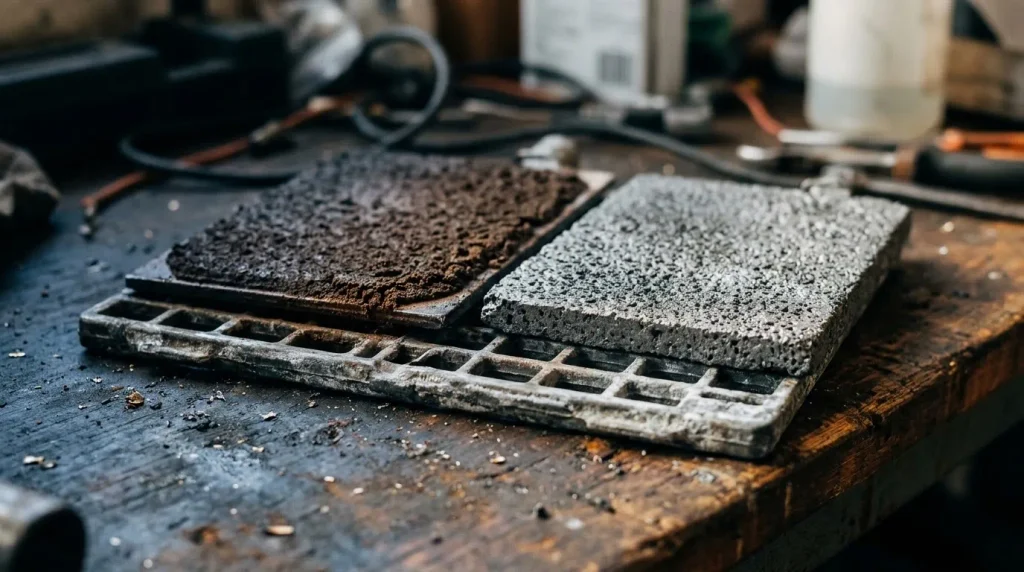
Lead plates are made of a lead grid coated with an active paste. The grid is a frame that holds the paste and carries current to the terminal. The paste is the part that reacts with acid.
Positive plates carry lead dioxide, a dark brown form of lead oxide. Negative plates carry sponge lead, a porous form of pure lead with a large surface. The two plates look alike at a glance, yet their coatings differ, and that difference drives the whole reaction.
Pure lead is soft, so makers add small amounts of other metals to stiffen the grids. Antimony and calcium are the common choices, and tin is used in some grids to help with strength and corrosion. Varta explains lead-acid battery construction in its guide to battery cells, grids, and plates.
Why is pure lead not used for the grids?
Pure lead is too soft to hold its shape through heat, vibration, and charge cycles. A soft grid can bend, shed paste, and let plates touch. Alloy metals add strength without changing the core reaction.
Calcium grids lose less water than older antimony grids, so many sealed batteries use calcium. Antimony grids cope with deep discharge in some designs, yet they lose more water through gassing. The alloy choice shapes maintenance needs, not the basic chemistry.
What is the electrolyte inside a car battery?
The electrolyte is a mix of sulfuric acid and distilled water. It fills the cells and covers the plates, and it carries ions between the positive and negative plates. Without it, the plates could not react and no current would flow.
The mix is about 35 percent sulfuric acid and about 65 percent distilled water in a charged flooded battery. Distilled water matters because tap water carries minerals that can foul plates and speed corrosion. Only distilled water should go into a flooded cell that needs a top-up.
The acid gets weaker as the battery discharges, because acid turns into water during the reaction. Charging reverses that change and restores acid strength. Edmunds gives the specific gravity as 1.265 at 80 degrees Fahrenheit for a charged battery, which shows how much heavier the acid mix is than plain water.
What do separators, connectors, and terminals add?
Separators are thin, porous sheets that sit between positive and negative plates. They stop the plates from touching and shorting, yet they let ions pass through the acid. Common separator materials are polyethylene, fiberglass, and microporous rubber.
Connectors join plates of the same charge into a group, and straps join the groups into cells. These parts are made of lead or lead alloy for high conductivity and acid resistance. The two outer posts, or terminals, are also lead alloy, and they give cables a firm point to grip.
The vent system sits in the cover and lets gas escape in a controlled way. Flooded batteries use caps or a labyrinth cover that keeps liquid in while gas leaves. Sealed AGM and gel batteries use a pressure valve that opens only when gas pressure rises past a set point.
What is the case made of, and what holds the cells apart?
The case is made of polypropylene, a tough plastic that resists acid, heat, and vibration. Internal walls divide the case into six cells, much like an ice cube tray. Each cell holds one set of positive and negative plates in acid.
Each cell makes about 2 volts, and the six cells join in series to make a 12-volt battery. Varta states that a fully charged battery reads 12.72 volts, which is six cells at about 2 volts each plus a small margin from full charge. The case, the walls, and the cover keep each cell apart so the cells work as one unit.
Small loads can drain those cells while the car sits still. Learn what drains a car battery when the car is off if your battery keeps going flat with no clear cause.
6
Cells in a 12-volt battery
Source: Varta
12.72
Volts when fully charged
Source: Varta
1.265
Specific gravity at 80 degrees Fahrenheit
Source: Edmunds
How do flooded, AGM, and gel batteries differ in materials?
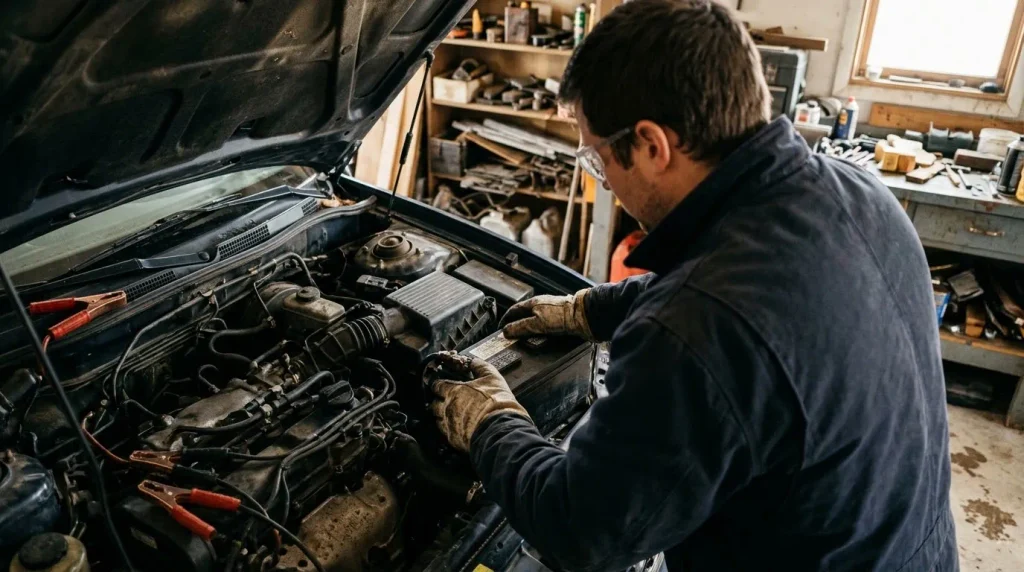
Flooded, AGM, and gel batteries share the same lead plates and the same acid chemistry. They differ in how the acid is held inside the cell. That one change alters spill risk, mounting, vibration resistance, and charging care.
Flooded batteries hold free liquid acid that covers the plates. AGM batteries hold the acid in glass fiber mats pressed between the plates. Gel batteries mix the acid with silica to form a thick gel that stays in place.
The table below compares the three types by the material that holds the acid.
| Battery type | Electrolyte form | Separator or holder | Spill risk |
|---|---|---|---|
| Flooded | Free liquid acid and water | Porous separator sheets | Liquid can spill if tipped |
| AGM | Acid held in glass fiber mats | Glass mat acts as separator | Acid stays in mat, spill risk is low |
| Gel | Acid mixed with silica to form gel | Standard separator, gel holds acid | Gel holds acid in place, spill risk is low |
AGM suits cars with start-stop systems and high electrical loads, because the mats hold the plates tight and resist vibration. Gel suits deep, slow discharge in some off-road and leisure uses, because the gel clings to the plates. Flooded suits plain starting duty at a lower cost, where the car stays upright and the owner can check water when the design allows it.
Tip
Check the label for flooded, AGM, or gel before you add water or pick a charger, because sealed AGM and gel batteries must not be opened.
How do the materials work together to make power?
The materials work through a reversible chemical reaction between lead, lead dioxide, and sulfuric acid. On discharge, both plates react with acid to form lead sulfate and water, and electrons flow out through the terminals. That flow is the current that turns the starter motor.
On charge, the alternator or a charger pushes current back through the battery. The lead sulfate breaks down, the plates return to lead and lead dioxide, and the acid grows strong again. This cycle can repeat for many charges, yet each cycle leaves a small loss behind.
The reaction needs all four parts at once: two different plate coatings, acid, and water. Remove the acid, and the ions have no path. Remove one plate type, and the voltage gap that drives current disappears.
You can charge a car battery with a jump starter in an emergency, yet a jump starter is a short-term aid, not a full charge.
Are car batteries made of lithium?
A normal starter battery is not made of lithium. It uses lead, lead dioxide, sulfuric acid, and water, with plastic and lead alloy parts. Lithium does not appear in that mix.
Lithium-ion packs power many hybrid and electric cars, yet those packs drive the motor, not the starter in the usual sense. Most of those cars still carry a small 12-volt lead-acid battery for lights, locks, and control units. Some micro-hybrid cars use a 48-volt lithium-ion system beside the 12-volt system, as Varta notes in its guide to new battery types.
Do not swap a lead-acid starter battery for a lithium-ion unit unless the car maker approves that exact fit. Charging voltage, cold cranking needs, and battery management differ, and a wrong swap can harm the charging system or leave the car unable to start in cold weather.
What happens to the materials as a battery ages?
Lead sulfate forms on both plates each time the battery discharges. Charging should turn most of it back into lead, lead dioxide, and acid. When a battery sits flat for a long time, some lead sulfate hardens into large crystals that resist charging.
That hardening is called sulfation, and it cuts the plate area that can react. Acid layering can add to the harm, because dense acid sinks and weak acid rises, so only part of the plate works well. Plates can also shed paste, buckle under heat and vibration, and let separators wear through.
Age shows up as slow cranking, dim lights, and a voltage that drops fast under load. A weak battery can also set codes in the car. A dead battery can cause an OBD2 code that points at a sensor or a module instead of the true cause.
Are the materials inside a car battery dangerous?
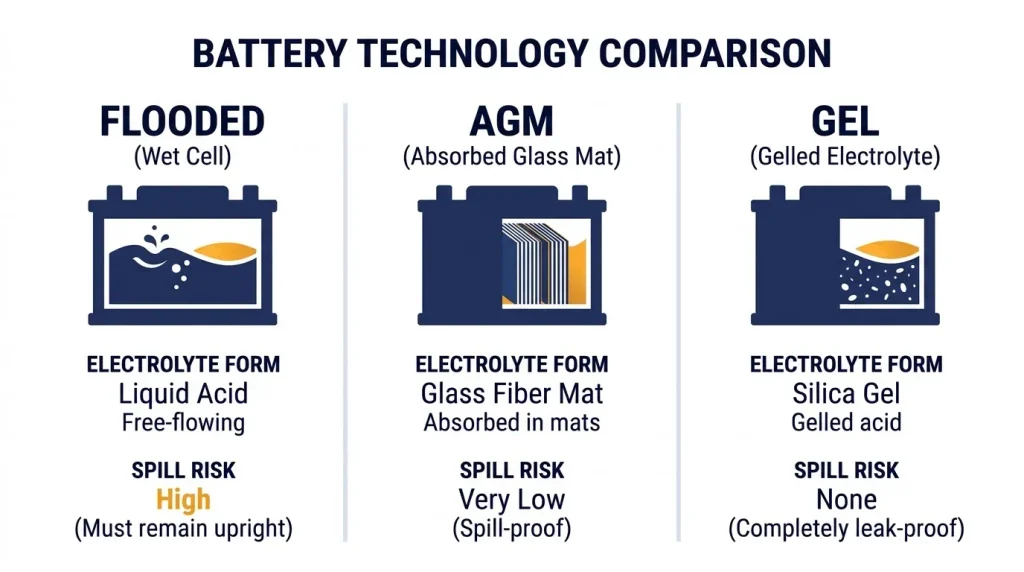
Lead and sulfuric acid are both harmful if they reach skin, eyes, or lungs. Acid burns skin and eyes on contact, and lead dust can harm the nervous system, kidneys, and blood if it is swallowed or breathed in. Children face a higher risk from lead, so keep a damaged battery away from them.
Charging can release hydrogen and oxygen gas, and that mix can catch fire in a closed space. Never lean over a battery while it charges or while you jump-start a car. Work in fresh air, wear eye protection and gloves, and keep sparks and flames away from the posts.
Warning
Acid can burn skin and eyes, and charging gas can catch fire, so wear eye protection and gloves, work in fresh air, and keep sparks away.
If acid touches skin or clothes, rinse the area with plenty of clean water and seek medical help if pain, redness, or eye trouble stays. Do not open a sealed battery to look inside, and do not tip a flooded battery on its side. A cracked case, a swollen case, or a strong rotten egg smell means the battery needs care from a trained fitter.
What happens to the materials when a battery is recycled?
Lead-acid batteries are taken apart at a recycler, and each material goes its own way. Lead plates and posts are melted and refined into new lead for new batteries. Polypropylene cases are cleaned, melted, and made into pellets for new cases.
Acid is drained and neutralized, or treated so it can be reused in other industrial uses. The EPA reports that lead-acid batteries are one of the most recycled products, with 99 percent recycled. That high rate comes from retailer take-back, core charges, and state bans on landfill disposal.
Return a spent battery to a battery retailer or a local household hazardous waste program, and do not put it in the trash or a municipal recycling bin. The EPA states that a lead-acid battery may hold up to 18 pounds of lead and about one gallon of corrosive lead-contaminated sulfuric acid. Safe handling matters at the end of its life.
See the EPA guidance on used household batteries for the return route in your area.
Frequently Asked Questions
What chemical is inside a car battery?
The chemical inside a car battery is sulfuric acid mixed with distilled water, and that mix is called the electrolyte. It fills the cells, covers the lead plates, and carries ions between them during charge and discharge. The acid is corrosive, so treat a leaking battery with care.
Is battery acid the same as shop sulfuric acid?
Battery acid is dilute sulfuric acid mixed with distilled water, while shop sulfuric acid is far stronger and is not a direct swap. A charged flooded battery holds about 35 percent acid and about 65 percent water. Never pour shop acid into a car battery.
Can you add tap water to a car battery?
You should not add tap water to a car battery, because tap water carries minerals that foul plates and speed corrosion. Use distilled water only, and only in a flooded battery with caps that allow a top-up. Sealed AGM and gel batteries must not be opened for water.
Why is a car battery so heavy?
A car battery is heavy because lead makes up much of its weight, and lead is a dense metal. Six cells of lead plates, lead straps, and lead posts add up fast inside a plastic case. That weight is the price of the strong starting current lead-acid chemistry gives.
Do all car batteries use the same materials?
Most starter batteries use the same lead-acid materials, with flooded, AGM, and gel types differing only in how they hold the acid. Hybrid and electric cars add a lithium-ion pack for driving, yet many still use a 12-volt lead-acid battery for lights and control units.
Can you open a car battery to see the plates?
You should not open a car battery to see the plates, because the acid inside can burn skin and eyes and the lead parts pose a health risk. Sealed batteries have no safe opening, and flooded caps are for distilled water only. Leave internal checks to a trained fitter with the right gear.
Conclusion
Car batteries are made of lead plates, sulfuric acid and water, porous separators, lead connectors, and a polypropylene case. If you own a flooded battery, check its type on the label before you add water or pick a charger.

I’m Alex Rahman, a car enthusiast and automotive writer focused on practical solutions, car tools, and real-world driving advice. I share simple and honest content to help everyday drivers make better decisions.
