When Did EOBD Become Mandatory? EU Petrol and Diesel Dates
Quick Answer
EOBD became mandatory in the European Union in stages, not on one day. For ordinary passenger cars up to 2,500 kg, it applied to all new petrol vehicles from 1 January 2001 and to all new diesel vehicles from 1 January 2004. New vehicle types had to comply a year earlier, in 2000 and 2003 respectively.
That staged answer is the part most short summaries leave out. The year for a particular car depends on its fuel, its weight class, and whether the date refers to a new model being approved or to every new vehicle being registered.
Why There Is No Single EOBD Date
EOBD stands for European On-Board Diagnostics. It is the European version of the on-board diagnostic system used to monitor emission-related parts, store standard fault codes, and warn the driver when a fault could push emissions above the permitted level.
The rules arrived with the Euro 3 emission standards under Directive 98/69/EC, adopted on 13 October 1998. It gave manufacturers a timetable tied to type approval, the process by which a new vehicle design is certified before it can be sold.
That is why two dates appear for the same fuel. The earlier date is for a newly approved type, meaning a new model or a substantially changed version. The later date is for all new vehicles in that category, including models already approved. Diesel cars also came later, because diesel diagnostic technology was less developed at the time.
The Mandatory Dates by Vehicle Type
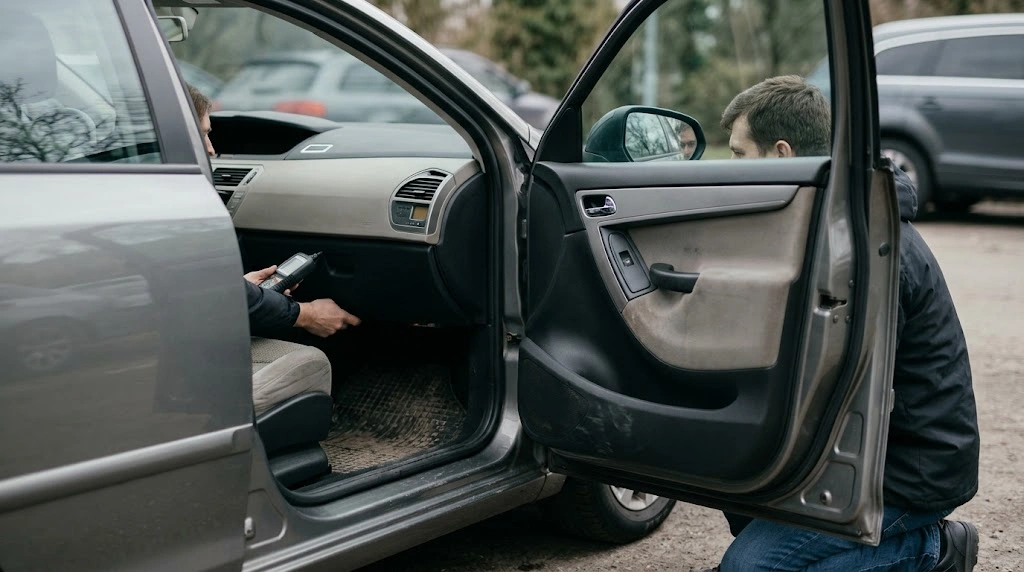
The table below gives the headline dates for the European Union. They are the dates most often used when checking whether a European-market car should have EOBD.
| Vehicle group | New vehicle types | All new vehicles |
|---|---|---|
| Passenger cars up to 2,500 kg, petrol | 1 January 2000 | 1 January 2001 |
| Passenger cars up to 2,500 kg, diesel | 1 January 2003 | 1 January 2004 |
| Heavier passenger cars and light commercial vehicles | Phased in later | Petrol from 1 January 2002; diesel from 1 January 2007 |
The first two rows cover the common case: an ordinary car, with no more than eight passenger seats and a maximum mass of 2,500 kg. This is the group most readers are asking about.
The third row needs more care. Heavier passenger cars and light commercial vehicles did not all follow one date, because their treatment depended on the exact vehicle class. The dates shown are the later start dates given in published summaries for those groups: petrol from 2002 and diesel from 2007. Near those boundaries, model-specific type-approval details matter more than a general table.
For background on the system itself, see what EOBD is and what it monitors. EOBD was an emissions-monitoring rule first, and a diagnostic convenience second.
What “New Type” and “All New Vehicles” Actually Mean
A new type date does not mean that every car sold after that day had EOBD. It means that a manufacturer seeking approval for a new design from that date had to meet the requirement. Existing designs could continue for a limited period until the all-new-vehicles date arrived.
Registration date is therefore a useful guide, but it is not the whole story. A petrol car first registered in late 2000 might already be EOBD-compliant if it was a newly approved model, or it might not be if it was an older design still being sold. A petrol car first registered in 2001, after the all-new-vehicles date, should be compliant if it was sold as a new European-market vehicle in the covered category.
Model year adds another layer of confusion. A car can be described as a 2001 model yet have been built or registered in a different calendar year, and imported vehicles may have been built for a different market. For EOBD, the safer check is the first registration date in the European market combined with the fuel and vehicle class, not the model-year label alone.
What Became Mandatory, and What Did Not
When EOBD became mandatory, a covered vehicle had to provide standardised access to emission-related diagnostics. That included a standard 16-pin diagnostic connector, standard fault codes for emission-related problems, live data for key values, and a malfunction indicator light to warn the driver.
The point was inspection and repair, not just fault-finding in a workshop. A standard system meant an emissions test or a roadside check could read the same basic information from different makes, and an independent garage was not locked out by a completely manufacturer-only plug or code format.
What EOBD did not do is just as important. It did not require older cars to be retrofitted, and it did not cover every system in the car. Manufacturer-specific features, such as many body or airbag functions, can still need a manufacturer-level tool even on a fully EOBD-compliant car.
Motorcycles, heavy trucks, and purely electric vehicles are also outside this passenger-car timeline. They have their own rules, or, for a battery-electric car, no exhaust emissions for EOBD to monitor.
How the European Dates Compare With the United States
The United States moved first. OBD-II became the standard for petrol passenger cars and light trucks for the 1996 model year, several years before the European system. Europe then built EOBD on the same basic idea, with European emission thresholds and its own timetable.
That gap explains a common scanner surprise. A European car from 1998 can have a diagnostic socket and some manufacturer diagnostics without being fully EOBD-compliant, while a United States car of the same year would normally be OBD-II compliant. A socket is a clue, not proof.
For a fuller comparison of the two systems, see the difference between OBD2 and EOBD. The United States timeline is also covered separately in when OBD2 became standard. Keeping the two timelines apart avoids the most common error: applying the 1996 United States date to a European car.
How to Check Whether Your Car Should Be EOBD
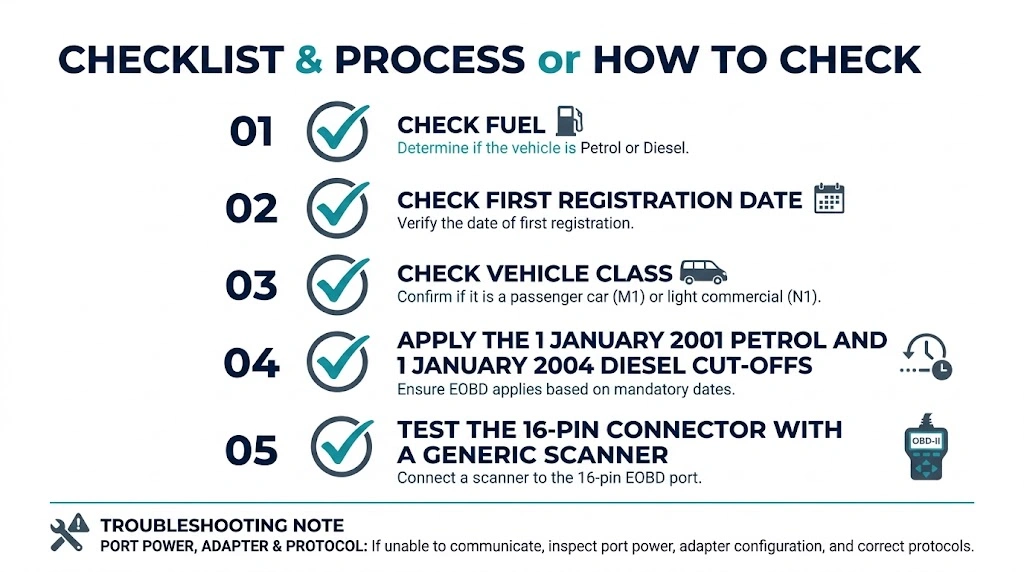
Start with three facts: the fuel, the first registration date, and whether the vehicle is an ordinary passenger car or a heavier or commercial vehicle. Then apply the table above. A European-market petrol passenger car first registered on or after 1 January 2001 should be EOBD-compliant. The equivalent diesel cut-off is 1 January 2004.
Next, look for the standard 16-pin connector, usually under the dashboard on the driver side, and try a generic scanner. If the scanner connects, reads codes, and shows readiness monitors, that is strong practical evidence. If it cannot connect, do not jump to a conclusion about the car alone: check the port power, the adapter, and the protocol setting first, because older European cars used ISO 9141-2 or KWP2000 before CAN became widespread.
For a step-by-step compatibility check, see how to check vehicle OBD2 compatibility. If the car was imported, converted, or first registered outside the European Union, treat the general dates as a starting point only. In that case, the market the car was built for matters as much as its age, as explained in whether OBD2 is the same worldwide.
Tip
If a car sits within a year of a cut-off date, check the registration document and the emissions or type-approval information rather than relying on a seller’s model-year claim. A few months can be the difference between a fully standard system and a manufacturer-only setup.
Common Date Mistakes to Avoid

The first mistake is quoting 2001 for every car. That date is correct for all new ordinary petrol passenger cars, but it is wrong for diesel cars, which followed in 2004, and for heavier and commercial vehicles, which followed later still.
The second mistake is quoting 2000 for every petrol car. The year 2000 was the new-type date, not the date by which every new petrol car had to comply. Both dates are real; they simply answer different questions.
The third mistake is assuming that a car without full EOBD has no diagnostics at all. Many pre-EOBD European cars had manufacturer systems, and some had a similar-looking socket. What they lacked was the guaranteed standard access, code format, and monitoring scope that the mandate required.
The fourth mistake is treating EOBD2 as a separate European mandate. The term is often used in marketing, but the European requirement to know is EOBD itself. A product labelled EOBD2 may support extra manufacturer features, but that label alone does not change the legal dates above.
Finally, later Euro standards did not replace EOBD with something unrelated. Euro 4, Euro 5, and Euro 6 tightened emission limits and monitoring thresholds, but the basic idea remained: a standard way to detect emission-related faults and make that information available.
Related Product
OBD2 / EOBD Scanner
A generic scanner is the practical way to confirm standard EOBD access on a car near a cut-off date, by checking codes, live data, and readiness monitors.
As an Amazon Associate, we earn from qualifying purchases.
Frequently Asked Questions
When did EOBD become mandatory for petrol cars?
For ordinary passenger cars up to 2,500 kg in the European Union, EOBD applied to new vehicle types from 1 January 2000 and to all new vehicles from 1 January 2001. The 2001 date is the one to use when asking whether a newly registered petrol car should have the system.
When did EOBD become mandatory for diesel cars?
For the same ordinary passenger-car group, diesel EOBD applied to new vehicle types from 1 January 2003 and to all new vehicles from 1 January 2004. A European diesel car first registered in 2002 therefore cannot be assumed to be fully EOBD-compliant, even if it has a diagnostic socket.
Did EOBD become mandatory on the same date in every European country?
The timetable came from European Union law, so member states applied the same framework, but local registration practice and vehicle history can still differ. An imported car, a car first registered outside the EU, or a vehicle with a complex approval history should be checked individually rather than assumed to follow the headline date.
Does a 2000 petrol car have EOBD?
It may do, but it is not guaranteed by the all-new-vehicles date. A newly approved petrol model from 2000 could already comply, while an older approved model sold in 2000 might not. Check the first registration date, the vehicle class, and whether a generic scanner can read standard codes and readiness data.
Is EOBD the same as OBD2?
They are closely related but not identical. EOBD is the European version of the on-board diagnostic approach used in the United States as OBD-II, with the same basic connector and standard-code idea but European emission thresholds and a later timetable. A generic OBD-II scanner can normally read the standard EOBD information on a compliant car.
Do older cars need to be retrofitted with EOBD?
No. The mandate applied to new vehicle types and then to all new vehicles from the dates above. It did not require owners to retrofit EOBD to cars built before those dates. An older car may still have manufacturer diagnostics, but it is not required to provide the full standard EOBD interface.
Conclusion
EOBD did not arrive on a single day, and that is the key to using its dates correctly. Remember the two headline cut-offs for ordinary passenger cars: 1 January 2001 for petrol and 1 January 2004 for diesel, with new types a year earlier in each case. Heavier and commercial vehicles followed later, so check the vehicle class before applying those dates. For any car near a boundary, first registration date, fuel, and a simple generic scan will usually settle the question faster than a model-year claim.

I’m Alex Rahman, a car enthusiast and automotive writer focused on practical solutions, car tools, and real-world driving advice. I share simple and honest content to help everyday drivers make better decisions.
