What Is SAE J1850 OBD2? VPW, PWM & Scan Tool Guide
Quick Answer
SAE J1850 is a legacy OBD2 communication protocol used in many vehicles built between roughly 1996 and 2007, most notably General Motors and Ford products. It defines how the engine computer talks to a scan tool and comes in two incompatible variants: VPW at 10.4 kbps (primarily GM) and PWM at 41.6 kbps (primarily Ford).
What SAE J1850 Actually Is
SAE J1850 is a technical standard for a “Class B” data communication network in vehicles. In plain terms, it is one of the languages a car’s computers can use to exchange diagnostic information with a scan tool through the OBD2 port.
The standard was written by the Society of Automotive Engineers and was incorporated into U.S. emission regulations as an approved on-board-to-off-board communication method for early OBD2 vehicles[reference:0]. It was never the only legal option — ISO 9141-2 and later ISO 14230 were also permitted — but it became the dominant choice for GM and Ford during the first decade of OBD2[reference:1].
What makes J1850 confusing for many people is that “SAE J1850” is an umbrella term. It contains two separate physical implementations that share a name but do not talk to each other directly. A scanner that supports one will not automatically work on a vehicle using the other.
The Two Variants: VPW and PWM
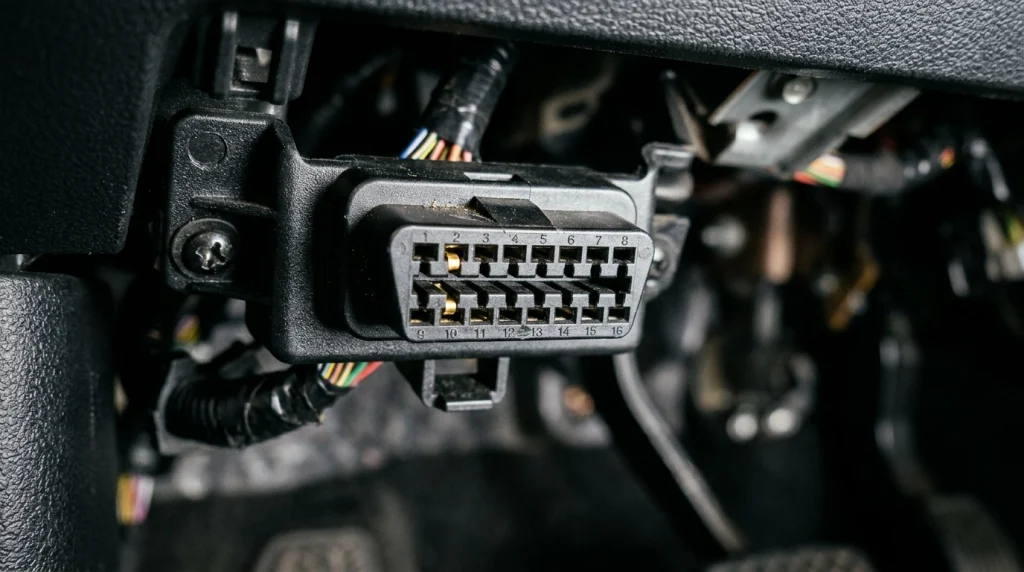
The two J1850 variants differ in speed, wiring, and the manufacturers that adopted them. The table below summarizes the practical differences.
| Variant | Speed | Bus Type | Typical Manufacturer | OBD2 Pins Used |
|---|---|---|---|---|
| J1850 VPW | 10.4 kbps | Single wire, variable pulse width | General Motors (GM, Chevrolet, Cadillac, etc.) | Pin 2 only |
| J1850 PWM | 41.6 kbps | Two-wire differential bus | Ford, Lincoln, Mercury | Pins 2 and 10 |
The speed difference is significant in practice. PWM’s 41.6 kbps bus transfers data roughly four times faster than VPW’s 10.4 kbps bus, but both are slow by modern CAN bus standards. The wiring difference matters more for diagnosis: VPW uses only Pin 2, while PWM uses Pins 2 and 10 as a differential pair[reference:2].
How to Tell Which J1850 Variant Your Vehicle Uses
The fastest way to identify the protocol is to look at the metal contacts inside the OBD2 connector under the dashboard. You do not need a scanner for this check.
If you see metal contacts on Pins 2, 4, 5, and 16, but not Pin 10, the vehicle is almost certainly using J1850 VPW. If Pins 2 and 10 are both populated along with 4, 5, and 16, the vehicle is using J1850 PWM[reference:3].
This visual check is not infallible because manufacturers sometimes populate unused pins, but it is a reliable first indicator. For a more complete breakdown of what each pin does, see this OBD2 port pinout guide. If the connector has no contacts on Pin 2 at all, the vehicle is probably not using J1850 and may be on ISO 9141-2 or CAN instead.
Which Vehicles Used SAE J1850
J1850 was primarily a domestic American protocol during the pre-CAN era. GM used VPW across a wide range of cars, trucks, and SUVs. Ford used PWM on most of its OBD2 vehicles from the late 1990s through the mid-2000s. Chrysler, European brands, and most Asian imports generally chose ISO 9141-2 or KWP2000 instead[reference:4].
This means J1850 is most likely to appear on:
- GM vehicles from roughly 1996 to 2007, including Chevrolet, GMC, Pontiac, Buick, Cadillac, and Oldsmobile.
- Ford vehicles from roughly 1996 to 2007, including Ford, Lincoln, and Mercury.
There are exceptions. Some vehicles from those years may use ISO protocols even within the same brand family, and some later models switched to CAN before the 2008 mandate. The protocol was not tied to the brand name alone; it was tied to the engine and emissions computer architecture of the specific model year.
For a broader explanation of how J1850 fits into the OBD2 timeline, including the 2008 CAN bus mandate, this guide on whether all OBD2 vehicles use CAN bus provides useful context.
Why J1850 Matters for Scan Tool Selection
A scan tool must support the specific J1850 variant used by the vehicle. Many modern budget scanners advertise “OBD2 compatibility” but only support CAN bus, which became mandatory in 2008. Those tools will power on when plugged into a 1999 GM truck, but they will fail to communicate with the engine computer.
When shopping for a scanner for a J1850 vehicle, look for explicit support for SAE J1850 VPW and SAE J1850 PWM in the product specifications. Scanner manufacturers such as Autel list these protocols individually, and some budget brands do not[reference:5].
If a scanner supports the protocol but still shows “NO DATA” or “Unable to Connect,” the issue is often not the protocol itself but power, ground, or pin contact problems. This guide on fixing “NO DATA” errors walks through the common causes.
SAE J1850 vs. CAN Bus: What Changed
CAN bus, standardized under ISO 15765-4, replaced J1850 and the ISO protocols because it is faster, more reliable, and simpler to wire. The U.S. EPA mandated CAN for all light-duty vehicles sold from model year 2008 onward, which effectively ended J1850’s use in new production vehicles[reference:6].
The practical difference for a technician or DIYer is not just speed. CAN bus supports multiple modules communicating on the same bus without a single “master” controller. J1850 was a slower, simpler network designed for emissions diagnostics, not for the growing number of electronic systems in modern cars.
That does not mean J1850 is irrelevant. Millions of 1996–2007 vehicles are still on the road, and many of them are not yet old enough to be considered classics. Anyone working on a GM or Ford from that era needs a way to communicate with J1850.
Practical Troubleshooting for J1850 Vehicles
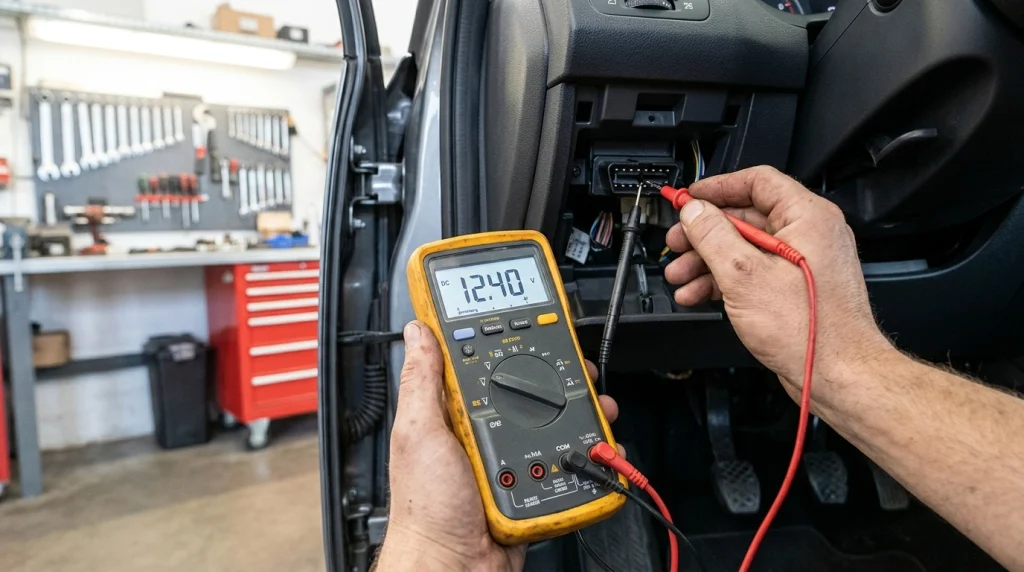
J1850 communication problems usually fall into three categories: the scanner does not support the protocol, the OBD2 connector is damaged or unpowered, or the vehicle’s data bus has an electrical fault.
Start with the simple checks. Confirm that the scanner explicitly lists J1850 VPW or PWM. Confirm that Pin 16 has 12 volts with the key on and that Pins 4 and 5 have good ground continuity. Inspect the connector pins for corrosion or pushback. If those pass, the problem may be a shorted or open data line, which requires a wiring diagram for the specific vehicle.
Tip
A quick bench test for a J1850 VPW scanner is to connect it to a known-good GM vehicle from the same era. If it communicates there but not on the problem vehicle, the fault is in the vehicle, not the tool.
One common mistake is assuming that a vehicle with an OBD2 connector under the dash must be fully OBD2-compliant on all pins. Early OBD2 vehicles sometimes had incomplete pin implementations, and aftermarket radios or remote starters can backfeed voltage onto data lines and disrupt communication.
Frequently Asked Questions
Is SAE J1850 the same as OBD2?
No. OBD2 is the overall standard for the connector, diagnostic trouble codes, and test modes. SAE J1850 is one of several communication protocols that can run underneath OBD2. A vehicle can be OBD2-compliant and use J1850, ISO 9141-2, KWP2000, or CAN.
Will a modern OBD2 scanner work on a J1850 vehicle?
Only if the scanner explicitly supports SAE J1850 VPW or PWM. Many inexpensive Bluetooth dongles and budget code readers only support CAN bus and will not communicate with a pre-2008 GM or Ford vehicle.
Can I use a J1850 VPW scanner on a J1850 PWM vehicle?
No. VPW and PWM are different physical layer implementations. A scanner that supports only one variant will not communicate with a vehicle using the other, even though both carry the “SAE J1850” label.
What pins does SAE J1850 use on the OBD2 connector?
J1850 VPW uses Pin 2 as a single data line. J1850 PWM uses Pin 2 (Bus+) and Pin 10 (Bus−) as a differential pair. Both variants use Pins 4 and 5 for ground and Pin 16 for battery power.
Why did manufacturers stop using SAE J1850?
The U.S. EPA required CAN bus for all light-duty vehicles from model year 2008 onward. CAN is faster, supports more modules, and reduces wiring complexity, so the industry moved away from J1850 and the older ISO protocols.
How can I tell if my car uses J1850 VPW or PWM without a scanner?
Look at the metal contacts in the OBD2 connector. If Pin 10 is empty, the vehicle likely uses VPW. If Pins 2 and 10 both have metal contacts, it likely uses PWM. This visual check is a useful first step before plugging in a tool.
Conclusion
SAE J1850 is not a single protocol but a family of two distinct OBD2 languages that dominated GM and Ford vehicles before the CAN bus mandate. The practical takeaway is straightforward: if you work on a 1996–2007 domestic vehicle, check which J1850 variant it uses before assuming a scan tool will connect. The pin check takes less than a minute, and it prevents the most common “scanner won’t communicate” frustration.
For vehicles from this era, protocol support is the first filter when choosing a diagnostic tool. After that, the usual checks — power, ground, and connector condition — resolve most remaining communication problems.

I’m Alex Rahman, a car enthusiast and automotive writer focused on practical solutions, car tools, and real-world driving advice. I share simple and honest content to help everyday drivers make better decisions.
