What Is OBD2 Mode 0A? Permanent DTCs Explained
Quick Answer
OBD2 Mode 0A is the diagnostic service that reports permanent, emissions-related trouble codes stored after codes have been cleared. A code shown here cannot be erased with a scan tool or by disconnecting the battery; it clears only when the vehicle itself runs the related monitor, passes it, and confirms the fault is gone.
Mode 0A often causes confusion because it looks like an ordinary code list. It is not. It is a separate check with a specific purpose: to show whether a previously confirmed emissions fault is still waiting for the vehicle to prove that a repair worked.
What Mode 0A Actually Requests
Mode 0A, also written as Service $0A or Mode 10, asks the vehicle for emissions-related codes with permanent status. In plain terms: “After the last clear or reset, which confirmed emissions codes are you still holding as permanent?”
These codes are stored in non-volatile memory, which keeps its contents when power is removed. That is why disconnecting the battery does not remove a permanent code. The code is a record that a confirmed fault occurred and that the vehicle has not yet completed the verification needed to remove it.
Mode 0A is also limited in scope. It covers emissions-related codes, not every fault a manufacturer-specific tool can see, so a Mode 0A result should not be treated as a complete vehicle health report.
Key Insight
Do not confuse Service $0A with PID $0A. Service $0A is for permanent codes; PID $0A, under Mode $01, is fuel pressure. The same value means different things in different places.
How Mode 0A Differs From Modes 03, 07, and 04

Each of these modes answers a different question, and mixing them up is a common source of false conclusions.
| Mode | What it shows or does | Can a scan tool clear it? |
|---|---|---|
| Mode 03 | Confirmed, stored emissions-related codes | Yes, through Mode 04 |
| Mode 07 | Pending codes detected in the current or last driving cycle | Yes, through Mode 04 |
| Mode 04 | Clears stored codes, freeze-frame data, and related emissions information | This is the clear command itself |
| Mode 0A | Permanent codes retained after a clear or reset | No, only the vehicle can remove it after verification |
After a repair, Mode 03 may show no codes and the check engine light may be off, yet Mode 0A can still list the old code. That does not automatically mean the repair failed; it means verification has not finished. The companion guide to what a permanent OBD2 code is covers that code type in more detail, while this article focuses on the Mode 0A service that reports it.
Why a Permanent Code Can Stay After You Clear Codes
Permanent codes exist to close a loophole: before they were required, a driver could clear a stored code shortly before an inspection, turn off the light, and pass before the vehicle retested the faulty system. Mode 0A lets inspection equipment see that a confirmed fault was recently cleared and has not yet been verified as fixed.
That is why Mode 04 behaves differently from what many people expect. It clears confirmed and pending codes, freeze-frame data, and related emissions information, and it resets readiness monitors, but it does not give the scan tool authority over the permanent-code record.
A permanent code is therefore not, by itself, proof that the car is still broken. A repaired sensor or emissions component can be working correctly while the code remains, simply because the right driving conditions have not yet occurred for the monitor to run and pass.
How a Mode 0A Code Is Actually Cleared
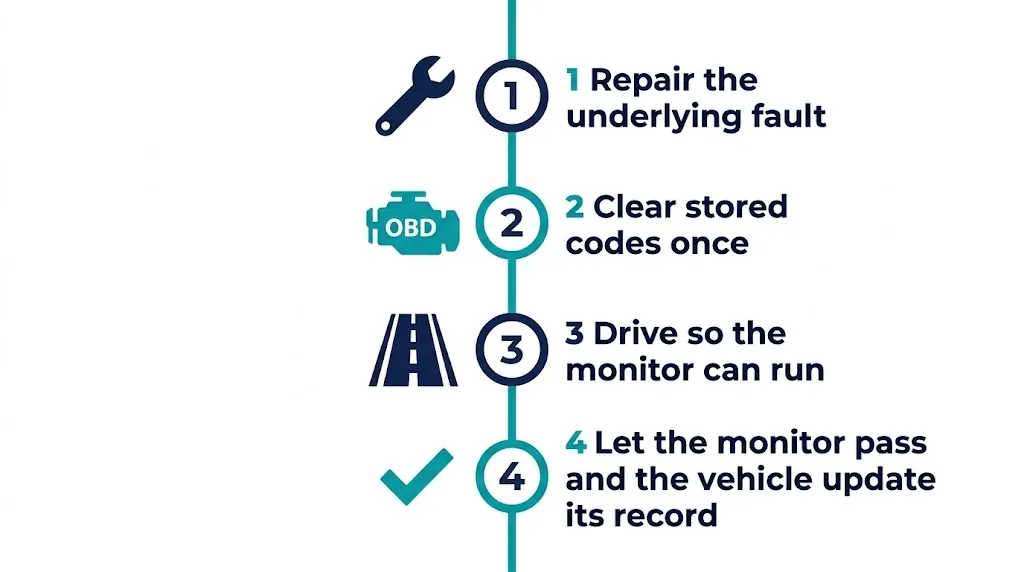
There is no button, menu option, or battery trick that reliably clears a Mode 0A code. The clearing process is controlled by the vehicle, and it follows a logical order rather than a fixed number of miles.
- Repair the underlying fault. If the cause is still present, the monitor will fail again and the permanent code will stay. No amount of driving will clear a code for a fault that has not been fixed.
- Clear stored codes once, if needed. This turns off the light but does not clear the Mode 0A record, and it resets readiness monitors.
- Drive in conditions that let the relevant monitor run. Many monitors need cold starts, steady cruising, idling, and deceleration. Short trips alone may not satisfy them.
- Let the monitor pass and the vehicle update its record. After a passing result, the vehicle can remove the permanent code, often after an ignition cycle. Exact timing varies by manufacturer, system, and model year.
Snap-on’s OBD-II service-mode guide describes the same pattern: permanent codes clear automatically after repairs are made and the module completes its monitor testing procedure. Some systems have more detailed conditions, such as cumulative engine-running time, time above a set speed, and idle time before an ignition cycle. Treat those as examples, not as a universal recipe; the vehicle-specific monitor is the authority.
That is why how OBD2 readiness monitors work matters here: a monitor that has not run cannot pass, and one that has not passed cannot clear the permanent code it is checking.
What to Check When Mode 0A Shows a Code but the Light Is Off
A Mode 0A code with no check engine light is common. Start by separating three questions: Is the fault still present, has the repair been verified, and is an inspection coming up?
- Check Mode 03 first. If the same code is confirmed in Mode 03, treat the fault as still active. If Mode 03 is clear, the Mode 0A code is more likely a verification record.
- Check the related monitor status. If the monitor is incomplete, the vehicle has not yet verified the repair. If it is complete and passing but the code remains, allow an ignition cycle, recheck, and look for manufacturer-specific conditions.
- Check for a new pending code. A pending result in Mode 07 can signal that the fault is returning, even before it becomes confirmed again.
- Do not clear codes again in a loop. Repeated clearing resets monitors and restarts verification, delaying clearing rather than speeding it up.
If the code keeps returning, or the monitor never completes, that points to an unresolved fault, an unmet monitor condition, or a deeper diagnostic issue. Live data, freeze-frame data, and the manufacturer’s procedure for that code are then more useful than another clear command.
Warning
Do not clear codes just before an emissions test to hide a fault. Clearing resets readiness monitors, and a Mode 0A record can still be visible to inspection equipment, often leading to a failed or incomplete test.
What Mode 0A Cannot Tell You
Mode 0A has clear limits. First, it is a CAN-only service, so a vehicle or module that does not support it over CAN may not respond at all. Some sources note it may be supported only by US vehicles and not by some EOBD vehicles, so an empty result does not always mean a clean result.
Second, not every scan tool shows Mode 0A clearly. Some list it as “Permanent DTCs,” “Permanent Codes,” or “Mode $0A,” while others show only confirmed and pending codes. A basic reader supporting only Modes 01, 03, 04, and 07 may not display permanent codes at all, and that is a tool limitation, not proof that none exists.
Third, Mode 0A gives the code, not the cause. A catalyst-efficiency code can be triggered by the catalyst, an oxygen sensor, an exhaust leak, or a fuel-control problem. The code narrows the system; diagnosis still has to find the fault.
Finally, permanent-code rules and inspection treatment vary by jurisdiction and vehicle. Check local inspection requirements before assuming a Mode 0A code will automatically pass or fail a test.
How to Read Mode 0A on a Scanner
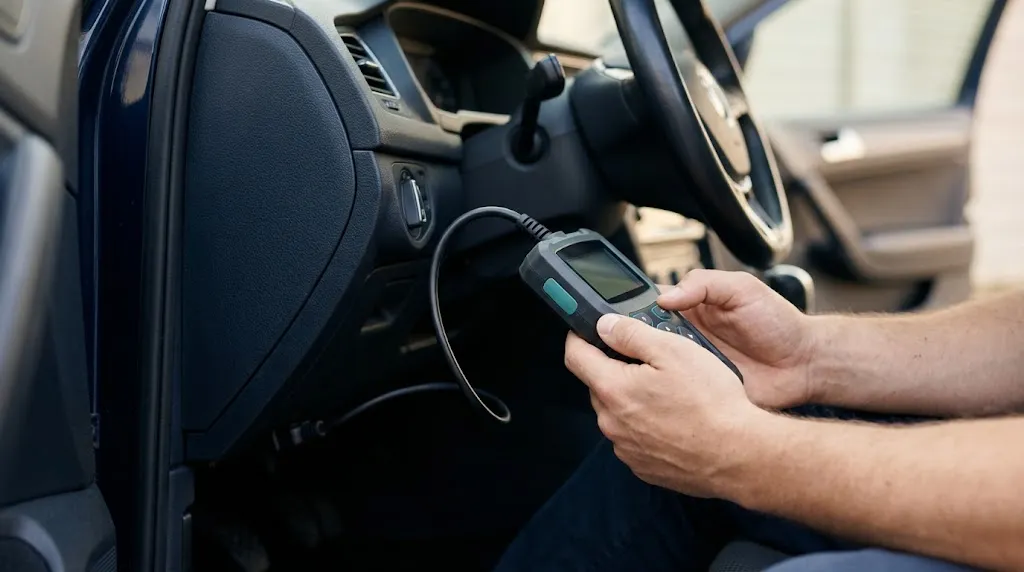
Scanners that support Mode 0A usually place it near the other code lists. Look in the diagnostic or trouble-code menu for Permanent DTCs, Permanent Codes, Mode $0A, Mode 10, or a permanent-code section inside the full scan.
A practical reading sequence is:
- Connect the scanner with the ignition on, following the tool’s instructions.
- Read confirmed codes first, then pending codes, then permanent codes. Recording all three lists separately prevents confusion later.
- Note the exact code, the category it came from, and whether the check engine light is on.
- Check readiness monitor status for the system linked to the code.
- After a repair, recheck Mode 0A only after the relevant monitor has had a realistic chance to run and pass.
If the scanner shows a permanent code but no confirmed code, note it as “permanent code only, light off, monitor incomplete” rather than “code still present,” because the two situations call for different next steps. For the confirmed-code side, the guide to what OBD2 Mode 03 does explains how confirmed codes are retrieved and why they matter.
Tip
Before an emissions test, check Mode 03, Mode 07, Mode 0A, and readiness monitors together. That catches cases where the light is off but a permanent code or incomplete monitor would still cause a problem.
Related Product
OBD2 Scanner With Permanent DTC Support
A scanner that lists permanent codes separately helps you check Mode 0A and readiness monitors after a repair, instead of guessing from the light alone.
As an Amazon Associate, we earn from qualifying purchases.
Frequently Asked Questions
Is Mode 0A the same as Mode 10?
Yes. Mode 0A is the hexadecimal name, and Mode 10 is the same service expressed in decimal, since hexadecimal 0A equals decimal 10. Scanner menus may use either label, so check for both names if you cannot find a permanent-code menu.
Does Mode 0A work on every car?
No. Mode 0A is defined for CAN-based diagnostics, and support varies by vehicle, model year, and market. Some non-CAN or EOBD modules may not respond, and an unsupported request is not a confirmed clean result.
Can a basic code reader show Mode 0A?
Some can, but many show only confirmed and pending codes. Confirm that its specifications or menu include permanent DTCs, Mode $0A, or Mode 10 before relying on it for this check.
Will a Mode 0A code fail an emissions test if the light is off?
It can, depending on the inspection program and equipment used. Inspection systems can read permanent codes even when the light is off, and an unverified code may be treated as not ready or non-compliant. Check local rules before booking a test.
How many drive cycles does it take to clear a Mode 0A code?
There is no single number for every vehicle and fault. Clearing depends on the repair, the monitor, its enabling conditions, and the manufacturer’s rules. Some cases need only a passing monitor and an ignition cycle; others need several trips or specific driving conditions.
Does disconnecting the battery clear Mode 0A?
No. Permanent codes are held in non-volatile memory, so removing battery power does not erase them. Disconnecting the battery can clear stored codes and reset monitors, delaying verification instead of helping it.
Conclusion
Mode 0A is best understood as a verification record, not another list of current faults. It shows which emissions codes the vehicle is still holding as permanent after a clear, and it stays until the related monitor passes and confirms the repair. Check confirmed, pending, and permanent codes together, confirm the relevant monitor status, and give the vehicle the driving conditions it needs to complete its test. If the code returns as confirmed, or the monitor never completes, the next step is diagnosis, not another reset.

I’m Alex Rahman, a car enthusiast and automotive writer focused on practical solutions, car tools, and real-world driving advice. I share simple and honest content to help everyday drivers make better decisions.
