What Is ISO 15765 OBD2? CAN Diagnostics Explained
Quick Answer
ISO 15765 is the family of standards for vehicle diagnostics over Controller Area Network (CAN). In everyday OBD2 use, it usually means ISO 15765-4: the CAN-based rules that let a scan tool talk to a car’s emissions systems through pins 6 and 14, normally at 500 kbit/s or 250 kbit/s.
When a scanner shows “ISO 15765” or “CAN,” it is not naming a fault code or a brand of tool. It is naming the language and wiring rules the tool and car have agreed to use for that session. That distinction matters, because a car can have a good OBD2 port and still fail to connect if the tool tries the wrong protocol, speed, or address.
ISO 15765 is also broader than one scanner setting. It covers general information, a transport layer for long messages, unified diagnostic services on CAN, and the specific emissions rules used for legislated OBD2. The family also explains why some messages arrive in one frame and others need several.
What ISO 15765 Actually Means
ISO 15765 carries the full title “Road vehicles — Diagnostics on Controller Area Networks (CAN),” later retitled in some parts as “Diagnostic communication over Controller Area Network (DoCAN).” The number is the series; the part after the dash tells you which job that document does. A reference without a part number is therefore shorthand for the family, not for a single rulebook.
CAN itself is the underlying network, defined mainly by ISO 11898. It is a two-wire, message-based network used all over a modern car, not only for diagnostics. ISO 15765 sits on top of that network and defines how diagnostic test equipment should use it: how to address a control unit, how to split and reassemble messages, and, for emissions work, which physical details a compliant vehicle must follow.
That layering clears up a common confusion: OBD2 is the diagnostic job, CAN is the road those messages travel on, and ISO 15765 is the traffic rules for diagnostic messages on that road.
Key Insight
Saying a car “uses CAN” does not by itself say which diagnostic standard it uses. ISO 15765-4 is the part that ties CAN to legislated OBD2, with fixed expectations for addressing, speed, and connector pins.
The Parts of ISO 15765, in Plain Terms
The original series had four parts; later revisions reorganised some material, with Part 3 largely replaced by ISO 14229-3 and a newer Part 5 covering the network connected to the diagnostic connector.
| Part | What it covers | Why it matters |
|---|---|---|
| Part 1 | General information and use cases | Sets the scope for CAN diagnostics |
| Part 2 | Transport protocol and network layer services, called ISO-TP or CAN-TP | Splits long messages across CAN frames |
| Part 3 | Unified diagnostic services on CAN, now largely ISO 14229-3 | Richer sessions beyond basic emissions checks |
| Part 4 | Requirements for emissions-related systems | The OBD2 rulebook most tools use |
Part 2 is useful far beyond emissions testing. The SNV listing for ISO 15765-2:2016 describes it as a transport protocol and network layer service for CAN-based vehicle networks, defined in line with ISO 14229-1 and ISO 15031-5 but not limited to them. The same splitting and flow-control mechanism can therefore carry OBD2 requests, UDS sessions, and many manufacturer diagnostic messages. Part 4 is narrower: it fixes the details that make emissions diagnostics interchangeable between brands.
How a Diagnostic Message Travels Over CAN
A classic CAN frame carries at most 8 data bytes. That is enough for a short request, such as asking for engine speed, but not for a 17-character vehicle identification number, a list of stored codes, or a longer response. ISO 15765-2 solves that limit without changing the CAN frame itself.
For a short payload, the tool sends a Single Frame. The first byte tells the receiver how many useful bytes follow. For a longer payload, the sender starts with a First Frame that announces the total length. The receiver answers with a Flow Control frame, which sets how many consecutive frames may be sent before pausing and how long the sender must wait between frames. The sender then delivers the rest as numbered Consecutive Frames, and the receiver reassembles them in order.
Those four frame types are the core vocabulary of ISO-TP. They are why a VIN or multi-code response can arrive cleanly, and why an out-of-sequence exchange can fail as a whole rather than returning a partial answer. Above them sits the diagnostic application: ISO 15031-5 for legislated OBD2, or UDS for enhanced diagnostics.
What ISO 15765-4 Fixes for Emissions Diagnostics
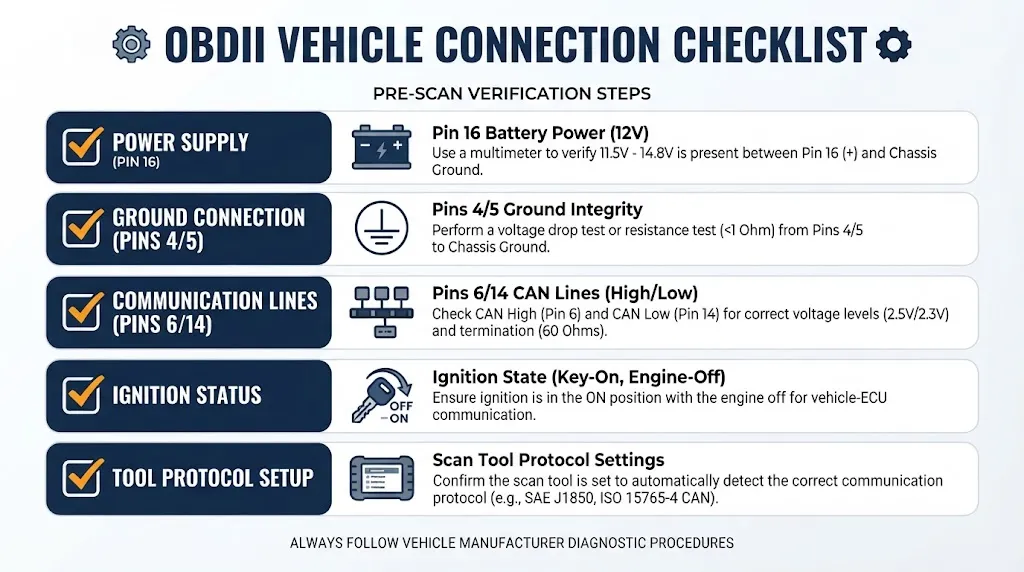
ISO 15765-4 removes guesswork that older OBD2 protocols left to the tool. It specifies CAN High on pin 6 and CAN Low on pin 14, with pins 4 and 5 for ground and pin 16 for battery power. That pin pattern is also a quick clue: if pins 6 and 14 are present, along with power and ground, CAN is a strong candidate for the car’s diagnostic protocol.
Speed is the next fixed expectation: 500 kbit/s commonly, with 250 kbit/s also used in some heavy-duty or earlier implementations. CAN can run faster elsewhere, and CAN FD extends payloads beyond 8 bytes, but neither automatically changes the OBD2 speed a generic tool should expect. A tool assuming the wrong rate will usually fail to connect, rather than connect slowly.
Addressing is the third fixed piece. A generic request is often broadcast to 0x7DF, and the engine control unit typically replies from 0x7E8, while physical addressing in the 0x7E0 to 0x7E7 range can target a specific unit. ISO 15765-4 also allows 11-bit and 29-bit identifiers; the 11-bit form is the common OBD2 case.
How ISO 15765 Differs From Older OBD2 Protocols
Before CAN became mandatory for new light vehicles in the United States for model year 2008, OBD2 allowed several very different methods. The SparkFun OBD-II protocols guide summarises those older methods alongside CAN, including their pins and speeds, and notes the 2008 mandate that made CAN the normal case for newer cars.
The practical differences are speed and wiring. Older serial protocols ran at roughly 10.4 kbit/s, while CAN-based OBD2 runs at 250 or 500 kbit/s, using a differential pair in which CAN High rises as CAN Low falls, helping reject noise. Our guide to ISO 9141 OBD2 covers the earlier single-wire approach, and our guide to ISO 14230 OBD2 covers Keyword Protocol 2000, which built on that wiring with faster initialisation and richer sessions. Neither is interchangeable with ISO 15765.
For a modern car, expect ISO 15765-4 CAN first if it is a 2008-or-newer light vehicle sold in the United States. If it is older, check its actual protocol before assuming CAN; a manual setting left on an older protocol can look like a broken port.
What to Check When a Scanner Reports ISO 15765
First, treat the label as good news about compatibility, not as a diagnosis. It means the tool and car have established CAN communication. The next step is to see what the car actually returns: live data, stored codes, pending codes, freeze frame, and readiness monitors are separate services, and one can work while another returns nothing useful.
Second, check the basics: power at pin 16, ground at pins 4 and 5, and the correct ignition state for that service. Mode 03 for stored fault codes is a different request from live data or readiness, so a failure in one mode does not prove the whole CAN link is down. Our guide to what an OBD2 scanner can tell you is a useful reality check, because generic OBD2 covers emissions-related powertrain data first and does not guarantee access to every module.
If the tool cannot connect at all, check the port for bent pins, a blown accessory fuse, or an adapter that is not seated fully. Then confirm the tool is set to CAN or auto, rather than locked to an older protocol. If those checks pass and the car still will not talk, our guide to an ELM327 not connecting to the ECU walks through the ignition, power, and protocol checks that most often separate a settings problem from a vehicle-side fault.
Tip
When a connection fails, change one variable at a time: protocol setting, ignition state, then adapter and cable. Changing all three at once makes it hard to tell which change fixed the problem.
Where ISO 15765 Stops
ISO 15765 does not make every diagnostic job generic. Manufacturer-specific codes, calibrations, security access, and many body, chassis, and safety functions sit outside legislated OBD2, even when they also travel over CAN. A generic tool may see the powertrain controller clearly and still report no codes for a module that needs a different session or a manufacturer-level tool.
Readiness monitors, supported parameter IDs, and freeze-frame availability also vary by vehicle and model year, so two cars with the same label can show different live-data lists. Newer UDS-based diagnostics and CAN FD reuse ideas from ISO 15765 but add their own definitions. The European EOBD counterpart system also moved to CAN-based diagnostics for legislated emissions work, though regional timing and requirements are not identical.
Related Product
OBD2 Scanner That Supports CAN (ISO 15765-4)
A scanner with explicit CAN support is the practical next step if you want to read codes, live data, and readiness on a modern car using ISO 15765-4.
As an Amazon Associate, we earn from qualifying purchases.
Frequently Asked Questions
Is ISO 15765 the same as CAN bus?
No. CAN bus is the underlying two-wire network, defined mainly by ISO 11898. ISO 15765 defines how diagnostic messages use that network, including transport, addressing, and, in Part 4, the emissions-related OBD2 rules.
Is ISO 15765 the same as OBD2?
No, but they overlap closely on modern cars. OBD2 is the diagnostic system and its emissions requirements. ISO 15765-4 is the CAN-based standard that implements legislated OBD2 on newer vehicles. Older OBD2 cars used other protocols instead.
Which cars use ISO 15765-4?
As a first rule, expect it on 2008-and-newer light vehicles sold in the United States, and on many European and Asian cars from around the same era onward. Earlier cars may use ISO 9141, ISO 14230, or SAE J1850 instead.
Why does my scanner show ISO 15765-4 CAN 11-bit or 29-bit?
That label describes the CAN identifier length in use. The 11-bit form is the common OBD2 case, while the 29-bit extended form provides more addressing room. Either can be correct, depending on the vehicle.
Does ISO 15765 let a generic scanner read every module?
No. Generic OBD2 over ISO 15765-4 primarily covers emissions-related powertrain information. Some body, chassis, and safety modules may need a different session or a manufacturer-level tool, even when they also use CAN.
What should I do if my car will not connect on ISO 15765?
Check power at pin 16, ground at pins 4 and 5, and that pins 6 and 14 are present and undamaged. Confirm the ignition state, set the tool to CAN or auto, and try one change at a time. If those checks pass and it still will not communicate, the fault may be vehicle-side.
Conclusion
ISO 15765 is best understood as the diagnostic rulebook for CAN, not as a code or a cable. Part 2 moves long messages across short CAN frames, Part 4 fixes the pins, speeds, and addresses that make emissions diagnostics interchangeable, and the wider family leaves room for richer UDS work. Seeing ISO 15765-4 means the tool and vehicle are speaking the expected language; what matters next is what the car returns through it, checked in the right condition.

I’m Alex Rahman, a car enthusiast and automotive writer focused on practical solutions, car tools, and real-world driving advice. I share simple and honest content to help everyday drivers make better decisions.
