
What Does Throttle Position PID Show? Explained
Quick Answer
The throttle position PID shows how far open the throttle plate is, as a percentage from 0% to 100%. In most cases this means Mode 01 PID 0x11, absolute throttle position, calculated as A × 100 / 255. It reports the throttle body, not the pedal, so a reading at idle is often above 0% and can differ from accelerator pedal position.
The number looks simple, yet it causes confusion because several throttle-related PIDs share similar names. The key is knowing which PID is on screen, what 0% and 100% mean for that PID, and what the plate is doing at that moment.
What the throttle position PID actually reports
The throttle position PID reports how far the throttle plate inside the throttle body has opened. That plate is the butterfly valve controlling how much air can enter the engine. When it is nearly closed, little air passes. When it opens wider, more air can enter, and the engine control unit adjusts fuel to match.
The reading comes from the throttle position sensor, often called the TPS. The sensor measures the angle of the throttle shaft and sends a signal to the engine control unit. The scanner does not measure the plate directly. It asks the control unit for the value and displays the result. The value is live, not stored. It should move when the pedal moves, fall back when the pedal is released, and stay fairly steady at a steady cruise.
It is a position, not a power or airflow figure. A reading of 40% does not mean 40% power or 40% airflow.
Which PID is it? Mode 01 PID 0x11 and the other throttle PIDs
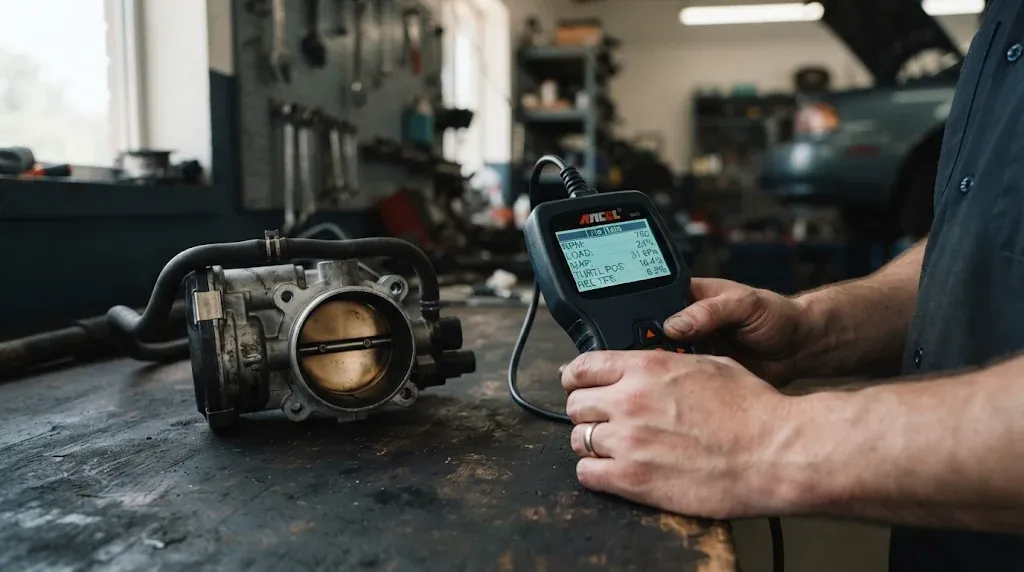
Most scanners label the main value simply as Throttle Position, TP, or THR POS. Behind that label, the usual standard PID is Mode 01 PID 0x11, absolute throttle position. It uses one data byte and reports 0% to 100%.
| PID | Name | What it shows |
|---|---|---|
| 0x11 | Absolute throttle position | Raw throttle plate position, 0% to 100% |
| 0x45 | Relative throttle position | Plate position relative to the learned closed position |
| 0x47 / 0x48 | Absolute throttle position B / C | Additional throttle sensors, where fitted |
| 0x49–0x4B | Accelerator pedal position D / E / F | Pedal position, not throttle plate position |
| 0x4C | Commanded throttle actuator | The position the control unit is asking for |
Not every vehicle supports every PID here. A scanner may show an unsupported PID as unavailable or blank. That is different from a faulty sensor. The CSS Electronics OBD2 PID table lists these standard Mode 01 PIDs with the same 0% to 100% range and the same A × 100 / 255 conversion.
How the percentage is calculated
PID 0x11 returns one byte, labelled A in the standard formula. The byte can hold a value from 0 to 255. The scanner converts it with a simple formula: throttle position (%) = A × 100 / 255. A raw byte of 0 gives 0%, a raw byte of 128 gives about 50%, and a raw byte of 255 gives 100%.
The same conversion applies to the other throttle PIDs in the table above. The difference is not the maths. It is what the control unit measured before it sent the byte. Because the result is a percentage, it has no unit such as volts or degrees. Some advanced scanners can also show the underlying sensor voltage, often around 0.5 volts near closed throttle and around 4.5 volts near wide open on many systems. That voltage is a separate view of the same sensor, and ranges vary by vehicle.
Absolute vs relative throttle position, and pedal position
Absolute and relative throttle position sound like the same reading, but they answer different questions. Absolute position reports the plate position as measured, without subtracting the idle position. Relative position reports how far the plate has moved from its learned closed position.
That distinction explains a common surprise. On many modern cars, absolute throttle position at idle is not 0%. It may read roughly 10% to 20% because the plate is held slightly open to let enough air in for idle. Relative throttle position on the same car at the same moment is often close to 0%, because the control unit has treated that idle opening as its zero point. Neither reading is wrong by itself.
The pedal is a separate measurement again. Accelerator pedal position reports how far the driver has pressed the pedal. Throttle position reports how far the plate has actually opened. On most modern cars there is no cable between them. The engine control unit sits between the two and can open the plate more or less than the pedal suggests, for a smooth start, traction control, or cruise control.
If pedal position rises smoothly but throttle position jumps or lags, check the throttle body, sensor, wiring, or actuator first.
What normal readings look like
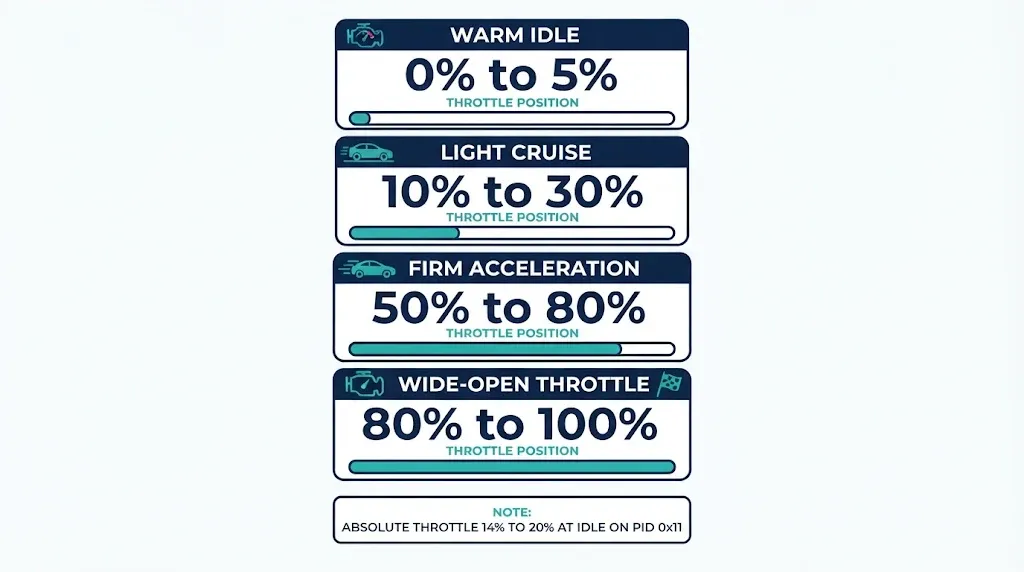
Normal values vary by vehicle, engine, temperature, and whether the reading is absolute or relative. The ranges below are typical guides for relative throttle position, which is the version most readers use for a quick sanity check. They are not a specification for any one car.
At warm idle, relative throttle is usually 0% to 5% and fairly steady. At light cruise it is often 10% to 30%, rising and falling smoothly with gentle pedal changes. Under firm acceleration it is often 50% to 80%, and at wide-open throttle it should usually reach 80% to 100%.
Absolute throttle often reads higher at idle. A warm idle reading of 14% to 20% on PID 0x11 can be normal on some cars, while the same car shows near 0% on PID 0x45. Cold start can also hold it slightly more open.
What the throttle position PID does not show
It does not show pedal position, even though the two often move together. It does not show throttle angle in degrees, even though the percentage is derived from the plate angle. It does not show airflow in grams per second, fuel delivery, engine power, or torque.
It also does not show whether the throttle body is clean, whether the sensor is accurate, or whether the plate is physically free to move. The PID reports the sensor’s view, not a direct inspection. A single odd reading can come from a cold engine, a learning procedure, or a slow scanner update. Our guide to what OBD2 live data can show explains which other live values are available in the same view.
When a reading looks wrong
A wrong-looking throttle reading is usually a pattern, not a single value. Stuck at one value means the percentage does not change when the pedal moves. Check the sensor wiring and connector, and whether the scanner is still updating other PIDs. Jumps or drops during a slow pedal press often point to a worn sensor track, a poor connection, or an intermittent signal.
High at idle means relative throttle stays well above 5% at warm idle. Check for a sticking plate, carbon build-up, an air leak, or a lost learned closed position. Never reaches near 100% means the value stops well short of wide open on a full pedal press. Check pedal position, commanded throttle, and whether the control unit is limiting the plate.
Do not replace a sensor on a single reading. Repeat the check and note the exact PID. The guide on whether an OBD2 scanner can diagnose a throttle position sensor covers the limits of that check.
Warning
Do not test wide-open throttle on a public road or with a cold engine. A throttle sweep is best done with the car parked, in Park or Neutral, with the parking brake on. If the engine surges, stalls, or the throttle does not return, stop and get the car checked.
A quick throttle sweep check, and live vs freeze frame
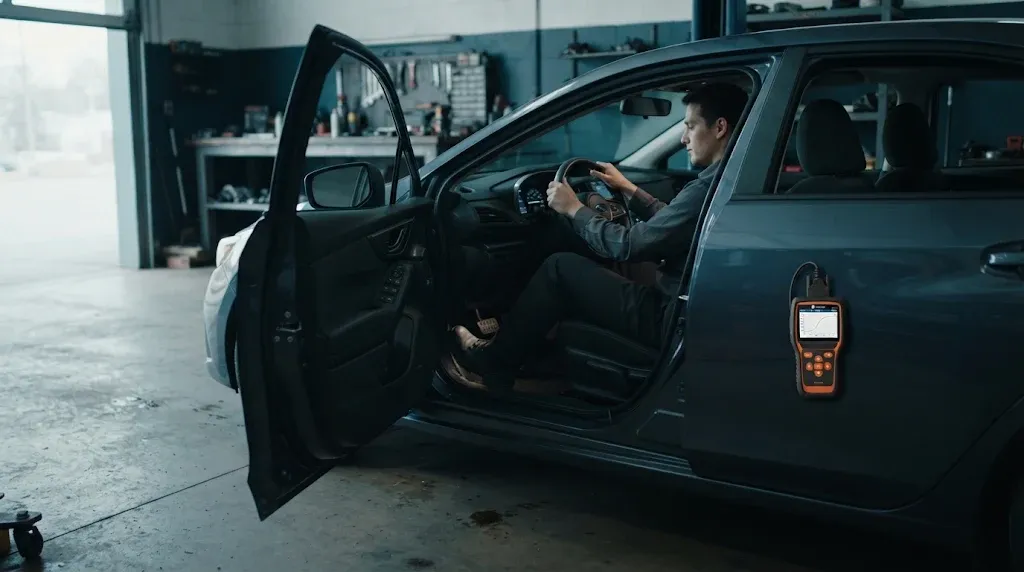
A slow sweep is the simplest useful check. Warm the engine, park safely, and open live data on the throttle PID you intend to use. Note the PID number and the idle value. Press the pedal very slowly from rest to full travel, then release it just as slowly. Watch the percentage rise and fall without jumps or flat spots, and note the lowest and highest values. Compare it with what the RPM PID shows to confirm the engine is responding.
A smooth sweep rules out the most obvious dead spots and dropouts. A rough sweep is a clear reason to look closer at the sensor, its wiring, and the throttle body. A slow Bluetooth adapter may update only a few times per second, which can make a smooth sweep look stepped. Our guide to how accurate OBD2 live data is explains how update rate and adapter choice can change what a live graph shows.
Live data shows throttle position right now. Freeze frame shows it at the moment a fault code was stored, so the two can differ.
After a throttle body cleaning, sensor replacement, or battery disconnect, some cars need a relearn to learn the new closed and open positions. The guide on whether an OBD2 scanner can perform a throttle relearn explains when a relearn is needed and what a scanner can and cannot do in that process.
Related Product
OBD2 Scanner With Live Data
A scanner with live data lets you watch throttle position, pedal position, RPM, and load together during a slow sweep.
As an Amazon Associate, we earn from qualifying purchases.
Frequently Asked Questions
What does throttle position PID 0x11 show?
PID 0x11 shows absolute throttle position as a percentage from 0% to 100%. It reports how far open the throttle plate is, using the formula A × 100 / 255. It does not show pedal position or airflow.
Why is my throttle position not 0% at idle?
On many cars, absolute throttle is above 0% at idle because the plate is held slightly open for idle air. Relative throttle, PID 0x45, is often near 0% at idle because it subtracts that closed position. Check which PID is on screen first.
Is throttle position the same as accelerator pedal position?
No. Accelerator pedal position shows how far the driver pressed the pedal. Throttle position shows how far the plate actually opened. On electronic throttle systems, the engine control unit decides the plate position, so the two values can differ.
What should throttle position be at wide-open throttle?
Relative throttle position should usually reach 80% to 100% on a full pedal press, depending on the vehicle. A value that stops well short of the top, or does not move at all, deserves a further check.
Can a throttle position PID reading prove the sensor is bad?
No, not on its own. A stuck or jumping reading is a useful clue, but it can also come from wiring, a sticking plate, or a slow scanner update. A smooth sweep and comparison with pedal position give a stronger picture.
Does the throttle position PID show throttle angle in degrees?
No. The standard PID reports a percentage, not degrees. The percentage is derived from the throttle position sensor signal, which reflects plate angle, but the PID itself does not report the angle in degrees.
Conclusion
The throttle position PID shows how far open the throttle plate is, as a percentage. The most common version is Mode 01 PID 0x11, absolute throttle position, but relative throttle position and pedal position are separate PIDs with different meanings. Check the PID number first, compare the reading with pedal position and RPM, and use a slow sweep to judge smoothness. That short routine turns a single percentage into a useful check, and it helps avoid replacing a sensor for a reading that was normal for that PID.

I’m Alex Rahman, a car enthusiast and automotive writer focused on practical solutions, car tools, and real-world driving advice. I share simple and honest content to help everyday drivers make better decisions.
