What Does the RPM PID Show? OBD-II Engine Speed Data Guide
Quick Answer
The RPM Parameter ID (PID) shows the real-time rotational speed of the engine crankshaft as reported by the vehicle’s Engine Control Unit (ECU). Represented in standard OBD-II diagnostics as Mode 1 PID 0C, this live data stream provides precise engine revolutions per minute, allowing technicians and DIYers to monitor idle speed, verify sensor accuracy, and diagnose performance issues.
Understanding the Basics of OBD-II PIDs and Engine Speed
When you plug an OBD-II scanner into a vehicle’s diagnostic link connector, the tool queries the onboard computer system using standardized codes known as Parameter IDs (PIDs). These codes act as direct communication requests sent to the Engine Control Unit (ECU) or Powertrain Control Unit (PCM).
Among the dozens of live data parameters available during standard diagnostics, engine speed is one of the most fundamental metrics. It provides an instantaneous numerical readout of how fast the internal components of the engine are rotating.
Far from being just a digital replica of your dashboard gauge, the RPM PID supplies raw, unfiltered data straight from the primary engine sensors. Understanding how to interpret this data is essential for accurate automotive troubleshooting.
What the Engine RPM PID (PID 0C) Specifically Shows
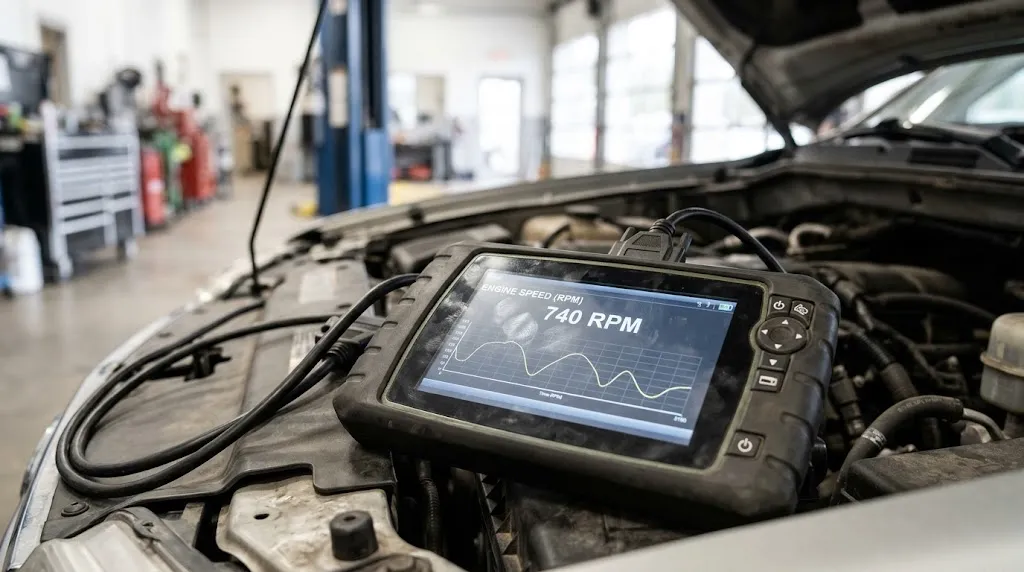
In standard OBD-II protocol architecture, engine rotational speed is designated as PID 0C under Mode 1. When a scan tool requests this parameter, the ECU responds with a two-byte hexadecimal value that translates into actual revolutions per minute.
Specifically, the RPM PID shows:
- Real-Time Crankshaft Velocity: The exact speed at which the crankshaft is spinning at the exact millisecond the query is processed.
- Idle Stability: Whether the engine maintains a steady baseline speed when the throttle is completely closed.
- Load Response: How quickly the engine speed reacts when electrical accessories, air conditioning, or transmission engagement places a load on the motor.
- Cranking Speed: How fast the starter motor spins the engine during starting attempts, which helps evaluate battery health and compression.
By monitoring this value continuously, diagnostic software can plot graphs or display digital numbers that reveal subtle fluctuations invisible to the naked eye.
How the Engine Control Unit (ECU) Measures and Reports RPM
The numbers displayed on your scan tool do not come from magic; they are calculated rapidly from physical sensor inputs. The ECU determines engine speed primarily by monitoring signals generated by the crankshaft position sensor and, in many modern engines, the camshaft position sensor.
As the crankshaft rotates, a reluctor wheel with specialized notches or teeth passes by the magnetic tip of the crankshaft sensor. Each passing tooth induces an electrical pulse. The ECU counts these pulses over a precise fraction of a second, calculates the frequency, and converts that frequency into revolutions per minute.
This calculated value is then broadcast across the vehicle communication bus (such as CAN bus) so that transmission controllers, instrument clusters, and external scan tools can read it instantaneously.
RPM PID Data Versus Dashboard Tachometer Readings
Many drivers assume that the number shown on a scan tool for the RPM PID is identical to what the dashboard tachometer displays. While they generally match closely under normal driving conditions, important technical differences exist between them.
Dashboard tachometers in modern vehicles are often driven by stepper motors or digital instrument panels that apply internal software smoothing. Manufacturers intentionally filter dashboard readouts to prevent needle jitter or minor fluctuations from alarming the driver during normal operation.
Conversely, the OBD-II RPM PID provides a much more direct look at what the ECU is processing. Scan tool data can reveal rapid micro-fluctuations, momentary hesitation, or slight hunting during idle that the dashboard needle smooths over and hides from everyday view.
Why Monitoring Live RPM PID Data Matters in Diagnostics
Live data streaming transforms guesswork into methodical troubleshooting. When diagnosing drivability complaints, observing the RPM PID under specific operating conditions provides immediate clues about underlying mechanical or electrical failures.
Technicians look at this data stream across several distinct operational phases:
- Cold Start Phase: Observing high idle speeds and how the engine gradually steps down its RPM as coolant temperature increases.
- Warm Idle Stability: Checking for erratic surges, drops, or rolling idle conditions caused by vacuum leaks or dirty throttle bodies.
- Snap Throttle Test: Evaluating how quickly the engine revs and whether it returns smoothly to base idle without dipping too low or stalling.
Diagnosing Rough Idles and Engine Stalling
A rough idle often manifests as a fluctuating RPM PID value bouncing up and down by 50 to 200 RPM while the vehicle is stationary in drive or park. If the scan tool shows unstable engine speed alongside erratic fuel trim adjustments, it points directly toward unmetered air leaks, failing idle air control valves, or faulty mass airflow sensors.
Identifying Transmission Slippage and Shift Points
Because engine speed and transmission output speed are intrinsically linked through the torque converter and gear ratios, comparing the RPM PID with vehicle speed data can highlight transmission issues.
If engine RPM surges unexpectedly while vehicle speed remains constant or slows down during acceleration, it indicates internal clutch pack slippage or torque converter lockup failure.
Catching Intermittent Misfires and Sensor Dropouts
A sudden, momentary drop in the RPM PID value can signal an instantaneous cylinder misfire or a brief signal dropout from the crankshaft position sensor. Even if a permanent diagnostic trouble code has not yet set, these transient anomalies are easily spotted on a live graphing scan tool.
Common Misconceptions About Scan Tool RPM Data
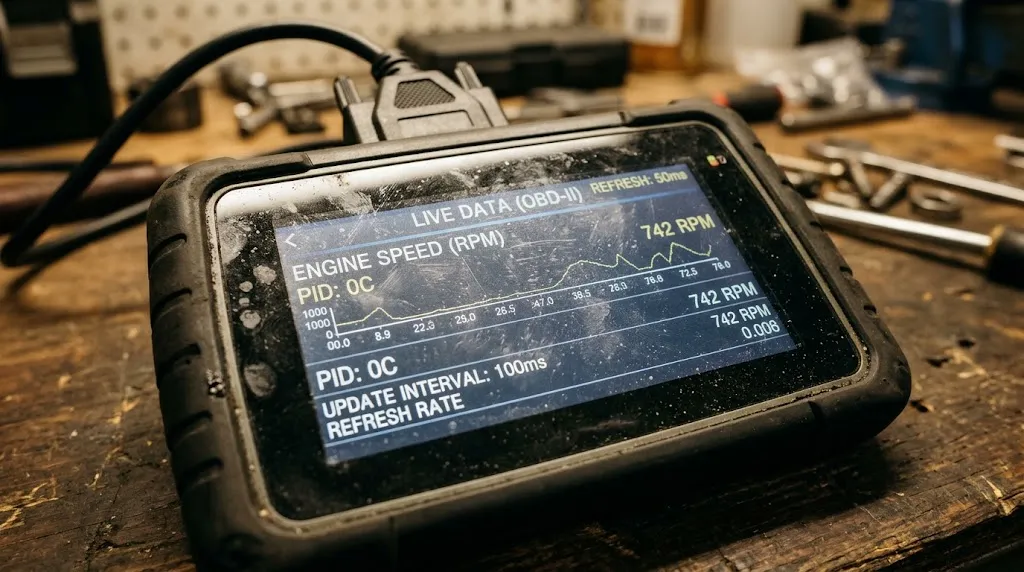
Working with OBD-II live data requires an understanding of tool limitations and network communication constraints. One common misconception is that the scan tool displays engine speed instantly without delay.
Due to the processing overhead of the OBD-II protocol and the refresh rate of the scan tool software, there is usually a slight latency—often between 50 to 200 milliseconds—between what the engine is physically doing and what appears on the screen. For high-speed engine analysis or precise tuning, professional diagnostic oscilloscopes connected directly to sensor signal wires are required rather than a standard OBD-II generic scan tool.
Another misconception is that all vehicles report RPM with decimal precision. Standard OBD-II PID 0C reports values in whole integer increments because the calculation divides the raw byte data by four, yielding a resolution of 0.25 RPM rounded or displayed as whole integers depending on the interface.
Related Product
OBD-II Diagnostic Scan Tools
A reliable live-data OBD-II scanner allows you to monitor real-time engine RPM PIDs, graph sensor performance, and diagnose drivability issues accurately.
As an Amazon Associate, we earn from qualifying purchases.
Frequently Asked Questions
What is the standard OBD-II code for engine RPM?
In standard Mode 1 OBD-II diagnostics, engine speed is designated as PID 0C. Most diagnostic software and scan tools translate this automatically into plain English labeled as “Engine RPM.”
Why does my scan tool RPM differ from my dashboard tachometer?
Dashboard tachometers often apply software smoothing to prevent needle jitter and display stable readings for the driver. Scan tools report raw or minimally filtered data directly from the ECU, which can show rapid minor fluctuations more clearly.
Can a faulty crankshaft sensor affect the RPM PID reading?
Yes. Because the ECU calculates engine speed primarily using signals from the crankshaft position sensor, a failing, dirty, or misaligned sensor can cause erratic RPM readings, hesitation, or complete engine stalling.
What causes erratic RPM fluctuations at idle?
Erratic idle speed shown on a scan tool is typically caused by vacuum leaks, dirty throttle bodies, failing idle air control valves, faulty mass airflow sensors, or unmetered air entering the intake manifold.
Does a generic OBD-II scanner show live RPM data?
Almost all modern generic OBD-II scan tools and smartphone-based ELM327 adapters support live data streaming, including the engine RPM PID, as long as the vehicle complies with standard OBD-II protocols.
How fast does the scan tool refresh the RPM data?
Refresh rates vary depending on the scan tool hardware, Bluetooth or USB connection speed, and the vehicle’s communication protocol. Typical update intervals range from several times per second up to once every few hundred milliseconds.
Conclusion
The engine RPM PID is one of the most reliable and foundational live data streams available in automotive diagnostics. By providing a direct, unfiltered view of crankshaft rotational speed reported by the ECU, it allows technicians and vehicle owners to look past instrument cluster smoothing and evaluate true engine performance. Whether you are tracking down an elusive idle surge, checking cold-start behavior, or evaluating transmission load responses, mastering how to read and interpret the engine RPM PID provides an invaluable advantage in maintaining vehicle health.

I’m Alex Rahman, a car enthusiast and automotive writer focused on practical solutions, car tools, and real-world driving advice. I share simple and honest content to help everyday drivers make better decisions.
