Can OBD2 Show Transmission Pressure? | Explained
Quick Answer
Sometimes, but not on every car and not with a basic generic scan. A scanner can show transmission pressure only when the vehicle exposes that value and the tool can read the transmission module or the relevant manufacturer-specific data. On many cars, what looks like pressure is only the pressure the computer has commanded, not a measured reading.
That distinction matters more than the number on the screen. If you treat a command as a measurement, you can conclude that the hydraulics are healthy when the scanner has told you nothing about what actually happened inside the transmission.
Why a Basic Generic Scan Usually Does Not Show It
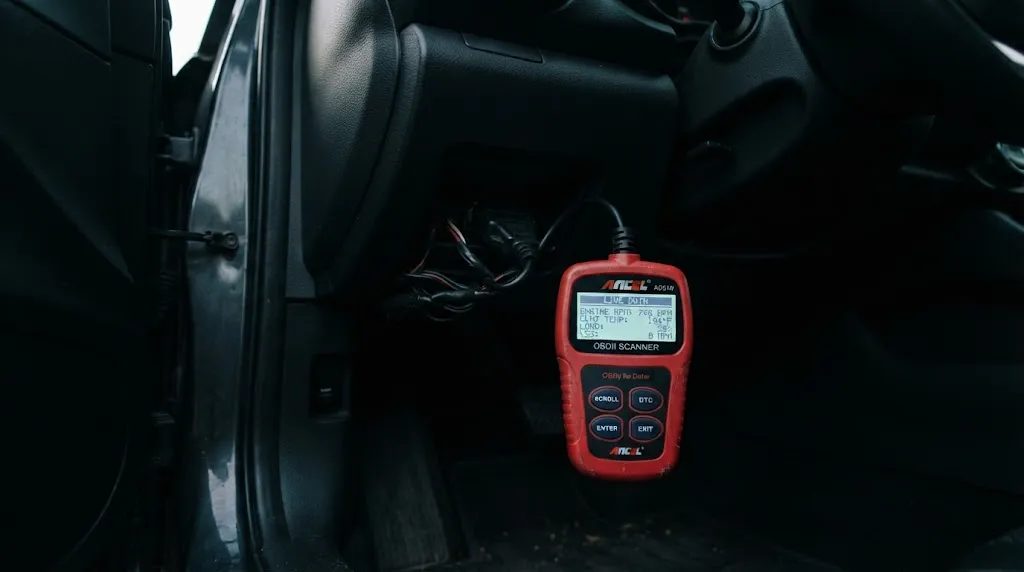
Generic OBD2 was built mainly around emissions-related powertrain data. Its standard live-data list covers items such as engine speed, coolant temperature, vehicle speed, fuel trims, and oxygen-sensor activity. Transmission pressure is not part of that common, standard list in the same way.
That is why two scanners can behave very differently on the same car. A basic code reader may show engine data and a generic transmission fault code, yet offer no pressure parameter. A more capable tool may reach the transmission control module and show additional manufacturer-specific values.
For a broader sense of what a general tool can and cannot reveal, see what an OBD2 scanner can tell you. The key point for this topic is narrower: absence of a pressure reading does not prove that the transmission has no pressure sensor, and presence of a label does not prove that the reading is measured.
What the Number on the Screen Might Actually Be
Transmission pressure is not one single measurement. Depending on the vehicle and the tool, a label may refer to line pressure, a clutch or circuit pressure, a continuously variable transmission secondary pressure, a pressure-control solenoid command, or a sensor voltage that the tool converts into a pressure value. Labels also vary by maker and by app, so the same physical idea can appear under different names.
The most important split is between commanded and measured pressure. A commanded value is the pressure the control module is asking for. A measured value comes from a pressure transducer or sensor reporting what is actually present. Many transmissions have no transducer input to the control module, so the scanner can show a command without showing a measurement.
Sonnax’s guide to transmission diagnostics with pressure gauges makes this warning explicit: some scan tools show a pressure command that is easily mistaken for transducer data, while only some transmissions, such as certain Chrysler units, provide pressure data from a transducer. If the commanded value and a gauge reading agree, that supports the pump, solenoid, and valve operation. Agreement is the check; the command alone is not proof.
| What you see | What it usually means | What it does not prove |
|---|---|---|
| Commanded line pressure | The pressure requested by the control module | That the hydraulic circuit reached that pressure |
| Measured or actual pressure | A sensor-reported pressure, where fitted | That every clutch circuit is healthy |
| Solenoid current or duty cycle | How hard the control module is driving a solenoid | The resulting hydraulic pressure by itself |
| No pressure parameter | The tool or vehicle does not expose one | That the transmission is faulty |
Units and naming can also mislead. One tool may show psi, another kPa, and a third a voltage or percentage for a related control value. Before comparing a reading with a specification, check whether the parameter says commanded, actual, desired, or simply pressure.
How to Check Whether Your Car and Scanner Support It
Start with the transmission module, not the generic live-data list. On a capable scanner, select the transmission or powertrain control module, then open its live-data or data-stream menu. Search that list for line pressure, actual pressure, desired pressure, pressure control, or a similarly named transmission parameter. If only engine live data is available, the tool may not have reached the transmission module at all.
- Connect the scanner, switch the ignition on, and let it identify the vehicle correctly. Wrong model or year selection can hide manufacturer-specific data.
- Open the transmission module specifically, rather than stopping at generic OBD2 live data.
- Search the full parameter list for pressure, and note whether it says commanded, actual, or desired.
- Record the reading at idle, then watch how it changes with gear selection, throttle, and temperature. A single parked number rarely tells the story.
- If no pressure parameter appears, check whether the tool offers a manufacturer-specific or enhanced diagnostics add-on for your make.
If the transmission module itself will not open, that is a separate access problem. Our guide to why a scanner cannot access the transmission module covers the common causes, from tool coverage to module communication faults. Do not assume that a missing pressure value means the same thing as a missing module.
Manufacturer-specific data is also inconsistent by design. OBDLink’s support guide explains that transmission temperature PIDs are defined by each maker, with no required common name. The same principle applies to pressure.
How to Read a Pressure Value Without Overclaiming It
There is no single normal transmission pressure that applies to every car. Line pressure depends on the transmission design, the gear selected, engine load, throttle position, fluid temperature, and whether the control module is compensating for a detected slip or fault. A value that looks low at idle may be expected there, and a value that rises under load may be the control strategy working as intended.
Use the reading as part of a pattern, not as a pass-or-fail score. Compare commanded and actual values when both are available, and watch them together during the symptom. A large or persistent gap between commanded and actual pressure points toward a control, solenoid, sensor, or hydraulic problem, but it does not by itself identify which one. A normal-looking command with a slipping or harsh shift points in a different direction from a command that is already unusually high.
Sonnax’s diagnostic logic helps narrow the search: if pressure is commanded high, look outside the transmission for a bad input or control cause; if the command is normal but the symptom remains, look inside. It does not replace checking the specific code, fluid condition, and service information for your model.
Also check the surrounding data before drawing a conclusion. Gear, input and output speed, fluid temperature, throttle position, and torque-converter clutch state help explain why pressure changed. Our guide to whether live OBD2 data can diagnose transmission problems explains that broader live-data approach, while this article stays focused on the pressure parameter itself. For the limits of any single live reading, see how accurate OBD2 live data is.
Key Insight
A pressure command answers what the computer wants. Only a measured pressure, or a gauge reading, can answer what the hydraulics delivered. Keeping those two questions separate prevents the most common misreading.
When a Scanner Is Not Enough
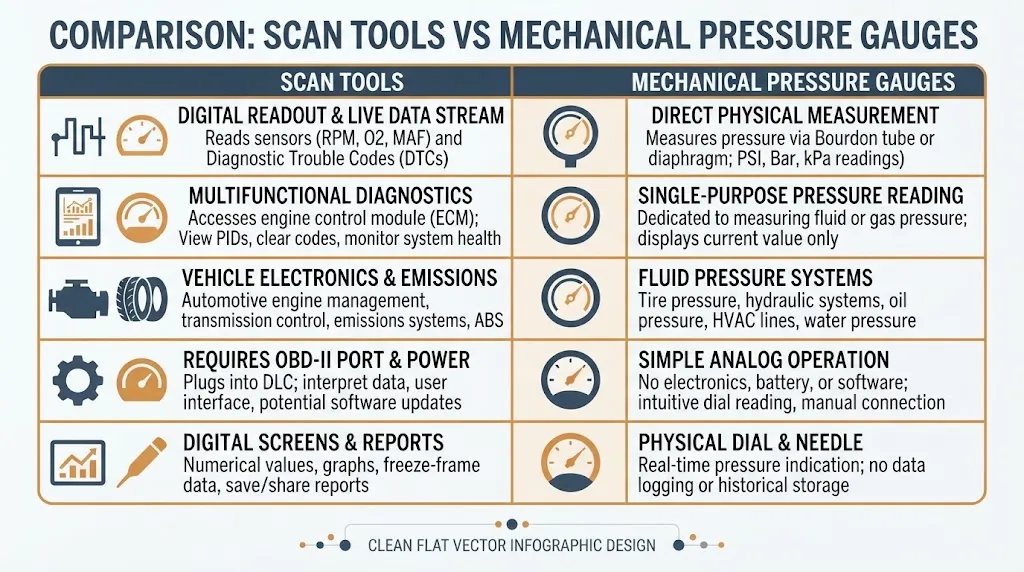
A scanner is strongest for codes, commands, sensor inputs, and patterns over time. A mechanical pressure gauge is strongest for proving hydraulic reality at a test port. When a shift problem persists, when commanded and actual values disagree, or when no measured parameter exists, a gauge check becomes the deciding test rather than an optional extra.
A gauge can test pump capability, minimum and maximum line pressure, pressure rise, and regulator behaviour in a way that a command value cannot. It can also reveal a leak in an applying component after a shift is commanded. That is why a normal-looking scanner screen should not close an investigation on its own.
Gauge testing has practical limits too. Some transmissions have no convenient pressure tap, and the correct port and procedure vary by model. If the procedure, port location, or specification for your transmission is unclear, stop and use model-specific service information or a transmission specialist.
Mistakes That Make a Pressure Reading Misleading
- Calling a commanded value an actual measurement, then ruling out a hydraulic fault.
- Comparing a reading with a generic pressure range found online instead of the specification for the exact transmission.
- Judging pressure from one parked reading, without gear, load, and temperature context.
- Assuming a better scanner automatically creates a sensor the car does not have.
- Clearing a transmission code and watching pressure alone, without checking whether the code, slip, or harsh shift returns under the same conditions.
The most useful OBD2 PIDs are useful precisely because they are chosen for a purpose. Pressure earns its place in that kind of shortlist only when you know which pressure it is and what question it answers. Otherwise it is just another number moving on a screen.
Warning
Do not drive while staring at a live-data screen, and do not run load or stall tests on a public road to chase a pressure number. Record data safely, or have a passenger monitor the scanner while you drive.
Related Product
OBD2 Scanner With Transmission Live Data
If your current tool shows only generic engine data, a scanner with transmission-module access and live data is the practical next step for checking whether a pressure parameter exists for your car.
As an Amazon Associate, we earn from qualifying purchases.
Frequently Asked Questions
Can a cheap OBD2 scanner show transmission pressure?
Usually not. A basic code reader normally covers generic engine data and codes, not manufacturer-specific transmission parameters. You generally need a tool with transmission-module access and enhanced diagnostics for your make, and the vehicle must still expose a pressure value.
Why does my scanner show transmission temperature but no pressure?
Because the two values are exposed independently. A vehicle may provide temperature but no pressure, or a pressure command without a measured sensor value. Availability depends on transmission design, control-module software, and scanner coverage.
What is the difference between line pressure and clutch pressure?
Line pressure is the main hydraulic pressure supplied within the transmission, while clutch pressure relates to a specific clutch circuit. A scanner may show one, both, or neither. Do not treat them as interchangeable.
Can OBD2 show transmission pressure on a CVT?
Sometimes, where the CVT control system exposes a secondary pressure command or actual value. Confirm whether it is commanded or measured, and use the correct CVT specification, not a conventional automatic range.
Does a normal pressure reading rule out a transmission problem?
No. A normal command does not prove normal hydraulics, and one normal measured value does not rule out an intermittent leak, a worn clutch, or a fault in another circuit. Codes, shift behaviour, fluid condition, and related live data still matter.
Should I buy a new scanner just to see transmission pressure?
Only after checking coverage for your exact make, model, and year. Confirm that it lists transmission live data for your vehicle. If your car does not expose a measured pressure value, a more expensive tool will not create one.
Conclusion
OBD2 can show transmission pressure on some vehicles, but the answer is conditional in a useful way. Check whether your scanner reaches the transmission module, whether the parameter is commanded or measured, and whether the specification matches your exact transmission. When those three points are clear, a pressure value becomes a genuine diagnostic clue. When any of them is unclear, treat the number as a command or an incomplete clue, and use a gauge check or model-specific service information before ruling a hydraulic fault in or out.

I’m Alex Rahman, a car enthusiast and automotive writer focused on practical solutions, car tools, and real-world driving advice. I share simple and honest content to help everyday drivers make better decisions.
