Can an OBD2 Scanner Work on Diesel Cars?
Quick Answer
Yes, a generic OBD2 scanner can work on many diesel cars, but only if the vehicle is OBD2 or EOBD compliant. The key is the vehicle’s age, market, and weight class, not the fact that it runs on diesel. A compliant light-duty diesel will usually give you standard fault codes, live data, and readiness information, while deeper diesel functions may still need a diesel-capable or manufacturer-level tool.
Diesel ownership creates a natural doubt: the engine uses glow plugs rather than spark plugs, and its exhaust system looks very different from a petrol car’s. Those differences change what the vehicle monitors, but they do not automatically remove it from the OBD2 system.
Does a Diesel Car Use the Same OBD2 Port and Codes?
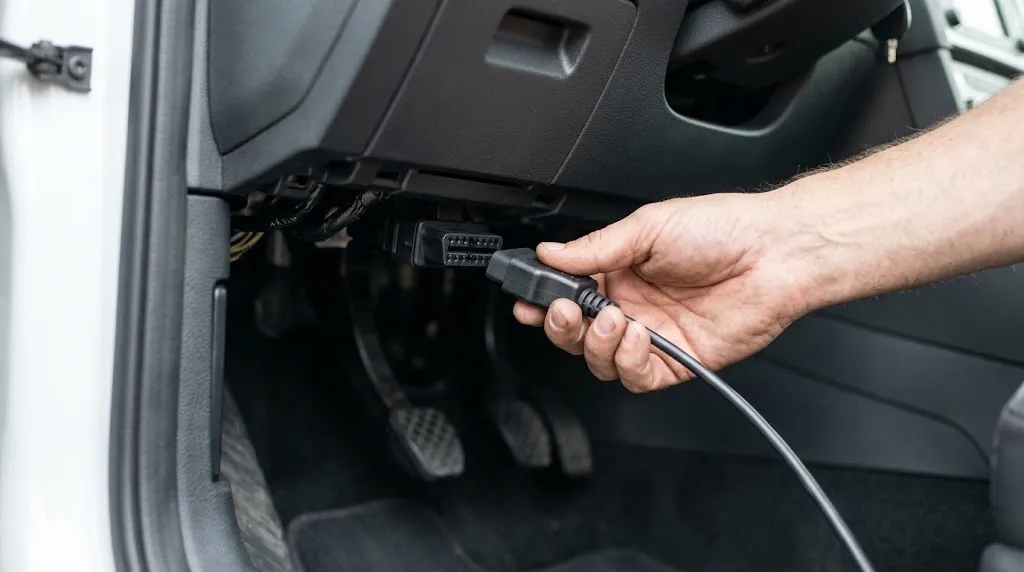
For a compliant light-duty vehicle, yes. The standardized 16-pin connector is the normal access point, and generic powertrain codes beginning with P0 are shared across compliant vehicles. That standardization is what lets one basic scanner read a fault code from cars of different brands.
What changes is the monitored system behind those codes. A diesel monitor set is built around compression ignition and diesel aftertreatment, not around spark ignition and a petrol evaporative system. So a diesel fault may point to the EGR system, glow plugs, turbo boost control, fuel rail pressure, a diesel particulate filter (DPF), or a selective catalytic reduction (SCR) system using diesel exhaust fluid (DEF), rather than to a petrol-specific part.
U.S. Environmental Protection Agency guidance lists EGR, glow plugs, complete lack of cylinder combustion, and electronic powertrain inputs and outputs among the main diesel items monitored, and notes that diesel engines do not have the same components and monitors as petrol engines. That distinction matters when a code description sounds unfamiliar: it may still be a standard emissions-related fault, just in a diesel system.
Which Diesel Cars Will a Generic OBD2 Scanner Work On?
The practical test is compliance, not fuel type. A vehicle that meets the standard for its market should respond to a generic scanner, while a vehicle built before that standard took effect may offer only manufacturer-specific diagnostics or partial coverage.
| Market and vehicle type | Useful diesel cutoff | What it means |
|---|---|---|
| United States, light-duty diesel below 8,500 lb GVWR | 1997 model year | Full federal OBD compliance was required from 1997 after earlier waivers ended. |
| Europe, M1 passenger cars up to 2,500 kg | New types 2003; all new vehicles 2004 | The earlier date covers newly approved types; the later date covers all new vehicles in the class. |
| Europe, heavier passenger cars and light commercial diesel vehicles | Later, commonly 2007 | Do not assume a 2004 car in this heavier class is automatically EOBD compliant. |
| United States, medium- and heavy-duty diesel, 8,500–14,000 lb GVWR | Phased in from 2004 | Coverage depends on model year, class, and the vehicle’s diagnostic system, not on the badge alone. |
The California Air Resources Board states that all 1997 and newer model year diesel passenger cars and trucks are required to meet OBD II requirements, and that the words “OBD II” on the emission control label under the hood are a useful check. For European cars, the separate question of whether OBD2 is the same in Europe and the US helps explain why a European diesel and a US diesel can have different cutoff years even when the connector looks identical.
Two cautions apply. First, a 16-pin socket alone does not prove compliance; some manufacturers fitted the plug before the full system arrived. Second, an early-adopting manufacturer may offer generic access before the legal cutoff, but that is model-specific. If you are unsure about the year boundary, our guides to whether an OBD2 scanner works on any car and to older cars use the same compliance-first logic.
What a Generic Scanner Can Read on a Diesel
On a compliant diesel, a generic scanner should normally be able to read and clear standardized fault codes, show whether the malfunction indicator lamp is commanded on, display freeze-frame data for a stored fault, and show readiness monitor status. It can also display live data for the parameters the vehicle supports.
Useful diesel live data often includes engine speed, coolant temperature, boost pressure, fuel rail pressure, EGR position, exhaust temperature, DPF differential pressure, and, where supported, DPF soot load, NOx sensor readings, and DEF level. A missing parameter does not always mean a fault; it may simply be one that model does not expose through generic OBD2.
Readiness is especially important before an emissions test. Clearing codes can reset monitors to “not ready,” so a clean code list immediately after clearing is not the same as a vehicle that has completed its monitors. That is why it helps to check whether an OBD2 scanner can check emissions readiness before treating a cleared scan as a pass.
Key Insight
“Generic” is a scope limit, not a quality judgment. It means the scanner uses the standardized emissions-related data every compliant vehicle must expose. It does not mean the scanner can see every module or run every diesel service function.
What It Often Cannot Do on a Diesel
The most common disappointment is not a connection failure, but a coverage gap. A basic scanner may show a generic P0 code while the manufacturer-specific detail, the DPF service data, or the SCR adaptation data stays in another module or behind a manufacturer-specific code range beginning with P1.
Functions that commonly need a diesel-capable, enhanced, or manufacturer-level tool include forced DPF regeneration, injector coding after replacement, detailed SCR and DEF system tests, and glow-plug control-module diagnostics beyond a basic circuit code. Some advanced consumer tools cover some of these functions for some models, but coverage is model-specific and should be checked before purchase.
This is the same boundary that applies to other systems: a generic tool is designed for standardized powertrain diagnostics first. For service actions that command a component, see whether an OBD2 scanner can control vehicle components, and do not assume a tool that reads codes can also command a regeneration or reset an adaptation.
Why a Diesel Scanner May Connect but Show No Data
If the scanner powers up but cannot link, work through the simple causes before concluding the car is incompatible. Check that the ignition is on, and that the engine is running if the function you want needs live data. Confirm the connector is fully seated, check the accessory or diagnostic-port fuse if the scanner has no power, and let the scanner use automatic protocol detection rather than forcing an older protocol.
Other causes are vehicle-specific. A pre-compliance diesel, a heavy-duty truck on a different diagnostic system, a damaged port, or a low-quality clone adapter can all produce a “no link” result. A scanner that works on a petrol car is not proof that the adapter or app supports that diesel model.
How to Check Before You Buy or Scan
- Confirm the market and year. Use the model year, the market where the vehicle was first sold, and its weight class, not just the year it was built.
- Look for the compliance label. On a US vehicle, check for “OBD II” on the emission control information label under the hood.
- Match the tool to the job. If you only need codes, live data, and readiness, a generic scanner may be enough. If you need DPF service, injector coding, or SCR diagnostics, check the tool’s diesel coverage for your exact model first.
- Record before clearing. Note the codes, freeze-frame data, and readiness status first, because clearing can erase useful diagnostic context and reset monitors.
Heavy-Duty Diesels Are a Different Case
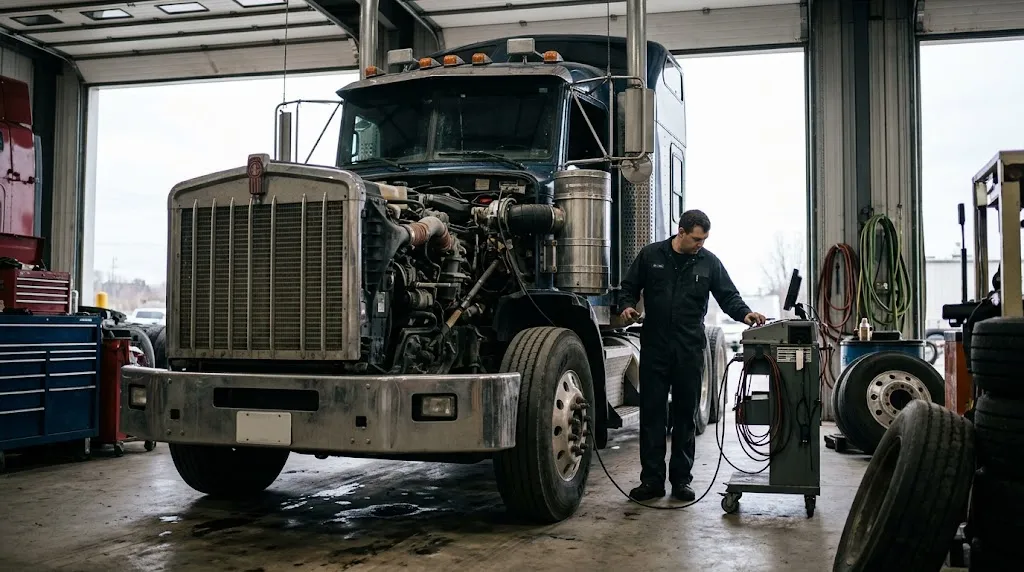
A large diesel truck is not automatically a bigger version of a diesel car for diagnostic purposes. Many heavy-duty vehicles use the J1939 protocol and a 9-pin Deutsch connector rather than, or in addition to, the car-style 16-pin OBD2 connector. Some also run on 24-volt electrical systems, so a car scanner rated only for 12 volts should not be forced into service on a truck.
An adapter cable can change the plug shape, but it does not by itself add J1939 protocol support, heavy-duty fault-code definitions, or truck service functions. If you work on a medium- or heavy-duty diesel, choose a tool that explicitly lists your vehicle class, connector, voltage rating, and protocol support.
Warning
Clearing a diesel fault does not repair a blocked DPF, a faulty NOx sensor, or an SCR fault. If a DPF warning, reduced-power mode, or DEF-related countdown returns, treat it as an active fault that still needs diagnosis, not as a code that simply needs another reset.
Related Product
Diesel-Compatible OBD2 Scanner
If your diesel needs more than basic codes, look for a scanner that explicitly lists diesel, DPF, and SCR coverage for your model.
As an Amazon Associate, we earn from qualifying purchases.
Frequently Asked Questions
Will an OBD2 scanner work on a 2002 diesel car in Europe?
Not automatically. For M1 passenger cars, the key EOBD dates were new types in 2003 and all new vehicles in 2004, so a 2002 model may or may not have generic EOBD access depending on when that type was approved and whether the manufacturer adopted the system early. Check the exact model and its compliance label rather than relying on the port shape.
Can a generic OBD2 scanner read DPF soot level?
Sometimes, but not always. Some compliant diesels expose DPF differential pressure or soot-related data through generic live data, while others keep detailed DPF service data in manufacturer-specific diagnostics. If soot level is essential, choose a tool that explicitly lists DPF data for your model.
Can an OBD2 scanner force a DPF regeneration?
A basic generic scanner normally cannot. Forced regeneration is a service command, not a standard code-reading function, and it requires a compatible diesel-capable tool, a supporting vehicle, and the correct operating conditions. Never assume a code reader can start a regeneration.
Does OBD2 work on diesel pickup trucks?
Often yes for light-duty pickups that are OBD2 compliant and use the standard 16-pin port. Medium- and heavy-duty trucks are more variable: they may use different protocols, connectors, or service tools, so check the truck’s class, connector, and the scanner’s heavy-duty coverage.
Why does my diesel have a 16-pin port but the scanner says no link?
The port alone does not prove full OBD2 or EOBD compliance. The vehicle may predate the requirement, use a different protocol, have a blown diagnostic-port fuse, a loose connector, or an adapter that does not support its protocol. Confirm compliance, ignition state, fuse, seating, and automatic protocol detection before replacing parts.
Will clearing a code reset a diesel DEF or SCR warning?
Clearing a stored code is not the same as completing a repair or resetting an SCR inducement state. If the underlying fault remains, the warning, reduced-power condition, or countdown can return. Diagnose the fault, repair it, and then allow the system to complete its own checks.
Conclusion
A diesel engine does not put a car outside OBD2 diagnostics, but its age, market, and weight class decide how much a generic scanner can do. For a compliant light-duty diesel, expect standard codes, useful live data, and readiness checks, and expect deeper DPF, SCR, injector, and manufacturer-specific work to need a better-matched tool. Check compliance first, record codes before clearing them, and choose the scanner for the diesel system you actually need to diagnose.

I’m Alex Rahman, a car enthusiast and automotive writer focused on practical solutions, car tools, and real-world driving advice. I share simple and honest content to help everyday drivers make better decisions.
