Can OBD2 Diagnose Ignition Problems? Misfires, Coils & Codes
Quick Answer
Yes, OBD2 can diagnose many ignition problems, but it usually points to the affected cylinder and the type of fault rather than naming the exact failed part. It is strongest at detecting misfires and ignition-coil circuit faults, and weaker at proving whether a spark plug, coil, wire, injector, or compression problem caused the misfire.
A rough idle, hesitation under load, or a flashing check-engine light can all feel like the same problem. The ignition system is often the first suspect: without a strong spark at the right moment, the mixture in a cylinder does not burn cleanly.
The key distinction is between detection and proof. The computer detects that combustion did not happen as expected, and a scanner reads that report. It does not watch the spark or measure spark strength. The rest of the diagnosis narrows the cause with live data, freeze-frame data, and a few controlled checks.
What OBD2 Actually Detects in the Ignition System
OBD2 monitors ignition indirectly, through its effect on the engine. When a cylinder fires normally, it pushes the crankshaft forward with a predictable pulse of speed. When it misfires, that push is weak or missing, and the crankshaft slows slightly. The computer watches those speed changes through the crankshaft position sensor and counts them.
OBD2 can also detect some electrical faults more directly. An ignition-coil circuit code points to a problem in the coil’s primary or secondary circuit, or in its control wiring. A crankshaft or camshaft position sensor code can matter too, because the computer needs those signals to time the spark. What OBD2 does not do is test a spark plug in isolation. There is no standard code that means “spark plug worn out.” A worn plug, a failing coil, a damaged wire, a weak injector, a vacuum leak, and low compression can all produce the same code.
Which Codes Point Toward an Ignition Problem?
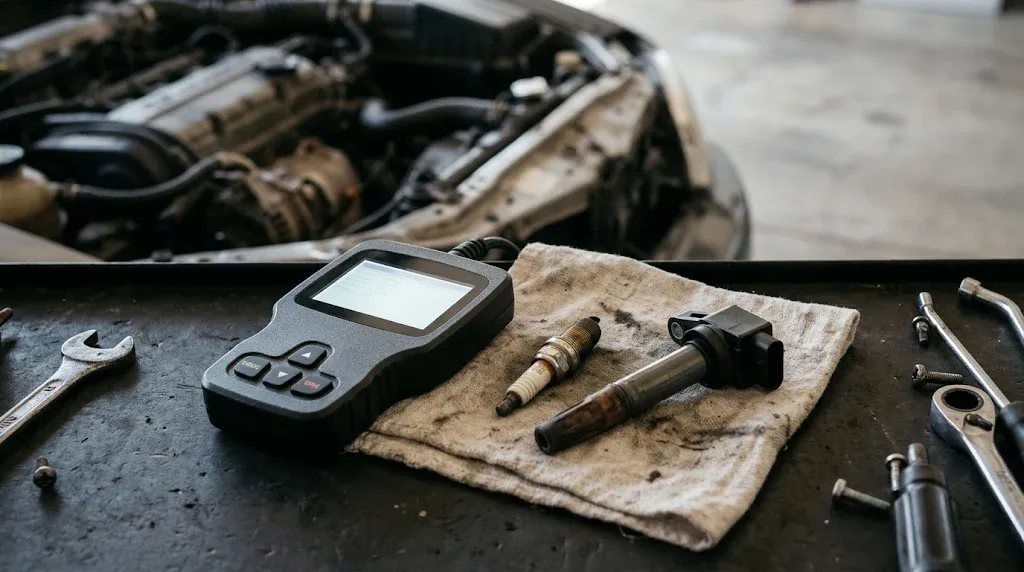
Read the full set, including stored, pending, and manufacturer-specific codes. A companion code often changes the meaning of the first one.
| Code | Meaning | Check first |
|---|---|---|
| P0300 | Random or multiple-cylinder misfire | A shared cause: worn plugs, fuel pressure, an intake leak, or a sensor issue |
| P0301–P0308 | Misfire in a specific cylinder | That cylinder’s plug, coil, wire, injector, or compression |
| P0316 | Misfire during start-up | A cold-start fault that may change as the engine warms up |
| P0350–P0358 | Ignition-coil circuit fault | The coil or its control circuit for the named cylinder |
| P0335, P0340 | Crankshaft or camshaft sensor fault | A timing-signal problem that can affect spark timing |
A single-cylinder code such as P0302 narrows the search to cylinder 2, but it still does not prove that cylinder 2’s coil is bad. A random misfire code such as P0300 is broader, because the misfire affects several cylinders at once. For more detail, see whether OBD2 can detect a misfire.
How the Misfire Monitor Works
The misfire monitor compares crankshaft acceleration after each firing event with what the computer expects. A healthy event adds speed; a weak or missing event does not. The computer uses thresholds to separate normal variation from a fault, and it stores a pending code before a confirmed code.
Freeze-frame data adds the conditions: engine speed, load, coolant temperature, and fuel trim at the moment the code was set. A misfire at cold idle points in a different direction from a misfire at high load. The U.S. Environmental Protection Agency guidance on OBD regulations lists engine misfire among the systems OBD must monitor.
Key Insight
A misfire code is a symptom code, not a part code. It reports that combustion failed in a cylinder. It does not report which part failed to cause it.
What OBD2 Cannot Tell You About Ignition
First, OBD2 cannot measure spark quality. It cannot tell you whether a plug gap has widened, whether a coil is weak only when hot, or whether a plug wire is breaking down under load. A scanner reading at idle may look normal.
Second, a misfire can have a non-ignition cause that looks identical in the code. A clogged or leaking injector, low fuel pressure, an intake leak, low compression, or a timing problem can all cause a cylinder to miss. Fuel trim and oxygen-sensor data can help separate fuel and air causes from ignition causes, but they do not settle the question on their own.
Third, intermittent faults may not set a code at all. If a coil fails only briefly under load, or only when hot, the count may stay below the threshold. The driver feels the hesitation, but the scanner shows no stored code. Live misfire counters and Mode 06 data are more useful then than a simple code read.
How to Check an Ignition Problem With an OBD2 Scanner

Work in order, from the broadest information to the narrowest test.
- Read all codes. Note stored, pending, and manufacturer-specific codes, plus companion codes for fuel, air, or timing sensors.
- Check whether the light is flashing. A steady light means a fault is stored. A flashing light means a severe misfire is happening now and the catalytic converter may be at risk.
- Read the freeze-frame data. Note RPM, load, coolant temperature, and fuel trim when the code set. See whether an OBD2 scanner can display freeze-frame data for what that snapshot contains.
- Watch live misfire counters. Run the engine under the freeze-frame conditions. A count in one cylinder points to that cylinder; counts spread evenly point to a shared cause.
- Check fuel trim and ignition timing. High fuel trim at idle that improves at higher RPM can point to an intake leak; fuel trim that stays high under load can point to fuel delivery.
- Check Mode 06 if your scanner supports it. It can show misfire test results for each cylinder, sometimes before a code is stored. Compare the numbers with the manufacturer’s limits for that car.
- Do a swap test only when it is safe. Move the coil, then the plug if needed, from the misfiring cylinder to another cylinder, clear the codes, and drive under the same conditions. If the misfire follows the part, that part is the likely cause.
- Inspect the plug and coil you remove. Look for fouling, a cracked insulator, carbon tracking, a damaged boot, or corrosion on the connector.
If the misfire stays with the original cylinder after a swap, check compression, injector operation, and intake sealing. That narrows the fault by ruling ignition parts out. Do not clear codes before recording the freeze frame and live data, because clearing removes that history.
Reading Live Data Without Overreading It
A single unusual value rarely proves a cause. A pattern across several values is stronger. One cylinder counting misfires points to that cylinder’s plug and coil first. All cylinders counting evenly points to a shared cause, such as fuel pressure, an intake leak, or worn plugs. Misfires only at idle suggest an intake leak; misfires only under load suggest a weak coil or a fuel-delivery fault.
Warning
A flashing check-engine light means a severe misfire is happening now. Reduce load, avoid hard acceleration, and get the car checked promptly. Continued driving with a severe misfire can overheat and damage the catalytic converter. If the engine is shaking badly or losing power, stop in a safe place rather than continuing to drive.
Which Scanner Capability Actually Matters?
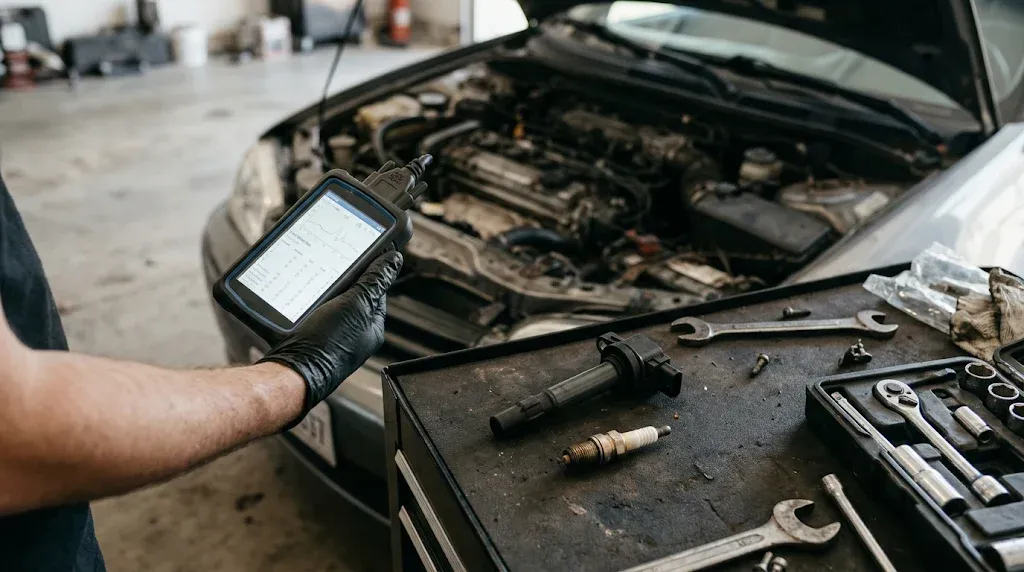
For ignition diagnosis, the scanner’s features matter more than its brand. Live data is the first useful upgrade: per-cylinder misfire counters, fuel trim, RPM, load, and ignition timing turn a single code into a pattern. Freeze-frame support is the second, because without it you lose the conditions that made the code set. Mode 06 support is the third, and it is often missing from cheap readers.
Bidirectional control is useful in a workshop, but it is not required for most DIY checks. A swap test, a visual inspection, and a compression test often settle what a scanner cannot. For a misfire-focused walkthrough, see whether OBD2 can diagnose an engine misfire.
Tip
Before buying a scanner for ignition work, check that it lists live misfire counters, freeze-frame data, and Mode 06 support for your vehicle.
When OBD2 Points Away From Ignition
Sometimes the most useful thing OBD2 does is tell you the ignition system is probably not the cause. If all cylinders misfire evenly and fuel trim is far from normal, a fuel or air problem is more likely than a single bad coil. If a misfire code appears with a sensor code, a timing-signal fault may be affecting spark timing. If it appears with a converter efficiency code, fix the misfire before judging the converter. See whether OBD2 can detect a catalytic converter problem.
Diesel engines are a separate case: they have no spark plugs or ignition coils in the petrol-engine sense, because they ignite fuel by compression. Older cars with a distributor and a single coil also behave differently, because one shared coil can affect several cylinders at once.
Related Product
OBD2 Scanner With Live Data and Mode 06
A scanner with live misfire counters, freeze-frame data, and Mode 06 support makes it easier to see which cylinder is misfiring and under what conditions.
As an Amazon Associate, we earn from qualifying purchases.
Frequently Asked Questions
Can OBD2 tell me if my spark plugs are bad?
No, not directly. OBD2 can report a misfire in the cylinder with a worn or fouled plug, but it cannot measure plug wear or spark strength. A visual inspection, plus a swap test, is needed to confirm the plug itself is the cause.
Will a bad ignition coil always set a code?
No. A coil that fails badly enough to cause repeated misfires will usually set a misfire code, and a coil circuit fault may set a P0350–P0358 code. A coil that fails only when hot or only under load may not set a code if the misfire count stays below the threshold.
What does a flashing check-engine light mean?
It means a severe misfire is happening now, at a rate the computer considers damaging to the catalytic converter. Reduce load, avoid hard acceleration, and get the car checked promptly. A steady light means a fault is stored, but a flashing light is an active warning.
Can OBD2 diagnose ignition problems with no check-engine light?
Sometimes. A scanner with live data and Mode 06 support may show misfire counts before a code is stored, and pending codes may be present even when the light is off. A basic reader may show nothing, even though the driver can feel a hesitation.
Is P0300 always an ignition problem?
No. P0300 means random or multiple-cylinder misfires, and it can be caused by ignition, fuel, air, timing, or mechanical faults. A shared cause such as worn plugs, low fuel pressure, or an intake leak is often more likely than a single bad coil.
Should I replace all coils if one cylinder misfires?
Not on the basis of one code alone. If a swap test shows the misfire follows one coil, replacing that coil is the logical step. Replacing all coils may make sense if they are the same age and several are failing, but that is a maintenance decision, not something the code itself proves.
Conclusion
OBD2 can diagnose many ignition problems, but it does so by reporting the effect, not the part. A misfire code tells you which cylinder is missing, a coil-circuit code points to the coil circuit, and freeze-frame and live data show the conditions that made the fault appear. The proof comes from checking the pattern, inspecting the plug and coil, and using a swap test to see whether the fault moves.

I’m Alex Rahman, a car enthusiast and automotive writer focused on practical solutions, car tools, and real-world driving advice. I share simple and honest content to help everyday drivers make better decisions.
