Can an OBD2 Scanner Reset Transmission Adaptations?
Quick Answer
Yes, some advanced OBD2 scanners can reset transmission adaptations, but a basic code reader usually cannot. You need a diagnostic tool with the correct vehicle-specific transmission control module (TCM) service function. After a reset, the transmission may also need a guided relearn or specified driving procedure. Simply clearing fault codes is not the same thing.
If your automatic transmission shifts harshly after a repair, you may have heard that a scanner can erase its learned behavior. That can be true, but the right question is not simply whether a scanner plugs into the OBD2 port. It is whether the scanner can execute the exact adaptation procedure your transmission requires.
Resetting the wrong values—or resetting them before diagnosing a mechanical problem—can make shift behavior worse temporarily and may leave an important repair unfinished. Here is how to distinguish a genuine transmission reset from ordinary code clearing, verify tool compatibility, and approach relearning safely.
What Are Transmission Adaptations?
Transmission adaptations are learned adjustments that an electronically controlled automatic transmission uses to fine-tune shift behavior. Depending on the transmission, the TCM or powertrain control module (PCM) may adjust clutch fill times, hydraulic pressure commands, or shift timing based on sensor feedback and operating conditions.
The goal is to account for normal manufacturing differences and changes in components over time. For example, if a clutch applies more slowly than intended, the control system may adapt the relevant command within its permitted calibration range. That does not mean the computer can repair a worn clutch or compensate indefinitely for a failing transmission.
A General Motors transmission service bulletin describes how certain eight-speed transmissions use input- and output-speed feedback to refine clutch pressure and shift feel. This is one manufacturer-specific example, not a universal procedure for every automatic gearbox.
Which OBD2 Scanners Can Actually Reset Them?
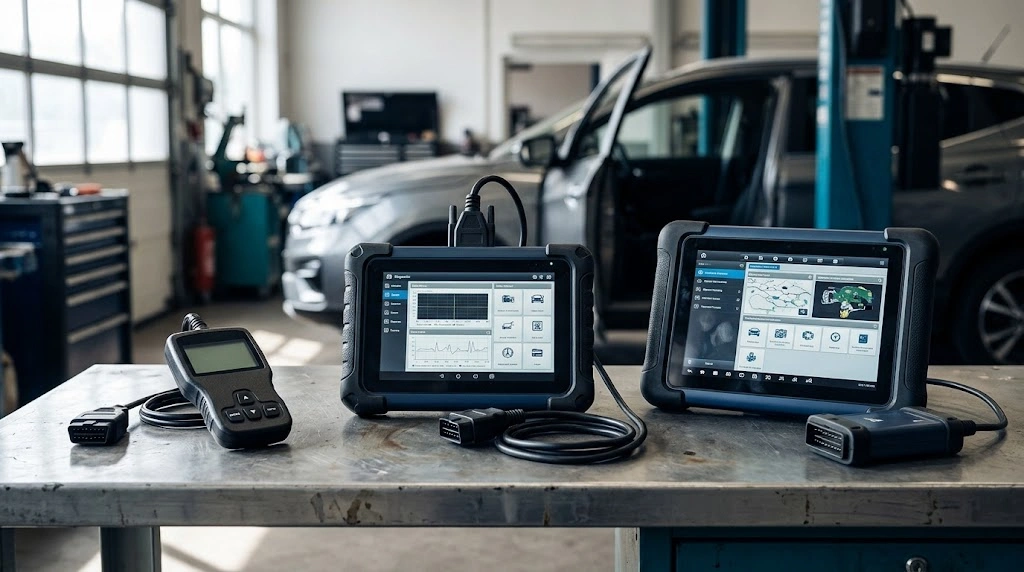
A scanner must support enhanced diagnostics and the particular transmission reset service for your vehicle. Access to transmission codes alone is insufficient. Some advanced professional and enthusiast diagnostic platforms provide supported reset, initialization, or relearn functions; other multi-system scanners stop at reading codes and live data.
If you are comparing features, the site’s guide to essential OBD2 scanner functions explains the difference between ordinary diagnosis and advanced service operations.
| Scanner capability | Can it reset transmission adaptations? |
|---|---|
| Basic generic OBD2 code reader | Generally no; reads and clears common diagnostic codes. |
| Multi-system diagnostic scanner | Not necessarily; TCM code access does not guarantee reset capability. |
| Advanced service-function or bidirectional scanner | Sometimes, when the exact transmission adaptation function is supported. |
| Manufacturer diagnostic system | Often supports specified OEM procedures on covered vehicles, subject to access and equipment requirements. |
Some scanners advertise “transmission reset,” while others list “clutch adaptation,” “adaptive pressure reset,” or “quick learn.” These names may refer to different procedures. For instance, LAUNCH’s published feature description lists a transmission reset but cautions that service-function availability varies by vehicle. Always check model-specific coverage rather than relying on the function count printed on the box.
How to Confirm Your Scanner and Vehicle Are Compatible
Start with the car, not the advertised scanner feature. The same model line can use different transmissions across engine options, model years, and markets. A function that works on one vehicle may be absent on another.
- Identify the exact vehicle. Record the make, model, model year, engine, and transmission designation if available. The VIN can help verify configuration.
- Check the tool manufacturer’s coverage database. Look for the precise vehicle and function, not just “all systems” or “transmission diagnostics.”
- Identify the required service operation. Your repair instructions may call for an adaptive pressure reset, a fast learn, clutch initialization, or another procedure.
- Confirm software and access requirements. Some functions need updated vehicle software, security authorization, or a manufacturer interface.
- Check operating prerequisites. A supported function can still refuse to start if temperature, battery voltage, brake input, or gear-selection conditions are wrong.
A good question for the scanner vendor is: “Does this exact tool and software version perform the transmission adaptation reset specified for my VIN and transmission?” A generic yes to “Does it support transmission?” is not enough.
When Is an Adaptation Reset Necessary?
A reset is most appropriate when the manufacturer’s procedure or repair information specifically calls for one. Transmission rebuilding, valve-body replacement, control-solenoid service, and certain TCM software updates are examples that may require resetting or relearning values.
It is not automatically necessary after every fluid change or whenever a transmission shifts poorly. The correct response depends on the transmission and the cause of the symptom. In fact, GM guidance for some eight-speed transmissions distinguishes between major repairs that require Service Fast Learn and specific shift complaints where a targeted driving learn is preferred instead.
That distinction matters because learned data may be useful evidence. A transmission that suddenly develops hard shifts may have low or incorrect fluid, an electrical fault, a hydraulic issue, or internal wear. Erasing adaptive values cannot fix those faults and may temporarily disguise the original pattern.
Warning
Do not perform an adaptation reset as a trial-and-error cure for severe slipping, loss of drive, overheating, or a transmission warning. Diagnose the fault first. If the vehicle cannot move safely or shows signs of major transmission failure, avoid a test drive and seek qualified service.
How a Transmission Adaptation Reset Is Normally Performed
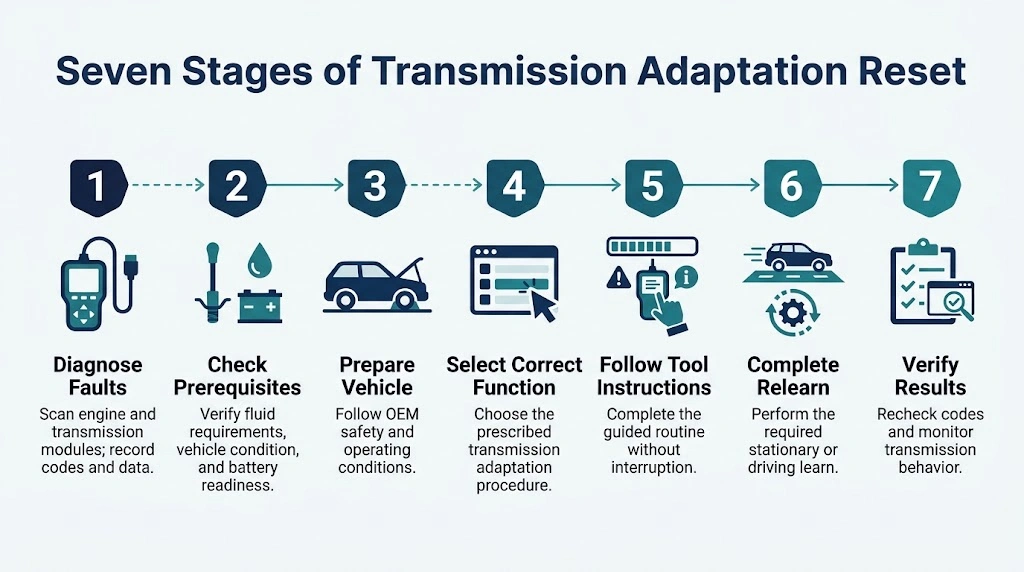
The actual menu path, engine-running requirement, temperature range, and relearn sequence depend on the manufacturer. The following is a decision framework, not a substitute for your vehicle’s service manual.
- Diagnose and record existing faults. Scan the engine and transmission modules, save the codes and relevant data, and investigate problems that may prevent a successful learn.
- Check the repair prerequisites. Verify proper transmission fluid specification and level using the correct temperature-based procedure, and ensure the vehicle and battery are in suitable condition.
- Prepare the vehicle safely. Follow the OEM instructions for parking brake, wheel restraint, service brake, gear selector, and ventilation. Some routines command clutch engagement while stationary.
- Choose the correct function. In the scanner’s transmission or module setup menu, select the adaptation operation specifically prescribed for that gearbox.
- Follow every on-screen instruction. Do not interrupt the process, switch off the ignition unexpectedly, or improvise the sequence if the tool reports an error.
- Complete the specified relearn. Some transmissions require a stationary fast-learn routine, others a controlled driving sequence, and some need both.
- Verify the result. Recheck codes and monitor shift behavior, temperature, and any available relevant learned-data parameters.
For a concrete example, GM service guidance describes a GDS2 path through transmission module diagnostics and configuration/reset functions to a Service Fast Learn routine on specified eight-speed transmissions. The procedure is vehicle-specific; copying it to an unrelated transmission would be inappropriate.
Resetting Adaptations Is Not the Same as Relearning
An adaptation reset clears or initializes selected learned values. Relearning is the process by which the control system establishes suitable operating adjustments again. Some diagnostic routines perform learning as part of the reset operation; others require the vehicle to be driven in defined conditions afterward.
This is also different from simply deleting a trouble code. Standard code clearing addresses stored diagnostic information; it does not guarantee that transmission-specific adaptive values were changed. Likewise, disconnecting the battery is not a dependable substitute for a documented TCM adaptation procedure. Learned values may be retained in nonvolatile memory, and other vehicle settings can be affected.
For a clearer explanation of command-capable tools, see the guide to active tests and bidirectional diagnostics. A scanner capable of issuing commands has more potential than a passive reader, but even bidirectional capability does not guarantee this particular service function.
What Should You Expect After a Reset?
Some vehicles may shift differently while values are relearned. For example, Ford technical guidance for certain vehicles warns that shifts may feel firmer after adaptive strategy reset until the computer has relearned. That observation should not be turned into a universal promise that every harsh shift is normal or will disappear after a few days.
Use the manufacturer’s recommended test conditions and expectations. If the procedure completed correctly but harsh engagement, flare, slipping, or a warning persists, stop treating relearning as the solution and investigate the underlying transmission condition.
It is also possible for the scanner to report that a function is unavailable or failed. Common explanations include unsupported vehicle software, wrong module selection, unmet operating conditions, or an active fault. Record the exact message and check the relevant service information before trying again.
How to Decide Between a DIY Scanner and a Professional Shop

If your tool documentation explicitly confirms the correct function for your transmission, you have access to the repair procedure, and the required steps are safe to perform, a supported DIY reset may be practical. This is especially true when the reset is a documented follow-up to a completed repair rather than a guess about an unexplained symptom.
A professional shop or dealer is the better route when the procedure needs manufacturer-specific software, controlled clutch-pressure routines, programming, security access, or equipment that you do not have. Professional service is also appropriate when symptoms suggest internal damage rather than a learning issue.
The useful dividing line is not a scanner’s price. It is whether you can verify the function, understand the prerequisites, and confirm the transmission is mechanically and electronically ready to relearn.
Practical Tip
Before paying for a tool, ask the seller to confirm the exact transmission adaptation function for your VIN in writing. “Reads transmission codes” and “supports 30 reset functions” are not proof of compatibility.
Related Tool Category: Advanced Transmission Diagnostic Scanner
A scanner with vehicle-specific TCM service functions may be useful for prescribed adaptation resets and relearn procedures. Verify your exact vehicle and function before purchasing.
Frequently Asked Questions
Can a cheap Bluetooth OBD2 adapter reset transmission adaptations?
Usually not by itself. It depends on the adapter, app, supported vehicle protocols, and whether the software includes the exact manufacturer-specific adaptation function. Generic Bluetooth code-reading apps normally do not.
Does clearing transmission fault codes reset shift learning?
Not necessarily. Clearing diagnostic trouble codes and resetting learned transmission adaptation values are distinct operations. Use the named service function required by the vehicle manufacturer.
Will disconnecting the battery reset transmission adaptations?
Not reliably. Some modules retain learned values after power is removed, and a battery disconnect cannot replace a specified guided reset and relearn procedure.
Do transmission adaptations need resetting after a fluid change?
Not as a universal rule. Routine fluid service alone does not establish a need to erase adaptive values. Follow the repair instructions for the specific transmission and service performed.
Can a reset repair slipping or a worn transmission?
No. A reset changes learned control values, not damaged clutches, worn seals, failed solenoids, or an incorrect fluid level. Slipping or loss of drive calls for diagnosis rather than repeated resets.
How long does transmission relearning take?
There is no universal duration. Some systems use a guided stationary procedure; others require specified driving conditions and additional adaptation over subsequent operation. Use the manufacturer’s instructions for your exact transmission.
Conclusion
An OBD2 scanner can reset transmission adaptations only when it provides the correct vehicle-specific service function. Basic code readers cannot be assumed to do it, and a generic code clear is not a relearn. Verify the exact tool coverage, diagnose any faults first, and follow the manufacturer’s reset and learning instructions instead of treating adaptation clearing as a universal shift-quality fix.

I’m Alex Rahman, a car enthusiast and automotive writer focused on practical solutions, car tools, and real-world driving advice. I share simple and honest content to help everyday drivers make better decisions.
