Can a Scan Tool Perform a Transmission Relearn? Explained
Quick Answer
Yes, a scan tool can perform a transmission relearn, but only the right kind of tool on the right vehicle. A bidirectional scan tool with a transmission relearn, quick-learn, or adaptation-reset function can clear old shift adapts and start the relearn. A basic code reader cannot. Even after a tool starts the process, the transmission usually still needs a careful drive cycle to finish learning.
A transmission relearn is not one button for every car. The tool, the transmission type, the repair that came before it, and the driving that follows it all change what happens next.
What Does a Transmission Relearn Actually Mean?
A transmission relearn clears outdated adaptive values and lets the transmission control module, or TCM, rebuild them for the transmission as it is now. Those values cover clutch fill time, line pressure, shift timing, and torque converter lock-up. Small corrections, but they decide whether a shift feels smooth, firm, late, or harsh.
As friction material wears, the TCM adds pressure or changes timing to keep shifts consistent. After a rebuild, a valve body change, a solenoid replacement, or a fluid service, that record describes hardware that no longer exists. A relearn gives the TCM a clean starting point and fresh measurements.
A relearn is different from clearing a fault code, which removes a stored code but does not necessarily erase adaptive tables. It is also different from programming, which loads software into a module. Some jobs need both, such as a replacement TCM that needs programming first and a relearn afterward.
The Two Ways a Transmission Relearns
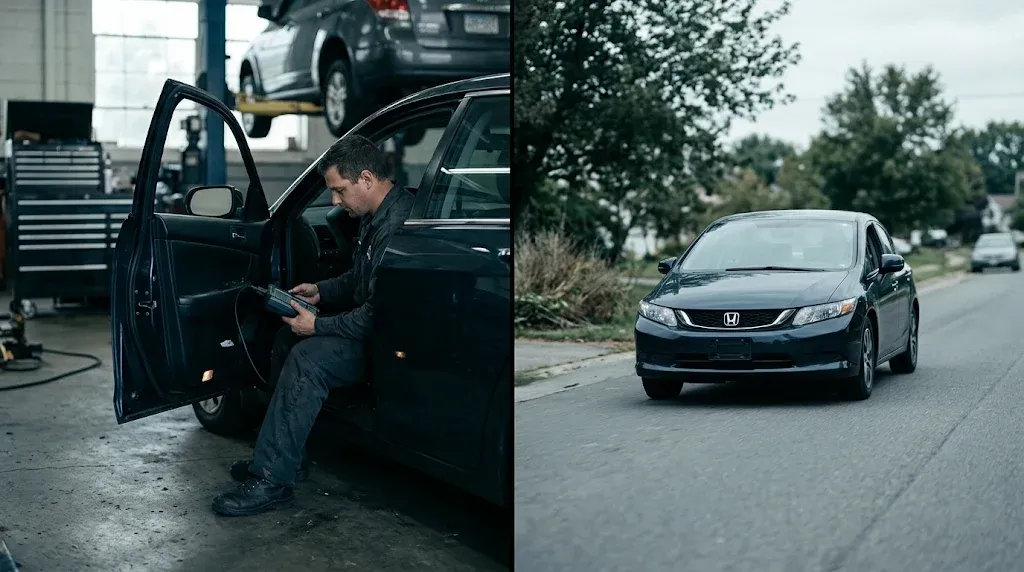
Most modern transmissions relearn in one of two ways, and many vehicles use both in sequence. Understanding the difference explains why one owner fixes harsh shifts with a scan tool in minutes while another needs days of driving.
1. A commanded quick-learn
A commanded quick-learn is a scan-tool routine. The tool talks to the TCM, erases stored shift adapts, and on many platforms runs a guided cycle that commands shifts under set conditions. The aim is to re-baseline pressures quickly, rather than waiting for normal driving to supply enough shift events.
This method is common on GM fast-learn procedures, many Chrysler and Ram quick-learn routines, and ZF 8HP adaptation resets. The routine often takes only a few minutes, but the tool still expects correct fluid temperature, a healthy battery, and no active transmission fault codes.
2. An adaptive drive-cycle relearn
An adaptive drive-cycle relearn happens through driving. After the adapts are cleared, the TCM watches real upshifts, downshifts, coasting, and converter lock-up, then adjusts its tables over repeated events. This is slower than a commanded routine, but it is how many vehicles finish the job even after a tool reset.
Full smoothing usually takes roughly 50 to 100 miles of mixed driving, with some systems needing up to 200 miles. Light-throttle shifts, steady cruising, and gentle deceleration give the TCM useful data. Hard acceleration early on can teach the wrong values for normal driving.
Can a Scan Tool Perform a Transmission Relearn?
Yes, when three conditions line up. First, the scan tool must be able to send commands to the TCM, not only read codes. Second, it must list the relearn, quick-learn, or adaptation-reset function for that exact year, make, model, and transmission. Third, the vehicle must be in the condition the routine requires, with fluid at operating temperature and no fault that blocks the procedure.
That is why price alone is unreliable. A tool may support relearn on a GM truck and not on a VW DSG, or on a Chrysler 68RFE and not on a Nissan CVT. Look for Transmission Relearn, Quick Learn, Fast Learn, Adaptation Reset, Basic Settings, or Clutch Adaptation. Before buying or borrowing a tool, check its coverage list for your exact vehicle and transmission.
Tip
Check the tool’s vehicle coverage before the repair, not after the transmission is back together. If the relearn function is missing for your car, you will need a different tool or a shop with dealer-level equipment.
Which Scan Tools Can Do It, and Which Cannot?
The dividing line is bidirectional control. A bidirectional tool can send a command to a module and ask it to act. A read-only tool can only ask for data. That difference decides whether a relearn is possible.
| Tool type | Relearn? |
|---|---|
| Basic code reader | No, reads and clears engine codes only |
| Bluetooth adapter with a generic app | Usually no |
| Mid-level all-system scanner | Sometimes, if the function is listed |
| Bidirectional professional scanner | Yes, when covered |
| Dealer-level or OEM tool | Yes, for its brand |
Reading transmission codes is not the same as performing a relearn. If you cannot find a relearn entry under the TCM or service menu, the tool is reporting, not commanding. See whether an OBD2 scanner can control vehicle components.
What Happens During a Scan-Tool Relearn?
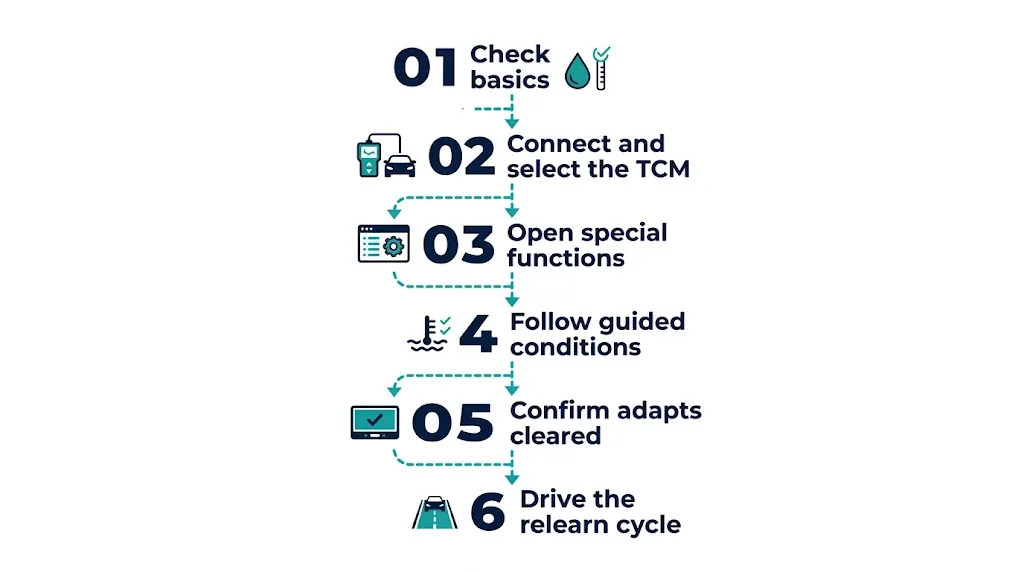
The exact steps vary by vehicle, so always follow the on-screen prompts and the service information for your year, make, and model. The general flow below shows what to expect.
- Check the basics first. Confirm fluid level and condition, battery voltage, and that no transmission fault code is active. A relearn will not fix low fluid, a failed solenoid, or a mechanical fault.
- Connect and select the TCM. Plug the tool into the OBD2 port, select the vehicle, then open the transmission control module. Our guide to how to scan a transmission control module covers the navigation and live data to check.
- Open special functions. Look for Service Functions, Special Functions, or Active Tests, and select Transmission Relearn, Quick Learn, or the manufacturer term for your vehicle.
- Follow the guided conditions. The tool may ask for the engine running or off, the selector in Park, the brake held, or fluid within a set temperature range. Do not skip a condition, because the routine will often stop without it.
- Confirm the adapts cleared. After the routine, check TCM live data. Adaptive corrections should return to zero or to factory default values.
- Drive the relearn cycle. Warm the transmission fully, then drive with light to moderate throttle through the full gear range, with steady cruising and gentle coast-downs, repeated over several trips.
Some platforms add a stationary phase before the road test. VW DSG basic settings, for example, use a stationary calibration followed by an adaptation drive. See whether an OBD2 scanner can reset transmission adaptations.
When Do You Need a Transmission Relearn?
A relearn is most clearly needed after work that changes how the transmission applies clutches or controls pressure. That includes a rebuild, a valve body or solenoid pack replacement, a TCM replacement, a mechatronic unit service, and some fluid services on adaptive transmissions. It is also needed when a replacement transmission is installed, because the TCM must learn the new unit rather than keep the old one’s corrections.
A relearn may also help after a battery disconnect on platforms that lose adapts when power is cut. Not every service needs one: a routine fluid change with no internal work, no code, and no change in shift feel may not require a commanded relearn.
What a Scan Tool Cannot Do in a Relearn
A scan tool cannot repair a worn clutch, a leaking seal, a sticking valve, or a damaged torque converter. If harsh shifts come from mechanical wear, a relearn may make them slightly smoother for a short time, but the underlying fault will return.
A scan tool also cannot force a relearn when the TCM will not accept it. Active fault codes, low fluid temperature, a weak battery, or a module that needs programming first can block the routine. On some OEM-locked systems, only dealer-level software can run it. Foxwell’s guide to transmission adaptation reset makes the same distinction: the reset clears learned data, and the drive cycle rebuilds it.
Warning
Do not run a relearn to hide a slipping transmission, a burnt-fluid smell, or a flashing transmission warning. Those signs point to a fault that needs diagnosis first.
Common Mistakes That Make a Relearn Fail

The most common mistake is stopping after the reset. The tool did its part, but the TCM still needs shift events to learn. Driving only a few miles, or only at highway speed, leaves many gears unlearned. Mixed city and highway driving, with repeated light-throttle shifts, gives the TCM a fuller data set.
Another mistake is driving too hard too soon. Wide-open throttle teaches a different table from normal driving, and aggressive shifts during the early phase can make normal shifts feel worse. Keep the first trips gentle, then return to normal driving once shifts have settled.
Skipping the temperature condition is also common. Warm the transmission to normal operating temperature first. Do not confuse a battery disconnect with a full relearn. See how to use an OBD2 scanner before you start.
How to Tell If the Relearn Worked
Shifts should become more consistent over the first trips, not perfect on the first mile. Early roughness, a slight hesitation, or a firmer shift is normal while adapts are still forming. The direction matters more than the first impression: shifts should trend smoother as the TCM collects data.
Check for new codes after the drive cycle. A relearn that keeps setting a code, or that leaves the vehicle in limp mode, has not solved the problem. If shifts do not improve after the expected mileage, stop repeating the reset and get the transmission diagnosed.
Related Product
Bidirectional OBD2 Scanner With Transmission Relearn
A bidirectional scanner is the tool type that can actually send a relearn or adaptation-reset command to the TCM, so check that the listing names transmission relearn for your vehicle before you buy.
As an Amazon Associate, we earn from qualifying purchases.
Frequently Asked Questions
Can a basic OBD2 code reader perform a transmission relearn?
No. A basic code reader can read and clear engine codes, but it cannot send a relearn command to the TCM. You need a bidirectional tool that lists transmission relearn, quick-learn, or adaptation reset for your vehicle.
How long does a transmission relearn take?
The tool routine itself often takes only a few minutes. The full learning process usually takes 50 to 100 miles of mixed driving, and some systems need up to 200 miles before shifts fully smooth out.
Will my transmission relearn on its own without a scan tool?
Some vehicles will, through normal driving after the adapts are cleared or after a battery disconnect. Others, including many GM, Chrysler, and ZF 8HP applications, need a commanded quick-learn to start correctly after internal work.
Does disconnecting the battery perform a transmission relearn?
Not reliably. A battery disconnect may clear temporary data, but it does not run a guided quick-learn or erase all adaptation values on many platforms. If the manufacturer calls for a tool routine, use the tool routine.
Can a transmission relearn fix slipping or harsh shifting?
It can fix harsh shifting caused by outdated adapts after a repair, but it cannot fix slipping from worn clutches, low fluid, or a failed solenoid. If slipping continues after a proper relearn, the transmission needs diagnosis and repair.
Do I need a dealer tool for a transmission relearn?
Not always. A good bidirectional aftermarket tool can perform the relearn on many vehicles when the function is covered. Dealer-level equipment is needed when the routine is OEM-locked, when programming is required first, or when the aftermarket tool does not list your transmission.
Conclusion
A scan tool can perform a transmission relearn when it has bidirectional control and the relearn function for your vehicle, but the tool is only the first half of the job. Clear the old adapts, check that the values reset, then drive gently through mixed conditions until shifts settle. If shifts do not improve, stop resetting and get the transmission diagnosed.

I’m Alex Rahman, a car enthusiast and automotive writer focused on practical solutions, car tools, and real-world driving advice. I share simple and honest content to help everyday drivers make better decisions.
