Can a Scan Tool Perform Steering Angle Calibration?
Quick Answer
Yes, a scan tool can perform steering angle calibration if it supports the required Steering Angle Sensor (SAS) calibration function for your specific vehicle. Basic OBD2 code readers usually cannot perform this procedure. You typically need an enhanced diagnostic scanner with access to steering, ABS, or electronic stability control modules. Some vehicles also require manufacturer-specific calibration steps.
A steering angle sensor tells the vehicle’s electronic control systems how far and in which direction the steering wheel is turned. If its reference position becomes incorrect, stability control, traction control, or steering assistance may not behave as intended.
Calibration may be necessary after certain wheel alignments, steering repairs, sensor replacements, or electronic control module work. The key is knowing whether your vehicle requires a scan-tool procedure and whether your scanner can perform it.
What Type of Scan Tool Can Perform Steering Angle Calibration?
You generally need an enhanced diagnostic scan tool that supports a dedicated SAS calibration, steering angle adjustment, or steering angle initialization function.
A basic OBD2 scanner typically reads and clears emissions-related engine trouble codes. It normally does not offer the manufacturer-specific commands needed to recalibrate the steering angle sensor.
Advanced diagnostic scanners may communicate with the ABS, electronic stability control, electric power steering, or steering angle sensor modules to initiate the required service routine.
The following comparison explains the differences.
| Scanner Type | SAS Calibration Capability |
|---|---|
| Basic OBD2 code reader | Usually unavailable |
| Enhanced multi-system scanner | Available on some supported vehicles and models |
| Professional diagnostic tablet | Often supported, subject to vehicle coverage |
| Manufacturer-specific diagnostic equipment | Designed for the manufacturer’s supported service procedures |
Even an expensive professional scanner may lack a particular procedure for a specific model year. Always verify vehicle coverage instead of relying on the scanner’s general feature list.
How Does Steering Angle Sensor Calibration Work?
Steering angle calibration establishes or updates the reference that the vehicle uses to interpret steering wheel position.
When the steering wheel and road wheels are correctly centered, the electronic control system needs to recognize that position as its neutral reference. Depending on the vehicle, calibration may involve storing a new zero point, initializing the sensor, or synchronizing information between control modules.
This information is important for systems such as:
- Electronic Stability Control (ESC): Compares intended steering direction with vehicle movement.
- Traction Control: Works alongside stability and braking systems to manage wheel traction.
- Electric Power Steering (EPS): May use steering-related sensor data for assistance and control.
- Advanced Driver Assistance Systems (ADAS): Certain steering-assistance features rely on accurate steering information.
Calibration does not repair a damaged steering component, correct wheel alignment, or straighten an incorrectly positioned steering wheel. Those mechanical problems must be addressed separately.
How to Perform Steering Angle Calibration With a Scan Tool
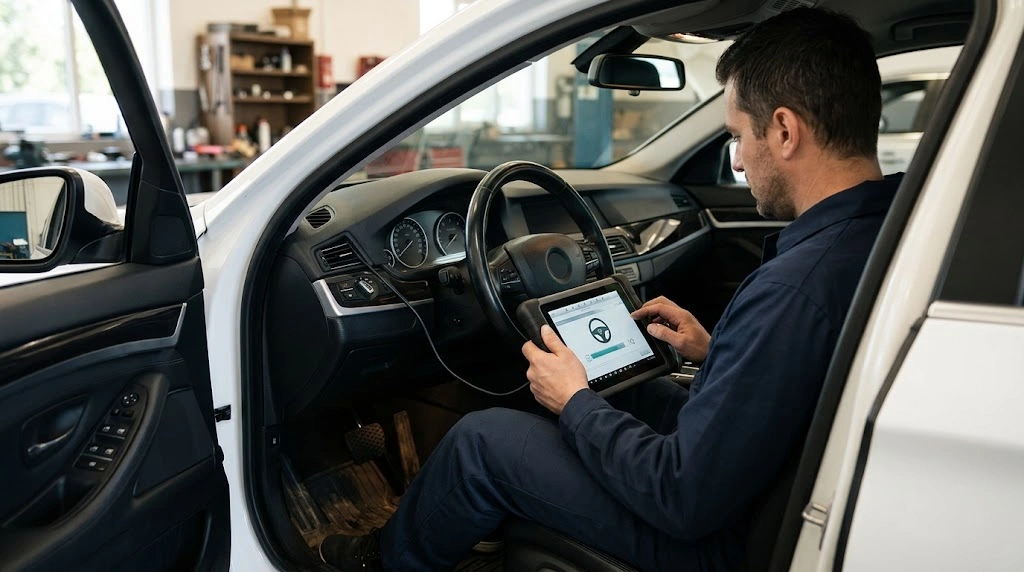
The exact calibration sequence depends on the manufacturer, model, year, and installed systems. The steps below describe the general workflow rather than a universal procedure.
Step 1: Verify the Vehicle’s Calibration Requirements
Check the vehicle’s service information before starting. Confirm whether it requires an electronic calibration, a driving-based learning procedure, or additional initialization steps.
Also verify that the scanner supports the exact vehicle and required service function.
Step 2: Prepare the Vehicle
Park on a suitable level surface, following the manufacturer’s instructions. Ensure the steering wheel and front wheels are correctly centered, and address any mechanical alignment problems first.
Some procedures require a particular battery voltage, ignition setting, or other preparation. Follow the specified requirements rather than assuming every vehicle uses the same conditions.
Step 3: Connect the Diagnostic Scanner
Connect the supported scan tool to the vehicle’s diagnostic connector, usually located beneath the dashboard.
Identify the vehicle using the VIN or the appropriate manufacturer, model, and year selections. Enter the relevant diagnostic system according to the scanner’s instructions.
Step 4: Locate the SAS Calibration Function
Depending on the diagnostic software, the function may be labeled:
- Steering Angle Sensor Calibration
- SAS Reset
- Steering Angle Adjustment
- Steering Angle Initialization
- Neutral Position Learning
- Steering Angle Sensor Zero-Point Calibration
The menu name does not guarantee that two scanners perform an identical operation. Confirm the function matches the procedure required by your vehicle.
Step 5: Run the Calibration Routine
Follow the scanner’s instructions carefully. The vehicle may require you to keep the steering wheel stationary, change ignition states, or perform additional actions.
Do not move the steering wheel during a stationary calibration unless the procedure specifically instructs you to do so.
For a manufacturer example, the Mitsubishi steering wheel sensor calibration procedure demonstrates how initialization and calibration can involve more than one electronic control module.
Step 6: Verify the Result
Confirm the scanner reports successful completion. Check relevant diagnostic trouble codes and steering angle live data if available.
When appropriate, follow the manufacturer-prescribed final checks or road-test procedure. Calibration is not complete merely because a warning light disappears.
Safety Warning
Do not use calibration to compensate for incorrect wheel alignment, damaged steering components, or unresolved stability-control faults. If the vehicle pulls, the steering wheel is visibly off-center, or safety-system warnings remain active, diagnose those problems before returning the vehicle to normal use.
When Is Steering Angle Calibration Necessary?
Calibration requirements vary between vehicles and repair procedures. Common situations in which service information may specify steering angle calibration include:
- Wheel alignment: When the manufacturer requires the steering reference to be updated after adjustment.
- Steering angle sensor replacement: When a new sensor needs initialization or neutral-position learning.
- Steering rack or column repairs: When repair work changes steering geometry or sensor relationships.
- ABS or stability control module replacement: When a control module requires steering information to be learned again.
- Collision repairs: When steering, suspension, alignment, or related electronic components have been affected.
- Relevant diagnostic faults: When diagnosis identifies an incorrect or missing steering angle reference.
Not every wheel alignment automatically requires electronic SAS calibration. The manufacturer’s service instructions determine whether the procedure is necessary.
Hunter Engineering’s steering angle reset guidance explains the relationship between wheel alignment and steering sensor reset procedures.
Can You Calibrate a Steering Angle Sensor Without a Scan Tool?
Some vehicles support a manual or driving-based steering angle learning procedure, while others require an electronic calibration command from compatible diagnostic equipment.
For certain vehicles, the learning process may involve specified ignition operations, steering movements, or controlled driving conditions.
However, there is no reliable universal method that works across all manufacturers. Turning the steering wheel fully left and right is not a substitute for a vehicle-specific calibration procedure.
If the service manual requires a commanded reset, use appropriate diagnostic equipment. If the vehicle supports automatic learning, follow the exact conditions provided by the manufacturer.
Why Might a Scan Tool Fail to Calibrate the Steering Angle Sensor?
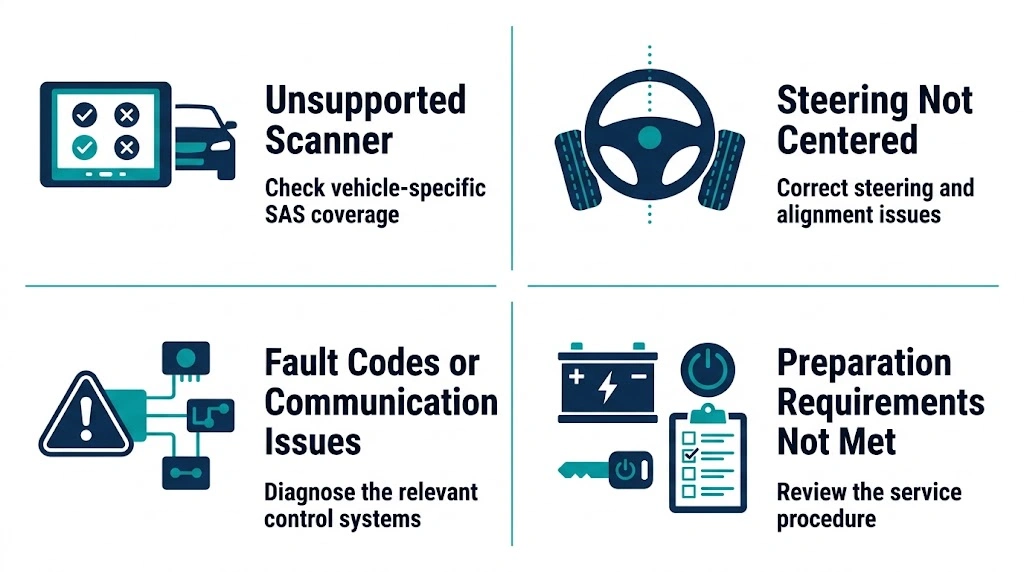
A failed calibration does not necessarily mean the sensor is defective. Several mechanical, electrical, and software conditions can prevent the procedure from completing.
The Scanner Does Not Support the Vehicle
Some scanners advertise SAS calibration but only support selected manufacturers or model years. Check the tool manufacturer’s vehicle-specific function coverage and software requirements.
The Steering Wheel Is Not Correctly Centered
If the wheels or steering wheel are incorrectly positioned, the required calibration conditions may not be satisfied.
Correct underlying alignment and steering issues before attempting to establish the neutral position.
Active Fault Codes or Communication Problems Exist
Stored faults in the steering, ABS, or stability control system may indicate problems that must be resolved before calibration.
Communication failures can also prevent the scanner from accessing the required module. For a related explanation, see why an OBD2 scanner cannot access the ABS system.
A Required Preparation Step Was Missed
Incorrect ignition settings, unsuitable battery voltage, incomplete initialization, or an omitted manufacturer-specific step can cause failure.
Review the scanner’s message and the vehicle service procedure rather than repeatedly running the same calibration command.
How Can You Tell Whether Calibration Was Successful?
A successful procedure should meet the manufacturer’s completion criteria, not simply erase a dashboard warning.
Useful verification checks may include:
- The diagnostic tool confirms successful calibration.
- Relevant sensor data changes smoothly when steering is moved.
- The steering angle reading is consistent with the specified neutral-position requirement.
- Applicable steering and stability control fault codes are resolved.
- Any required post-calibration checks have been completed.
A steering angle reading of exactly zero is not a universal requirement for every scanner display or vehicle. Interpret the value according to the manufacturer’s diagnostic specification.
If warning lights remain illuminated, perform a complete diagnosis rather than assuming another reset will fix the issue.
Our guide to reading ABS trouble codes with an OBD2 scanner explains why enhanced system access matters when troubleshooting these faults.
Does Clearing Trouble Codes Calibrate the Steering Angle Sensor?
No. Clearing diagnostic trouble codes and performing steering angle calibration are different operations.
Clearing codes removes stored fault information when the control module permits it. Calibration establishes or updates a steering angle reference through the manufacturer’s required procedure.
Some calibration routines may automatically clear certain related codes after successful completion, but the reverse is not necessarily true.
This distinction matters because a scanner that can erase ABS codes may still lack the ability to calibrate the steering angle sensor.
Key Insight
Three scanner capabilities are different: reading steering angle data, clearing steering-related fault codes, and commanding SAS calibration. Before choosing a tool, verify that it supports the third function for your exact vehicle.
What Should You Check Before Choosing a Scanner?
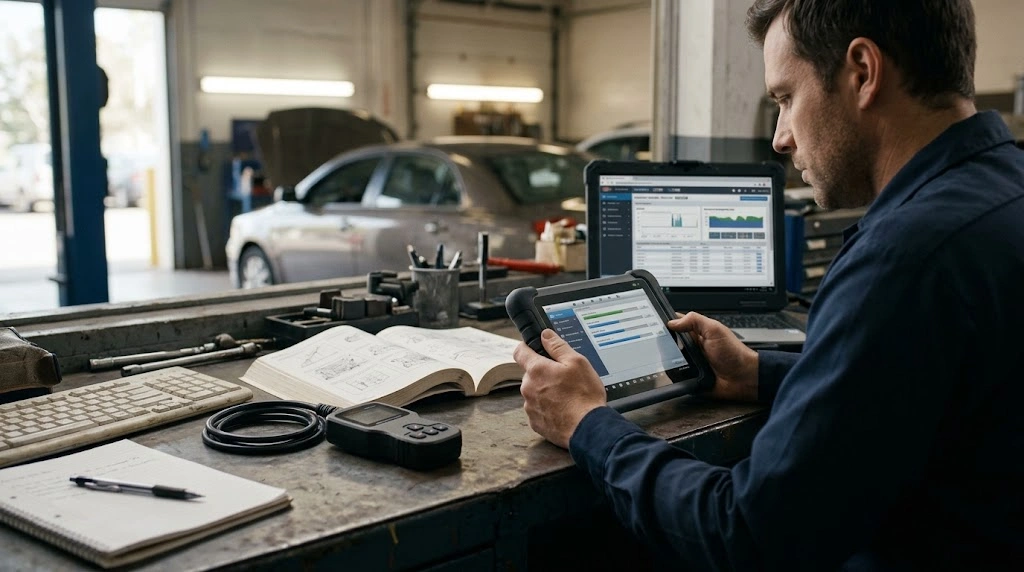
Start with vehicle compatibility rather than brand reputation or the number of advertised diagnostic functions.
Check the scanner manufacturer’s coverage database using the vehicle’s make, model, year, and applicable configuration. Confirm that SAS calibration is specifically supported.
Also determine whether the procedure requires access to ABS, steering, or stability control modules, whether software updates are needed, and whether security gateway authorization applies.
For a broader discussion of scanner limitations, see what OBD2 scanners cannot detect or perform.
Related Tool: SAS Calibration Scan Tool
An enhanced automotive diagnostic scanner with vehicle-specific SAS service functions may be useful for steering angle calibration and related system diagnostics. Confirm your exact vehicle’s compatibility before purchasing.
Affiliate disclosure: As an Amazon Associate, we may earn from qualifying purchases.
Frequently Asked Questions
Can a Bluetooth OBD2 scanner calibrate a steering angle sensor?
Only if the Bluetooth adapter, diagnostic application, and vehicle-specific software support the required SAS calibration command. A basic Bluetooth code reader usually cannot perform this function.
Is steering angle calibration the same as wheel alignment?
No. Wheel alignment adjusts the vehicle’s mechanical wheel geometry. Steering angle calibration establishes or updates the electronic steering reference. Some vehicles require both procedures after certain repairs.
Can an incorrect steering angle sensor cause an ESP warning light?
Yes. Incorrect steering angle information can contribute to electronic stability system warnings. However, the warning may have other causes, so relevant trouble codes and sensor data should be diagnosed first.
Does replacing the steering angle sensor always require calibration?
Calibration or initialization is required on many vehicles after sensor replacement, but the exact procedure varies. Follow the manufacturer instructions for the replacement part and vehicle.
Can a steering angle sensor be calibrated while driving?
Some vehicles support a manufacturer-specified driving or automatic learning procedure. Others require a stationary diagnostic routine, sometimes followed by a driving verification step.
Will disconnecting the battery reset the steering angle sensor?
Not reliably. Battery disconnection may trigger initialization requirements on some vehicles, but it does not replace a manufacturer-required SAS calibration procedure.
Final Thoughts
A scan tool can perform steering angle calibration when it provides the correct vehicle-specific service function. Basic OBD2 readers normally lack this capability, while enhanced diagnostic scanners and manufacturer-specific equipment may support it.
The most reliable approach is to verify the manufacturer’s procedure, correct any underlying steering or alignment problems, perform calibration using compatible equipment, and confirm that the vehicle meets the required completion checks.

I’m Alex Rahman, a car enthusiast and automotive writer focused on practical solutions, car tools, and real-world driving advice. I share simple and honest content to help everyday drivers make better decisions.
