10 Best Portable OBD2 Scanners for 2026: Pocket Diagnostics That Travel
The best portable OBD2 scanner right now is BlueDriver Bluetooth Pro OBD2 Scan Tool for iPhone & Android with no subscription. We compared 10 portable scanners, scoring each on Portability, Diagnostic Coverage, and Ease of Use. Most portable scanners look alike on paper but fail in cramped footwells or weak signal. Whether you need a glovebox reader, a phone-based adapter, or a workshop-ready handheld, this guide gives you one answer.
Quick Comparison: All 10 Products Ranked
| # | Product | Best For | Rating | Badge | |
|---|---|---|---|---|---|
| 1 | BlueDriver Bluetooth Pro OBD2 Scan Tool for iPhone & Android | everyday drivers who want phone-based diagnostics | 4.9/5 | Best Overall | Buy → |
| 2 | FOXWELL NT301 OBD2 Scanner | drivers who want a standalone handheld reader | 4.8/5 | Best Handheld | Buy → |
| 3 | OBDLink MX+ Bluetooth OBD2 Adapter | phone and laptop users who want fast data | 4.8/5 | Best Bluetooth Adapter | Buy → |
| 4 | Autel AutoLink AL319 OBD2 Scanner | budget buyers who need core code reading | 4.7/5 | Best Budget | Buy → |
| 5 | LAUNCH CR529 OBD2 Scanner | DIY users who watch live sensor data | 4.7/5 | Best Live Data Display | Buy → |
| 6 | ANCEL AD310 OBD2 Scanner | first-time users who want simple checks | 4.6/5 | Best Simple Reader | Buy → |
| 7 | Veepeak OBDCheck BLE+ Bluetooth OBD2 Scanner | iPhone users who want a tiny adapter | 4.6/5 | Best for iPhone | Buy → |
| 8 | Autel MaxiAP AP200 Bluetooth OBD2 Scanner | DIY users who want wider system coverage | 4.6/5 | Best App-Based System Scan | Buy → |
| 9 | FIXD Bluetooth OBD2 Scanner | beginners who want plain-English explanations | 4.5/5 | Best for Beginners | Buy → |
| 10 | MOTOPOWER MP69033 OBD2 Scanner | value buyers who need a spare reader | 4.5/5 | Best Value Pick | Buy → |
How We Chose These Portable Scanners
What we compared
10 portable scanners: 5 handheld readers and 5 Bluetooth adapters, checked against listed connection types, vehicle coverage, and core diagnostic functions.
Our 3 scoring criteria
Portability, Diagnostic Coverage, and Ease of Use, each scored out of 5 for every product.
Editorial ratings note
Scores are editorial ratings based on listed specifications, not laboratory or hands-on test results. No independent expert was consulted for this roundup.
What we cut — and why
Large tablet-based professional systems and workshop-only tools were cut because they are not pocket-portable for everyday drivers.
What to Look for When Buying a Portable OBD2 Scanner
Portable means different things to different drivers: a dongle you forget is plugged in, or a handheld you grab for a roadside check. Start with how you will actually use it, then check coverage. This guide covers what to look for in a scanner in the same cluster for a deeper checklist.
1. Size, Weight, and Pocket Fit
A portable scanner earns its place by being there when a light comes on. A dongle wins if you want it always plugged in, while a compact handheld wins if you want a screen without draining your phone. Check whether it fits your glovebox, door pocket, or tool pouch without rattling loose.
2. Connection Type: Handheld Screen or Phone App
Handheld scanners work on their own and draw power from the car, which is ideal at the roadside. Bluetooth adapters are smaller and often cheaper, but they need a charged phone and a compatible app. The choice between a handheld scanner versus phone app is really a choice about which screen you trust more.
3. Vehicle and Protocol Compatibility
Most portable scanners cover 1996 and newer OBD2 vehicles in the United States, but enhanced coverage varies by brand, model, and year. Check your vehicle year and whether you need engine-only codes or wider system coverage. Also confirm scanner coverage on electric vehicles before buying, since electric-vehicle support is often limited to generic data.
4. Live Data, Freeze Frame, and Code Depth
Reading a code is only the first step. Live data shows what a sensor is doing now, and freeze frame shows conditions when the fault was set. If you plan to diagnose a check engine light properly, prioritise tools that show both, plus I/M readiness for inspections. Plain-language explanations also help if you are not fluent in code definitions.

BlueDriver Bluetooth Pro OBD2 Scan Tool for iPhone & Android — Pocket adapter, no subscription needed
BlueDriver suits drivers who want a scanner that lives in the glovebox and works through a phone. The small Bluetooth adapter plugs into the OBD2 port, pairs with iPhone or Android, and explains codes in plain language instead of leaving you with a bare number. It covers enhanced codes on many vehicles, live data, freeze frame, and a smog check, so a warning light becomes a clearer next step. There is no subscription for the core app, which keeps ownership simple. Its main limit is dependence on your phone, so a flat phone battery leaves you without a screen.
- Pocket-size Bluetooth adapter for glovebox storage
- No subscription for core app features
- Plain-language code explanations and repair reports
- Needs a charged phone to display results
- Enhanced coverage varies by vehicle brand
4.9/5
4.8/5
4.9/5
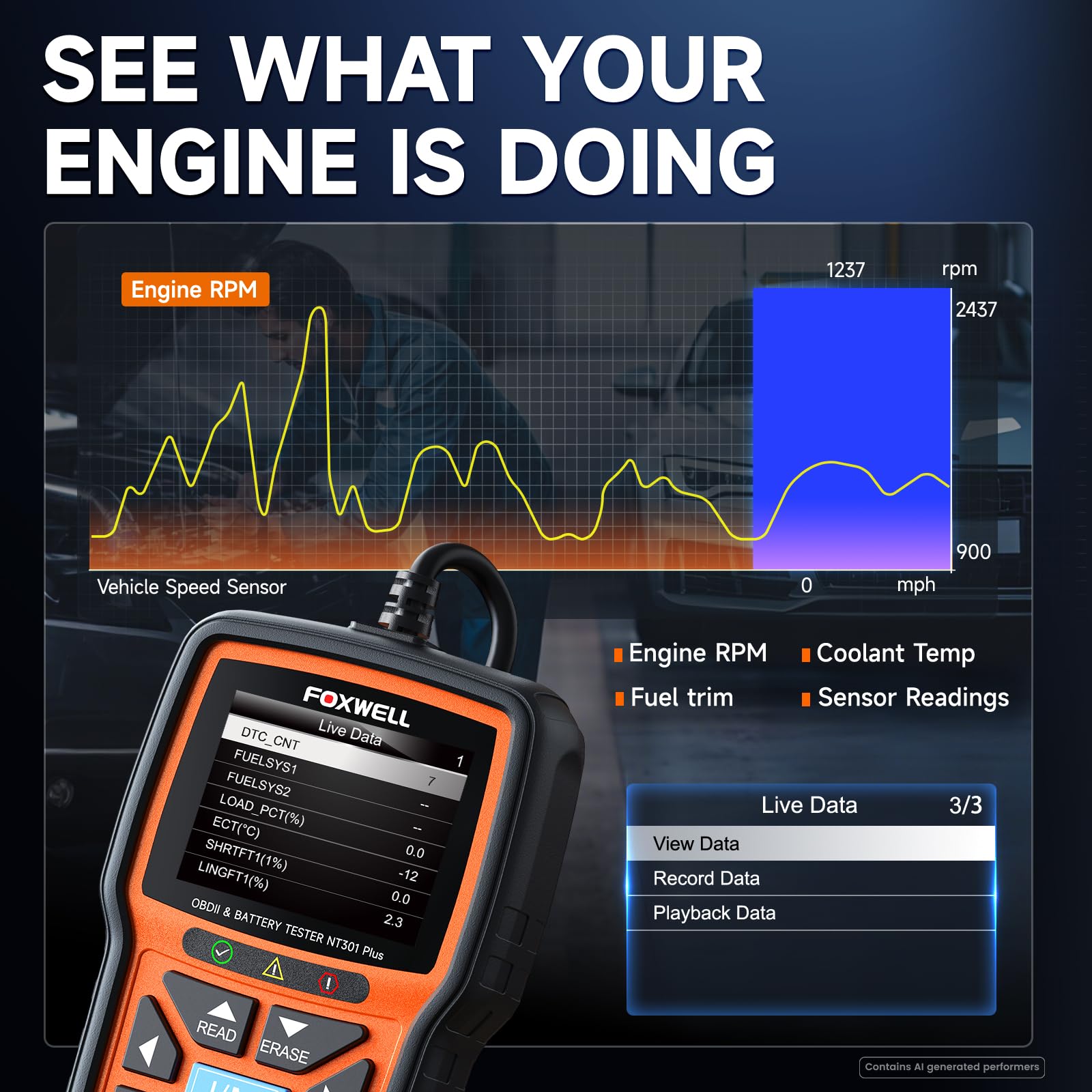
FOXWELL NT301 OBD2 Scanner — Standalone reader, no phone required
FOXWELL NT301 suits drivers who prefer a self-contained tool rather than a phone app. Its colour screen, buttons, and built-in code library make reading and clearing codes straightforward at the car, even where phone signal is weak. It covers full OBD2 modes, live data, freeze frame, I/M readiness, oxygen sensor tests, and EVAP checks, so most everyday warning-light jobs are covered without extra software in most cases. The trade-off is a larger glovebox footprint than a dongle, and it does not offer the full-system coverage of larger professional tablets.
- Standalone screen and buttons, no phone needed
- Built-in code library for quick lookups
- Covers I/M readiness and oxygen sensor tests
- Bulkier than a Bluetooth dongle
- No full-system professional tablet coverage
4.7/5
4.9/5
4.8/5

OBDLink MX+ Bluetooth OBD2 Adapter — Fast adapter for phones and laptops
OBDLink MX+ suits users who want one small adapter for a phone, tablet, or Windows laptop. It connects by Bluetooth, supports third-party diagnostic apps, and handles faster data rates than many basic dongles, which helps live-data graphs feel responsive rather than laggy. It also supports manufacturer-enhanced diagnostics in its own app on supported vehicles, adding useful depth beyond generic codes. The adapter is still app-dependent, and some advanced features sit behind the app you choose, so check app compatibility before buying if you have a specific vehicle in mind first.
- Works with phones, tablets, and Windows
- Faster live-data response than basic dongles
- Supports third-party diagnostic apps
- Needs a compatible app for full features
- Advanced coverage varies by app and vehicle
4.9/5
4.8/5
4.7/5

Autel AutoLink AL319 OBD2 Scanner — Simple budget reader that covers essentials
Autel AL319 suits buyers who want the essentials without paying for features they will rarely use. This compact handheld reads and clears generic and manufacturer-specific codes where supported, shows freeze frame and live data, and checks I/M readiness before an inspection. Its colour screen and one-click readiness key keep the workflow quick for a first-time user, and it draws power from the car, so no charging is needed. It is not a full-system tool, so ABS, airbag, and other non-engine systems are generally outside its scope, which matters if those lights are your main concern.
- Compact handheld with colour screen
- One-click I/M readiness check
- No charging or phone pairing needed
- Generally no ABS or airbag coverage
- Smaller feature set than larger Autel tools
4.8/5
4.6/5
4.8/5

LAUNCH CR529 OBD2 Scanner — Handheld with clear live-data graphs
LAUNCH CR529 suits DIY users who want to watch sensor readings, not just read a code. Its handheld screen shows live data streams, graphs, and freeze frame, which helps you spot a sensor that reads oddly under load rather than guessing from a single snapshot. It covers full OBD2 functions, reads and clears codes, and checks I/M readiness, with free lifetime updates listed for the tool. The trade-off is that it remains an engine-focused OBD2 reader, so deeper manufacturer-system work still needs a more advanced tool, and its screen is smaller than a tablet.
- Live-data graphs on a handheld screen
- Free lifetime updates listed
- Full OBD2 functions and I/M check
- Engine-focused, not a full-system tool
- Screen smaller than a tablet display
4.7/5
4.7/5
4.7/5

ANCEL AD310 OBD2 Scanner — Beginner-friendly reader, minimal setup
ANCEL AD310 suits first-time users who want the shortest path from warning light to answer. Plug it in, read the code, and check whether the car is ready for inspection, without installing an app or learning a menu system. It reads and clears engine codes, shows freeze frame, and supports I/M readiness checks, which covers the most common reason most people buy a scanner. It is deliberately basic, so live-data depth and non-engine systems are limited, and you will need a different tool if ABS or airbag diagnosis is the priority.
- Plug in and read, no app needed
- Simple menus for first-time users
- Covers I/M readiness checks
- Limited live-data depth
- Generally no ABS or airbag diagnosis
4.8/5
4.5/5
4.9/5

Veepeak OBDCheck BLE+ Bluetooth OBD2 Scanner — Tiny BLE adapter for iPhone users
Veepeak OBDCheck BLE+ suits iPhone users who need a dongle that works over Bluetooth Low Energy, where classic Bluetooth adapters often fail on iOS. The tiny adapter stays plugged in without adding bulk, pairs with compatible third-party apps, and covers generic OBD2 codes, live data, and freeze frame on supported vehicles. Because it relies on the app you choose, the experience varies: one app may show richer data than another, and enhanced manufacturer coverage is not guaranteed. It is a strong pocket choice for generic checks, but not a replacement for a full-system professional tool.
- Bluetooth Low Energy for iPhone compatibility
- Tiny adapter that stays plugged in
- Works with compatible third-party apps
- Experience varies by chosen app
- Enhanced coverage not guaranteed
4.9/5
4.5/5
4.7/5

Autel MaxiAP AP200 Bluetooth OBD2 Scanner — App tool with wider system coverage
Autel MaxiAP AP200 suits DIY users who want more than engine codes from a pocket adapter. It connects by Bluetooth to a phone app and offers full-system scanning on supported vehicles, plus service functions listed for the tool, which makes it a step up from a generic code reader for home maintenance. AutoVIN can speed up vehicle identification, and the adapter itself remains small enough for a glovebox. The trade-off is app and vehicle dependence: coverage and service availability vary, and the workflow is less immediate than a handheld with its own screen.
- Full-system scanning on supported vehicles
- Service functions listed for the tool
- AutoVIN for faster vehicle identification
- Coverage varies by vehicle and app
- No built-in screen for quick checks
4.9/5
4.7/5
4.5/5

FIXD Bluetooth OBD2 Scanner — Beginner adapter with plain-English guidance
FIXD suits beginners who want a warning light translated into plain language and a sense of urgency, rather than a raw code to research alone. The small Bluetooth sensor plugs into the port, connects to a phone app, and explains common issues, tracks maintenance reminders, and can monitor more than one vehicle with additional sensors. That guidance is genuinely helpful for a first scanner, but deeper live-data work and manufacturer-system coverage are limited compared with advanced tools, and some app features may require a subscription, so check what is included before relying on it long term.
- Plain-English explanations for beginners
- Maintenance reminders in the app
- Can monitor multiple vehicles with sensors
- Limited deeper live-data work
- Some app features may need subscription
4.9/5
4.4/5
4.8/5

MOTOPOWER MP69033 OBD2 Scanner — Low-cost spare reader for basic checks
MOTOPOWER MP69033 suits value buyers who want a spare reader for the glovebox, a second car, or a first attempt at home diagnostics. This compact handheld reads and clears engine codes, checks I/M readiness, and shows freeze frame, covering the core jobs most drivers actually use a scanner for. Its simple controls and port power mean no app, pairing, or charging to manage, which is a real advantage on the roadside. It is basic by design, so live-data depth, graphing, and non-engine systems are limited, and it should not be bought as a professional-grade diagnostic station.
- Compact spare reader for a glovebox
- No app, pairing, or charging needed
- Covers core code and readiness checks
- Limited live-data depth and graphing
- Generally no non-engine system coverage
4.8/5
4.4/5
4.7/5
Top 3 Head-to-Head: BlueDriver vs FOXWELL NT301 vs OBDLink MX+
These three are the common final choices because they cover the three portable styles: phone adapter, standalone handheld, and fast multi-device adapter.
| Feature | #1 BlueDriver | #2 FOXWELL NT301 | #3 OBDLink MX+ |
|---|---|---|---|
| Portability | 4.9/5 — Best | 4.7/5 | 4.9/5 |
| Diagnostic Coverage | 4.8/5 | 4.9/5 — Best | 4.8/5 |
| Ease of Use | 4.9/5 — Best | 4.8/5 | 4.7/5 |
| Choose if… | You want phone guidance with no subscription | You want a standalone screen and buttons | You want fast data on phone or laptop |
Who These Portable Scanners Are NOT For
Portable scanners are excellent for engine codes and everyday checks, but they are not a substitute for a professional workshop tool.
They are also a poor fit if you need to program keys, code modules, or perform advanced service resets on many brands. For those jobs, confirm the exact function for your vehicle before buying any portable tool.
Common Mistakes to Avoid
Most portable-scanner regrets come from a coverage or connection mismatch, not from a faulty tool.
Frequently Asked Questions About Portable OBD2 Scanners
What is a portable OBD2 scanner?
A portable OBD2 scanner is a small diagnostic tool you can carry in a glovebox or pocket and plug into a car’s OBD2 port. It reads fault codes, shows freeze frame data, and often displays live sensor readings. Handheld versions have their own screen, while Bluetooth versions send results to a phone app. Either style helps you understand a warning light before visiting a workshop.
Do portable OBD2 scanners work on all cars?
No, portable OBD2 scanners do not work on all cars. They generally cover gasoline vehicles from 1996 onward in the United States and compatible OBD2 or EOBD vehicles elsewhere. Older cars, some motorcycles, and vehicles with manufacturer-specific ports may need an adapter or a different tool. Always check your vehicle year, port type, and the scanner’s listed compatibility before buying.
Is a Bluetooth OBD2 scanner better than a handheld one?
Neither style is better for everyone, because they solve different problems. A Bluetooth scanner is smaller, cheaper to carry, and often gives richer phone-app explanations, but it needs a charged phone. A handheld scanner has its own screen and works without pairing, which is better at the roadside. Choose the screen you are most likely to have with you when a light appears.
Can a portable OBD2 scanner work without internet?
Yes, a portable OBD2 scanner can usually read codes and live data without internet, because the car and scanner communicate directly. A phone app may still need internet for code definitions, repair guidance, or updates, depending on the app. If you often scan in garages or rural areas, check whether your chosen app stores its code library offline. This guide also covers a Bluetooth scanner without internet access in the same cluster for more detail.
Can a portable OBD2 scanner read ABS and airbag codes?
Some portable scanners can read ABS and airbag codes, but many basic models cover engine codes only. Full-system tools such as Autel MaxiAP AP200 offer wider coverage on supported vehicles, while simple readers generally do not. If ABS or airbag lights are your main concern, check system coverage for your exact make, model, and year before buying, rather than assuming every portable scanner covers them.
Do I need a subscription for a portable OBD2 scanner app?
No, you do not always need a subscription, but it depends on the product and app. BlueDriver offers core features without a subscription, while some apps charge for advanced reports, repair guidance, or multi-vehicle features. Handheld scanners usually avoid app subscriptions altogether. Before buying, check which features are included, which need payment, and whether updates are free for life.
Our Final Verdict
Portable scanners split cleanly by screen: phone adapters are smallest, handhelds are most independent. For most everyday drivers, a pocket Bluetooth adapter with plain-language guidance is the easiest tool to actually keep in the car. Bluetooth adapters win on size, handhelds win on independence, so choose by the screen you will actually have with you.

I’m Alex Rahman, a car enthusiast and automotive writer focused on practical solutions, car tools, and real-world driving advice. I share simple and honest content to help everyday drivers make better decisions.
