Are Cheap OBD2 Scanners Accurate? The Honest Answer
Quick Answer
Yes, for basic generic engine codes. A cheap scanner that connects correctly can report the same standard trouble code as a dearer tool. It becomes less reliable for manufacturer-specific codes, other vehicle systems, fast-changing live data, and diagnosis, because a code alone does not identify the failed part.
A low price does not automatically make a scanner dishonest, and a high price does not automatically make its first reading correct. Accuracy depends on what you are asking the tool to do, which vehicle system holds the fault, and whether the software can interpret the result. This article separates those questions so a cheap scanner is neither dismissed out of hand nor trusted further than its design allows.
What Counts as Cheap, and What It Does Not Guarantee
Cheap usually means a basic handheld code reader or a small Bluetooth or Wi-Fi adapter paired with a phone app. The common feature is a narrow job: read and clear supported engine and emissions codes, and sometimes show a few live values. It does not normally mean full access to every computer in the car.
That distinction matters because OBD2 is a standard gateway, not a single diagnostic system. The port and the generic emissions functions are standardised, but access to anti-lock brakes, airbags, transmission control, body electronics, and manufacturer-specific functions is a separate capability. A tool can be perfectly adequate at the first job and unsuitable for the second.
Price also says little about the app or firmware behind an adapter. Two adapters that look alike can differ in protocol support, update history, code definitions, and connection stability. Checking the exact model and its supported functions matters more than assuming every low-cost tool is the same.
Why Basic Generic Codes Are Usually Reported Correctly
Generic powertrain codes, such as those beginning P0, have standardised meanings across compliant vehicles. When a compatible scanner requests a stored code from the engine computer and receives it, the code it displays is the record the vehicle produced. In that narrow sense, a cheap reader and a professional tool can agree, because neither tool creates the code.
The EPA overview of vehicle inspection and maintenance programs describes this same basic relationship: the onboard system monitors emissions-related systems and records a diagnostic trouble code when a fault is detected. The scanner retrieves information the vehicle already holds; it does not measure exhaust gas or inspect the part itself.
This is also why the broader question of scanner accuracy needs care. A correct code can still lead to a wrong repair if the reader, or the person using it, treats the code as a part name. For the general distinction between retrieving a code, trusting a sensor value, and proving a diagnosis, see the guide to how accurate OBD2 scanners are. The present article focuses only on where a low-cost tool is most likely to diverge.
Where Cheap Scanners Lose Accuracy
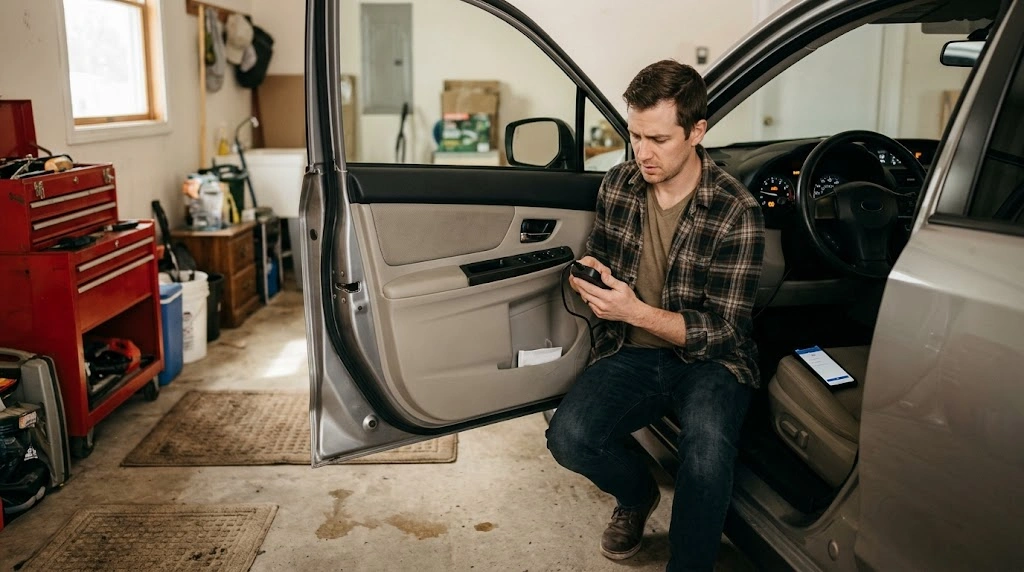
Most cheap-scanner errors are not invented codes. They are missing information, slow information, vague definitions, or results from the wrong system.
- Manufacturer-specific codes: A P1 code, or a code from another module, may be retrieved without the correct manufacturer definition. The number can be right while the plain-language explanation is generic, incomplete, or wrong for that brand.
- Other modules: An engine-only reader may report no codes while an ABS, airbag, or transmission controller holds a fault. No engine code is not the same as no fault anywhere in the vehicle.
- Protocol gaps: Older or less common protocols can expose weak adapter firmware. A tool that works well on a modern CAN vehicle may connect unreliably, or not at all, on an older vehicle using a different protocol.
- Slow or smoothed live data: Cheap Bluetooth adapters and apps can refresh slowly, especially when many values are requested at once. A delayed reading can hide a brief drop, spike, or slow sensor response.
- App and database quality: With an adapter, the app supplies much of the interpretation. An outdated code library, a wrong vehicle profile, or a misleading repair suggestion can make a valid code look like a different problem.
- Clone firmware: Some very low-cost ELM327-style adapters use incomplete or copied firmware. They may connect for basic codes yet drop connections, miss protocols, or behave inconsistently with advanced functions.
| Task | Cheap basic scanner | What a better tool adds |
|---|---|---|
| Generic engine code | Usually reliable when connected | More context, not a different generic code |
| Manufacturer code meaning | Often partial or generic | Brand-specific definitions and module access |
| ABS or airbag fault | Often unavailable | Supported module coverage for that vehicle |
| Fast live data | Slower, sometimes smoothed | Faster refresh, graphing, and recording |
| Root-cause diagnosis | Starting point only | More tests, still not proof by itself |
The table is a guide to capability, not a guarantee for any named model. Each row still needs a check against the exact vehicle, module, and software version.
How to Check a Cheap Scanner Before Trusting It
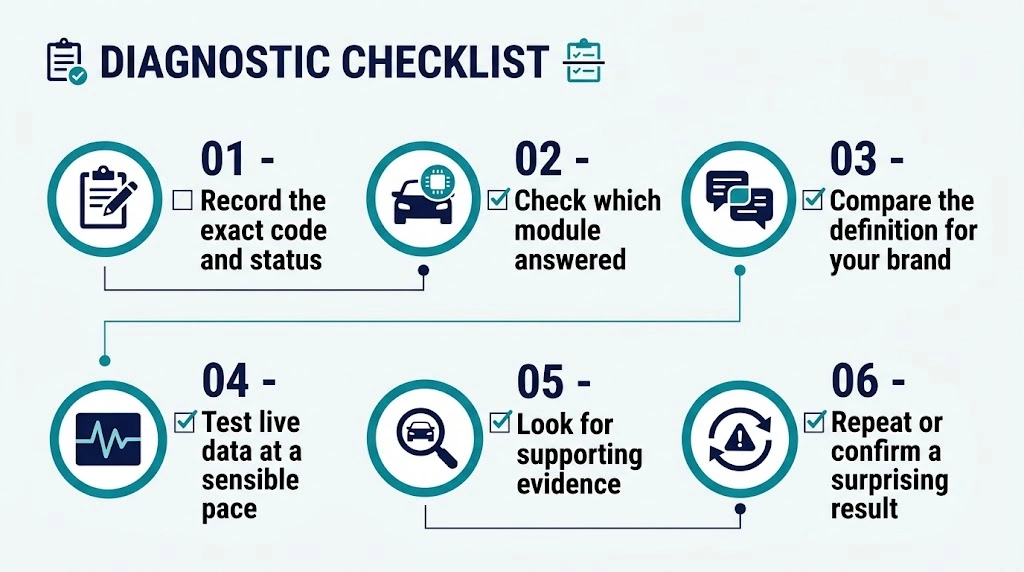
Use a short verification routine before replacing a part or dismissing a warning. It takes a few minutes and catches most cheap-tool limitations.
- Record the exact code and its status. Save the five-character code, whether it is stored, pending, or permanent, and any freeze-frame snapshot. Do not clear it yet.
- Check which module answered. If the scan covered only the engine, an ABS or airbag warning may belong to a system the tool never checked.
- Compare the definition for your brand. For a manufacturer-specific code, check the definition against your make and model rather than accepting a generic app description. The guide to whether an OBD2 scanner can read manufacturer codes explains why retrieval and interpretation are different skills.
- Test live data at a sensible pace. Select only the values you need, warm the engine when the check requires it, and watch whether values update smoothly or freeze. A reading that never changes deserves suspicion, not acceptance.
- Look for supporting evidence. Related codes, fuel trims, symptoms, and a visual check can narrow the cause. A single code naming a sensor does not prove that sensor has failed.
- Repeat or confirm a surprising result. If a value looks impossible, a code appears and disappears, or the tool disconnects, repeat the scan and, when needed, confirm with an independent test such as a multimeter check or professional scan.
Tip
If live data looks frozen, reduce the number of selected values before blaming the sensor. Requesting too many values at once is a common cause of slow or stale readings on a basic adapter.
Mistakes That Make a Correct Code Look Wrong
A cheap scanner is often blamed for a diagnostic error that actually comes from how the result was used. Clearing a code before recording freeze-frame data removes context. Treating a code as a repair order can replace a healthy sensor while a vacuum leak, wiring fault, or exhaust leak remains. Assuming a blank engine scan clears the whole car can miss a fault in another module.
Live-data mistakes follow the same pattern. Comparing a cold-engine value with a warm-engine expectation, watching too many values at once, or reading a calculated value as if it were directly measured can all create a false alarm. The steps in the guide to reading OBD2 live data help separate a useful reading from a misleading one, whatever the price of the tool.
Key Insight
A scanner can report a vehicle value faithfully while that value is physically wrong, because the scanner usually displays what the vehicle computer reports, not a measurement it made itself.
When a Cheap Scanner Is Enough, and When It Is Not
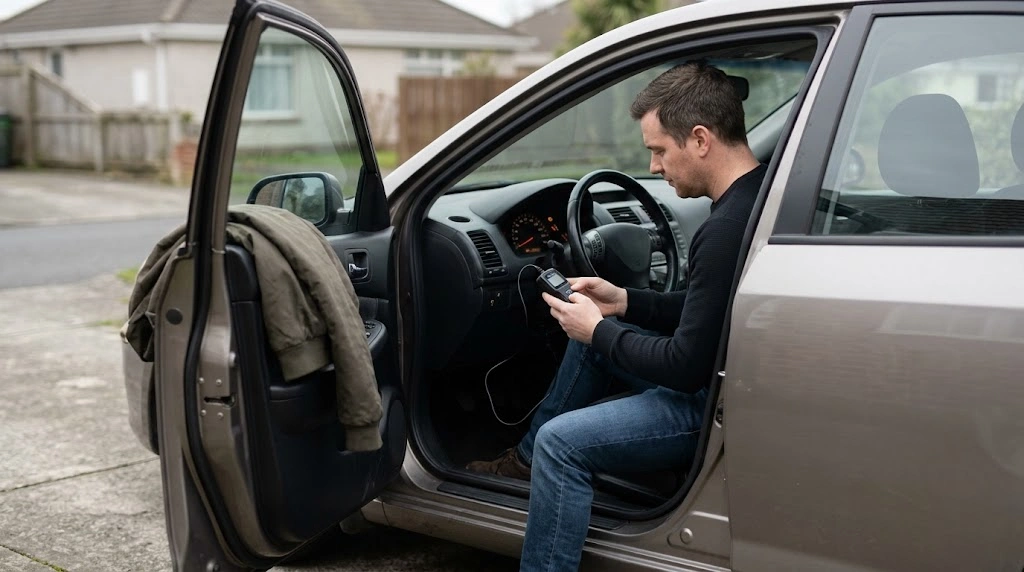
A cheap scanner is usually enough when the job is narrow: find out why a check engine light came on, record a generic engine code, check readiness after a repair, or monitor a few basic values on a compatible vehicle. For those jobs, the main risks are a vague definition and a missing module, both of which can be checked with the routine above.
Step up when the fault sits outside generic engine diagnostics, when the vehicle or protocol is unusual, when live data must be fast and reliable, or when a repair decision is expensive. In those cases, verified module coverage, a maintained code database, and stable software matter more than the adapter price alone. The practical guide to choosing an OBD2 scanner gives a checklist for matching coverage to the exact vehicle and task.
If symptoms are serious, do not let a reassuring cheap scan override them. A flashing check engine light, severe misfire, overheating, or a brake or airbag warning needs prompt attention under the vehicle manual, even if a basic engine scan shows nothing.
Related Product
OBD2 Scanner With Live Data
A scanner that shows live sensor values, as well as codes, makes it easier to check evidence before deciding on a repair.
As an Amazon Associate, we earn from qualifying purchases.
Frequently Asked Questions
Can a cheap OBD2 scanner give the same code as an expensive scanner?
Yes, for a supported generic engine code. If both tools communicate with the same module and request the same standard function, they can report the same code. The expensive tool may add module coverage, context, or faster live data, but it does not change that generic code.
Why does my cheap scanner show no codes when a warning light is on?
The fault may sit in a module the scanner cannot reach, may be intermittent, or may not yet meet the vehicle criteria for a stored code. Identify which warning is lit, confirm the scanner covers that system, and check whether the scan actually connected to the relevant module.
Are cheap Bluetooth adapters less accurate than handheld readers?
Not by connection type alone. A stable, compatible Bluetooth adapter can retrieve the same generic data as a handheld reader. Accuracy problems usually come from adapter firmware, app decoding, protocol support, or connection drops, rather than Bluetooth itself.
Can a cheap scanner read manufacturer-specific codes?
Sometimes it can retrieve a manufacturer-specific powertrain code, but it may not explain it correctly for your brand or reach codes in other modules. Record the exact code and module, then check the manufacturer-specific definition before acting on it.
Should I trust live data from a cheap scanner?
Use it as evidence, not proof. Check that values update, compare them with expected warm-engine behaviour, select only the values you need, and confirm a surprising or frozen value with another test. Slow refresh and calculated values are the most common traps.
Does a cheap scanner damage accuracy by clearing codes?
Clearing does not make past readings less accurate, but it removes diagnostic evidence and can reset readiness monitors. Record codes and freeze-frame data first, and do not treat an empty code list after clearing as proof that a fault is fixed.
Conclusion
Cheap OBD2 scanners are accurate enough for their core job: reporting supported generic engine codes on a compatible vehicle. Their weakness is depth, not basic honesty. Manufacturer definitions, other modules, protocol coverage, live-data speed, and app interpretation are where low-cost tools diverge, and those are exactly the areas to verify before a repair decision. Treat the first scan as evidence, check the module and definition, and confirm surprising results before spending money on parts.

I’m Alex Rahman, a car enthusiast and automotive writer focused on practical solutions, car tools, and real-world driving advice. I share simple and honest content to help everyday drivers make better decisions.
