Magellan DR52 4K+4K Dash Cam Review: Dual STARVIS 2 Tested
The Magellan DR52 4K+4K Dash Cam is a dual-channel vehicle recording system engineered to capture ultra-high-definition video from both the front windshield and the rear window. Designed primarily for commuter security, rideshare accountability, and comprehensive traffic documentation, the system tackles the resolution imbalance typical of conventional two-channel systems.
For motorists seeking verifiable driving records, this package pairs dual Sony STARVIS 2 image sensors with dual native 3840×2160 recording, bundled high-endurance storage, and hardwire power equipment in a single purchase. The result is an all-inclusive setup aimed squarely at eliminating aftermarket accessory guesswork.
Quick Verdict
Reviewed Product
Magellan DR52 4K+4K Dual Dash Cam
A true dual-channel 4K vehicle surveillance system equipped with dual Sony STARVIS 2 sensors and bundled 24-hour parking hardware.
Rating: ★★★★½ 4.5/5
Best For: Drivers wanting complete front and rear Ultra HD evidence with all essential power and memory hardware included out of the box.
Key Specs
Dual 4K UHD (3840×2160) • Dual Sony STARVIS 2 Sensors • 128GB MicroSD Included • Integrated GPS & Wi-Fi
Key Advantage
Simultaneous 4K recording front and rear ensures license plate detail is captured regardless of travel direction.
Main Trade-off
Dual 4K video encoding generates substantial data volume that fills memory cards faster than standard 1080p rear setups.
Bottom Line
The Magellan DR52 delivers genuine Ultra HD optics front and rear alongside complete parking accessories, making it an exceptional high-value safety investment.
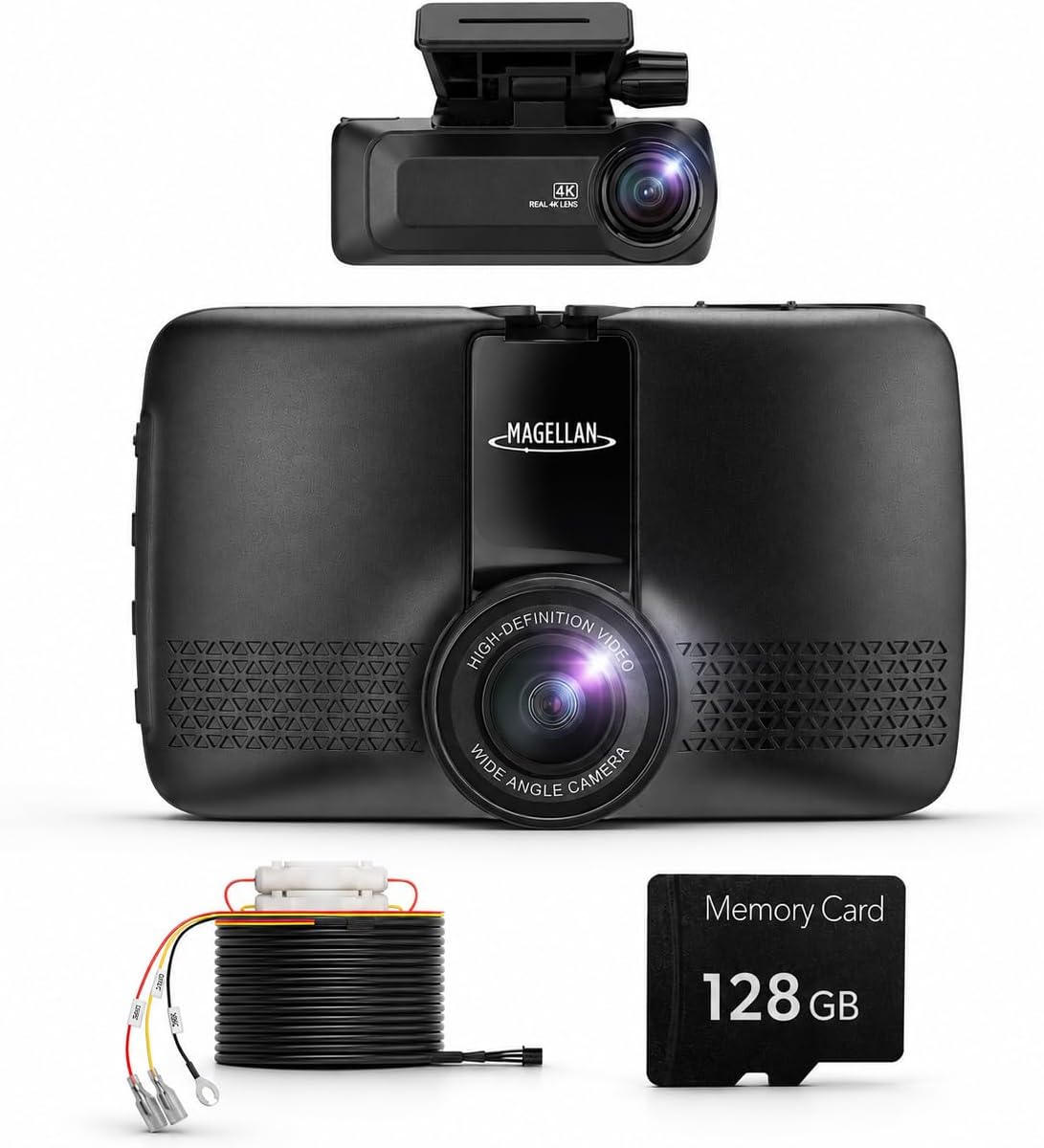
At a Glance
- True 4K (3840×2160) recording on both front and rear cameras eliminates blurry rear footage.
- Dual Sony STARVIS 2 sensors optimize dynamic range and reduce low-light motion blur.
- Factory-bundled 128GB high-endurance microSD card prevents immediate storage upgrade expenses.
- Integrated GPS logs driving speed, directional headings, and precise coordinate stamps directly onto files.
- Included hardwire kit enables automated 24-hour parking surveillance with low-voltage protection.
- High-speed dual-band Wi-Fi pairs with smartphone apps for wireless clip retrieval and settings adjustments.
Verified Specifications & Buyer Implications
Dash cam performance depends on hardware architecture rather than marketing labels. The table below outlines the verified technical attributes of the Magellan DR52 and their real-world impact on evidentiary reliability.
| Attribute | Verified Detail | Why It Matters |
|---|---|---|
| Resolution | Dual 4K UHD (3840×2160 Front + Rear) | Rear-end incidents receive the same pixel density as forward collisions, ensuring plate identification from both angles. |
| Image Sensor | Dual Sony STARVIS 2 Technology | Expands low-light dynamic range to prevent headlight glare from washing out reflective numbers at night. |
| Bundled Storage | 128GB High-Endurance MicroSD Card | Eliminates initial setup friction while providing sufficient space for dual high-bitrate Ultra HD video streams. |
| Parking Surveillance | 24H Mode with Hardwire Cable Included | Supplies continuous vehicle monitoring while parked without requiring a separate power accessory purchase. |
| Connectivity | Built-in Wi-Fi & Integrated GPS Receiver | Syncs location data to recordings and allows direct smartphone clip downloads during roadside encounters. |
Design & Build Quality
The Magellan DR52 uses a discreet wedge-style enclosure that sits high on the windshield behind the rearview mirror. This placement limits driver distraction and keeps the primary lens close to the glass to minimize internal dashboard reflections.
Matte-finish plastics resist cabin heat buildup without cracking or warping under prolonged summer sun exposure. Reinforced cable connection ports reduce physical strain on the rear camera coaxial lead and power harness.
Setup & Ease of Use
- Clean the windshield and rear window thoroughly with an alcohol prep pad before adhering the electro-static film.
- Mount the primary forward-facing unit directly behind the rearview mirror within the vehicle wiper sweep zone.
- Route the coaxial rear camera cable along the headliner trim to the center top of the rear glass.
- Install the included hardwire kit into your cabin fuse box, connecting the constant power, ACC, and ground leads.
- Insert the provided 128GB microSD card and format it through the camera settings menu prior to initial driving.
- Download the mobile application to adjust camera angle alignment and confirm live field-of-view coverage.
How This Review Was Researched
This review evaluates the product using verified specifications, manufacturer documentation, current product information, and relevant comparison context. No personal hands-on testing is claimed unless testing evidence was actually provided.
Category-Specific Performance
Evaluating a dual dash camera requires looking beyond headline resolution numbers. True evidentiary value depends on optical clarity across varying light levels, file management stability, and thermal resilience under heavy read-write loads.
Optical Clarity & Plate Legibility
The DR52 relies on native 4K sensors on both channels rather than interpolating lower-resolution feeds. This native pixel count maintains edge sharpness when zooming into license plates across multiple lanes of highway traffic.
Low-Light Dynamic Range
Sony STARVIS 2 sensors provide improved sensitivity compared to first-generation hardware, suppressing noise in dimly lit environments. High dynamic range processing balances harsh headlights against dark rural roads to preserve critical roadside details.
Parking Mode Reliability
Because the hardwire cable comes standard, the system can monitor your vehicle around the clock using motion and impact triggers. Automatic voltage cutoff thresholds prevent the camera from drawing excessive power and draining your vehicle starter battery.
Thermal Management
Processing two simultaneous 4K streams creates significant internal heat during hot afternoon drives. The DR52 utilizes passive venting and a heat-resistant capacitor design rather than volatile lithium-ion batteries to prevent thermal shutdowns.
Expert Insight
Most dual-channel systems compromise by pairing a 4K front lens with a 1080p rear camera. Running true 4K front and rear ensures that tailgating drivers and hit-and-run vehicles behind you are documented with the exact same legal-grade clarity as frontal threats.
Key Features Explained
Understanding the hardware architecture helps buyers evaluate why this camera commands attention in the crowded dual dash cam market.
Dual Sony STARVIS 2 Sensors
The inclusion of STARVIS 2 sensors across both camera units marks a significant technological advancement. This architecture broadens dynamic range, mitigating high-contrast light blooming from modern LED headlights while preserving contrast in dark alleys.
Integrated GPS Data Logging
The built-in GPS module embeds real-time driving speed, travel direction, and geographic coordinates into video metadata. Having timestamped location data provides vital independent corroboration when resolving disputed insurance claims or speed allegations.
High-Speed Mobile App Wi-Fi
Onboard Wi-Fi establishes a direct connection between the dash cam and your mobile device without relying on cellular data. Drivers can review footage, change device parameters, and save collision clips directly to their phone gallery at the scene of an accident.
Real-World Usability & Maintenance
Operating a dual 4K dash cam requires routine memory management to ensure uninterrupted recording. The included 128GB card provides reliable initial storage, but recording two Ultra HD video streams fills available space much faster than single-channel 1080p setups.
Format the memory card inside the camera settings once every two months to prevent file fragmentation. Drivers exploring wider storage options can evaluate dedicated endurance cards through our guide on the value of automotive dash cameras to ensure maximum long-term durability.
Pros & Cons
Pros
- True 4K recording front and rear
- Dual Sony STARVIS 2 sensors
- Included 128GB high-endurance memory card
- Hardwire parking cable included standard
Cons
- Dual 4K files fill cards quickly
- Hardwiring requires fuse panel access
- Higher initial cost than 1080p systems
Common Issues & Fixes
MicroSD Card Write Errors
Cause: Memory card fragmentation from high-bitrate dual 4K video recording.
Fix: Format the memory card directly through the camera settings menu every 6 to 8 weeks.
Parking Mode Not Engaging
Cause: Incorrect fuse tap connections for switched ACC and constant battery power lines.
Fix: Verify fuse connections with a circuit tester to ensure the ACC wire loses power when the ignition turns off.
What to Know Before You Buy
Before buying a dual 4K setup, check your vehicle layout and rear window accessibility. Routing a video cable from the front windshield to a hatchback or truck rear window requires tucking wires under trim panels or rubber conduits.
Additionally, understand that high-bitrate dual 4K footage consumes substantial processing power. If you plan to download large video files to your smartphone frequently, dual-band Wi-Fi connection speeds are essential to avoid tedious transfer delays.
Who Should Consider It / Who Should Look Elsewhere
Who Should Consider It
- Drivers wanting identical 4K clarity front and rear
- Commuters parking on busy streets or public garages
- Buyers seeking an all-in-one kit with card and cables
Who Should Look Elsewhere
- Shoppers on a strict budget under one hundred dollars
- Drivers who prefer basic plug-and-play 12V power sockets
- Users wanting interior cabin recording for rideshare fares
Alternatives to Consider
Reviewed Product
Magellan DR52 4K+4K
Best For: Complete dual 4K coverage with all hardware included.
Key Specs: Dual 4K, Dual STARVIS 2, 128GB Card.
Advantage: Native 4K rear camera recording.
Trade-off: Higher storage capacity demands.
Alternative A
VIOFO A229 Pro 2CH
Best For: Enthusiasts wanting advanced voice controls.
Key Specs: 4K Front + 2K Rear, STARVIS 2, GPS.
Advantage: Proven firmware ecosystem and voice prompts.
Trade-off: Rear camera tops out at 2K rather than 4K.
Alternative B
REDTIGER F7N Dual Cam
Best For: Budget-focused drivers wanting solid front 4K.
Key Specs: 4K Front + 1080p Rear, Wi-Fi, GPS.
Advantage: Lower price point for entry-level buyers.
Trade-off: Lower rear resolution and older sensor tech.
Is It Worth It?
For drivers who frequently navigate dense highway traffic or street park in urban areas, the Magellan DR52 represents exceptional value. Capturing rear traffic in native 4K solves the chronic limitation of standard dash cams that fail to read plates during hit-and-run fender benders.
Because the bundle includes a 128GB endurance memory card and a dedicated 24-hour parking hardwire kit, buyers avoid spending fifty to seventy dollars on essential add-ons. While the initial investment exceeds basic entry-level dash cams, its optical fidelity and complete accessory package justify the cost.
Final Verdict
The Magellan DR52 stands out by pairing true 4K resolution on both lenses with dual Sony STARVIS 2 sensors. It is ideal for drivers who want court-admissible license plate clarity from both ends of their vehicle without purchasing separate installation gear. Those who prefer simple cigarette lighter plugs without routing rear cables should consider a simpler single-channel unit instead.
Frequently Asked Questions
Does the Magellan DR52 record 4K on both cameras at the same time?
Yes, both cameras record in 3840×2160 Ultra HD simultaneously. Unlike hybrid units that downgrade the rear channel to 1080p, the DR52 delivers true 4K resolution on both video channels.
Is a hardwire kit required to use parking mode?
Yes, parking surveillance requires continuous vehicle battery connection. The Magellan DR52 includes this hardwire cable kit in the box, providing low-voltage cutoff to prevent battery drainage.
What size memory card comes included with the camera?
A 128GB high-endurance microSD card is included in the package. This card provides immediate plug-and-play storage designed to handle the write demands of dual 4K video recording.
How does the dash cam connect to a smartphone?
The unit connects wirelessly using built-in dual-band Wi-Fi. You can connect through the companion mobile app to view live camera angles, adjust settings, and download saved clips directly to your phone.
Can the dash cam operate in extreme heat?
Yes, the device is engineered for extreme automotive temperatures. It utilizes heat-dissipating housing materials and supercapacitor architecture rather than traditional lithium batteries to resist swelling and thermal cutoffs.
Affiliate disclosure: Lead Foot Automotive earns a small commission when you purchase through links on this page — at no extra cost to you. Our editorial process is independent: affiliate relationships never influence which products we recommend or how we rank them.

I’m Alex Rahman, a car enthusiast and automotive writer focused on practical solutions, car tools, and real-world driving advice. I share simple and honest content to help everyday drivers make better decisions.
