Dash Cam Front and Rear 1296P: Honest 2026 Buyer Review
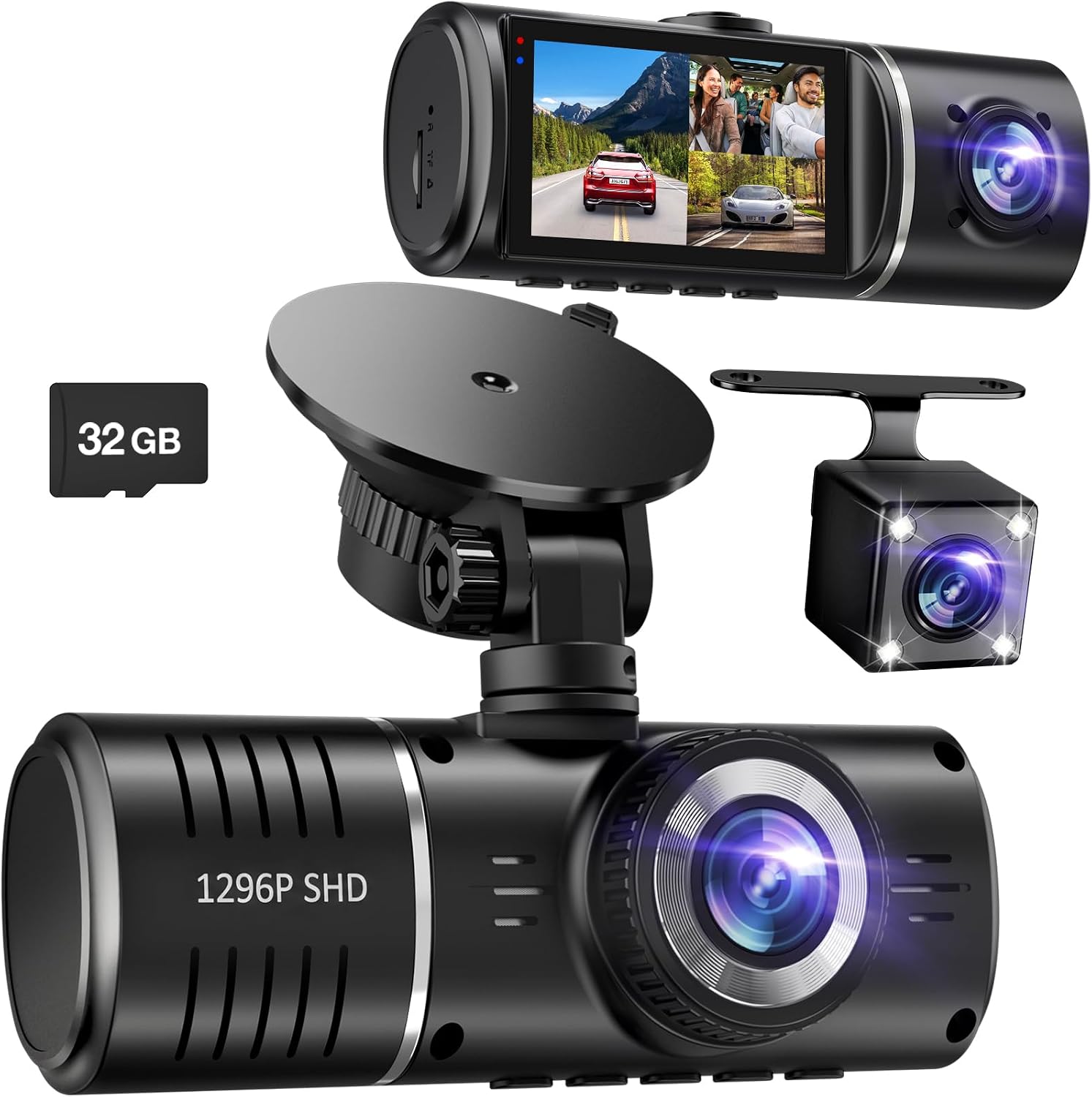
The Dash Cam Front and Rear, 1296P Dash Camera for Cars, 3 Channel Car Camera Front Rear and Inside with 32GB Card, Loop Recording, Night Vision, HDR, 24Hr Parking, G-Sensor is built for drivers who want front, cabin, and rear coverage without premium pricing. The SUVCON J06 pairs a wide front lens with cabin IR lighting, a waterproof rear camera, and an included 32GB microSD card.
Its value is easy to see. The catch is that the “1296P” headline needs context: the J06 manual lists lower simultaneous resolutions when all three channels record together. For a budget three-channel setup, that tradeoff matters more than the marketing number.
| Overall: 4.0/5 | Performance: 3.8/5 |
| Value: 4.4/5 | Design: 3.8/5 |
✅ Best For: budget-minded commuters, rideshare drivers, and families wanting three viewing angles.
❌ Not Ideal For: buyers who need true multi-channel 4K, built-in GPS, or a polished phone-first workflow.
Price: about $59.99 from other sellers when checked; Amazon showed no featured offer.
What Comes With the SUVCON J06?
The box is unusually complete for this price tier. It includes the front-and-cabin camera, an adjustable suction mount, a rear camera with a 19.68-foot cable, an 11.48-foot car charger, a 32GB memory card, a Type-C cable, trim tool, four cable clips, and the manual.
The suction mount can be repositioned before you commit. The 19.68-foot rear-camera lead is useful, though clean cable routing still takes patience. The camera uses a 3.47-inch IPS display and physical controls, while the main unit weighs 6.24 ounces.
How the 3-Channel Setup Performs
The real value is coverage rather than maximum detail. The front lens is 170°, while the cabin and waterproof rear cameras are 150° each.
Daytime Commuting
Amazon lists 1296p capture and 30 FPS, but the J06 manual shows 1080P+720P+480P as the higher three-channel mode. Expect useful incident footage, not the plate-reading reach of a modern 4K front camera.
Night Driving and Cabin Video
The cabin camera has four infrared LEDs, useful for rideshare or family use after dark. HDR can balance bright signs, headlights, and darker areas, but exterior night footage still cannot guarantee sharp moving plates.
Loop Recording on Long Drives
The camera can save clips in 1- or 3-minute intervals and overwrite the oldest unlocked files when storage fills. That is normal dash-cam behavior, not a fault. If short clips look confusing at first, this guide on why dash cams record in 3-minute segments explains the logic. The 32GB card is convenient, but protected event files can still eat space over time.
Hard Braking and Impact Events
The built-in G-sensor can lock the current file after a sudden shock or movement so loop recording does not erase it. Sensitivity can be set to low, medium, or high. High sensitivity may save too many clips on rough roads, so medium is a sensible starting point. Check the event folder after a week rather than assuming storage is managing itself.
Parking-Lot Protection
Parking mode is impact-triggered according to the J06 manual. After the car is off, a detected shock can wake the camera, record a short clip, and shut it down again. The important catch is power: the manual recommends continuous power through a hardwire setup because the internal battery is not intended to run parking protection for long periods. For setup context, see how dash cams work while a car is parked.
What Daily Ownership Feels Like
Day to day, this is an old-school workflow. Plugging into the car charger starts recording, while the menu handles resolution, loop length, HDR, audio, time stamp, parking mode, and card formatting. The manual centers on buttons and local playback, not a phone-first experience.
Small habits matter. Check the date and time, wipe fingerprints from the lens, and make sure the rear cable is not pinched under trim. If the suction mount sags, clean the glass and cup before tightening it.
Build, Screen, and Mounting
The J06 is a compact windshield-mounted system with a 3.47-inch IPS display and a suction mount. The listing confirms a black finish, but the exact casing material is not clearly specified, so [confirm casing material from listing] before describing it as plastic or metal.
| Part | Verified detail |
| Main unit | 6.24 oz |
| Front view | 170° |
| Mount | Windshield suction |
The suction design is convenient for moving the camera between cars, though it is more visible than a small adhesive mount. Stability depends on clean glass, cup tension, and tidy cable routing.
Video Quality After Dark
In daylight, the front camera has enough field of view to document lane position, nearby cars, traffic lights, and the broad scene around an incident. The simultaneous three-channel resolution is the main limitation if you want to zoom deeply into distant plate text.
At night, the cabin camera has the clearest advantage because its four IR LEDs are designed for low-light interior recording. HDR can reduce harsh exposure swings around headlights and street lamps. Rain, fog, glare, and fast-moving plates will still reduce detail. Expect the footage to answer “what happened?” more reliably than “what was every character on that far-away plate?”
Keeping the J06 Reliable
Clean the lenses with a soft microfiber cloth, keep the suction surface free of dust, and inspect the rear cable where it bends near trim or the hatch.
| Task | Practical habit |
| Lens | Wipe when hazy |
| microSD | Check locked files |
| Cables | Inspect pinch points |
The 32GB microSD card is included and the listing currently states 32GB maximum support. Before removing it, power the camera down to reduce file-corruption risk. If you need an incident clip, this guide on retrieving dash cam recordings covers the safest workflow. Formatting from the camera menu is also worth doing after important clips are backed up.
Where It Wins and Loses
The J06 gives you a lot of coverage for the money, but the low price comes with real compromises in resolution, storage headroom, and convenience.
| ✅ Pros | ❌ Cons |
|
|
How It Compares for the Money
Two alternatives show what you gain by spending more. One keeps three-channel coverage but adds premium image hardware; the other drops the cabin camera in exchange for a stronger front/rear feature set.
SUVCON J06 vs Vantrue N4 Pro
The Vantrue N4 Pro is the serious upgrade if cabin coverage and plate detail both matter. It costs several times more, but its feature set is in a different class. A fuller breakdown is in this Vantrue N4 Pro review.
| Feature | SUVCON J06 | Vantrue N4 Pro |
| Channels | 3 | 3 |
| 3CH video | 1080P+720P+480P | 4K+1080P+1080P |
| Wi-Fi | Not confirmed | 2.4/5GHz |
SUVCON J06 vs REDTIGER F7N
The REDTIGER F7N is a two-channel model, so it gives up cabin recording. In return, it offers 4K front, 1080P rear, built-in GPS, Wi-Fi, supercapacitor power, parking support, and up to 256GB storage. It suits drivers who care more about exterior detail and easier footage access than passenger coverage.
Who Should Buy the J06?
Buy this if:
- You want front, cabin, and rear views on a tight budget.
- You drive rideshare and want IR-lit cabin footage.
- You prefer an included card and simple physical controls.
Avoid this if:
- You need dependable long-distance plate detail at night.
- You want built-in GPS or confirmed high-speed Wi-Fi.
- You need large-card support for long recording history.
What to Expect Long Term
The listing gives no verified service-life figure. The suction mount, lithium-ion battery, rear cable, and microSD card deserve the most attention because they face heat, movement, or constant write cycles.
Keep the camera out of extreme heat when practical, inspect the mount before long trips, and replace the card if recordings start corrupting. The warranty field on Amazon is unclear, so [confirm warranty term from seller] before relying on a specific coverage period.
Power and Installation Reality
Normal driving power is straightforward: the package includes an 11.48-foot car charger plus a Type-C cable. The exact recording power draw is not clearly confirmed, so use [confirm exact power draw from listing] rather than inventing a watt figure.
Parking mode is the bigger consideration. The manual says continuous power is required and a hardwire kit is not included. That means overnight monitoring needs extra installation and sensible battery-voltage protection. Cable routing is the longest part of setup, especially the 19.68-foot rear lead. For everyday recording, the included car charger keeps the install simple.
Questions Buyers Actually Ask
These are the practical questions that matter most before buying a budget three-channel camera.
Does the SUVCON J06 record all three cameras at once?
Yes. The manual lists a three-channel mode of 1080P front, 720P cabin, and 480P rear, plus a lower 720P+480P+480P option.
Is the SUVCON J06 really 1296P?
Amazon lists 1296p as the product’s video capture resolution. However, the manual shows lower simultaneous resolutions when all three channels are active, so do not read “1296P” as 1296P on every camera at once.
Does parking mode work with the car off?
Yes, but the manual says it needs continuous power for practical use. A separate hardwire solution is recommended because the internal battery is not meant to power long parking sessions.
How does the 32GB card handle loop recording?
The camera can record 1- or 3-minute clips and overwrite the oldest unlocked files. G-sensor event files are protected, so check them periodically to avoid filling the card with locked clips.
Does this dash cam have GPS or Wi-Fi?
Built-in GPS and a confirmed Wi-Fi specification are not clearly listed for this J06 configuration. If either feature is essential, verify the exact seller listing before buying rather than assuming it is included.
Verdict reminder: strong three-angle coverage for the price, with clear limits in resolution and storage.
Price: about $59.99 from other sellers when checked. Amazon rating: 4.0/5 from 6,945 ratings.
Final Verdict on the SUVCON J06
The SUVCON J06 makes the most sense for someone who values coverage first. Front, cabin, and rear recording, a 32GB card, IR cabin lights, HDR, loop recording, and G-sensor protection are a strong bundle near the $60 mark. It is especially easy to justify for rideshare use, a family car, or a first dash cam.
The weaknesses are just as clear. Three-channel resolution is modest, storage support is limited on the current listing, parking mode needs extra power hardware, and GPS or a strong wireless workflow are not confirmed. If those limits fit your needs, it is a sensible budget choice. If plate detail and connectivity matter more, spend more on a higher-end model.

I’m Alex Rahman, a car enthusiast and automotive writer focused on practical solutions, car tools, and real-world driving advice. I share simple and honest content to help everyday drivers make better decisions.
