
What Causes Readiness Monitors to Reset | Leadfoot
Quick Answer
Readiness monitors reset when the engine computer loses its stored test results. The most common causes are clearing trouble codes with a scan tool, disconnecting or replacing the battery, a dead or weak battery, and replacing or reflashing the engine computer. A reset does not mean a part has failed. It means the self-tests must run again.
Seeing every monitor change to Not Ready after a repair or a battery change can feel like something went wrong. In most cases, nothing new has broken. The car has simply lost the record of tests it had already finished.
That distinction matters. A reset is different from a failed test, and from a monitor that has never had the right driving conditions to run. Knowing which one you have tells you whether to drive more, check the battery, or look for a blocking fault.
What a Reset Actually Means
A readiness monitor is a self-test the engine computer runs on an emissions system, such as the catalyst, oxygen sensors, evaporative system, or exhaust gas recirculation system. When a test has finished, the monitor shows Ready. When it has not finished since the last reset, it shows Not Ready.
Those results live in keep-alive memory, which needs a small, constant supply of power to hold its data. If that power is cut, or a clear command tells the computer to erase its stored information, the results go with it. The systems are still there. The computer just has no completed test history for them.
Not Supported is separate: the vehicle does not have that system, so there is no test to run.
The Causes That Erase Monitor Results
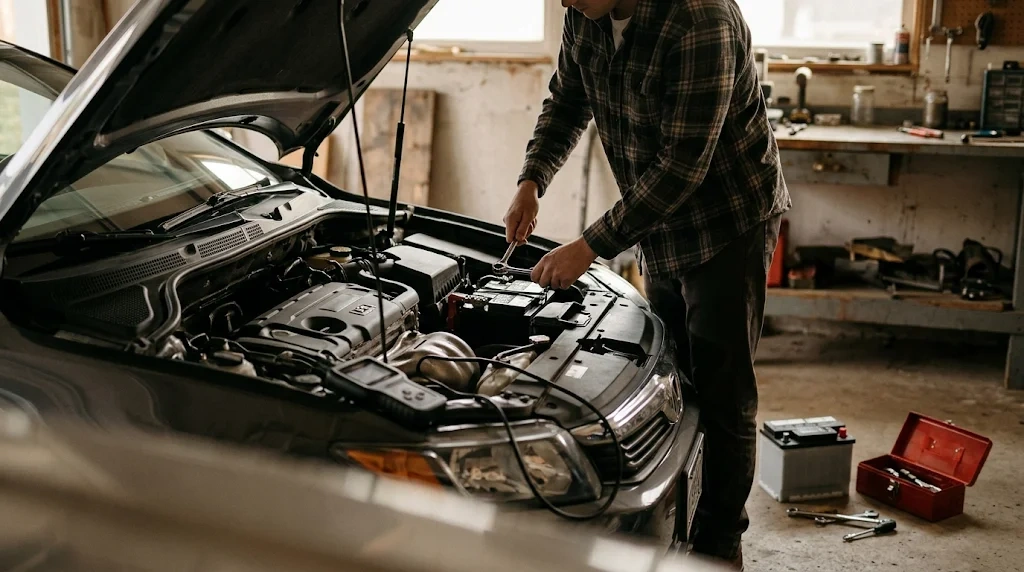
Four events account for most true resets. They all remove the stored results, the stored codes, or the power that keeps those results alive.
Clearing trouble codes with a scan tool
This is the most common cause, and the easiest to do by accident. When a scan tool sends a clear-codes command, it does more than turn off the check engine light. It erases stored trouble codes and freeze-frame data, and resets the monitors to Not Ready.
That behaviour is deliberate. It stops a driver from clearing a code in the inspection station car park and passing before the fault is found again. Whether the clear followed a genuine repair or was done to hide a fault, the car needs to be driven again before an emissions test can rely on its monitors. Clearing codes and readiness monitors explains what else is erased at the same time.
Battery disconnected, replaced, or run flat
Disconnecting the battery cuts power to keep-alive memory. Replacing a battery does the same thing, even when the swap is quick. A battery that has gone flat, or drops sharply in voltage during cranking, can have the same effect.
This is why a car can fail an emissions check the week after a new battery, even though the engine runs well and no light is on. The battery work did not create an emissions fault. It created a new waiting period while the monitors run again. Jump-starting, long storage, and a loose or corroded terminal can also interrupt that power supply.
Engine computer replaced, reflashed, or updated
Replacing the powertrain control module, or PCM, starts the car with a blank test history. Reflashing it with new software, or updating it during a recall or repair, can do the same thing. The new module has no record of tests run before, so every monitor starts as Not Ready.
This is normal after that kind of work. It does not mean the replacement module is faulty. The car needs normal driving, with cold starts, steady cruising, and stops, before the monitors can complete again.
Power loss to the computer itself
A blown fuse feeding the PCM, a damaged power or ground wire, or a charging-system fault can interrupt the computer in the same way as a battery disconnect. This kind of loss is often repeated. If the monitors reset again after a short drive, or the car also loses radio presets or clock settings, check the power supply before assuming the monitors are simply slow.
A weak alternator, a poor ground, or a terminal that loosens with heat and vibration can cause voltage to dip while driving. That dip may not stall the engine, but it can interrupt a test or lose stored results. Fix the power problem first. Driving more will not hold the results in place if the supply keeps dropping out.
Causes That Only Look Like a Reset
Not every Not Ready result comes from something being erased. Some monitors simply have not had a chance to run yet. That is not a reset in the same sense, even though the scanner shows the same status.
Short trips are a common example. If the engine never reaches full operating temperature, or the car is switched off before a test begins, the monitor waits. Heavy traffic can have the same effect when a test needs steady speed or a coast-down. A fuel tank that is nearly empty or nearly full can also hold back the evaporative-system test, which commonly needs a middle fuel level, a cold soak, and a temperature inside a defined range. The exact window varies by manufacturer.
A fault can block a test too. A stuck-open thermostat that keeps the engine cool can lock out the catalyst and evaporative tests. A pending code can stop a later test because the computer cannot trust the sensor data it would need. In those cases the monitor is waiting for the underlying condition to be fixed, not only for a drive cycle. When only one or two monitors stay incomplete while the rest set normally, why OBD2 monitors show Not Ready covers that pattern.
| Situation | What it usually means | What to do first |
|---|---|---|
| All monitors Not Ready after battery or code clear | True reset | Drive normally over several trips, then recheck |
| Most monitors Ready, EVAP still Not Ready | Test conditions not met yet | Check fuel level, cold start, and mixed driving |
| One monitor will not set, others do | Possible blocking fault | Read pending and stored codes before driving more |
| Monitors reset again after a short drive | Repeated power loss | Check battery, terminals, grounds, and charging |
A true reset affects many monitors at once and follows a clear event. A blocked or unmet-condition problem usually affects one monitor, or a small group, while the rest complete.
Why Some Monitors Reset and Others Do Not
Continuous monitors run whenever the engine is running. They cover misfire, fuel-system control, and comprehensive components. After a reset, they can start testing again almost straight away, so they often return to Ready quickly.
Non-continuous monitors only run when a specific set of enabling conditions is met. The catalyst, oxygen-sensor, evaporative, exhaust gas recirculation, and secondary-air monitors fall into this group on many vehicles. Each one needs its own conditions, so they set at different times. The evaporative monitor is often last because it needs a cold soak, a suitable fuel level, and stable conditions after start-up.
Permanent codes are the exception. A permanent code is written when a confirmed fault has been stored, and it cannot be erased by a scan tool or by disconnecting the battery. It clears only when the vehicle itself runs the related monitor, passes it, and confirms the fault is gone.
How to Tell Which Cause Reset Yours
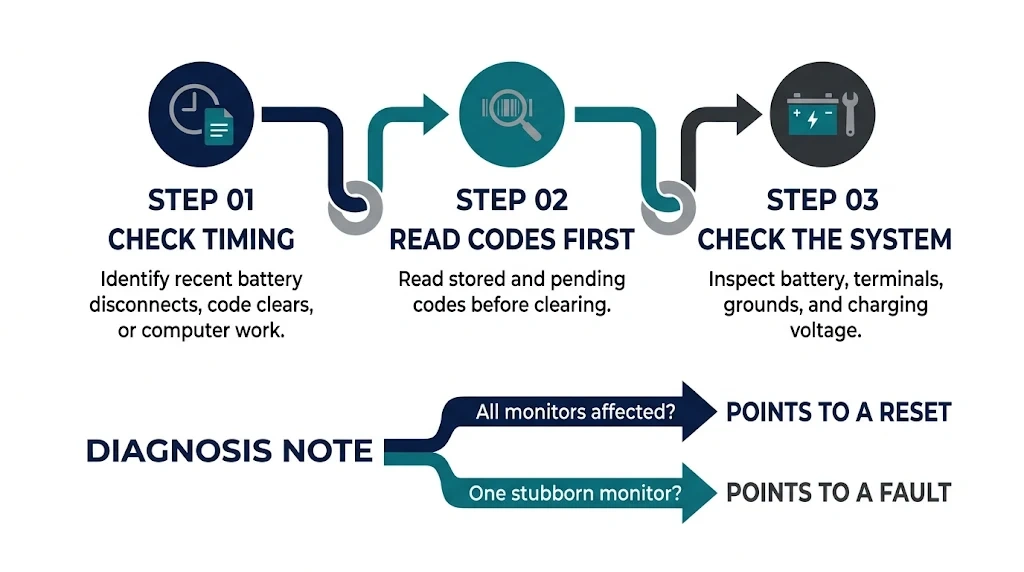
Start with timing. If all the monitors changed to Not Ready the same day a battery was fitted, codes were cleared, or the computer was updated, that event is the likely cause. If no recent work was done, look for a power problem or a blocking fault.
Next, read the codes before clearing anything. Stored codes, pending codes, and freeze-frame data can show what the computer saw before the reset. If that information is already gone, that itself points to a recent clear or power loss. All monitors affected points to a reset. One stubborn monitor points to conditions or a fault.
Then check battery age and voltage, terminal tightness and corrosion, ground connections, and charging voltage while driving. If those check out and the monitors still will not set after several days of mixed driving, the next step is diagnosis, not another reset. checking emissions readiness with a scanner shows what a readiness check can and cannot prove at this stage.
What to Do After a Reset

Drive normally over several trips, with cold starts, city driving, and steady highway cruising. A single long drive does not always do it, because some tests need a cold start after the car has sat.
Do not book an emissions test straight after a reset. EPA guidance for inspection programs allows up to two monitors Not Ready for 1996 to 2000 model-year vehicles and one for 2001 and newer vehicles, but state programs set their own limits. The EPA technical support document on OBD inspection notes that battery disconnection and scan-tool clearing are among the legitimate reasons a car can arrive Not Ready. Check readiness with a scanner before you go. How many monitors can be incomplete and how long monitors take to become Ready cover those checks.
Related Product
OBD2 Scanner With Readiness Check
A scanner with a readiness display lets you check which monitors are Ready before an emissions test, instead of finding out at the station.
As an Amazon Associate, we earn from qualifying purchases.
Frequently Asked Questions
Does disconnecting the battery reset readiness monitors?
Yes, in most cases. Disconnecting the battery cuts power to the keep-alive memory that holds monitor results, so the monitors return to Not Ready. A flat or replacement battery, and a loose terminal, can have the same effect.
Does clearing codes always reset all readiness monitors?
A clear-codes command resets readiness monitors as part of the same operation. It also erases stored codes and freeze-frame data. It does not erase permanent codes, which only clear when the vehicle passes the related test itself.
Can a bad battery keep resetting the monitors?
Yes. A weak battery or a charging problem can cause repeated voltage drops that interrupt testing or lose stored results. If the monitors reset again after a short drive, check the battery, terminals, grounds, and charging system.
Why is only the EVAP monitor still Not Ready?
The evaporative monitor often needs a cold soak, a middle fuel level, and stable conditions after start-up. Short trips, or a nearly full or nearly empty tank, can keep it incomplete while other monitors set.
How long does it take for monitors to become Ready again?
It varies by vehicle and monitor. Continuous monitors can set quickly, while non-continuous monitors may need several days of mixed driving with cold starts, city driving, and steady highway cruising.
Will a reset hide a check engine light problem?
Only briefly. A reset turns the light off and clears the stored code, but it does not fix the fault. When the related monitor runs again and finds the same fault, the code and the light return.
Conclusion
Readiness monitors reset when their stored results are erased, most often by clearing codes, disconnecting or replacing the battery, or replacing or reflashing the engine computer. A monitor that stays Not Ready because its test conditions have not been met, or a fault is blocking it, is a different problem. Match the pattern to the cause, fix any power or fault problem first, then drive normally over several trips and check readiness with a scanner before an emissions test.

I’m Alex Rahman, a car enthusiast and automotive writer focused on practical solutions, car tools, and real-world driving advice. I share simple and honest content to help everyday drivers make better decisions.
