Can OBD2 Diagnose a Catalytic Converter? Explained
Quick Answer
Yes, an OBD2 scanner can help diagnose catalytic converter problems by reading trouble codes such as P0420 and P0430, checking catalyst monitor readiness, and displaying oxygen sensor data when supported. However, it cannot always confirm that the catalytic converter itself is defective. Exhaust leaks, fuel mixture problems, misfires, and sensor faults can produce similar symptoms, so further testing may be needed before replacing the converter.
A check engine light and a P0420 code can make a catalytic converter replacement seem inevitable. But an OBD2 scanner is reporting what the vehicle’s computer has detected, not necessarily identifying the exact component responsible.
The distinction matters because a converter can be expensive to replace, and installing a new one without correcting the underlying problem may lead to another failure.
Understanding what OBD2 measures, how to interpret the results, and which checks to perform next can help you avoid unnecessary repairs.
How Does OBD2 Detect Catalytic Converter Problems?
OBD2 systems monitor emissions-related components while the engine operates. On many gasoline vehicles, the engine control module evaluates catalytic converter performance using information from sensors positioned before and after the converter.
The upstream sensor helps the engine computer manage the air-fuel mixture. The downstream sensor helps the computer evaluate conditions after exhaust gases pass through the catalyst.
By examining these signals under specified operating conditions, the computer can estimate whether the catalyst is performing adequately.
What Oxygen Sensors Reveal
A conventional narrowband upstream oxygen sensor often switches between rich and lean indications as the engine adjusts fuel delivery. On a properly functioning catalyst system, the downstream sensor signal may change more slowly because the converter stores and releases oxygen while processing exhaust gases.
If the downstream response begins to resemble the upstream response under the conditions used by the vehicle’s catalyst monitor, the computer may identify reduced catalyst efficiency.
However, modern vehicles use different sensor technologies and monitoring strategies. Some upstream sensors are wideband air-fuel ratio sensors, and their readings cannot be interpreted using the same simple voltage rules as older narrowband sensors.
For that reason, comparing two oxygen sensor graphs can provide useful clues, but it is not a universal pass-or-fail test.
The U.S. Environmental Protection Agency’s OBD guidance identifies catalyst efficiency and oxygen sensor performance among the emissions-related functions monitored by OBD systems.
Which OBD2 Codes Indicate a Catalytic Converter Problem?
The most recognizable catalytic converter trouble codes are P0420 and P0430. Both indicate that the engine computer has detected catalyst efficiency below its programmed threshold.
| Code | Meaning | What to Check |
|---|---|---|
| P0420 | Catalyst System Efficiency Below Threshold, Bank 1 | Bank 1 catalyst, exhaust leaks, fuel control, and sensor operation |
| P0430 | Catalyst System Efficiency Below Threshold, Bank 2 | Bank 2 catalyst and related engine or exhaust issues |
| P0130–P0167 | Various oxygen sensor circuit, response, or heater faults | The specific sensor and fault identified by the code |
| P0300–P0308 | Random or cylinder-specific misfire faults | Ignition, fuel delivery, compression, and related engine conditions |
Bank 1 refers to the engine bank containing cylinder number one. Bank 2 refers to the opposite bank on engines with two banks. A typical inline four-cylinder engine has only one bank.
A P0420 or P0430 code does not automatically mean the catalytic converter must be replaced. The converter may have deteriorated, but another problem can affect the sensor signals or the exhaust composition used to evaluate it.
For example, an exhaust leak ahead of a downstream oxygen sensor can introduce outside air and distort readings. An engine running excessively rich may also damage the converter over time.
How to Check a Catalytic Converter With an OBD2 Scanner
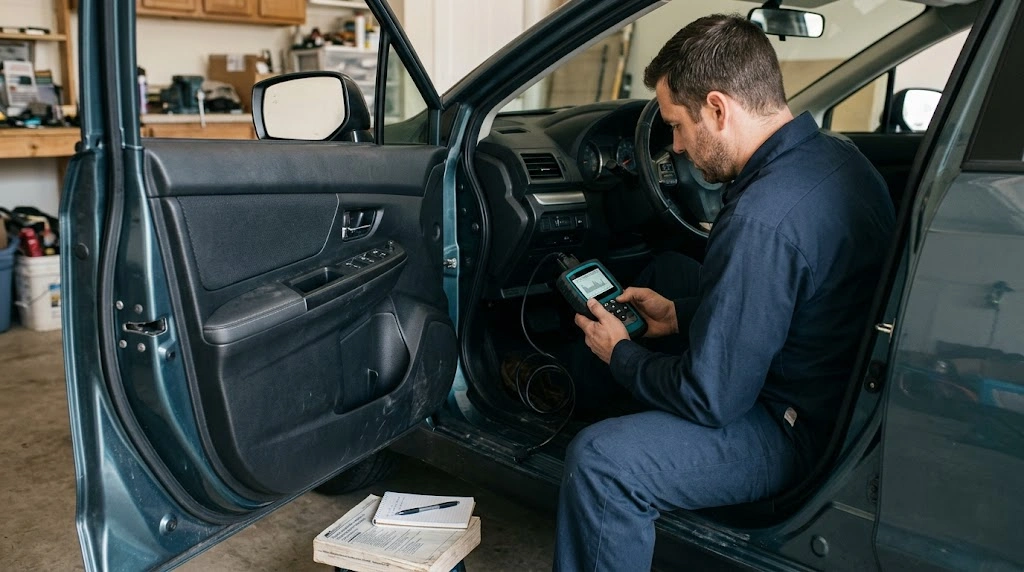
A basic code reader can identify stored faults. A scanner with live data, freeze-frame information, and readiness monitor support allows a more useful initial investigation.
Follow this sequence before deciding whether the converter needs replacement.
Step 1: Connect the Scanner and Read All Codes
Locate the vehicle’s diagnostic connector, commonly found beneath the dashboard on OBD2-equipped passenger vehicles. Connect the scanner and switch the ignition on according to its instructions.
Read stored, pending, and permanent trouble codes where supported. Record every code instead of focusing only on P0420 or P0430.
A related misfire, fuel trim, or oxygen sensor code may point toward an underlying problem that should be investigated first.
Step 2: Save Freeze-Frame Information
Freeze-frame data captures selected operating conditions when a fault was detected. Depending on the vehicle, it may include engine speed, load, coolant temperature, vehicle speed, and fuel trim.
This information can help explain when the fault appeared. For example, a code recorded after the engine reached normal temperature may indicate a different troubleshooting direction from one accompanied by cold-running fuel control problems.
Not every scanner displays the same freeze-frame information, so save whatever relevant data is available.
Step 3: Check Catalyst Readiness
Open the scanner’s I/M readiness or emissions monitor menu. Look for the catalyst monitor status.
A Ready or Complete status indicates that the applicable monitor has finished its evaluation under the required conditions. It does not, by itself, prove that the converter is healthy.
A Not Ready or Incomplete status means that the evaluation has not finished. The vehicle may need additional driving under manufacturer-specified conditions.
The EPA’s explanation of readiness monitors makes this distinction clear: an incomplete monitor does not establish whether a fault is present or absent.
Step 4: Examine Oxygen Sensor Live Data
With the engine fully warmed and operating safely, use the scanner to view available upstream and downstream oxygen sensor or air-fuel ratio sensor parameters.
On some older systems with conventional narrowband sensors, a downstream signal that closely follows upstream switching can support a suspicion of reduced catalyst oxygen-storage performance.
But avoid diagnosing the converter solely from a similar-looking graph. The interpretation depends on sensor type, engine operating conditions, exhaust integrity, and the manufacturer’s monitoring method.
A basic scanner may also refresh data too slowly to show the complete sensor behavior accurately.
Step 5: Examine Fuel Trims and Other Engine Faults
Check short-term and long-term fuel trim values if your scanner provides them. Fuel trims show how the engine computer is adjusting fuel delivery in response to its control strategy.
Large or unusual corrections can suggest fuel mixture issues. Their significance depends on engine speed, load, vehicle design, and whether the engine is operating in closed-loop control.
Investigate misfires, intake leaks, fuel delivery problems, and sensor faults before condemning the converter.
Step 6: Confirm With Additional Testing if Necessary
If the code persists and related engine problems have been ruled out, further diagnosis may involve exhaust leak inspection, manufacturer-specific catalyst tests, emissions testing, or exhaust backpressure measurement.
These tests help distinguish poor chemical conversion from a physically restricted exhaust system. They answer different questions and should not be treated as interchangeable.
Diagnostic Tip
Record the trouble codes, freeze-frame information, and readiness status before clearing anything. Clearing codes can erase useful diagnostic evidence and reset readiness monitors, making the original problem harder to evaluate.
What Else Can Cause a P0420 or P0430 Code?
A deteriorated converter is one possible cause, but the diagnosis should also consider problems that change exhaust chemistry or interfere with sensor measurements.
- Exhaust leaks: Leaks near relevant sensors may allow outside air to affect readings.
- Fuel mixture problems: Excessively rich or lean operation can influence catalyst performance and monitoring results.
- Misfires: Unburned fuel entering the exhaust can overheat and damage the catalyst.
- Oxygen or air-fuel sensor problems: Incorrect or sluggish readings may interfere with engine control or diagnostic evaluation.
- Engine mechanical problems: Oil consumption or coolant entering the combustion chamber can contaminate the catalyst.
- Exhaust modifications: Certain nonstandard components may change the conditions expected by the emissions monitoring system.
These possibilities are not equally likely on every vehicle. A proper diagnosis uses the complete fault-code picture, symptoms, vehicle service information, and test results to narrow the cause.
Replacing the converter without correcting an active misfire or fuel control fault may result in damage to the replacement unit.
Can OBD2 Detect a Clogged Catalytic Converter?
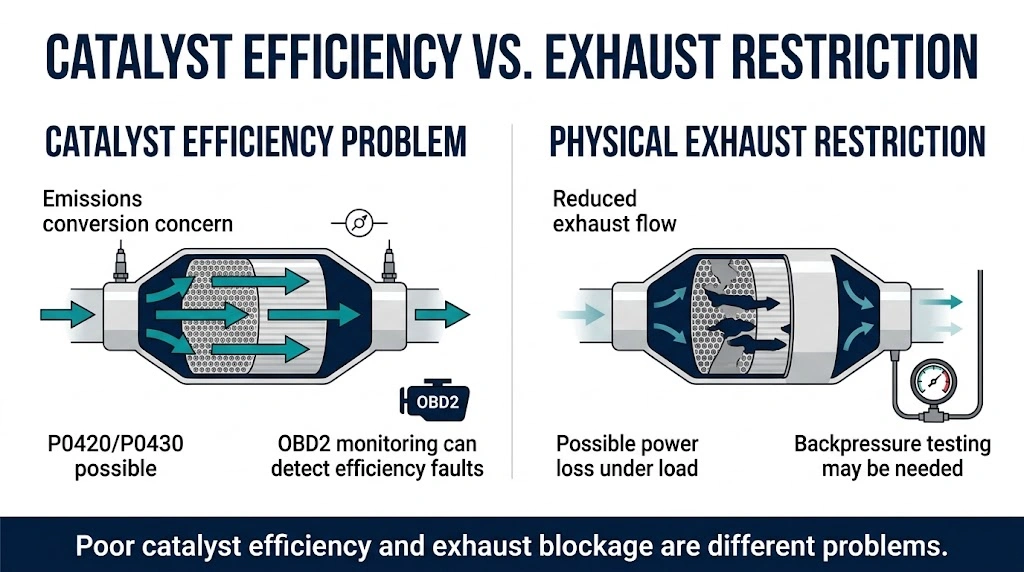
Not reliably on its own. OBD2 catalyst efficiency monitoring primarily evaluates emissions-related performance rather than directly measuring exhaust restriction.
A converter can lose chemical efficiency without becoming severely clogged. Conversely, a partially obstructed exhaust system may create driving problems even when the scanner does not show a catalyst efficiency fault.
Possible symptoms of a restricted exhaust include poor acceleration, reduced power under load, excessive exhaust backpressure, and unusual exhaust-related noises.
These symptoms can also come from ignition, fuel supply, turbocharger, or other engine problems. They are clues rather than confirmation.
A technician may use a suitable exhaust backpressure test or other manufacturer-recommended procedures to determine whether the exhaust path is restricted.
Warning
If the check engine light is flashing, avoid continued driving under load and arrange prompt diagnosis. A flashing light can indicate a catalyst-damaging misfire. Also, never touch or disconnect exhaust components while they are hot.
Basic Code Reader vs. Live-Data Scanner: What Can Each Diagnose?
Different diagnostic tools provide different levels of information. More expensive equipment is not always necessary for the first check, but a basic code reader usually cannot perform a complete converter diagnosis.
| Capability | Basic Reader | Advanced Scanner |
|---|---|---|
| Read P0420/P0430 | Usually | Yes |
| Check readiness | Often | Usually |
| Graph oxygen sensor data | Limited or unavailable | Often supported |
| View manufacturer-specific tests | Generally unavailable | Depends on tool and vehicle |
| Directly measure exhaust restriction | No | No, separate testing required |
A scanner that supports live data, freeze frames, readiness status, and vehicle-specific diagnostic tests is more useful for detailed troubleshooting. Even then, physical inspection and independent measurements may be required.
When Should You Replace the Catalytic Converter?
Replacement makes sense when diagnostic evidence identifies the converter as the problem and other faults that could cause the same code have been addressed.
Strong supporting evidence may include persistent efficiency faults after related repairs, failed manufacturer-specified catalyst tests, or confirmed physical deterioration of the catalyst substrate.
A rattling converter, visible physical damage, or demonstrated exhaust restriction can justify additional inspection, but these findings must be interpreted in the context of the vehicle’s condition.
Before replacement, also investigate what may have damaged the original converter. Persistent rich operation, engine misfires, or oil contamination can shorten the life of a new unit.
Do not assume that a cleared code means a successful repair. The catalyst monitor must complete its evaluation again before the system can provide a meaningful updated result.
Common Mistakes When Diagnosing a Catalytic Converter

Several shortcuts can turn a manageable diagnostic problem into an unnecessary repair bill.
- Replacing the converter from one code: P0420 and P0430 identify an efficiency problem, not necessarily the failed part.
- Replacing oxygen sensors without testing: A sensor can report a real problem accurately even when its readings look unusual.
- Ignoring other engine codes: Misfire and fuel control issues may be the original cause.
- Clearing codes too early: This removes evidence and may reset emissions monitor readiness.
- Assuming no code means no problem: Monitoring may be incomplete, or the fault may not meet the threshold for setting a code.
- Confusing efficiency with blockage: Poor conversion and restricted exhaust flow are different conditions.
The most useful approach is to treat the scanner as the starting point of diagnosis rather than the final authority on which part to replace.
Helpful Diagnostic Tool: Live-Data OBD2 Scanner
An OBD2 scanner with live oxygen sensor data, fuel trims, freeze-frame information, and readiness monitoring can help you investigate catalyst efficiency faults before buying replacement parts. Check compatibility with your vehicle before purchasing.
Browse live-data OBD2 scanners on Amazon
Affiliate disclosure: As an Amazon Associate, we may earn from qualifying purchases at no additional cost to you.
Frequently Asked Questions
Can a cheap OBD2 scanner detect a bad catalytic converter?
A cheap scanner can usually read catalyst efficiency codes such as P0420 and P0430. However, it may not provide enough live data or manufacturer-specific testing to determine whether the converter itself has failed.
Can a catalytic converter be bad without a check engine light?
Yes. A converter may have physical damage or exhaust restriction without triggering an efficiency code. The monitor may also be incomplete, or the problem may not yet meet the vehicle’s programmed diagnostic threshold.
Does P0420 always mean a bad catalytic converter?
No. P0420 indicates catalyst efficiency below the monitored threshold on Bank 1. Exhaust leaks, sensor faults, fuel mixture problems, and other conditions should be investigated before replacement.
Can an OBD2 scanner test catalytic converter temperature?
Some vehicles expose exhaust temperature information through diagnostic data, but many scanners cannot directly display actual converter temperatures. Temperature readings alone are also insufficient to confirm catalytic converter efficiency.
Will clearing a P0420 code fix the catalytic converter?
No. Clearing the code removes diagnostic information but does not repair the underlying fault. The code may return after the vehicle repeats the operating conditions required for catalyst monitoring.
How long does the catalyst monitor take to become ready?
There is no universal driving distance or time. Readiness depends on the vehicle’s manufacturer-specific drive cycle, operating temperature, fuel level where relevant, and other conditions. Follow the applicable service information rather than relying on a fixed mileage.
Final Verdict
An OBD2 scanner can identify catalytic converter efficiency concerns and supply useful evidence through diagnostic codes, oxygen sensor data, fuel trims, and readiness monitors. It cannot always establish that the converter itself is defective or physically blocked.
If your vehicle shows P0420 or P0430, begin by recording the available data and checking for related engine and exhaust problems. Confirming the cause before replacing parts is the best way to avoid an unnecessary converter replacement and prevent recurring faults.

I’m Alex Rahman, a car enthusiast and automotive writer focused on practical solutions, car tools, and real-world driving advice. I share simple and honest content to help everyday drivers make better decisions.
