What Does Coolant Temperature PID Show? OBD2 Guide
Quick Answer
The coolant temperature PID shows the engine coolant temperature reported by the vehicle’s engine control module (ECM or PCM). On a standard OBD2 scanner, Service 01 PID 05 displays this value in degrees Celsius or Fahrenheit. It helps you monitor engine warm-up, identify unusually high or low temperature readings, and investigate cooling system problems. The reading comes from sensor information processed by the engine computer, so it should be interpreted alongside actual engine conditions.
When you connect an OBD2 scanner and open live data, you may see a parameter labeled ECT, Engine Coolant Temperature, Coolant Temp, or PID 05. All these labels generally refer to the same standard diagnostic measurement.
The number can tell you much more than whether the engine is hot or cold. Watching how it changes during a cold start, normal driving, and idling can help distinguish expected engine behavior from possible cooling system or sensor issues.
What Does the Coolant Temperature PID Actually Measure?
The coolant temperature PID reports the temperature value that the engine computer uses to represent engine coolant temperature. In many vehicles, this information comes from an engine coolant temperature (ECT) sensor positioned in a coolant passage, cylinder head, or another manufacturer-selected location.
The sensor is commonly a temperature-sensitive resistor called a thermistor. Its electrical resistance changes with temperature. The engine computer interprets the resulting electrical signal and converts it into a temperature value.
That value is made available through the vehicle’s diagnostic system, allowing a compatible scan tool to display it.
The ECM or PCM may use coolant temperature information for several engine-management functions, including:
- Adjusting fuel delivery during cold starts and warm-up.
- Modifying ignition and idle strategies where applicable.
- Determining when certain emission-control strategies can operate.
- Supporting radiator cooling fan control on vehicles that use this input.
- Monitoring engine temperature-related conditions and potential faults.
Important distinction: Coolant temperature PID 05 is not a direct measurement of the radiator, coolant reservoir, or every location inside the engine. It represents the temperature reported through the vehicle’s engine-management system.
What Is PID 05 on an OBD2 Scanner?
PID stands for Parameter ID. These identifiers tell a diagnostic scanner which information to request from a vehicle’s onboard computer.
In conventional OBD2 diagnostics, Service 01 requests current powertrain diagnostic data, while PID 05 identifies engine coolant temperature.
| Parameter | Meaning |
|---|---|
| Diagnostic service | 01 — Current diagnostic data |
| PID | 05 (hexadecimal) |
| Parameter name | Engine Coolant Temperature |
| Abbreviation | ECT |
| Standard calculation | A − 40 (°C) |
| Encoded range | −40°C to 215°C |
The encoded range describes what the standard data format can represent. It does not mean that all temperatures within that range are safe or normal for an operating engine.
The technical mapping is documented in the Emtron OBD II J1979 reference.
How does the scanner calculate coolant temperature?
The standard PID 05 response uses one data byte identified as A. The temperature in Celsius is calculated by subtracting 40 from its unsigned decimal value.
Coolant Temperature (°C) = A − 40
For example, a response of hexadecimal 82 represents decimal 130. The scanner calculates 130 − 40, giving a temperature of 90°C.
If the scanner displays Fahrenheit, it converts the Celsius result using the standard temperature-conversion formula.
Most consumer scan tools perform these calculations automatically, so the driver sees a readable temperature rather than raw diagnostic bytes.
What Is a Normal Coolant Temperature PID Reading?
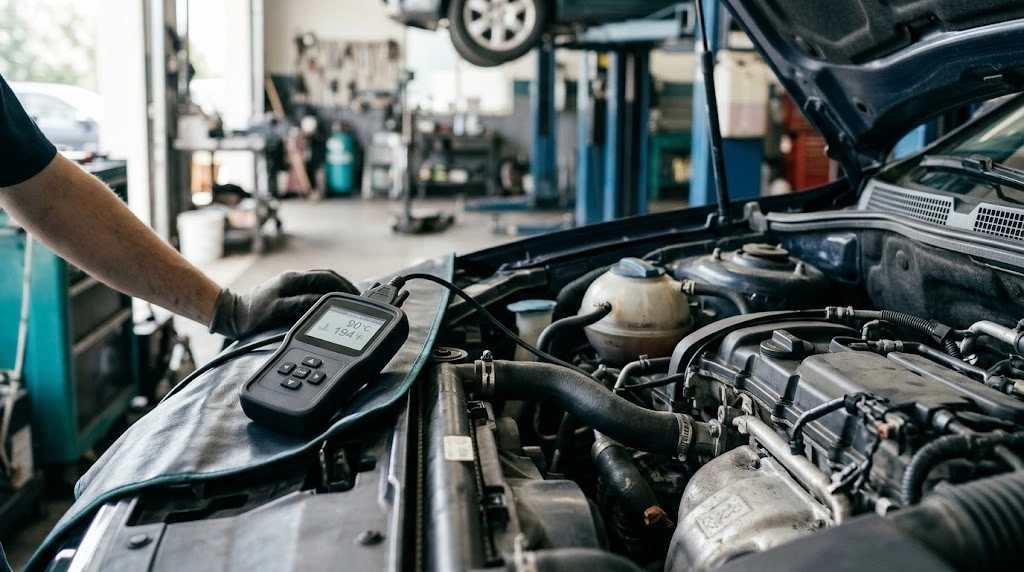
Many conventional liquid-cooled passenger vehicle engines operate around 85–105°C (185–221°F) after warming up. However, this is a broad illustrative range, not a universal specification or safe operating limit.
Actual temperatures depend on the engine design, thermostat calibration, cooling fan strategy, driving conditions, sensor location, and manufacturer specifications.
Some engines run cooler under particular conditions, while others intentionally operate at higher temperatures during certain operating modes.
The following table explains how to interpret common example readings.
| PID Reading | Possible Interpretation |
|---|---|
| 20°C / 68°F | Plausible for an engine that has cooled to approximately 20°C ambient temperature. |
| 60°C / 140°F | May indicate an engine still warming up. |
| 90°C / 194°F | Commonly plausible for a fully warmed engine. |
| 105°C / 221°F | Can be normal for some vehicles and operating conditions. |
| 115°C / 239°F | Warrants checking against the vehicle specification and current conditions. |
These readings are examples, not diagnostic thresholds. A single number cannot establish whether the engine is overheating or operating correctly.
The more useful question is whether the temperature behaves as expected for your specific engine and driving conditions.
How Should Coolant Temperature Change During Engine Warm-Up?
After a genuine cold start, the coolant temperature reading should generally be close to the surrounding temperature. Once the engine runs, the temperature should normally increase as engine heat transfers into the coolant.
A simplified warm-up sequence looks like this:
- Before starting: After sufficient time for the engine to cool, the ECT reading should be reasonably close to ambient and intake air temperature.
- Initial warm-up: The temperature usually rises as combustion produces heat.
- Thermostat operation: Coolant flow through the radiator changes as the thermostat responds to temperature.
- Normal operating condition: The temperature generally stabilizes within the vehicle’s intended operating range.
- Changing driving conditions: Moderate fluctuations may occur with traffic, engine load, cooling fan operation, and airflow.
The rise does not need to be perfectly linear. Thermostat movement, changing engine load, and coolant circulation can affect the rate of temperature change.
A reading that jumps instantly between widely different temperatures without a corresponding physical explanation is more suspicious than a smooth change during normal engine operation.
What Can Abnormal Coolant Temperature PID Readings Indicate?
An unusual coolant temperature reading may point toward a genuine cooling system problem, an inaccurate sensor signal, or an issue with how the data is being interpreted.
Coolant temperature stays unusually low
If an engine runs for an extended period but fails to reach its specified operating temperature, possible causes include a thermostat stuck open, unusually cold operating conditions, or an incorrect ECT signal.
A thermostat that allows excessive coolant circulation through the radiator can slow warm-up and sometimes prevent the engine from maintaining its expected temperature.
However, the correct diagnosis requires comparing the reading with the manufacturer’s specifications and checking whether the sensor data is credible.
Coolant temperature rises excessively
A temperature that climbs beyond the manufacturer’s normal operating range can indicate reduced cooling capacity or abnormal engine heat production.
Possible causes include low coolant, cooling fan problems, restricted airflow, thermostat issues, circulation problems, or internal engine faults.
The PID alone cannot determine which component is responsible.
Safety Warning
If the vehicle displays an overheating warning, produces steam, or shows other signs of serious overheating, safely stop driving and follow the owner’s manual. Never remove the radiator or pressurized coolant reservoir cap while the cooling system is hot.
Temperature readings jump or become implausible
A sensor value that suddenly changes from a plausible warm-engine temperature to an extreme reading may indicate an intermittent electrical fault.
Possible explanations include damaged wiring, poor electrical connections, sensor problems, or a scanner communication issue.
Very low readings, including the lower encoding limit of −40°C, may appear with certain circuit faults. The exact interpretation depends on the sensor circuit and vehicle design.
Do not automatically replace the coolant temperature sensor simply because a value looks unusual. First verify the condition and investigate related diagnostic information.
How to Check Coolant Temperature PID Using an OBD2 Scanner
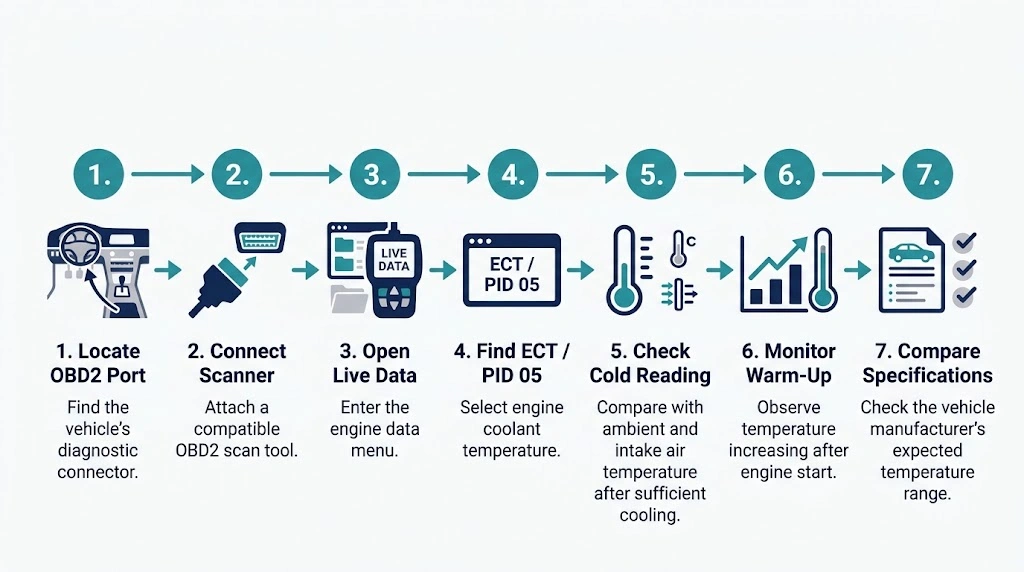
You can examine the coolant temperature PID with a scan tool that supports live OBD2 engine data and a compatible vehicle.
- Locate the diagnostic connector. Find the vehicle’s OBD2 port, usually beneath the dashboard on compatible passenger vehicles.
- Connect the scanner. Insert the connector securely and follow the scanner’s power and connection instructions.
- Open live data. Select the engine or powertrain data section.
- Find the ECT parameter. Look for Engine Coolant Temperature, ECT, Coolant Temp, or PID 05.
- Check the cold reading. If the engine has cooled completely, compare ECT with ambient and intake air temperature.
- Observe the warm-up. Start the engine when safe and monitor how the reading changes.
- Compare with specifications. Once warmed, evaluate the temperature against the manufacturer’s expected operating range and any accompanying symptoms.
If your scanner supports graphing, a temperature graph can reveal behavior that is difficult to recognize from a single number.
For example, a graph may show a consistently slow warm-up, an abrupt signal interruption, or a temperature increase that continues without stabilizing.
Observe live data safely. Do not operate a handheld scanner while driving; use a passenger or a suitable recording feature.
Diagnostic Tip
For a meaningful cold-start comparison, leave the engine off long enough for its temperature to approach ambient conditions. A recently driven engine may remain warm for hours, making a comparison with outside air temperature misleading.
How to Tell Whether the PID Reading Is Accurate
The most practical first test is to compare temperature values when the engine is completely cold.
After sufficient cooling time, the engine coolant temperature and intake air temperature should often be reasonably close to the surrounding temperature, although their exact relationship depends on sensor placement and environmental conditions.
If one sensor reports a dramatically different temperature, investigate the reason before assuming the engine is physically that hot or cold.
Other useful checks include reviewing stored fault codes, inspecting the sensor connector, and following the vehicle’s service procedures for testing the sensor circuit.
Common coolant-temperature-related diagnostic trouble codes include P0115 through P0119, which concern ECT circuit and performance issues. P0128 is often associated with coolant temperature not reaching the expected thermostat-regulated temperature under specified conditions.
These codes identify diagnostic directions, not automatic proof of a failed sensor or thermostat.
Where appropriate, a technician can also compare scan-tool data with independent temperature measurements taken at a suitable location, while accounting for differences between surface and internal coolant temperatures.
Coolant Temperature PID vs. Dashboard Temperature Gauge
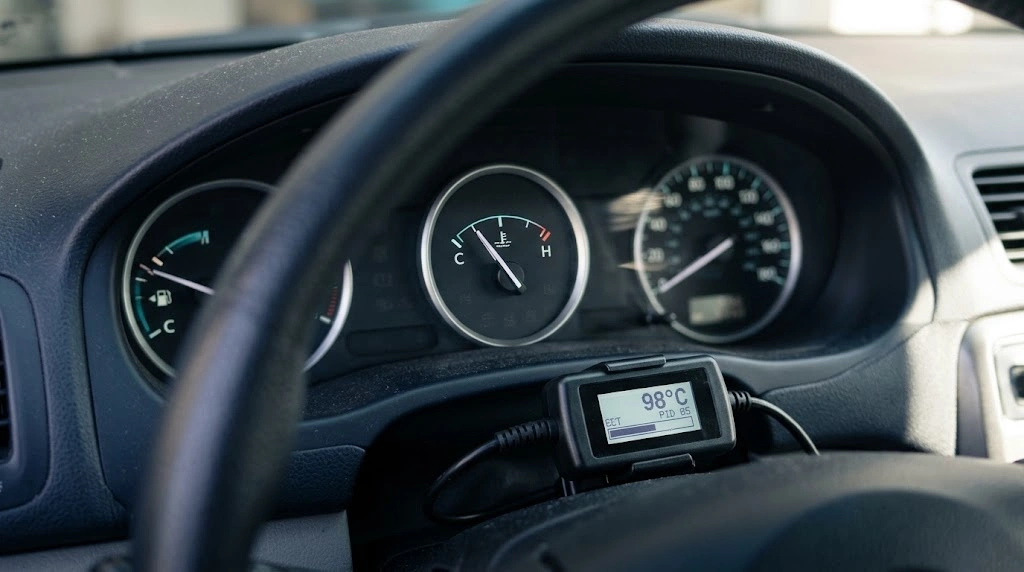
The OBD2 coolant temperature reading and the dashboard temperature gauge may be based on related sensor information, but they do not necessarily present that information in the same way.
A scan tool generally displays the reported temperature numerically, while many dashboard gauges are deliberately damped or programmed to remain near the middle across a range of normal temperatures.
As a result, a dashboard needle may appear steady even while the numerical ECT value changes.
The gauge behavior depends on the vehicle. Some vehicles also use separate sensors or additional control-module processing for dashboard displays.
Neither measurement should automatically override a serious overheating warning or obvious signs of a cooling system fault.
What the Coolant Temperature PID Cannot Tell You
The coolant temperature PID is useful, but it cannot provide a complete cooling system diagnosis by itself.
It does not directly tell you the coolant level, coolant concentration, radiator condition, water pump flow rate, or actual coolant pressure.
It also does not independently confirm that the thermostat is opening correctly or that every part of the engine is receiving adequate coolant circulation.
For example, a vehicle with very low coolant may develop localized overheating or steam pockets while the temperature sensor reports a value that does not accurately represent the hottest engine components.
This is one reason diagnostic decisions should combine live data with warning lights, coolant condition, other sensor readings, and the vehicle’s actual symptoms.
On hybrids and vehicles with multiple thermal circuits, standard engine coolant temperature should not be confused with inverter, battery, or other manufacturer-specific temperature measurements. The OBD2 PID Knowledge engine coolant temperature reference illustrates this distinction.
Frequently Asked Questions
Does coolant temperature PID show actual engine temperature?
It shows the temperature reported by the engine computer from the coolant-temperature sensing system. This is useful for assessing engine thermal conditions, but it is not a direct measurement of every engine component or the hottest location inside the engine.
Is 90°C a normal coolant temperature reading?
Yes, 90°C (194°F) is a plausible fully warmed operating temperature for many passenger vehicle engines. However, the manufacturer’s specified range determines what is normal for a particular vehicle.
Why does coolant temperature increase while idling?
During idling, airflow through the radiator may be lower than during driving, allowing coolant temperature to rise until the cooling fan or other control strategies manage the heat. A moderate rise can be normal, but continued overheating is not.
Can a bad coolant temperature sensor affect fuel consumption?
Yes. If the engine computer receives incorrect coolant temperature information, it may use an inappropriate fuel-control or warm-up strategy. The effect depends on the vehicle and the nature of the fault.
Why does my scanner show −40°C coolant temperature?
A reading of −40°C is the lower limit of the standard PID 05 encoding. If the actual environment is much warmer, it may indicate an electrical circuit problem, an invalid sensor signal, or incorrect data interpretation. Further testing is needed to identify the cause.
Can I use coolant temperature PID to test the thermostat?
Yes, coolant temperature live data can help evaluate engine warm-up behavior and identify patterns consistent with thermostat problems. However, the PID reading alone cannot conclusively establish whether a thermostat is defective.
Final Thoughts
The coolant temperature PID shows the engine coolant temperature reported through the vehicle’s OBD2 diagnostic system. Standard PID 05 provides a convenient way to examine engine warm-up, operating temperature, and potentially abnormal cooling behavior.
The most reliable interpretation comes from observing the temperature trend, comparing it with the manufacturer’s specifications, and considering other available diagnostic information.
Used correctly, this simple live-data parameter can be an effective starting point for understanding engine temperature and investigating cooling system concerns.