Can OBD2 Diagnose a Wheel Speed Sensor? ABS Explained
Quick Answer
Yes, but only with a scan tool that can reach the ABS module. A basic engine-only reader often shows no codes at all. An ABS-capable tool can read the chassis code for the affected wheel and compare live wheel speeds, narrowing the fault to one corner and circuit, but it cannot alone prove the sensor itself failed.
A wheel speed sensor, often called an ABS sensor, measures how fast one wheel turns and sends that signal to the ABS control module. The module compares all four wheels and can adjust brake pressure if one is about to lock. When the signal is missing, implausible, or unstable, the module usually stores a fault and switches off ABS and related assistance. The real question, then, is which module the scan tool can talk to, what code it finds, and what live data shows next.
The answer depends on what your scanner can reach
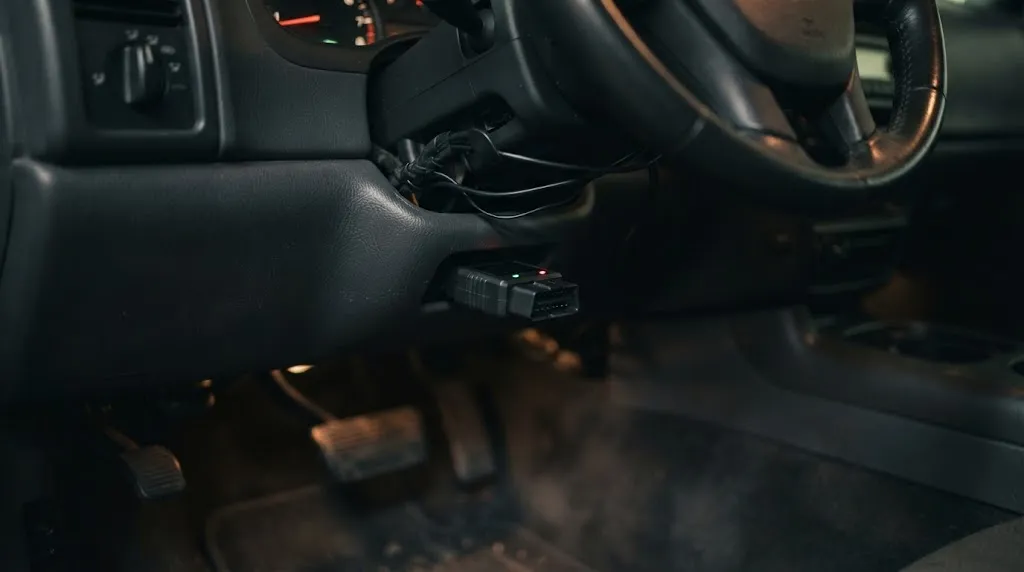
The OBD2 port is a doorway, not a single computer. A basic reader normally talks to the engine control module and reads powertrain codes, or P-codes. Wheel speed faults live elsewhere: the ABS, brake, or stability module, usually as chassis codes, or C-codes.
That explains the most common disappointment. A driver plugs in a cheap reader, sees “no codes,” and assumes the ABS light is a false alarm. In many cases the reader simply never asked the ABS module. A tool listing ABS, chassis, or all-system coverage for that vehicle is a different kind of tool, even though it uses the same 16-pin port, and coverage still varies by make, model, and year.
What an OBD2 scanner can tell you therefore depends on the modules it can access, not only on whether it fits the port. If the menu has no ABS, brake control, or chassis option, the tool cannot diagnose a wheel speed sensor through software alone.
What a useful wheel-speed scan actually shows
A useful scan gives two kinds of evidence: the stored code, and live data from all four wheels at the same time. On many vehicles using the common generic chassis-code pattern, the code points to a corner:
| Common code | Usual meaning |
|---|---|
| C0035 | Left-front wheel speed sensor circuit |
| C0040 | Right-front wheel speed sensor circuit |
| C0045 | Left-rear wheel speed sensor circuit |
| C0050 | Right-rear wheel speed sensor circuit |
These codes are a starting point, not a universal dictionary. Ford commonly uses C1233 to C1236 for wheel-speed faults, and Toyota and Lexus often use C1xxx codes. Use the description shown for the vehicle being tested, and check it against the maker’s service information before ordering a part.
Live data then tests whether the code matches what the car is doing now. During a slow, safe drive, the four readings should rise and fall together. The patterns that matter are:
- One wheel stuck at zero while the others move, suggesting a lost signal at that corner.
- A reading that drops out and returns, pointing to an intermittent connection, damaged tone ring, or signal that weakens at a certain speed.
- A reading that jumps or lags against the other three, suggesting a distorted signal rather than a dead sensor.
- All four readings wrong together, which is less likely to be one sensor and more likely to be a shared power, ground, module, or data problem.
How accurate OBD2 live data is depends on update rate and whether the fault is present while it is watched. An intermittent fault may look normal parked and only appear on the road.
How to check a wheel speed sensor with a scan tool
Do not clear codes until the evidence has been recorded. Clearing first can erase the corner, the code status, and supporting data that would have narrowed the search.
- Scan the ABS module, not just the engine. Select ABS or brake control, and record every code, its description, and whether it is current, stored, or intermittent.
- Check related modules. Traction and stability warnings can share the same wheel-speed input, so several warnings together do not mean several failures.
- Open live wheel-speed data for all four wheels. Compare them at rest, on a slow straight drive in a safe area, and in gentle turns. Note which wheel disagrees, and whether it is constant or intermittent.
- Inspect that corner. Look for a damaged sensor, chafed harness, loose or corroded connector, debris at the sensor tip, cracked tone ring, and play in the wheel bearing.
- Test the circuit correctly for the sensor type. The test for an older passive sensor is not the test for a modern active sensor, as explained below.
- Repair, rescan, and retest. Clear the code only after repair, then drive under similar conditions and confirm the readings agree and the code does not return.
If the tool cannot enter the ABS module at all, that is a coverage problem before it is a vehicle problem. The same limit appears elsewhere: why a scanner cannot access the transmission module often comes down to module coverage or vehicle support, rather than proof that the module is healthy.
Tip
Write down the code and the live-data pattern before clearing anything. “Left-front drops out above 20 mph” is a far better repair clue than “ABS light was on.”
A code names a circuit, not necessarily a bad sensor
This is where many diagnoses go wrong. A code such as C0035 usually describes a left-front wheel speed sensor circuit. That circuit includes the sensor, wiring, connector, tone ring or magnetic encoder it reads, the air gap between sensor and ring, and the ABS module input. A fault anywhere in that chain can produce the same code.
Look-alikes include a harness rubbed through near moving suspension parts, corrosion inside a connector, rust or debris distorting the ring, a cracked or missing tone-ring tooth, a damaged magnetic encoder inside a wheel bearing, and a sensor pushed too far from the ring after brake or bearing work. Mismatched tire sizes, incorrect pressure, and excessive bearing play can also make one wheel appear to turn at a different speed.
Use the code to choose the corner, live data to confirm the signal problem, and inspection plus the correct electrical test to choose the part. If a new sensor shows the same dropout, the fault was probably in the wiring, ring, encoder, or gap. The same caution applies to diagnosing a throttle position sensor with OBD2: a scan can identify the signal and circuit, but one code does not settle whether the sensor, wiring, or a mechanical cause is responsible.
Passive and active sensors need different follow-up tests
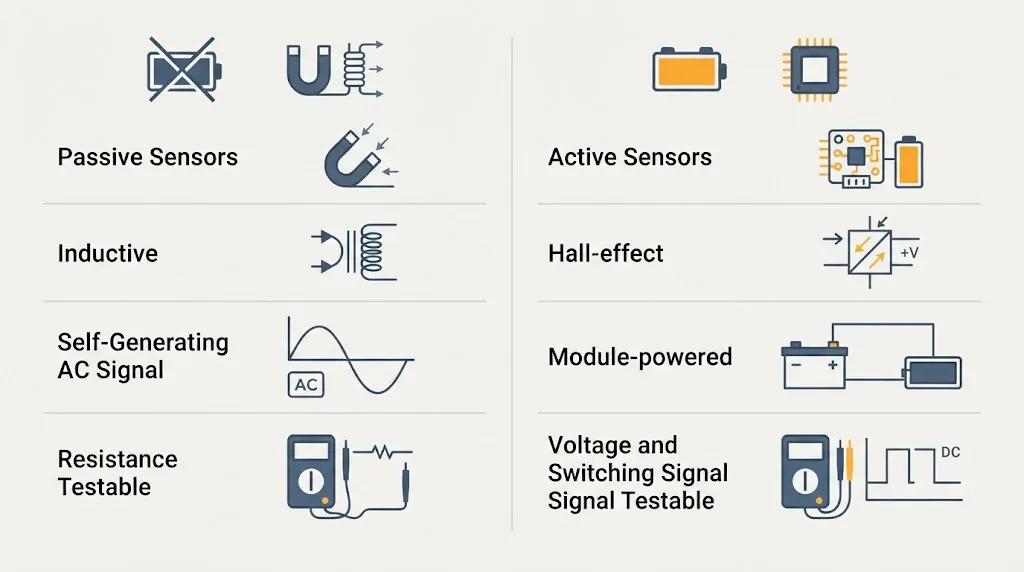
Older passive, or inductive, sensors generate their own alternating signal as teeth on a steel tone ring pass the sensor. Their output rises with wheel speed, and a resistance or alternating-voltage check may be useful when compared with the maker’s specification.
Modern active sensors are different. They are powered by the control module and use Hall-effect or magnetoresistive electronics to read a toothed ring or a multipole magnetic encoder, often built into the wheel bearing seal. HELLA’s wheel speed sensor guidance notes that internal resistance cannot be measured on active sensors, so an ohmmeter reading on one does not prove it good or bad.
For an active sensor, the useful checks are usually supply voltage and ground at the connector, followed by a switching signal checked with a scan tool or oscilloscope while the wheel turns. Use the vehicle’s wiring diagram for pins, voltages, and waveform, and do not force probes into sealed connectors in a way that spreads terminals or lets moisture in.
Warning
Do not use a resistance test to condemn a modern active sensor, and do not swap a sensor from another corner unless the parts and service information confirm they are the same.
When the scan is not enough
A scan tool is strongest when the fault is present, the module is accessible, and code and live data agree. It is weakest with intermittent faults, faults that only appear at speed or on rough roads, and mechanical damage that leaves the electrical circuit intact. A cracked tone ring, damaged bearing encoder, or wrong sensor gap can distort the signal while the sensor still works some of the time.
If the tool shows no ABS codes but the ABS light stays on, check coverage, ABS fuses and supply voltage, and whether another module stores a related fault. The same module-access issue explains why a scanner may fail to read SRS codes: the port is shared, but each module needs its own supported path.
Normal brakes usually still work when ABS is disabled, but stopping control in a skid or on a slippery surface is reduced. Diagnose promptly, drive conservatively, and do not test ABS by braking hard on a public road. If a brake warning also appears, pedal feel changes sharply, or a wheel feels loose, seek professional help rather than continuing to drive on a sensor guess.
Key Insight
One unreliable wheel-speed signal can disable several systems at once, because ABS, traction control, and stability control all use the same comparison. Multiple warnings are often one shared input problem, not multiple broken parts.
Related Product
ABS-Capable OBD2 Scanner
An ABS-capable scanner is the practical next step if a basic reader shows no codes, because it can reach the ABS module and compare live wheel speeds.
As an Amazon Associate, we earn from qualifying purchases.
Frequently Asked Questions
Will a cheap OBD2 reader diagnose a wheel speed sensor?
Only if it can access the ABS module and display chassis codes and live wheel-speed data. Many inexpensive readers are engine-only, so they may show no codes even when the ABS module has stored a fault. Check for ABS or all-system coverage for the specific vehicle first.
Does an ABS light always mean the wheel speed sensor has failed?
No. The light means the ABS system has detected a fault and may have disabled itself. The cause could be the sensor, wiring or connector, a damaged tone ring or bearing encoder, an incorrect air gap, or a module or power problem. The code identifies where to start, not which part to replace.
Can I drive with a wheel speed sensor fault?
Normal braking usually remains available, but ABS, traction control, and stability control may be reduced or disabled. Drive conservatively and have the fault diagnosed promptly. If braking feels abnormal or a brake warning also appears, stop and seek professional help.
Why does one wheel show a different speed in live data?
It can mean a faulty signal, but also a turn, mismatched tire sizes, low pressure, bearing play, or a damaged tone ring. Compare the wheels on a straight, slow drive first. A single wheel that stays at zero, drops out, or jumps erratically while the others agree is the strongest sign of a fault at that corner.
Will clearing the ABS code fix a wheel speed sensor problem?
No. Clearing removes the stored code and may turn the light off temporarily, but it does not repair the sensor, wiring, or tone ring. If the fault is still present, the code usually returns after the module runs its checks again. Clear codes only after a repair, then retest.
Can a phone app diagnose a wheel speed sensor?
It can, but only when the adapter, app, and vehicle together support ABS access. A generic Bluetooth adapter with an engine-only app has the same limit as a basic reader. Look specifically for ABS module access and live wheel-speed data.
Conclusion
OBD2 can diagnose a wheel speed sensor problem when the tool can reach the ABS module, read its chassis codes, and compare live speeds across all four wheels. A basic engine-only reader is the main reason for a misleading “no codes” result. Use the code, live data, and the correct sensor test before replacing a part.

I’m Alex Rahman, a car enthusiast and automotive writer focused on practical solutions, car tools, and real-world driving advice. I share simple and honest content to help everyday drivers make better decisions.
