
Can OBD2 Detect an Oxygen Sensor Problem? Yes, With Limits
Quick Answer
Yes. OBD2 is designed to watch oxygen sensors and can detect many sensor problems through dedicated sensor codes, heater-circuit checks, response-rate tests, and live sensor data. It cannot always prove that the sensor itself is faulty, because wiring, exhaust leaks, and other engine faults can produce a similar signal.
On an OBD2 vehicle, the engine computer watches the sensor signal during a drive, compares it with expected behaviour, and stores a code when it falls outside that behaviour. That is why a scan is often the first useful step when fuel economy drops or the check engine light comes on.
The key distinction is between detection and diagnosis. Detection says the sensor circuit, heater, or response is not behaving as expected. Diagnosis is working out whether the sensor, its wiring, the exhaust, or another engine condition is responsible.
How OBD2 watches an oxygen sensor
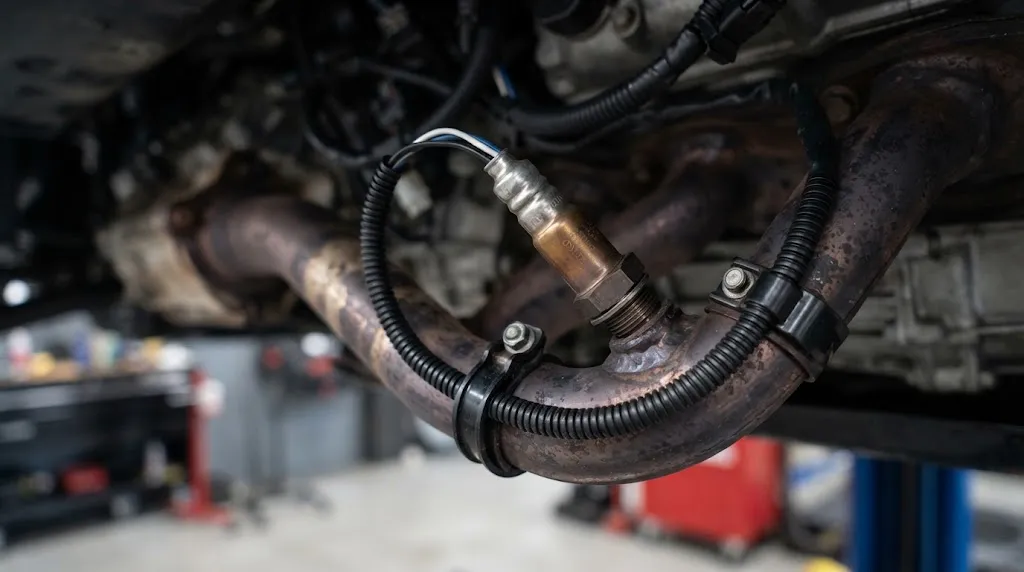
An oxygen sensor measures leftover oxygen in the exhaust, and the engine computer uses that information to keep the air-fuel mixture close to its clean, efficient balance point. Upstream sensors, before the catalytic converter, play the main role in fuel control. Downstream sensors, after the converter, mainly check whether the converter is doing its job.
OBD2 checks several things at once: whether the circuit is open or shorted, whether voltage is stuck high, stuck low, or missing, how quickly the signal switches between lean and rich, and whether the built-in heater works. A sensor needs heat to produce a useful signal, so the heater brings it up to temperature quickly after a cold start. If it fails, the sensor may respond slowly or stop working at idle.
The system also asks whether a reading makes sense alongside engine temperature, load, and fuel trim. A present but implausible reading can still fail a monitor. This is part of the wider emissions self-test system covered in the U.S. Environmental Protection Agency’s vehicle inspection and maintenance resources.
The codes that point to an oxygen sensor
A diagnostic trouble code does not name a part to replace. It names a circuit, a sensor position, and a type of failure. For oxygen sensors, the position is given as a bank and sensor number: Bank 1 is the side of the engine containing cylinder 1, Sensor 1 is upstream of the converter, and Sensor 2 is downstream. On a V-engine, Bank 2 covers the other side.
| Code group | What it usually points to |
|---|---|
| P0130 to P0135 | Bank 1, Sensor 1 circuit, range, slow response, or heater fault |
| P0136 to P0141 | Bank 1, Sensor 2 circuit, range, slow response, or heater fault |
| P0150 to P0155 | Bank 2, Sensor 1 circuit, range, slow response, or heater fault |
| P0156 to P0161 | Bank 2, Sensor 2 circuit, range, slow response, or heater fault |
Within each group, the last digits narrow the problem. A circuit code, such as P0130, means the signal is outside the expected range or missing. A slow-response code, such as P0133, means switching is too slow for accurate fuel control. A heater code, such as P0135, points to the heater circuit rather than the sensing element, and can be a wiring, fuse, relay, or connector problem rather than a dead sensor.
Some vehicles use wideband air-fuel ratio sensors upstream instead of conventional narrowband sensors. Those report a current or lambda value rather than a simple 0.1 to 0.9 volt swing, so their live-data numbers will not match the classic narrowband pattern.
What live data adds that a code alone cannot
A code tells you that a test failed. Live data shows how the sensor is behaving right now, and that often separates a failing sensor from a wiring fault or an engine problem. With the engine warm, a healthy conventional upstream sensor should switch fairly quickly between low voltage when lean and high voltage when rich, typically across roughly 0.1 to 0.9 volts. A sensor stuck near one voltage, switching very slowly, or flatlining is a stronger sign of trouble than a single stored code.
A healthy downstream sensor should look different. Once the converter is hot, its signal usually settles into a steadier range instead of mirroring upstream switching. If it keeps copying the upstream signal, converter efficiency is the more likely problem.
Fuel trim is the other clue to check at the same time. It shows how much the computer is correcting fuel delivery to hold the target mixture. A sensor reading falsely lean pushes fuel trim rich, and vice versa. Large corrections on one bank only suggest that bank’s sensor signal or air-fuel balance is wrong, but do not prove which. For that distinction, see the guide to whether OBD2 can diagnose fuel trim problems.
Key Insight
A sensor code is a test result, not a parts order. The code identifies the circuit and the failed test; live data, freeze frame, and a wiring check are what narrow that result to a cause.
When a sensor problem shows up without a sensor code
Not every failing sensor sets a sensor code straight away. Sensors degrade gradually, and monitors have thresholds: a sensor must be slow, stuck, or out of range long enough to fail. Before that point, the driver may notice worse fuel economy, rough idle, or hesitation, while the scan shows no sensor code.
In that grey area, indirect codes are often the first sign. A lean code such as P0171, or a rich code such as P0172, can appear when the computer can no longer correct the mixture within its normal range. Those codes do not name the oxygen sensor; they say the mixture is off, and the sensor is only one possible cause, alongside vacuum leaks, fuel delivery problems, exhaust leaks, and a faulty mass airflow reading.
A pending code is another early warning. Pending and stored codes differ in an important way: a pending code means a fault was seen once but has not yet met the conditions for a confirmed code and a check engine light. Checking pending codes can therefore catch a sensor starting to fail before the light comes on.
Monitor status matters too. Oxygen-sensor and catalyst monitors need the right engine temperature, speed, and load, so a fault may not be recorded yet if its test has not completed, especially after codes were cleared or the battery was disconnected.
What OBD2 detection cannot prove
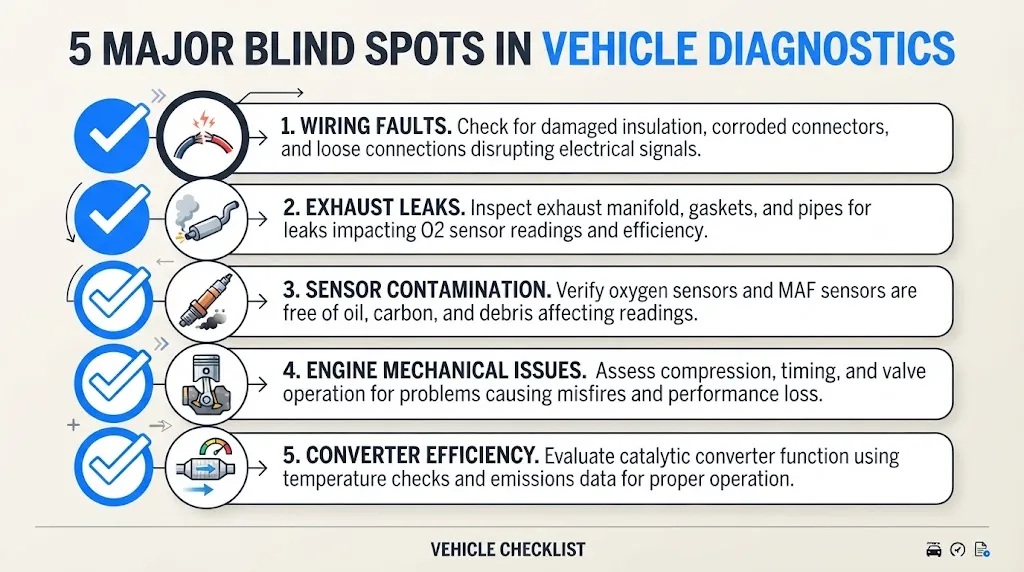
OBD2 sees the sensor through its electrical signal. It cannot see the physical sensor, its wiring, or the exhaust around it. That creates several blind spots before replacing anything.
- Sensor versus wiring: a damaged wire, corroded connector, blown heater fuse, or poor ground can produce the same circuit or heater code as a failed sensor.
- Sensor versus exhaust leak: air leaking into the exhaust ahead of the sensor can make the exhaust look lean, so the sensor reports lean even though it is working correctly.
- Sensor versus contamination: coolant, oil, or silicone contamination can slow a sensor, and the code will describe the slow signal, not the contamination that caused it.
- Sensor versus another engine fault: a misfire, vacuum leak, or fuel pressure problem can distort the exhaust mixture and make a good sensor look wrong.
- One sensor versus the converter: a downstream reading that mirrors the upstream reading is more often a converter-efficiency problem than a downstream sensor failure.
OBD2 also cannot check a connector by sight or confirm the correct part is fitted. Those checks belong to hands-on diagnosis. This article focuses on detection: what the system can notice and report. For the steps that follow a sensor code, the companion guide to whether OBD2 can diagnose oxygen sensor faults covers the diagnostic sequence in more depth, rather than repeating it here.
Warning
Do not replace an oxygen sensor on a code alone if wiring is damaged or a leak is suspected. A new sensor in the same faulty circuit or leaking exhaust will usually set the same code again.
A practical check sequence
A short, ordered check gives OBD2 the best chance to show what is happening.
- Scan for all codes, not just the first one. Record confirmed, pending, and permanent codes, plus any fuel trim, misfire, or catalyst codes.
- Note the sensor position. Bank and sensor numbers tell you whether it is upstream or downstream, and on which side of a V-engine it sits.
- Check freeze frame. The conditions captured when the code set show whether the fault appeared cold, warm, at idle, or under load.
- Watch live data warm. Compare upstream switching, downstream steadiness, and fuel trim on both banks, and note whether the sensor is stuck, slow, or reporting a mixture problem.
- Check the simple physical causes. Look for damaged wiring, loose connectors, exhaust leaks ahead of the sensor, and heater-circuit supply problems.
- Clear only after a repair, then recheck monitors. Clearing without fixing the cause only resets the test; the monitor must run again before the result means anything.
That sequence guards against the most common mistake: treating the first code as the whole story. A sensor code plus a large fuel trim correction on the same bank, or a heater code on its own, points in a different direction from a sensor code alone.
Related Product
OBD2 Scanner With Live Oxygen Sensor Graphing
A scanner that graphs live oxygen sensor voltage and fuel trim makes a stuck or slow sensor much easier to spot than a code list alone.
As an Amazon Associate, we earn from qualifying purchases.
Frequently Asked Questions
Can OBD2 detect a bad oxygen sensor if the check engine light is off?
Yes, sometimes. A pending code or abnormal live data can point to a sensor problem before the light comes on. A scan showing only confirmed codes can miss an early fault, so check pending codes and live switching as well.
What OBD2 code means an oxygen sensor is bad?
No single code proves a sensor is bad. Codes in the P0130 to P0167 range point to a circuit, response, or heater problem at a named bank and sensor position. The code identifies the failed test; wiring, leaks, and other engine faults still need to be ruled out.
Can a scanner tell an upstream sensor from a downstream sensor?
Yes. Sensor 1 is upstream, before the catalytic converter, and Sensor 2 is downstream, after it. Bank 1 is the side with cylinder 1, and Bank 2 is the other side on a V-engine.
Why would fuel economy get worse with no oxygen sensor code?
A sensor can degrade gradually without crossing the threshold for a code. The computer may still be correcting the mixture, so fuel trim drifts and economy falls, but no sensor test has failed yet. Slow switching in live data is often the first evidence.
Does clearing an oxygen sensor code prove the sensor is fixed?
No. Clearing removes the stored code and resets the monitors, but it does not repair anything. The sensor monitors must run again under the right driving conditions, and if the fault is still present, the code will return once the test fails again.
Can OBD2 tell whether the sensor, wiring, or an exhaust leak is at fault?
Not on its own. OBD2 reports the electrical signal and the failed test, so a wiring fault, exhaust leak, or contaminated sensor can look similar in code form. Live data, freeze frame, and a physical wiring and exhaust check are needed to separate those causes.
Conclusion
OBD2 can detect many oxygen sensor problems through sensor and heater codes, response-rate tests, pending codes, monitor results, and live data. The strongest use of a scan is to combine those signals, rather than relying on a single code. Check the bank and sensor position, watch how the sensor switches when warm, and rule out wiring and exhaust leaks before replacing a part.

I’m Alex Rahman, a car enthusiast and automotive writer focused on practical solutions, car tools, and real-world driving advice. I share simple and honest content to help everyday drivers make better decisions.
