Can OBD2 Diagnose a Hybrid System? | Leadfoot
Quick Answer
Yes, OBD2 can diagnose a hybrid system, but only to the depth your tool and vehicle allow. A generic scan usually finds engine codes and some hybrid codes, while a hybrid-capable, full-system scan is needed to check the battery control, inverter, motor-generators, and hybrid control modules as one connected system.
A hybrid warning rarely names one part. It usually means the control system has seen an out-of-range value, temperature, voltage, or communication problem somewhere in a chain of parts that must work together. A useful diagnosis asks which part of the system the code belongs to, and whether a simpler fault, such as a weak 12-volt battery, is creating noise.
What “Diagnosing a Hybrid System” Actually Means
A hybrid system is not just a battery added to an ordinary car. It is a coordinated powertrain: the engine, one or more motor-generators, the high-voltage battery, the inverter and converter, the hybrid control unit, and the cooling system exchange commands and measurements continuously. Regenerative braking and the transmission are part of the same conversation.
Diagnosing the system therefore means checking relationships, not only parts. A battery may look weak because its cooling fan is blocked. An inverter may overheat because its coolant pump has stopped. A motor may lose assistance because a module has stopped communicating. The code is the starting point, not the verdict.
What a Generic OBD2 Scan Can Already Tell You
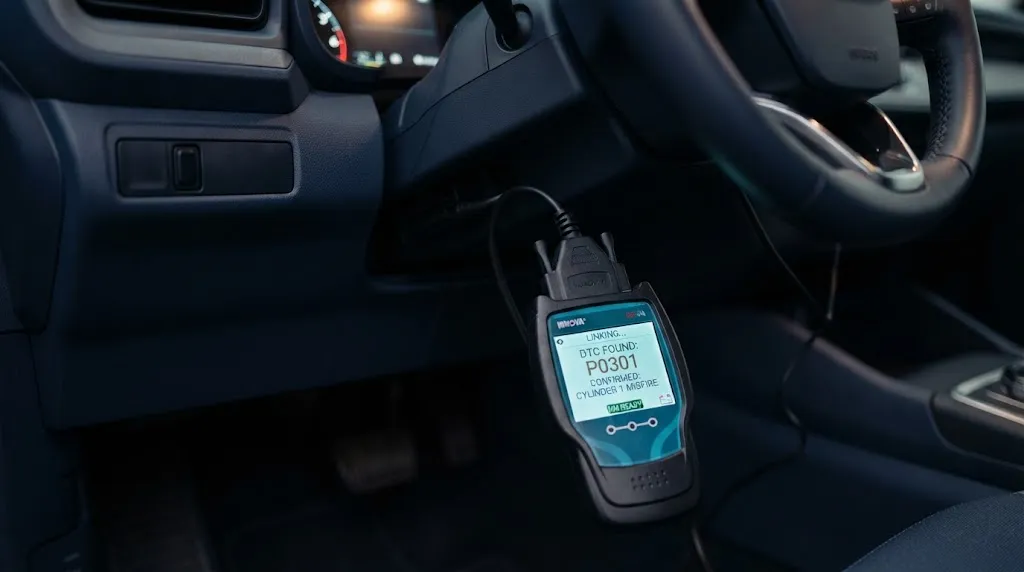
A generic scan uses the standardized emissions-related information every compliant car must expose. It can read stored and pending powertrain codes, show readiness and freeze-frame data for a qualifying fault, and display common live values such as engine speed, coolant temperature, and fuel system status.
On a hybrid, that layer can still be useful. It may reveal an engine misfire, a fuel-trim problem, an emissions monitor failure, or a widely recognized hybrid code such as P0A80 for hybrid battery pack deterioration. It can also show incomplete monitors after codes were cleared.
What it often cannot do is open every hybrid module, explain a manufacturer-specific subcode, or show detailed battery-block, inverter-temperature, and motor-control data. A generic tool may report “no codes” while a hybrid module holds a fault the generic scan never asked about. For broader coverage, see what an OBD2 scanner can tell you.
What Changes With a Hybrid-Capable Scan
A hybrid-capable tool adds manufacturer-specific coverage. It can select the hybrid control, battery energy control, inverter, and related brake or transmission modules where the maker supports them, rather than only the generic powertrain view. It may also read extra live data and subcodes.
Coverage still varies by make, model, year, and software version. A tool that reads detailed hybrid data well on one brand may be much thinner on another. Before trusting a blank screen, check that the tool lists your exact vehicle and the hybrid modules you need. A connection is not the same as coverage.
| Scan level | Usually available | Common limit |
|---|---|---|
| Generic OBD2 | Standard codes, readiness, basic live data, freeze frame | May miss hybrid-module faults and detailed hybrid data |
| Hybrid-capable, full-system | More hybrid modules, maker-specific codes, richer live data | Coverage depends on make, model, year, and software |
| Maker-level or specialist tool | Deepest module access, subcodes, guided tests | Cost and licensing can limit home use |
The EPA scan-tool evaluation makes a related point that still applies: generic and enhanced modes can expose different amounts of data, so the tool and mode matter as much as the port itself.
System by System: What OBD2 Can Point To
High-voltage battery and its controls
Battery codes can point to pack deterioration, a weak block, a voltage-sensing fault, or a battery control problem. Live data may show state of charge, battery temperature, current flow, and block-voltage spread where the tool supports it. A widening spread under load, or a fast-swinging state of charge, supports a battery problem more than a single code alone. Still, a code does not measure remaining capacity directly.
Inverter, converter, and motor-generators
The inverter changes battery power into the form the motors use, and the converter supplies lower-voltage systems. Codes here may point to cooling performance, converter performance, or a motor-generator fault. Temperature and coolant data matter, because heat is often the first sign of strain. Lost power or limited assist may mean the pump, coolant, or sensor needs attention first, not that the inverter has failed.
Hybrid control, cooling, and braking coordination
The hybrid control unit decides when the engine runs, when the motors assist, and when energy is recovered during braking. Its faults can look like poor fuel economy, rough transitions, lost regenerative braking, or a refusal to enter READY mode. Regenerative braking also depends on hybrid and brake cooperation, so an engine-only scan may miss a brake or communication fault. See whether live OBD2 data can diagnose transmission problems.
The engine side still counts
A hybrid still has an engine, and engine faults can trigger hybrid symptoms. A misfire, air-fuel problem, or cooling fault can change how often the engine runs and how the system balances power. Do not treat every hybrid warning as a high-voltage fault until ordinary powertrain data have been checked. The existing guide to whether OBD2 can diagnose hybrid vehicles covers the general yes-or-no question; this article focuses on the system map and diagnostic order behind that answer.
A Practical Scan Order That Avoids the Usual Traps
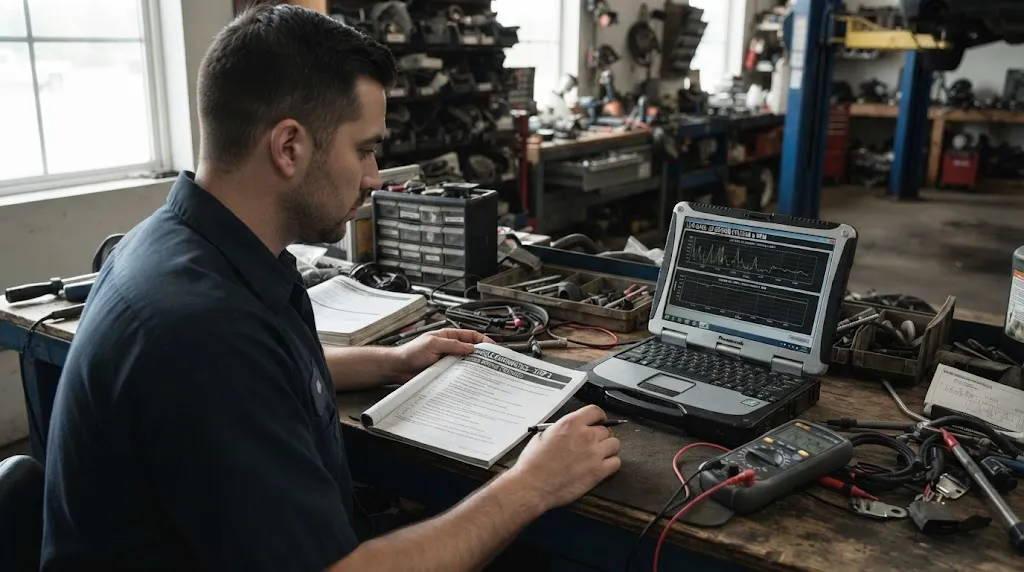
- Record the warning and conditions. Note READY mode, power loss, assist loss, heat, rain, standstill, or recent work.
- Check the 12-volt battery first. A weak auxiliary battery can cause strange warnings, lost communication, and misleading codes.
- Run a full-system scan. Record codes from every reachable module, including pending and communication codes.
- Read freeze frame before clearing anything. Clearing too early erases the snapshot from when the fault was set.
- Compare live data together. Watch battery temperature, state of charge, current, inverter temperature, and engine load for a pattern.
- Check physical items the scan cannot see. Cooling-intake blockage, inverter coolant level, loose connectors, and water intrusion can produce system symptoms.
- Decide what the evidence supports. A repeated code plus matching live data points to one area; a single code with normal data may be pending or intermittent.
If a code is pending rather than confirmed, the distinction matters. The guide to what a pending fault code means explains why a pending code is a warning that a test failed once, not yet a confirmed diagnosis.
Warning
Do not open, disconnect, or probe high-voltage components to “test” a hybrid fault. High-voltage cables, the battery pack, and the inverter can remain dangerous even when the car appears off. Scanning and visual inspection from outside sealed covers are the safe home boundary; high-voltage testing belongs to a hybrid-qualified technician.
Codes That Point to a System, Not a Single Part
Some codes are especially easy to misread. P0A80 generally signals hybrid battery pack deterioration beyond the control system’s threshold, but it does not prove every cell is bad, nor rule out a sensing or cooling contribution. P0A93 points to inverter cooling performance, which may be a pump, coolant, sensor, or airflow issue rather than an inverter replacement. P0AA6 signals a high-voltage isolation fault, meaning unwanted electrical contact with the chassis is suspected; that is a safety-related finding and should stop home high-voltage work.
P0A94 points to DC-to-DC converter performance, which affects charging of the 12-volt system and can create confusing low-voltage symptoms. Communication codes, often beginning with U, point to a module that is not talking to the rest of the system. A U-code does not automatically mean the silent module has failed; wiring, power supply, a gateway problem, or a weak 12-volt battery can produce the same result. The repair becomes clear only when the code, live data, freeze frame, and physical checks point to the same area.
What OBD2 Cannot Diagnose on Its Own
- Exact remaining battery capacity. A scan shows imbalance and charge behavior, but precise capacity needs controlled testing.
- The exact location of an isolation fault. Finding whether the leak is in the pack, cable, inverter, or connector needs specialist testing.
- Mechanical wear without an electrical signature. A worn bearing or damaged hose may set no code until it changes temperature or performance.
- A fault whose monitor has not run yet. See why OBD2 monitors are not ready: “no code” is not always “no fault.”
- Whether a repair will last. A cleared code and short drive do not prove it; a repeat drive cycle and completed monitors give a stronger answer.
Key Insight
The most useful hybrid diagnosis is rarely “the battery is bad.” It is “the battery area, the cooling loop, or the control communication is the weak link, and here is the evidence that separates them.”
When to Stop and Get Hybrid-Qualified Help
Stop home diagnosis and seek qualified help if the car will not enter READY mode, loses power suddenly, shows an isolation fault, smells of burning insulation, has visible high-voltage cable damage, or has been in water or a collision. The same applies if the same code returns immediately after a careful scan and simple checks, or if the tool cannot reach the hybrid modules at all. Bring the scan record with you: all codes, pending codes, freeze-frame values, and a note of when the fault appears.
Related Product
Hybrid-Compatible OBD2 Scanner
A scanner with hybrid and full-system coverage is the practical next step when a generic reader cannot reach the battery, inverter, or hybrid control modules on your car.
As an Amazon Associate, we earn from qualifying purchases.
Frequently Asked Questions
Can a basic OBD2 scanner diagnose a whole hybrid system?
No, not usually. A basic scanner can read generic and some hybrid codes, but often cannot open every hybrid module or show detailed battery, inverter, and control data. You need hybrid, full-system coverage for your exact make and model.
Why does my hybrid warning stay on when the scanner shows no codes?
Common reasons are limited module coverage, a fault in an unreached module, or a monitor that has not yet run. Try a full-system scan, pending codes, and a 12-volt check before assuming the warning is false.
Will clearing a hybrid code fix the problem?
No. Clearing erases the fault and freeze-frame snapshot, but not the cause. If the fault remains, the code usually returns when the monitor runs again. Record both first.
Can OBD2 tell whether the battery needs replacement or only cooling repair?
It can narrow the choice, but not always settle it. Battery codes plus block-voltage spread support a battery problem; cooling codes, high temperatures, and blocked airflow point toward cooling. Mixed evidence calls for specialist testing.
Can OBD2 diagnose a plug-in hybrid charging system?
Partly. OBD2 can reveal hybrid-module faults affecting charging, but charger, onboard-charger, and charge-port faults may need maker-specific data or specialist testing. First separate a vehicle fault from a charger or cable issue.
Do mild hybrids need a different kind of diagnosis?
The approach is similar, but the system is smaller: a mild hybrid usually uses a lower-voltage assist system, so its codes and modules differ. Confirm the tool supports that car’s mild-hybrid modules.
Conclusion
OBD2 can diagnose a hybrid system, but depth depends on the tool, the vehicle, and how the result is read. A generic scan is a useful first check; a hybrid-capable scan adds the battery, inverter, control, and communication layers that turn a warning into a system location. Check the 12-volt battery and cooling basics, keep freeze frame before clearing codes, and treat isolation or READY failures as a reason to get qualified help. That discipline avoids the most expensive mistake in hybrid diagnosis: replacing a part before the system itself has been identified.

I’m Alex Rahman, a car enthusiast and automotive writer focused on practical solutions, car tools, and real-world driving advice. I share simple and honest content to help everyday drivers make better decisions.
