Can an OBD2 Scanner Read Hybrid Battery Data? | Explained
Quick Answer
Yes, but only with the right tool and coverage. A basic OBD2 scanner usually shows a hybrid fault code and little else, while a hybrid-capable scanner can show battery block voltages, state of charge, temperature, and current. Even then, it shows live battery behaviour, not a direct measurement of remaining capacity.
A hybrid battery is not part of the standard emissions data every car must share. It is managed by a separate battery or hybrid control system, so two tools plugged into the same port can give very different answers.
Why a Basic Scanner Usually Stops at a Code
Generic OBD2 was built around a common set of emissions-related codes and live values. A basic reader can therefore read a powertrain code, show engine data, and check readiness, but it does not automatically get access to every module in the car. The hybrid battery data lives outside that common set, in manufacturer-specific data often called enhanced data.
This explains the most common disappointment: the scanner connects, reads a code such as P0A80, and then shows no battery screen. The connection is working; the tool simply lacks the make, model, and system coverage to ask the battery system the right questions. For the broader picture, see what an OBD2 scanner can tell you.
An EPA evaluation of OBD hand-held scan tools found the same variation: tools meeting basic SAE requirements still differ widely in additional features and system coverage.
What Battery Data a Capable Scanner Can Show
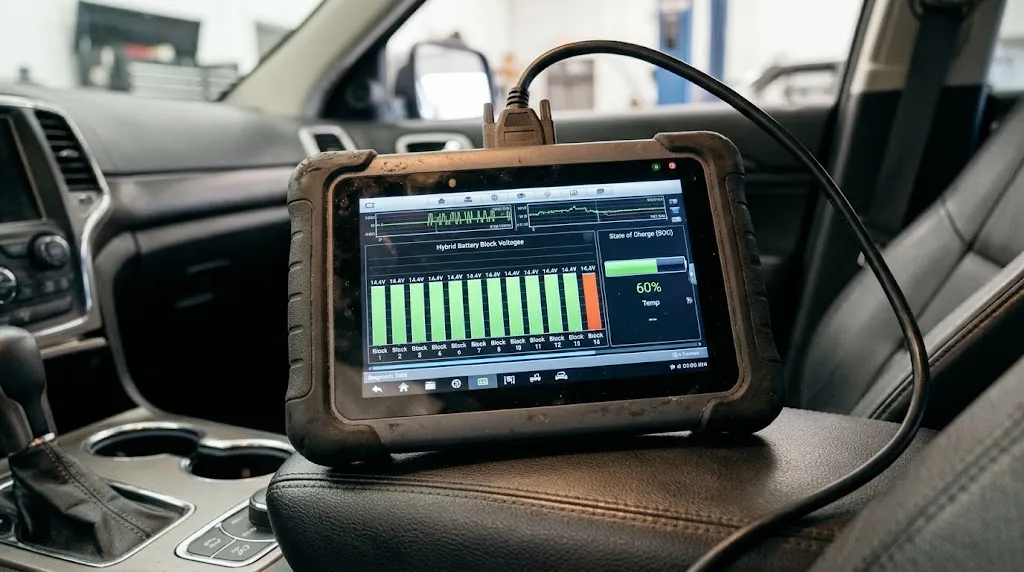
With hybrid coverage for your exact vehicle, the useful values are usually live readings, not a single health score.
| Battery value | What it shows | Why it matters |
|---|---|---|
| Block voltages | Voltage of each monitored group of modules | Uneven blocks point to a weak group |
| State of charge | How full the system judges the pack to be | Rapid swings suggest lost usable capacity |
| Battery temperature | Sensor readings from different parts of the pack | Heat and hot spots speed up ageing |
| Battery current | Amps flowing in or out during driving | Needed to judge voltage sag under load |
| Cooling fan data | Fan speed or duty cycle, where supported | A fan stuck high can signal heat trouble |
Block voltage is the most practical clue. On a classic Toyota Prius pack, the system monitors 14 blocks, each made of two modules, rather than every individual cell. A single low block does not name the exact failed cell, but it narrows the problem far better than a code alone. Other hybrids use different block counts and labels, but the principle is the same.
If you are choosing which readings to watch, our guide to which OBD2 PIDs are most useful explains why a short, relevant list beats a screen full of numbers.
What a Scanner Cannot Show About the Battery
A scanner cannot directly measure remaining amp-hour capacity. Capacity is what a pack can actually store and deliver, and proving it normally needs a controlled charge and discharge test, not a quick reading through the diagnostic port. An app may estimate a health percentage from voltage behaviour, but that estimate is not a capacity test.
It also cannot show every cell separately on most systems. Where the car monitors blocks, one weak module is averaged with its partner, so a block reading can hide a smaller problem until the gap grows. Physical faults are another blind spot: corrosion, a damaged harness, a blocked cooling inlet, or a leaking module will not appear as a neat number.
A high-voltage isolation code likewise deserves special care. It does not mean the scanner has measured the leak in detail, and it does not make the pack safe to open.
Warning
Scanning through the OBD2 port is safe for most owners. Opening the high-voltage battery enclosure, disconnecting orange high-voltage cables, or probing pack terminals is not. Leave that work to a qualified hybrid technician with the right training and equipment.
How to Read the Numbers Without Misjudging the Pack
Start with balance, not total voltage. A healthy pack usually keeps its blocks close together. On older Toyota NiMH systems, a spread of roughly 0.3 volts is often discussed as a warning threshold, but the exact limit is vehicle-specific, not a universal pass or fail line. What matters most is a block that stays low while the others stay together, especially under load.
Next, watch state of charge over time. Hybrids normally keep charge in a controlled middle range, so a single percentage means little on its own. A pack that drops quickly, climbs unusually fast, or swings widely during normal driving gives a stronger signal than any one snapshot.
Temperature and current complete the picture. Compare readings only in similar conditions, and if one sensor reads far hotter than the others, or the fan runs hard while temperatures stay high, suspect cooling or a struggling section of the pack. Cross-check anything surprising with a second drive, as explained in our guide to how accurate OBD2 live data is.
Tip
Record the highest block, lowest block, spread, state of charge, temperatures, and current together, with the driving condition noted. A dated set of readings is far more useful than a single screenshot.
A Practical Battery-Data Check
If battery data is missing at step two, the problem is usually coverage, not the battery.
- Plug in with the car in the state the tool asks for, usually ready or running, and run a full-system scan rather than an engine-only scan.
- Open the hybrid battery, battery control, or hybrid control section and confirm block voltages, state of charge, and temperatures are actually present.
- Note the readings at rest, then again during a gentle drive, so you can see behaviour under load.
- Compare blocks with each other, not only with the pack total, and note any block that stays low.
- Check stored and pending hybrid codes, fan operation, and temperature spread before deciding what the data means.
- Save or photograph the readings, including the date and driving conditions, for comparison later.
If the battery screen is blank, check vehicle selection, a full-system scan, updated software, and a better adapter in that order. Cheap clone adapters often fail to pass manufacturer-specific requests through reliably.
Why Results Differ So Much by Make, Model, and Tool
Coverage is uneven because hybrid systems are not standardised like emissions diagnostics. Toyota and Lexus models have the deepest consumer-tool support, helped by long-running model-specific apps and dealer-level software. Some Honda support exists, but it is narrower. Ford, Hyundai, Kia, and GM hybrids often have thinner consumer coverage, so a home scan may return the code and little battery detail.
Chemistry and vehicle type also change the data. A conventional hybrid, a plug-in hybrid, a nickel-metal hydride pack, and a lithium-ion pack do not all report the same values. A plug-in hybrid may show charging-related data a conventional hybrid never will, while a mild hybrid may have far less battery data to read.
The same module-access problem appears elsewhere: a scanner that cannot reach a transmission module is not necessarily broken, it may simply lack that coverage, as explained in our guide to why a scanner cannot access the transmission module. For the wider hybrid question, including inverter and motor faults, see can OBD2 diagnose hybrid vehicles; this article stays focused on battery data itself.
Battery Codes That Point Back to the Data
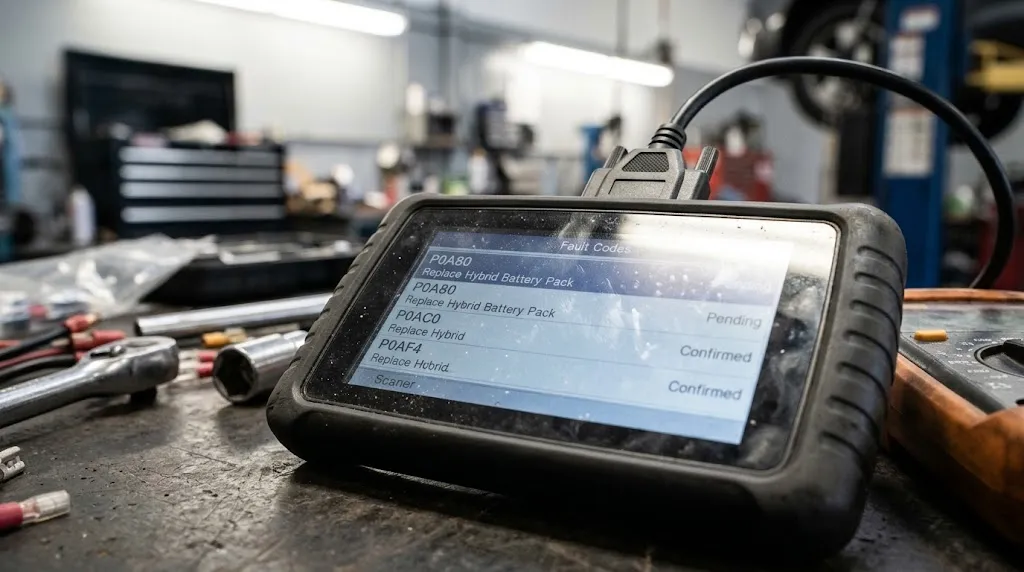
Codes are a starting point, not a verdict. P0A80 commonly points to a replace-battery-pack condition caused by weak blocks, P0A7F can point to battery deterioration, and P0AA6 can point to a high-voltage isolation fault. None, on its own, identifies the exact block, cell, connector, or cooling fault.
Use the code to decide which live data to check, then let block spread, temperature pattern, and current behaviour narrow it down. If the data looks even but the code returns, the fault may sit in sensing, wiring, cooling, or another hybrid component. Clearing the code without checking the data only restarts the same cycle.
Mistakes That Produce a False Battery Verdict
The most common mistake is judging a pack from one reading. A single low block after a cold start, a single state-of-charge figure, or one app-generated health percentage is not enough. Trends, load behaviour, and repeat readings carry the weight.
Another trap is confusing the two batteries in a hybrid. The small 12-volt auxiliary battery runs accessories and wakes up the computers, while the high-voltage pack drives the vehicle. A weak 12-volt battery can cause strange warnings, so check it before blaming the traction pack.
Finally, do not assume a blank screen means a dead battery, or a clean code list means a healthy one. Blank data usually means missing coverage, and a pack can lose usable capacity before it sets a code. When data and symptoms disagree, or a high-voltage fault is present, get a qualified hybrid inspection.
Related Product
OBD2 Scanner With Hybrid Battery Support
Choose a scanner and app combination that explicitly lists hybrid battery data for your exact make, model, and year.
As an Amazon Associate, we earn from qualifying purchases.
Frequently Asked Questions
Can a cheap code reader read hybrid battery voltage?
Usually not. A cheap generic reader can often show a hybrid-related fault code, but it normally lacks the manufacturer-specific coverage needed to display block voltages, state of charge, and battery temperatures.
Does a scanner show a battery health percentage?
Some tools and apps show an estimated health figure, but that is not a direct capacity measurement. Treat it as a clue, and give more weight to block balance, state-of-charge behaviour, temperature spread, and repeat readings.
Why does my scanner connect but show no battery data?
The most likely causes are missing hybrid coverage for your vehicle, an engine-only scan instead of a full-system scan, outdated software, or an adapter that does not pass enhanced data through. Check vehicle selection and coverage before assuming the battery is at fault.
Can I check a used hybrid battery with a scanner before buying?
Yes, as a screening step. Check for hybrid codes, block spread under load, temperature balance, and charge behaviour during a test drive. A clean scan does not prove full remaining capacity, so a specialist inspection is still wise for a high-value purchase.
Is state of charge the same as battery health?
No. State of charge says how full the system judges the pack to be right now. Battery health is about how much usable capacity remains and how evenly the pack performs, which needs trend and load behaviour, and in some cases a dedicated capacity test.
Do plug-in hybrids show different battery data than regular hybrids?
Often, yes. Plug-in hybrids may report charging-related values and a wider usable charge range, while conventional hybrids normally operate in a narrower middle range. The exact labels and values still depend on the make, model, and tool coverage.
Conclusion
An OBD2 scanner can read hybrid battery data, but the answer is only useful once you know which scanner, which vehicle, and which data you mean. A generic tool gives you a code. A hybrid-capable tool gives you block voltages, charge behaviour, temperatures, and current, and those readings can reveal a weak block or a cooling problem long before a code list explains it.
Use the data as evidence, not as a final health certificate. Compare blocks, watch trends under load, check the 12-volt battery, and get qualified help for high-voltage faults.

I’m Alex Rahman, a car enthusiast and automotive writer focused on practical solutions, car tools, and real-world driving advice. I share simple and honest content to help everyday drivers make better decisions.
