How to Check Readiness When Buying a Used Car | Leadfoot
Quick Answer
Before the test drive, plug a scanner into the OBD2 port, open I/M Readiness, and photograph every monitor status. A good first screen is: check-engine light off, no stored or pending codes, and supported monitors ready. Several monitors showing Not Ready is a warning, not proof of a fault: it often means codes were recently cleared or the battery was disconnected.
A readiness check is not a full mechanical inspection. It answers one narrow question: has this car’s emissions system finished its self-tests, or has its history been reset? A car with no warning light can still hide an untested fault.
Scan before the test drive, note the exact results, drive the car, then scan again. A seller who will not let you scan before driving is asking you to skip the most useful evidence.
What a Readiness Result Actually Tells You
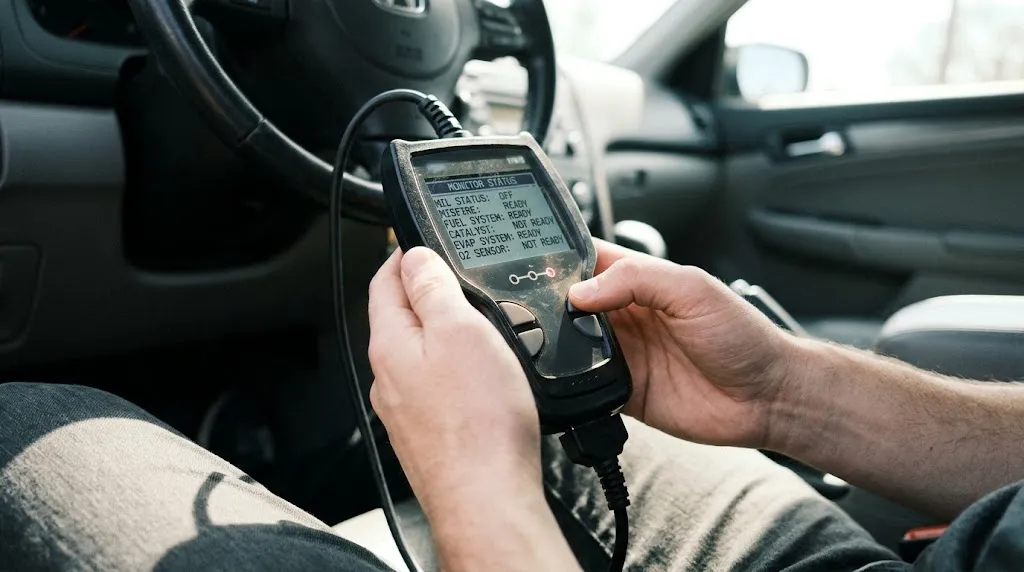
Each readiness monitor is a self-test for one emissions-related system, such as the catalyst, oxygen sensors, evaporative system, or exhaust gas recirculation. Ready means its test has run and completed. Not Ready, or Incomplete, means the test has not finished, so that system has not yet been judged pass or fail.
That is the key point for a buyer. Not Ready does not mean broken, and Ready does not mean perfect. A fault can still be present in a system whose monitor is incomplete, because the test that would reveal it has not run yet.
There is also a third status: Not Supported. That means the car was not built with that monitor, so it should not count against the car. If you want the background first, checking emissions readiness with an OBD2 scanner explains how the scanner reads these statuses.
Also check the check-engine light and the stored, pending, and permanent code lists. A car can have a stored code even when the light is off, and a pending code can show a fault seen once but not yet repeated enough to turn the light on.
Do the Scan Before the Test Drive
Scan first because driving can change the evidence. A test drive may complete a monitor or trigger a pending code, but it cannot show what the car looked like when you arrived.
- Ask permission, then locate the port. On most 1996 and newer cars, the port is under the driver’s-side dashboard, near the steering column. A refusal is itself useful information.
- Turn the ignition on without starting the engine, if your scanner allows it. Many scanners power up from the port and can read readiness in this state.
- Open I/M Readiness, not just the code list. Some scanners hide it under Emissions, Inspection, or Monitor Status. Codes alone can miss incomplete monitors.
- Record the lamp status and every monitor. Photograph the full list, plus the date and mileage.
- Read stored, pending, and permanent codes. Do not clear anything: clearing codes resets monitors.
- Check that the check-engine light works. With ignition on and engine off, it should illuminate as a bulb check, then go out after starting if no fault is commanded.
Tip
Take it before and after the test drive: if a monitor completes or a pending code appears, you have a dated record for the seller or inspector.
Read the Result Like a Buyer
Do not judge the car by green ticks alone. Judge it by the combination of light status, codes, and monitor completion. Your state’s inspection rules still decide whether the car can pass its official test.
| What you see | What it usually means | Buyer action |
|---|---|---|
| Light off, no codes, supported monitors ready | Self-tests completed without a stored fault. | Proceed with the test drive and other checks. |
| One or two monitors Not Ready, no codes | Testing is incomplete, often after a battery change, repair, or code clear. | Ask why and ask for receipts. |
| Many monitors Not Ready | Diagnostic memory was probably reset recently. | Pause until the reason is documented or monitors complete. |
| Light on, or a code commanding the light | A fault has been detected and needs diagnosis. | Get a repair estimate or professional inspection first. |
| Pending code, light off | A fault has been seen, but not yet confirmed over repeated trips. | Investigate that system before committing. |
| Permanent code present | Fault history cannot be erased by a normal code clear. | Do not accept “we cleared it” as a fix. |
How Many Incomplete Monitors Can Still Pass?
Inspection programs do not all use the same rule, so check your state’s current requirements before you buy. As a widely used EPA-based guideline, 1996 to 2000 vehicles may be allowed up to two unset noncontinuous monitors, while 2001 and newer vehicles may be allowed up to one. The EPA technical support document on OBD inspection also notes that an unset readiness code is not itself proof of an emissions problem; it means the relevant monitor has not run yet.
For a buyer, the allowance is context, not reassurance: a car within it can still fail once the remaining monitor runs. See how many OBD2 monitors can be incomplete.
Ask the Right Questions When Monitors Are Not Ready
Not Ready results have innocent causes: a battery replacement, a power-disconnecting repair, or a recent service visit can all reset monitors. Clearing codes has the same effect, so separate a documented reset from an unexplained one.
- Was the battery recently replaced or disconnected? Ask for the receipt and date. A fresh battery makes this plausible, but the car is still unproven.
- Was emissions-related work just done? Ask what was repaired and whether the shop cleared codes afterward.
- How has the car been driven since then? Short trips or long periods parked can prevent some monitors from running. The evaporative monitor often needs specific cold-start and fuel-level conditions.
- Can the seller show an older scan or inspection report? A previous passing report helps, but does not prove the current state.
- Will the seller allow a recheck after normal driving? Agreement to a second scan gives you a much stronger basis for a decision.
If the explanation does not match the pattern, slow down: a seller who says nothing was touched, yet nearly every monitor is incomplete, is describing a reset without a cause. Why OBD2 monitors stay not ready covers faults that can also block a monitor.
Warning
Do not let anyone clear codes during your viewing to “make the light go away.” Clearing codes also resets readiness monitors, so a cleared car looks cleaner on a code list while becoming less proven on readiness.
Scan Again After the Test Drive
Drive through varied conditions when safe and legal: a cold start if possible, steady cruising, gentle acceleration, and normal stop-and-go driving.
After the drive, repeat the same screens and compare them with your first screenshot. Watch for a monitor completing, a new pending code, or a permanent code remaining. If a monitor completes, check whether a code appeared when it ran.
A pending code deserves a closer look: it often means a fault was detected once but needs another occurrence to become confirmed. What a pending fault code means explains that lifecycle. If it points to the catalyst, oxygen sensors, misfire, or evaporative system, get a professional opinion first.
When to Walk Away, Negotiate, or Get an Inspection

Use the scan to choose your next step, not to judge the whole car. A clean result supports the purchase, but it does not replace checking tires, brakes, fluids, bodywork, service history, and title status.
Walk away, or at least pause, when the seller refuses a scan, the bulb never illuminates, many monitors are incomplete without a documented cause, or a permanent code remains.
Negotiate with evidence when a stored or pending code points to a definable repair, or an inspection will likely require a retest. Bring the screenshot, code numbers, and a written estimate.
Get a pre-purchase inspection when the scan shows a catalyst, misfire, or evaporative fault, monitors will not complete after normal driving, or the car is higher-priced. A professional inspection can check manufacturer-specific codes and physical condition a generic screen cannot.
Key Insight
Treat readiness as a condition, not a verdict. “Monitors ready, no codes” is a green light to continue checking the car. “Monitors not ready” is a reason to ask for proof, allow time for a recheck, or make the sale conditional on a passing inspection.
Mistakes That Make a Clean Scan Misleading
- Scanning only after the seller has warmed up and driven the car. That drive may have completed monitors or hidden a pending fault.
- Checking codes but not readiness. No stored codes plus several incomplete monitors means the car has not been fully tested.
- Assuming one incomplete monitor is always safe. It may be within an allowance, but the remaining monitor could still fail.
- Ignoring the VIN. Compare the scanner VIN, when available, with the plates and paperwork.
- Treating a generic scan as a complete diagnosis. Generic OBD2 may not show manufacturer-specific codes in other modules.
- Buying on a promise that monitors “will set.” Some set with normal driving, but a monitor blocked by a fault will not. Put the recheck in writing before you pay.
Rules also vary by state, vehicle age, fuel type, and weight class, so check the registration state’s rules before relying on the seller’s local inspection history.
Related Product
OBD2 Scanner With I/M Readiness Display
A scanner that clearly shows I/M readiness, stored codes, and pending codes makes this check possible in minutes at the seller’s location.
As an Amazon Associate, we earn from qualifying purchases.
Frequently Asked Questions
Can a used car pass inspection with one monitor not ready?
Sometimes, depending on state and model year. Under widely used EPA-based guidance, 2001 and newer vehicles may be allowed one unset noncontinuous monitor, and 1996 to 2000 vehicles may be allowed two. Check your state’s current rule.
Does a check-engine light that is off mean the car is ready?
No. No fault is currently commanding it on, but monitors can still be incomplete and a pending code can be present. Read the readiness screen and code lists, not just the dashboard.
How long does it take for readiness monitors to complete?
There is no single time for every car. Some complete during normal mixed driving; others need a cold start, steady cruising, a specific fuel level, or a manufacturer drive cycle.
Should I buy a used car with all monitors not ready?
Not on that evidence alone. All monitors incomplete usually means diagnostic memory was recently reset. Ask for a documented cause, allow a recheck, or make purchase conditional on inspection and a passing result.
What should I do if the seller cleared codes before I arrived?
Do not treat the cleared list as a clean bill of health. Ask what was cleared and why, request receipts, and insist on a recheck after the relevant monitors complete.
Is a readiness scan enough for a used-car purchase?
No. It does not check brakes, suspension, tires, leaks, accident history, title status, or manufacturer-specific faults outside generic OBD2. Use it with a test drive, service records, and an independent inspection for a significant purchase.
Conclusion
Scan before the test drive, photograph the full readiness and code results, ask for a documented reason for anything incomplete, then scan again after driving. A ready result with no codes supports the purchase; several incomplete monitors mean the car is still unproven. When evidence is uncertain, make a recheck or professional inspection part of the deal.

I’m Alex Rahman, a car enthusiast and automotive writer focused on practical solutions, car tools, and real-world driving advice. I share simple and honest content to help everyday drivers make better decisions.
