What Is ISO 14230 OBD2? KWP2000 Explained | Leadfoot
Quick Answer
ISO 14230 is the standard for Keyword Protocol 2000 (KWP2000), a diagnostic language that lets a scan tool talk to a vehicle’s control units, usually over a single K-line wire. In OBD2 use, it is one of the older communication protocols a scanner may need to support, not a fault code, a scanner type, or OBD2 itself.
What ISO 14230 Actually Defines
ISO 14230 defines how an off-board tester and one or more on-vehicle electronic control units (ECUs) exchange diagnostic information. It sets the rules for starting a session, formatting requests and responses, timing, and the diagnostic services the tester can call on.
The name Keyword Protocol 2000 comes from the keyword exchange used when the tester and ECU first agree on communication settings. Once the session is open, the tester sends a service request and the ECU sends a response, so the tester can read data, read codes, run a supported test, or close the session.
ISO 14230 is broader than emissions testing alone, because manufacturers also used KWP2000 for wider diagnostic work. The emissions-related OBD2 use is narrowed down in ISO 14230-4, the part most relevant to a generic OBD2 scanner.
The Parts of ISO 14230
| Part | What it covers |
|---|---|
| ISO 14230-1 | Physical layer, including the K-line |
| ISO 14230-2 | Data link layer, framing and timing |
| ISO 14230-3 | Application layer, diagnostic services |
| ISO 14230-4 | KWP2000 for emission-related OBD data |
The first two parts were later retitled Diagnostic Communication over K-Line, or DoK-Line, while Part 3 remains the KWP2000 application layer. ISO’s page for ISO 14230-4:2000 describes it as covering the KWP2000 data link and scan tool when used for emission-related test data.
How a KWP2000 Session Starts
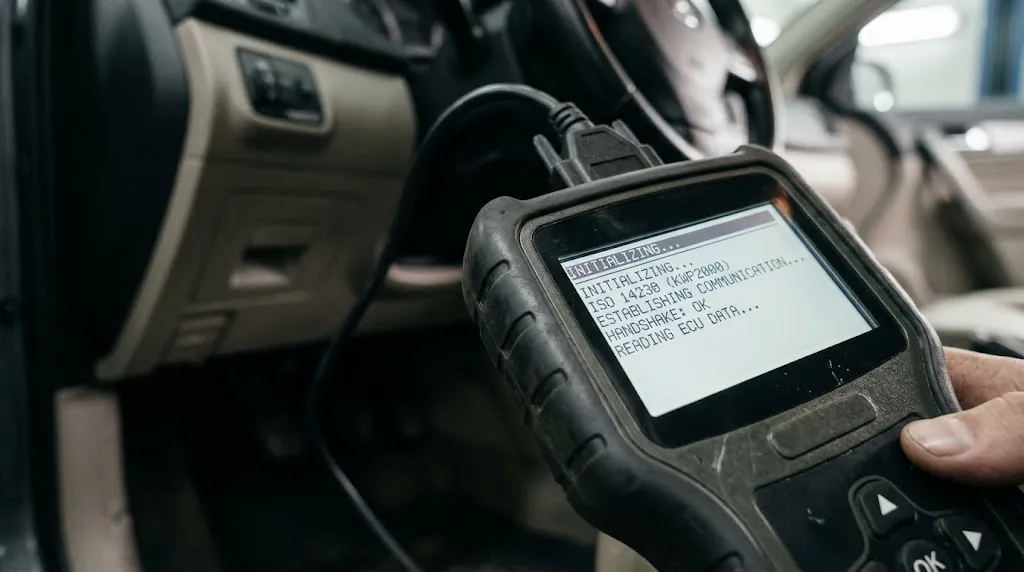
A KWP2000 conversation does not begin the moment the plug goes in. The tester must wake the ECU and agree on a communication setup first, and this startup step is where many connection failures happen. On a K-line system, startup timing is critical, so a rushed handshake or distorted wiring can produce a “no communication” result even when the car and tool are otherwise sound.
- 5-baud initialization: the tester sends the target address very slowly, at 5 baud, and the ECU replies with a synchronization byte and keyword bytes. This older method is also the one ISO 9141 relies on.
- Fast initialization: the tester sends a short wake-up pattern much more quickly, then moves to the agreed speed. This is a practical improvement KWP2000 added over ISO 9141.
After initialization, communication normally runs at 10.4 kbit/s on K-line, although the standard’s range is 1.2 to 10.4 kilobaud. That is enough for fault codes and many live-data readings, but slow by modern standards.
The K-Line, the Pins, and the Message
On the common K-line form of ISO 14230, communication is bidirectional serial data over a single K-line wire, with an optional L-line used for wake-up on some vehicles. In the standard 16-pin OBD2 connector, the K-line is pin 7 and the optional L-line is pin 15. Power is pin 16, and pins 4 and 5 are grounds. That pin layout is shared with ISO 9141, so the connector shape alone cannot tell you which protocol a car uses.
A KWP2000 message has a header, a data section, and a checksum. The header carries addressing and length information, the data section carries the service request or response, and the checksum lets the receiver check that the message arrived intact. A message may contain up to 255 bytes in its data field, which gives KWP2000 useful room for diagnostic services, even though the wire speed remains low.
For the connector itself, see our guide to the OBD2 port pin layout, including where pins 7 and 15 sit.
What a Scanner Can Do Over KWP2000
Over ISO 14230, a compatible tester can do the core diagnostic jobs most readers expect, plus some deeper functions when the vehicle and tool both support them. The exact menu depends on the tool and the car.
- Start and end a diagnostic session, and keep it alive while work continues.
- Read diagnostic trouble codes and clear them after a repair.
- Read live data and identification data from a supported ECU.
- Run supported actuator tests and routine functions on some systems.
- Use security access for protected functions, where the manufacturer requires it.
The important boundary is between the protocol and the tool’s coverage. ISO 14230 defines the language, but it does not force a manufacturer to expose every function to a generic tool. A generic OBD2 scanner will normally cover the standardized emissions functions, while deeper manufacturer functions may need a higher-level tool or security access.
This is why two scanners can behave differently on the same car. One may support both 5-baud and fast initialization cleanly, while another times out during the handshake. Before blaming the car, check whether the tool actually lists KWP2000 or ISO 14230 support, not just OBD2 in general. See also how an ELM327 communicates with a car.
ISO 14230 vs ISO 9141: The Closest Comparison
ISO 9141 is the nearest neighbour to ISO 14230, and the two are easy to confuse because they share the K-line, the connector pins, and the 10.4 kbit/s speed. The difference is what the protocol can do once the connection is open, and how quickly it can open it.
| Feature | ISO 9141 | ISO 14230 (KWP2000) |
|---|---|---|
| Startup | 5-baud initialization | 5-baud or fast initialization |
| Diagnostic range | Narrower, earlier OBD use | Wider services and sessions |
In short, KWP2000 builds on the same wire but adds a faster startup option and a richer service set. For the predecessor picture, see what ISO 9141 OBD2 is.
Where ISO 14230 Fits Next to CAN and UDS
CAN, defined for OBD2 use in ISO 15765, is the faster, two-wire network used on modern vehicles, commonly at 250 or 500 kbit/s. It replaced K-line as the main OBD2 transport because it can carry far more data and support many modules at once. In the United States, CAN became the required OBD2 protocol for new vehicles from model year 2008 onward.
UDS, or Unified Diagnostic Services under ISO 14229, is the successor diagnostic language that grew out of KWP2000 and related work. It is not the same as ISO 14230, even though the two share ideas such as sessions, services, and security access. For the wider map, see what OBD2 protocols are used.
Which Vehicles Used ISO 14230, and How to Tell
ISO 14230 was widely used on European and Asian vehicles before CAN-based OBD2 took over. It is not tied to one brand, and a model year alone does not prove which protocol a particular car uses, because fitment varied by market, engine, and module.
The most reliable check is the scanner itself. A tool that reports the detected protocol will usually name ISO 14230, KWP2000, ISO 14230-4, or a fast-init variant. If the tool connects and reads emissions data, the protocol question is already answered for practical purposes.
If the tool does not show the protocol, do not guess from the connector, since ISO 9141 and ISO 14230 share pins 7 and 15. A vehicle manual, a model-specific reference, or a tool with a protocol display is a better source. SparkFun’s OBD-II protocol guide also lists the K-line, L-line, power, and ground pins for KWP2000.
Why a KWP2000 Connection Fails
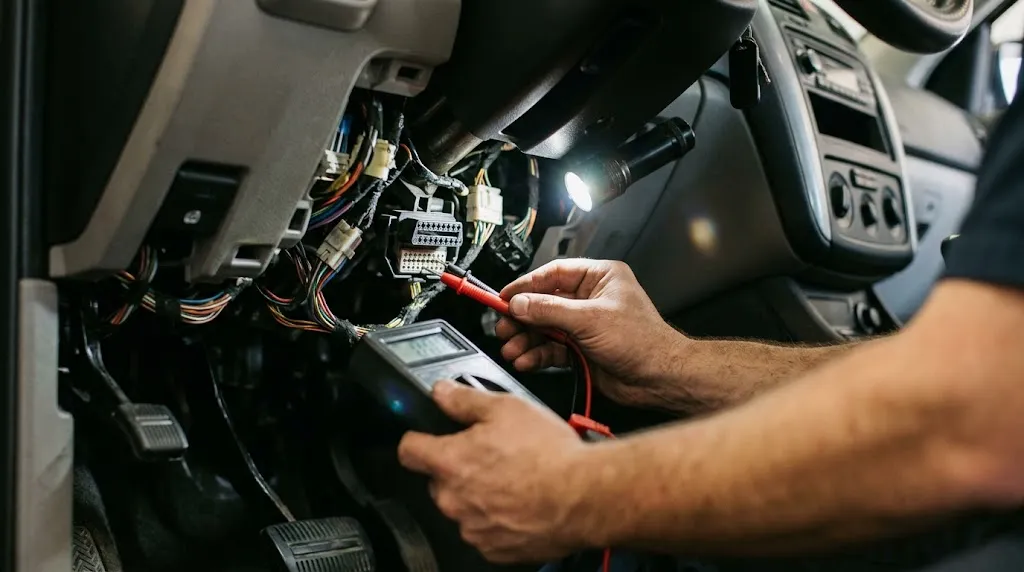
When a scanner will not connect over ISO 14230, work through the most likely causes in order, starting with the simplest. A protocol name on screen does not mean the protocol is the fault.
- Check power and seating first. The tool needs power from pin 16 and a good ground. A loose plug or damaged port can look exactly like a protocol failure.
- Confirm the tool supports KWP2000. Look for ISO 14230, KWP2000, fast init, or 5-baud support, not just a general OBD2 claim.
- Try the other initialization method if the tool allows it. An ECU that expects fast initialization may not respond well to a 5-baud attempt, and the reverse can happen on older modules.
- Check the K-line wiring. A broken or shorted K-line, or a faulty module pulling the line down, can block the handshake for every tool.
- Remove adapters, then swap the tool or the car. Test direct first, then try a known-good tool on the same car, or the same tool on a known-good car.
If the tool connects but reads slowly or times out during a long live-data session, that pattern fits K-line speed and timing limits better than a single broken wire. Shorten the parameter list and retest. For a fuller checklist, see why an OBD2 scanner won’t connect.
Warning
Do not force repeated connection attempts, clear codes, or run actuator tests on a car with an unstable K-line link. Check power, seating, and wiring first, because a partial session can give incomplete data that looks like a clean result.
Limits and Common Misunderstandings
Three misunderstandings cause most confusion here. First, ISO 14230 is not a fault code, so searching for it as a code will not explain a warning light. Second, supporting KWP2000 does not mean a scanner can access every module or perform every manufacturer function. Third, a car with a 16-pin OBD2 port is not automatically a CAN car, and a K-line car is not automatically broken or obsolete.
The practical limit is speed: K-line at 10.4 kbit/s cannot match CAN for data volume, which is why later systems moved to CAN and UDS.
Related Product
OBD2 Scanner With KWP2000 Support
If your car uses ISO 14230, the useful check is explicit KWP2000 support, not just a general OBD2 label.
As an Amazon Associate, we earn from qualifying purchases.
Frequently Asked Questions
Is ISO 14230 the same as KWP2000?
Yes, in normal use the two names refer to the same protocol family. KWP2000 is the common name for Keyword Protocol 2000, and ISO 14230 is the standard that defines it. ISO 14230-4 is the specific part for emission-related OBD use.
Is ISO 14230 the same as ISO 9141?
No. They share the K-line and connector pins, and both can use 5-baud initialization, but ISO 14230 adds fast initialization and a wider set of diagnostic services.
Does my car use ISO 14230?
It may if it is an older European or Asian OBD2 vehicle from before CAN became dominant, but model year alone does not prove it. The reliable check is a scanner that displays the detected protocol, or a model-specific reference.
Why does my scanner take so long to connect on KWP2000?
A 5-baud startup is slow by design, and K-line communication runs at only up to 10.4 kbit/s. Fast initialization helps where the ECU supports it, but large live-data requests will still feel slower than on CAN.
Can a KWP2000 scanner do manufacturer-level diagnostics?
Sometimes, but not automatically. The protocol allows deeper services, yet access depends on the vehicle, the tool, and any required security access. Generic OBD2 functions are the safest expectation.
Is ISO 14230 still used on new cars?
Not as the main OBD2 protocol. Modern vehicles use CAN transport with UDS services, and in the United States CAN has been required for new vehicles since model year 2008. ISO 14230 remains relevant for older K-line vehicles.
Conclusion
ISO 14230, or KWP2000, is the diagnostic language that let scan tools talk to ECUs over a K-line before CAN took over as the main OBD2 transport. Its value was a faster startup option and a wider service set than ISO 9141, on the same simple wire. For an older car, use a tool that explicitly supports KWP2000, and check power and seating first when a connection fails.

I’m Alex Rahman, a car enthusiast and automotive writer focused on practical solutions, car tools, and real-world driving advice. I share simple and honest content to help everyday drivers make better decisions.
