What Is EOBD? European Diagnostics Explained
Quick Answer
EOBD is European On-Board Diagnostics: the EU system that watches a car’s emission-related systems while it drives, stores a standard fault code when a problem could raise emissions, and turns on the malfunction indicator lamp. A normal OBD-II scanner can usually read it, because EOBD uses the same 16-pin connector and much of the same code format.
EOBD is not a different car computer or a scanner brand. It is a set of European rules about what a car must monitor, record, and make available to a standard scan tool. If you own a European petrol car from 2001 or a diesel from 2004 onward, EOBD is why a generic scanner can read its engine codes without a dealer-only tool.
What EOBD Actually Is
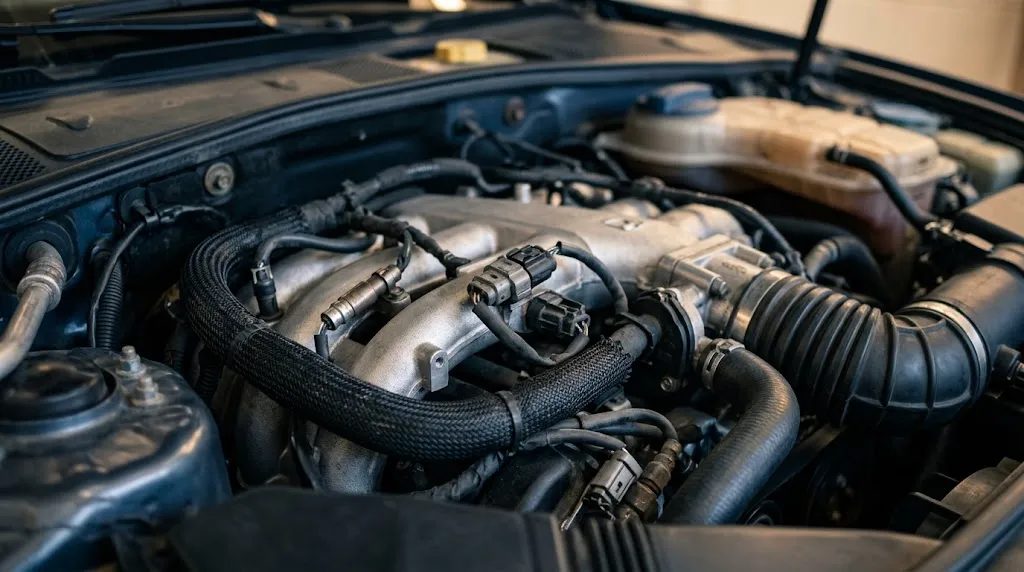
EOBD stands for European On-Board Diagnostics. It is the European equivalent of American OBD-II. Both were created for the same practical reason: emissions equipment only helps if it keeps working in real driving, not just in a laboratory test.
Under EOBD, the engine control unit checks the parts and sensors that affect exhaust emissions. When a fault is detected, it stores a diagnostic trouble code, or DTC, and often switches on the malfunction indicator lamp, the formal name for the check-engine light.
The scope matters. EOBD is primarily about emissions, not every system in the car. It does not guarantee that a basic scanner can read airbag, ABS, body, or infotainment faults. Those may need manufacturer-specific diagnostics, even on a fully EOBD-compliant car.
Which Cars Had to Have EOBD?
The dates explain why some older European cars will not talk to a modern generic scanner, even though the plug looks familiar. EOBD arrived with Euro 3, under Directive 98/69/EC, which required on-board diagnostics for petrol cars from 2000 and for new diesel vehicles from 2003 at type-approval stage.
First-registration dates differ, because type approval and first registration are not the same step. Newly introduced models generally complied a year earlier.
| Vehicle group | EOBD required from |
|---|---|
| Petrol passenger cars, M1, first registered in the EU | 1 January 2001 |
| Diesel passenger cars, M1, first registered in the EU | 1 January 2004 |
| Newly introduced petrol models | 1 January 2000 |
| Newly introduced diesel models | 1 January 2003 |
| Heavier cars over 2,500 kg and light commercial vehicles | Petrol 2002; diesel 2007 |
Category M1 broadly means passenger cars with no more than eight passenger seats.
What EOBD Monitors While You Drive
EOBD does not measure exhaust gases directly with a tailpipe analyser. Instead, the control unit uses existing sensors and software to judge whether emission-related systems are working within expected limits. If a result drifts far enough to suggest emissions could rise significantly, the system records it.
The systems most readers meet are misfire detection, fuel-system control, oxygen or lambda sensors, catalyst efficiency, exhaust gas recirculation, and the secondary air system where fitted. The control unit also watches sensor circuits.
Some checks run continuously, such as misfire and fuel-system monitoring. Others run only once per drive cycle, such as a catalyst test. That is why a monitor can stay incomplete after codes are cleared. Our guide to whether an OBD2 scanner can check emissions readiness explains that check.
How a Fault Becomes a Code and a Warning Light
The usual sequence is detection, confirmation, storage, and warning, although the drive cycles needed vary by fault and manufacturer calibration.
- Pending code: the fault has been seen, but not yet confirmed. The light may not be on yet.
- Confirmed code: the fault has repeated or persisted enough to be treated as real. The MIL is normally on.
- Freeze frame: a snapshot of speed, load, temperature, and fuel trim when the fault was stored.
- Permanent code: on later systems, a code a scanner alone cannot clear; it clears only after the monitor passes in normal driving.
A steady MIL usually means an emission fault needs attention soon, but the car can normally still be driven carefully to a workshop. A flashing MIL is different: it often points to a severe misfire that could damage the catalytic converter, so ease off, avoid hard acceleration, and get the car checked promptly.
Warning
Clearing a code does not repair the fault. If the problem is still present, the code and light will usually return once the monitor runs again.
How to Read an EOBD Code
A code has five characters: one letter followed by four numbers or letters. The first character shows the system area, and the second shows whether it is generic or manufacturer-specific. A second character of 0 normally means a generic code any compliant scanner should understand.
In P0301, P means powertrain, 0 means generic, 3 points to ignition or misfire, and 01 identifies cylinder 1 misfire. B codes relate to body, C codes to chassis, and U codes to network communication, although EOBD’s standardised coverage is strongest for powertrain.
The third character narrows the subsystem: P01xx is fuel and air metering, P03xx is ignition and misfire, P04xx is auxiliary emission controls, and P07xx and P08xx are transmission. The final two characters identify the individual fault. So a code is a starting point, not a parts order: P0301 tells you where to look, not whether the cause is a plug, coil, injector, compression, or wiring fault.
EOBD vs OBD-II: Same Tool, Different Rulebook
For most owners, the practical difference is smaller than the names suggest. EOBD is Europe’s implementation of the same basic idea as American OBD-II, with essentially the same connector and signal protocols. That is why many scanners are labelled OBD-II/EOBD.
| EOBD | OBD-II | |
|---|---|---|
| Region | European Union | United States |
| Petrol cars | 2001, first registration | 1996 |
| Diesel cars | 2004, first registration | Later phase-in |
| Connector | Same 16-pin connector | Same 16-pin connector |
| Purpose | Monitor emissions systems | Monitor emissions systems |
Threshold and wording differences still matter to manufacturers, and Euro V and Euro VI tightened EOBD thresholds versus Euro III and IV, but they rarely change what a home scanner shows. See our guide on whether OBD2 is the same in Europe and the US.
The Connector and the Protocols Behind It
An EOBD car has a standard 16-pin diagnostic link connector, usually in the passenger compartment within reach of the driver, often under or near the dashboard. No tools should be needed to reveal it, although it may sit behind a small cover.
The connector is standard, but the language through it depends on the car. Older European cars commonly used ISO 9141-2 or ISO 14230-4 (KWP2000), while modern cars use CAN (ISO 15765-4). A good scanner tries protocols automatically. No communication may mean wrong coverage, a missing power or ground pin, ignition off, or a pre-EOBD car, rather than a broken scanner.
ISO 9141-2 uses the K-line on pin 7, and sometimes the L-line on pin 15. Our guide to what ISO 9141 OBD2 means explains that protocol and why some adapters struggle with it.
What an Ordinary Scanner Can and Cannot Do

On an EOBD-compliant car, a standard scanner should read and clear generic emission codes, show whether the MIL is on, display freeze frame data, show live data for standard parameters, and report monitor and readiness status. That answers the first diagnostic question in most cases: is this an emissions fault, and which system is reporting it?
What it cannot reliably do is read every manufacturer-specific code, access every module, or perform dealer-level coding, adaptation, or actuator tests on every brand. A generic code such as P0420 is standardised, but a manufacturer-specific code beginning with P1, B1, C1, or U1 may need brand-specific software to interpret fully.
A scanner that fits and powers up has not proved the car is EOBD-compliant, and one that cannot connect has not proved it has no diagnostics. Check age, fuel type, ignition, and tool coverage. Our guides to how OBD2 works and whether an OBD2 scanner works on any car cover those limits.
Tip
Before an emissions test, check readiness first. If monitors are incomplete after a battery change or code clear, the car may need normal mixed driving before the test, even with no light on.
Common Misunderstandings About EOBD
EOBD2 is not a new official standard. The term is often marketing language for enhanced or manufacturer-specific features, or newer software built on EOBD. It does not mean a car has a second diagnostic system with a different plug.
EOBD is not a full dealer diagnostic. It standardises the emission-related gateway into the car. Behind it, manufacturers still have their own systems, codes, and procedures, and some faults only appear with enhanced software.
A 16-pin plug does not prove EOBD compliance. Some pre-EOBD cars used a similar connector for manufacturer diagnostics, and some cars outside Europe used it under a different regional system. Age, market, fuel type, and the tool’s coverage list are better checks than plug shape alone. Likewise, an ABS or airbag light with no EOBD codes is not necessarily a scanner failure; it may simply sit outside what EOBD covers.
Related Product
OBD2 / EOBD Scanner
A standard OBD2/EOBD scanner is the practical next step if you want to read generic codes, check readiness, and view freeze frame data on a compliant car.
As an Amazon Associate, we earn from qualifying purchases.
Frequently Asked Questions
What does EOBD stand for?
EOBD stands for European On-Board Diagnostics: the EU system for monitoring emission-related systems, storing standard fault codes, and warning the driver through the malfunction indicator lamp when emissions could be affected.
Can I use an OBD2 scanner on an EOBD car?
Yes, in most cases. EOBD uses the same 16-pin connector and a closely related code format, so a scanner supporting OBD-II/EOBD and your car’s protocol, usually CAN on modern cars or ISO 9141/KWP2000 on older ones, should read generic codes. Manufacturer-specific systems may need enhanced software.
Is my car EOBD-compliant?
As a first check, use petrol cars first registered in the EU from 1 January 2001 and diesel cars from 1 January 2004. Heavier cars and light commercial vehicles followed later, and new models complied a year earlier. Your manual or a coverage check for your exact model gives a firmer answer.
What is the difference between EOBD and EOBD2?
There is no separate official EOBD2 standard in the same sense as EOBD. EOBD2 is commonly marketing language for enhanced features or manufacturer-specific functions built around EOBD. Check the tool’s protocols and vehicle coverage rather than treating the label as a new plug or code system.
Why does my scanner show no codes when a warning light is on?
First, check whether the light is an emissions MIL or another warning, such as ABS or airbag, which EOBD may not cover. Then check whether the fault is pending, whether the ignition was on, and whether the tool supports your car’s protocol. A pending fault may need another drive cycle to become confirmed.
Does EOBD cover electric cars?
Not in the same way. EOBD was designed around combustion-engine emissions, including misfire, fuel control, catalyst, and exhaust sensors that do not apply to a battery-electric car in the same form. Many electric cars still have diagnostic connectors, but EOBD emissions monitoring is not the right framework for judging them.
Conclusion
EOBD is best understood as Europe’s emissions watchdog inside the car: it watches the systems that affect exhaust output, records a standard code when something goes wrong, and warns the driver when action is needed. Because it shares its connector and much of its code language with OBD-II, a standard scanner is usually enough for the first check. The useful next step is simple: confirm your car’s date and fuel type, read any generic codes, note whether the fault is pending or confirmed, and use freeze frame and readiness data before deciding whether a repair, a drive cycle, or a deeper brand-specific scan is needed.

I’m Alex Rahman, a car enthusiast and automotive writer focused on practical solutions, car tools, and real-world driving advice. I share simple and honest content to help everyday drivers make better decisions.
