Where Is the OBD2 Port Located? How to Find It Fast
Quick Answer
The OBD2 port is almost always located underneath the driver’s side dashboard, directly between the steering wheel base and the foot pedals. Regulated vehicles place it within three feet of the driver’s seat. If you cannot see it immediately, look upward under the lower trim edge, inspect the driver-side fuse panel, or check inside the center console.
Plugging in a diagnostic code scanner or an emissions device should take less than ten seconds. However, automakers frequently conceal the socket behind decorative plastic lids, bury it deep near the brake pedal assembly, or tuck it flush against the kick panel. When your check engine light illuminates, hunting blindly in dark footwells creates needless frustration.
Every light-duty passenger car and truck sold in the United States since January 1, 1996, is federally mandated to carry an On-Board Diagnostics II (OBD2) system. Knowing the standardized layout rules and physical characteristics of this port helps you locate it across any make and model quickly.
What Does the OBD2 Port Look Like?
Before feeling around blindly in the footwell, you need to recognize the exact physical shape of the port. The diagnostic connector—formally known as the Diagnostic Link Connector (DLC)—is an unshielded, 16-pin female electrical socket shaped like an uneven trapezoid.
The wider top edge contains eight pin cavities, while the narrower bottom edge contains another eight. This distinct D-shaped contour prevents scan tools from being plugged in upside down. In most consumer vehicles, the plastic housing is molded in black, though certain manufacturers use stark white, off-white, yellow, or bright violet plastic to make it more noticeable against dark carpeting.
A bare socket exposes open metal contact pins recessed inside the plastic cavities. If a port has never been accessed before, it might have a tethered rubber dust cap or a snap-in plastic plug labeled “OBD” or “Diagnostic.”
Standard OBD2 Port Locations by Zone
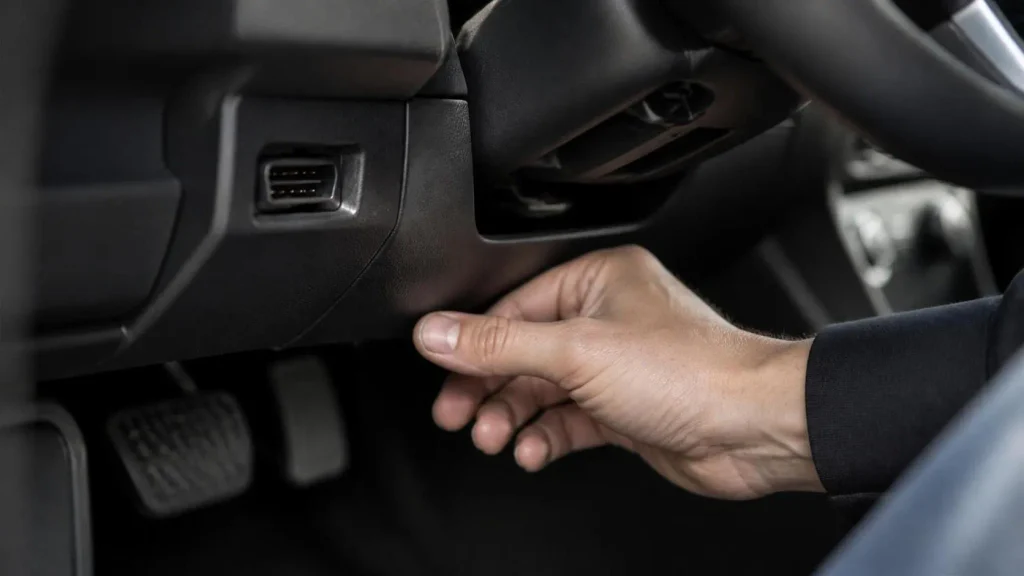
Under the Society of Automotive Engineers (SAE) standard J1962, vehicle engineers are legally restricted regarding where they can mount the port. The connector must reside within the passenger cabin, within three feet of the driver, and reachable without requiring specialized tools unless an access door is explicitly labeled.
Automakers partition this cabin area into specific interior zones. If the connector is not in the primary location, checking the adjacent zones in descending order of frequency will quickly resolve the search.
| Zone Location | Specific Position in Cabin | Common Vehicle Makes |
|---|---|---|
| Zone 1 (Primary) | Directly under steering column, lower dash rim | Ford, Chevrolet, Toyota, Nissan, Honda |
| Zone 2 (Driver Left) | Near left footrest, kick panel, or interior fuse box | Subaru, Hyundai, Kia, Mitsubishi |
| Zone 3 (Driver Right) | Under dash between steering wheel and center stack | Jeep, Dodge, Ram, older GM trucks |
| Zone 4 (Center Console) | Under ashtray compartment or inside armrest storage | Volkswagen, Audi, BMW (select platforms) |
| Zone 5 (Passenger Side) | Right of center tunnel or near passenger glovebox | Porsche, specialized European/RHD imports |
The vast majority of cars on North American roads position the socket in Zone 1. Sitting in the driver seat, you can generally reach down past your left knee along the plastic dash perimeter to find the rectangular bracket holding the socket facing downward toward the floor mats.
How to Find a Hidden OBD2 Port Step by Step
If running your hand along the underside of the dashboard yields nothing, the port is likely tucked behind a secondary cover or turned sideways. Follow this logical sequence to locate it without dismantling your interior.
- Park safely and illuminate the footwell: Turn off the engine and secure the parking brake. Grab a bright flashlight or use your smartphone torch rather than relying on the vehicle’s dim dome light.
- Get your eyes below the dash plane: Lean outside the driver door and kneel on the ground or place your head directly beneath the steering wheel looking upward. Many ports point straight down and remain invisible from a seated posture.
- Inspect the driver-side coin tray and fuse panel: Many Asian and European manufacturers incorporate the DLC inside the interior fuse cabinet. Locate the drop-down utility tray near your left knee, pull it open, and check inside or behind the removable plastic door.
- Look behind decorative trim tabs: Vehicles from Volkswagen, Audi, and Volvo frequently feature smooth dash styling that conceals service ports. Look for a small plastic flap with a finger notch near the lower center stack or beneath the climate control cluster.
- Check the center console and ashtray cavities: In select platforms, lifting the rubber liner inside the cup holder or removing the auxiliary coin tray exposes the 16-pin connector.
Tip
If you find an access panel with resistance, do not pry it aggressively with screwdrivers. Standard OBD2 access panels are designed to be popped open using finger pressure alone or a basic plastic trim tool without damaging dashboard clips.
Brand-Specific Port Locations and Quirks
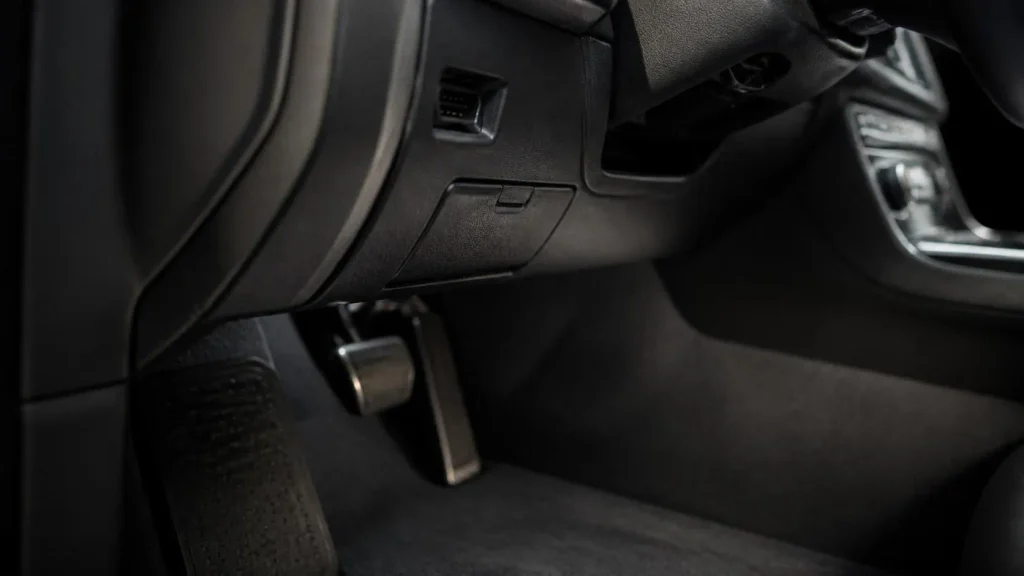
While domestic models rarely stray from the underside of the steering column, several imports and specialty manufacturers have adopted unique mounting strategies that trip up car owners.
Volkswagen and Audi (VAG Group)
Older Volkswagen models (such as Mk4 Golfs and Jettas) positioned the DLC behind a slide-away panel right below the climate controls or directly beneath the slide-out dashboard cup holder. Newer models shifted the connector back to Zone 1, but colored the plastic violet or bright pink, facing vertically downward next to the hood release lever.
BMW and Mini
Most modern BMW models seat the connector on the driver-side kick panel, approximately four inches above the footrest pedal. Notably, BMW enclosures usually feature a hinged plastic door embossed with the letters “OBD.” You must flick this cover downward using your fingernail to reveal the socket.
Toyota and Lexus
Toyota models place the connector openly under the bottom edge of the lower dash panel, aligned almost directly with the driver’s right knee. In select hybrid utility models, the connector is mounted sideways with the pins facing the engine firewall, requiring you to insert the scan tool cable horizontally.
Honda and Acura
Honda vehicles generally position the socket cleanly under the dash above the accelerator pedal. If your vehicle experiences intermittent sensor warnings alongside scan issues, verifying your maintenance schedule is critical; clean diagnostic access works hand in hand with regular upkeep.
Why You Can’t Find Your Port: Rare Exceptions and Edge Cases
If you have scrutinized every inch of the driver area and still cannot locate a diagnostic socket, one of four unusual circumstances usually explains the absence.
First, verify your vehicle’s manufacturing year. The United States Environmental Protection Agency emissions standards mandated OBD2 hardware on passenger cars starting in model year 1996. If your vehicle was manufactured in 1995 or earlier, it operates on OBD1 architecture, which does not utilize the universal 16-pin connector. OBD1 ports are frequently placed inside the engine compartment near the strut tower or fuse relay box.
Second, heavy-duty commercial vehicles with a Gross Vehicle Weight Rating (GVWR) exceeding 8,500 or 14,000 pounds were not held to identical passenger car phase-in deadlines. Many medium- and heavy-duty trucks utilize commercial J1939 or J1708 diagnostic standards, characterized by round 6-pin or 9-pin Deutsch connectors mounted near the driver-side floorboard.
Third, a previous owner, mechanic, or fleet manager may have pushed the connector out of its mounting bracket. The factory socket snaps into a stamped metal or plastic bezel using two side retention tabs. If someone stepped on a connected scanner or forced an ill-fitting plug, the socket can dislodge and slide backward into the hollow interior of the dash cavity.
Warning
If you locate a loose wiring harness hanging near the pedal linkages, make sure it is safely secured. A loose diagnostic connector caught behind the brake or clutch pedal arm creates an immediate physical hazard while driving.
Fourth, aftermarket security devices or telematics dongles installed by insurance carriers or dealerships might already occupy the port. Some trackers install an in-line pass-through “splitter” cable that relocates the dummy port while keeping the active hardware tucked away deep behind dash components.
Troubleshooting: Port Found but Scanner Won’t Power On
Locating the port is only the first step. When you firmly connect your code reader and the screen remains completely dark, the diagnostic link connector is failing to provide baseline electrical current.
Under the standardized OBD2 pinout, Pin 16 (located on the lower right corner when looking directly at the wider side of the socket) delivers constant +12V battery power directly from the vehicle’s electrical system, while Pins 4 and 5 supply chassis and signal grounds. Without power on Pin 16, portable hand scanners cannot boot up.
In most domestic and import vehicles, the automotive circuit feeding Pin 16 is shared directly with the 12V auxiliary power socket or cigarette lighter. If a metal coin, charging adapter, or foreign debris short-circuited your 12V power point, that shared fuse will blow, simultaneously disabling power to the diagnostic port.
To restore function, inspect the vehicle’s interior fuse box. Locate the fuse marked “CIG,” “AUX,” or “DLC” (typically a 10A, 15A, or 20A micro blade fuse). Replace any blown fuse with one of identical amperage before attempting to reconnect your diagnostic scanner.
Key Insight
If your scanner powers on but repeatedly displays a “Communication Error” or “Linking Error,” the issue is communication bus failure rather than power loss. Turn your ignition key to the “ON/RUN” position (without starting the engine) to awaken the Engine Control Module (ECM) communication network.
Related Product
OBD2 Extension Cables and Diagnostic Adapters
A flexible OBD2 extension cord relieves strain on tight under-dash ports and makes reading diagnostic trouble codes significantly easier.
As an Amazon Associate, we earn from qualifying purchases.
Frequently Asked Questions
Are all OBD2 ports the same shape?
Yes. The physical shape of the female OBD2 connector is strictly standardized across all vehicle manufacturers under SAE J1962. It always features 16 pin cavities laid out in two rows of eight, forming an uneven trapezoidal profile.
Can the OBD2 port be located under the hood?
No, not on standard light-duty vehicles made after 1996. Emissions regulations specifically mandate that the main OBD2 port must reside inside the passenger compartment within reach of the driver. Specialized manufacturer-specific round ports existed under the hood on older pre-2001 European cars, but these operated alongside the primary interior DLC.
Do electric vehicles have an OBD2 port?
Yes. While battery electric vehicles (EVs) do not produce tailpipe emissions, federal motor safety and diagnostics standards require an accessible port for diagnostic technician communication, crash data retrieval, and safety inspections. It is typically positioned under the driver dash in the standard location.
Can plugging a scanner into the OBD2 port damage my car?
Plugging in a reputable handheld code reader, diagnostic tool, or state inspection cable will not damage your vehicle. However, attempting to force a connector in backwards or jamming bent metal pins into the socket can short terminal connections and blow internal fuses.
What if my OBD2 port is missing completely?
If your car was built after 1996 and appears to lack a port, the connector has almost certainly popped out of its plastic dashboard retention bezel. Inspect the empty opening with a flashlight to see if the wiring harness and socket have fallen behind the lower knee bolster.
Does the vehicle need to be running for the OBD2 port to work?
The port receives battery power at all times via Pin 16, allowing a scanner to turn on. However, reading diagnostic fault codes, live data stream parameters, and readiness monitors requires turning the ignition key to the “ON” or accessory run position to power up the vehicle’s computers.
Conclusion
Locating your car’s OBD2 port is straightforward once you know the regulatory boundaries governing vehicle construction. In almost every car built over the last three decades, you will find the 16-pin connector tucked under the dashboard on the driver side, between the steering column and the foot pedals.
If it is not immediately visible, checking behind coin trays, drop-down fuse access doors, or center console trim panels will reveal the socket without requiring complicated disassembly.
Once connected, your scan tool can communicate directly with the onboard computers to pull diagnostic trouble codes and restore peace of mind.

I’m Alex Rahman, a car enthusiast and automotive writer focused on practical solutions, car tools, and real-world driving advice. I share simple and honest content to help everyday drivers make better decisions.
